PUBLISHER: Mordor Intelligence | PRODUCT CODE: 2124064

PUBLISHER: Mordor Intelligence | PRODUCT CODE: 2124064
Activated Bleaching Earth - Market Share Analysis, Industry Trends & Statistics, Growth Forecasts (2026 - 2031)
According to Mordor Intelligence, the activated bleaching earth market size is estimated at USD 4.26 billion in 2026, and is expected to reach USD 5.32 billion by 2031, at a CAGR of greater than 4.56% during the forecast period (2026-2031).
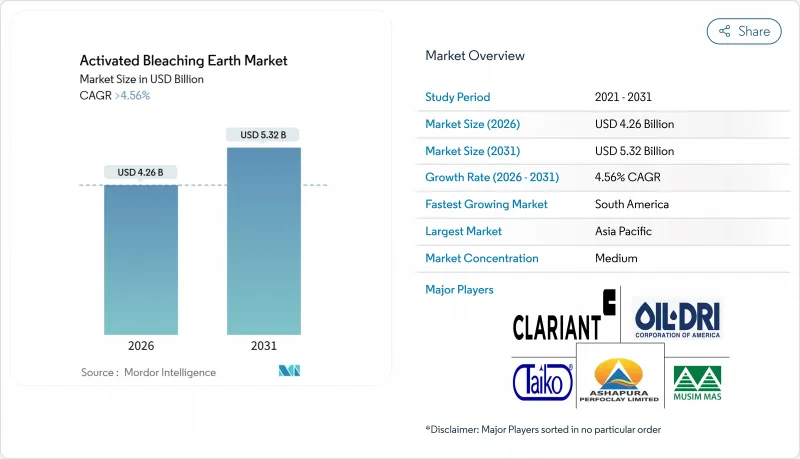
This report is Segmented by Technology (Wet Process, Dry Process, and Vapour-Phase Process), Application (Edible Oil and Fats, Mineral Oil and Lubricants, and Other Applications), and Geography (Asia-Pacific, North America, Europe, South America, and Middle East and Africa). The Market Forecasts are Provided in Terms of Value (USD).
Global Activated Bleaching Earth Market Trends and Insights
Rising Consumption of Refined Edible Oils and Fats
Global vegetable-oil throughput keeps rising, pushed by population growth and processed-food diets. Indonesia processed 47.5 million t of crude palm oil in 2024, underlining continuous clay demand in degumming and bleaching. Refiners are cutting clay dosage from 1.5-3.0% to 0.5-1.5% by adding enzymatic degumming and silica-hydrogel pre-treatments, saving up to 40% on clay while meeting color targets. This efficiency tempers volume growth but rewards suppliers offering high-activity grades that sustain lower dosages. Palm-oil's higher carotenoid load keeps clay needs above soybean benchmarks, and World Bank data showing 6% palm-oil price gains in 2025 incentivizes plants to maximize physical refining runs.
Expansion of Biodiesel and Renewable Diesel Production
Biofuel policies keep clay demand buoyant. Indonesia's B35 program consumed 11.96 million t of palm oil in 2024 and is preparing for B40, each step requiring double bleaching stages. Brazil's B15 and Argentina's export-oriented biodiesel add further pull. Hydrotreated renewable-diesel units, such as Pertamina's 477 kl-day plant, insist on ultra-low phosphorus feedstock, often pushing bleaching earth dosage toward the 1-3% ceiling. These projects shift procurement toward high-surface-area, low-metal clays that protect hydrotreating catalysts and create premium-grade demand.
Availability of Alternative Adsorbents and Processes
Silica hydrogels, synthetic zeolites, and activated carbon attract premium niches such as pharmaceutical-oil and cosmetic refining. Silica-hydrogel pretreatment can trim clay dosage by 40%, while activated-carbon's 500-1,500 m2-g surface area outperforms clay in pesticide removal. Regenerable adsorbents also cut disposal costs, pressuring clay pricing. Yet for bulk edible-oil bleaching, acid-activated bentonite still delivers the lowest cost-per-tonne outcome under GRAS and EU food additive clearances, sustaining its dominance.
Other drivers and restraints analyzed in the detailed report include:
- Growth in Mineral-Oil and Lubricant Quality Demands
- Industrialization Surge Across Asia-Pacific
- Volatile Bentonite Raw-Material Pricing and Supply
For complete list of drivers and restraints, kindly check the Table Of Contents.
Segment Analysis
Wet Process technology retained 54.38% revenue in 2025, anchored in palm- and soybean-oil corridors where cost per tonne drives selection. Its unwashed, acid-activated clay yields sufficient performance for bulk refining and supports rapid supply cycles to captive refineries across ASEAN and India. Dry Process remains niche in regions with low-cost thermal energy, while Vapour-Phase is forecast to grow at 5.12% CAGR as premium applications seek surface areas exceeding 320 m2-g and minimal residual acid. The Activated Bleaching Earth market size for Vapour-Phase grades is projected to rise alongside renewable-diesel feedstock qualification. Oxalic-acid routes offer a greener path, producing biodegradable effluents and aligning with circular-economy policies, yet process optimization is vital to curb calcium-oxalate precipitation that can blunt adsorption.
Vapour-Phase adoption is escalating in pharmaceutical-oil and cosmetic bases where trace metals must stay below parts-per-million limits. Plants installing vapour-acid reactors report 15-20% lower clay consumption thanks to higher activity, though capex remains a barrier. Suppliers leveraging proprietary oxalic vapour techniques position themselves for differentiated margin capture while meeting upcoming EU waste-water norms. Consequently, the Activated Bleaching Earth market continues to bifurcate into high-performance vapour-phase niches and cost-driven wet-process volumes, with technology selection dictated by feedstock quality and compliance pressures.
Complete Report Scope:
- By Technology
- Wet Process
- Dry Process
- Vapour-Phase Process
- By Application
- Edible Oil and Fats
- Mineral Oil and Lubricants
- Other Applications
- By Geography
- Asia-Pacific
- China
- India
- Japan
- South Korea
- ASEAN Countries
- Rest of Asia-Pacific
- North America
- United States
- Canada
- Mexico
- Europe
- Germany
- United Kingdom
- France
- Italy
- Spain
- NORDIC Countries
- Rest of Europe
- South America
- Brazil
- Argentina
- Rest of South America
- Middle-East and Africa
- Saudi Arabia
- South Africa
- Rest of Middle-East and Africa
- Asia-Pacific
Geography Analysis
Asia-Pacific maintained a 60.12% Activated Bleaching Earth market share in 2025, driven by 80 million t refining capacity across China, India, Indonesia, and Malaysia. Indonesia refined 47.5 million t of palm oil in 2024 and consumed 11.96 million t for B35 biodiesel, supporting twin demand streams. Export levy structures favor domestic refining, sustaining clay offtake. India's pivot to crude palm oil imports, now 99.7% of palm group volumes, will spur local refining capex as duty gaps persist. China's stricter mining rules are raising feedstock costs, opening import windows for Turkey and Brazil. Japan and South Korea continue to buy premium clays for pharmaceutical-oil and synthetic-lube segments, offering suppliers higher margins despite smaller volumes.
South America is the fastest-growing region at 4.96% CAGR, underpinned by Brazil's B15 rollout and Argentina's soybean-oil expansions. Brazilian biodiesel used 5-6 million t soybean oil in 2024, with B20 targeted by 2030, locking in clay demand for degumming and ester polishing. While enzymatic degumming trims dosage, refiners still require high-activity clay for low-phosphorus targets. Chile and Colombia are expanding edible-oil plants under import-substitution policies, contributing incremental volumes.
North America and Europe display mature trajectories. In the United States, renewable-diesel and sustainable-aviation-fuel plants provide pockets of growth, though Q3 2025 supplier comments pointed to policy-driven volume swings. Europe's strict 3-MCPD caps are shifting consumption toward natural clays, while ILUC rules curb palm-based biodiesel imports and promote rapeseed refining. The Middle East and Africa, though smaller, are scaling refining under food-security mandates in Saudi Arabia, Egypt, and Nigeria, creating new clay demand coupled with technical-service needs.
- 20 Microns Ltd
- Ashapura Perfoclay Limited (APL)
- CLARIANT
- EP Minerals
- Global Bleach Chem Pvt Ltd
- Hangzhou Yongsheng Catalyst Co., Ltd.
- HRP Industries
- Huangshan City Baiyue activated clay Co.,Ltd.
- Imerys
- Indian Clay & Mineral Co.
- Musim Mas Group
- Oil-Dri Corporation of America
- Phoenix Chemicals Pvt Ltd
- PT. Tunas Inti Bhakti Makmur (TIBM)
- Refoil Earth Pvt Ltd
- Taiko Group of Companies (Taiko Bleaching Earth Sdn. Bhd.)
- Tianyu Group's Activated Bleaching
- U.G.A. Group
Additional Benefits:
- The market estimate (ME) sheet in Excel format
- 3 months of analyst support
TABLE OF CONTENTS
1 Introduction
- 1.1 Study Assumptions and Market Definition
- 1.2 Scope of the Study
2 Research Methodology
3 Executive Summary
4 Market Landscape
- 4.1 Market Overview
- 4.2 Market Drivers
- 4.2.1 Rising Consumption of Refined Edible Oils and Fats
- 4.2.2 Expansion of Biodiesel and Renewable Diesel Production
- 4.2.3 Growth in Mineral Oil and Lubricant Quality Demands
- 4.2.4 Industrialisation Surge Across Asia-Pacific
- 4.2.5 Adoption of Ultrasound-Assisted Low-Dosage Bleaching
- 4.3 Market Restraints
- 4.3.1 Availability of Alternative Adsorbents and Processes
- 4.3.2 Volatile Bentonite Raw-Material Pricing and Supply
- 4.3.3 Tightening Mining/ Disposal Regulation Compliance Costs
- 4.4 Value Chain Analysis
- 4.5 Porter's Five Forces
- 4.5.1 Bargaining Power of Suppliers
- 4.5.2 Bargaining Power of Buyers
- 4.5.3 Threat of New Entrants
- 4.5.4 Threat of Substitutes
- 4.5.5 Degree of Competition
5 Market Size and Growth Forecasts (Value)
- 5.1 By Technology
- 5.1.1 Wet Process
- 5.1.2 Dry Process
- 5.1.3 Vapour-Phase Process
- 5.2 By Application
- 5.2.1 Edible Oil and Fats
- 5.2.2 Mineral Oil and Lubricants
- 5.2.3 Other Applications
- 5.3 By Geography
- 5.3.1 Asia-Pacific
- 5.3.1.1 China
- 5.3.1.2 India
- 5.3.1.3 Japan
- 5.3.1.4 South Korea
- 5.3.1.5 ASEAN Countries
- 5.3.1.6 Rest of Asia-Pacific
- 5.3.2 North America
- 5.3.2.1 United States
- 5.3.2.2 Canada
- 5.3.2.3 Mexico
- 5.3.3 Europe
- 5.3.3.1 Germany
- 5.3.3.2 United Kingdom
- 5.3.3.3 France
- 5.3.3.4 Italy
- 5.3.3.5 Spain
- 5.3.3.6 NORDIC Countries
- 5.3.3.7 Rest of Europe
- 5.3.4 South America
- 5.3.4.1 Brazil
- 5.3.4.2 Argentina
- 5.3.4.3 Rest of South America
- 5.3.5 Middle-East and Africa
- 5.3.5.1 Saudi Arabia
- 5.3.5.2 South Africa
- 5.3.5.3 Rest of Middle-East and Africa
- 5.3.1 Asia-Pacific
6 Competitive Landscape
- 6.1 Market Concentration
- 6.2 Strategic Moves
- 6.3 Market Share/Ranking Analysis
- 6.4 Company Profiles (includes Global level Overview, Market level overview, Core Segments, Financials as available, Strategic Information, Market Rank/Share, Products and Services, Recent Developments)
- 6.4.1 20 Microns Ltd
- 6.4.2 Ashapura Perfoclay Limited (APL)
- 6.4.3 CLARIANT
- 6.4.4 EP Minerals
- 6.4.5 Global Bleach Chem Pvt Ltd
- 6.4.6 Hangzhou Yongsheng Catalyst Co., Ltd.
- 6.4.7 HRP Industries
- 6.4.8 Huangshan City Baiyue activated clay Co.,Ltd.
- 6.4.9 Imerys
- 6.4.10 Indian Clay & Mineral Co.
- 6.4.11 Musim Mas Group
- 6.4.12 Oil-Dri Corporation of America
- 6.4.13 Phoenix Chemicals Pvt Ltd
- 6.4.14 PT. Tunas Inti Bhakti Makmur (TIBM)
- 6.4.15 Refoil Earth Pvt Ltd
- 6.4.16 Taiko Group of Companies (Taiko Bleaching Earth Sdn. Bhd.)
- 6.4.17 Tianyu Group's Activated Bleaching
- 6.4.18 U.G.A. Group
7 Market Opportunities and Future Outlook
- 7.1 White-Space and Unmet-Need Assessment

