PUBLISHER: Mordor Intelligence | PRODUCT CODE: 2124076

PUBLISHER: Mordor Intelligence | PRODUCT CODE: 2124076
Brake Fluids - Market Share Analysis, Industry Trends & Statistics, Growth Forecasts (2026 - 2031)
According to Mordor Intelligence, the brake fluids market size is expected to grow from 1.22 Million liters in 2025 to 1.27 Million liters in 2026 and is forecast to reach 1.54 Million liters by 2031 at 3.93% CAGR over 2026-2031.
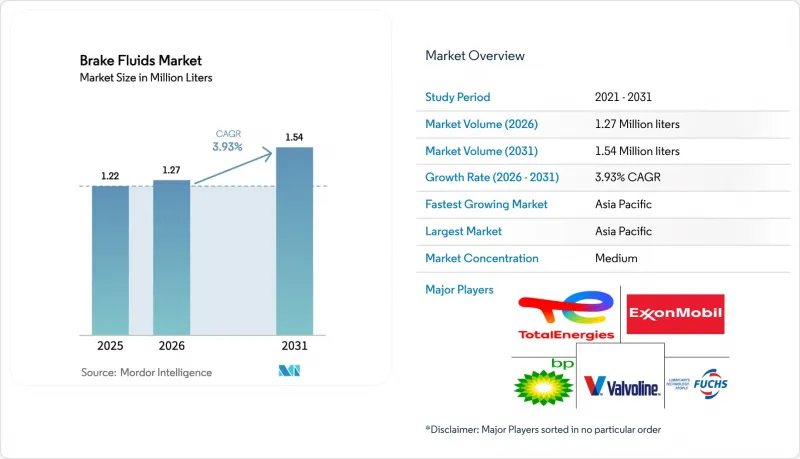
This report is Segmented by Base Oil (Glycol-Based and Silicone-Based), Product Type (DOT 3, DOT 4, DOT 5, and DOT 5. 1), Vehicle Type (Passenger Cars, Light Commercial Vehicles, Heavy Commercial Vehicles, Motorcycles, and Others), and Geography (Asia-Pacific, North America, Europe, South America, and Middle East and Africa). The Market Forecasts are Provided in Terms of Volume (Liters).
Global Brake Fluids Market Trends and Insights
Surging Global Vehicle Parc in Emerging Economies
China's vehicle stock reached 460 million units by mid-2025, including 36.89 million NEVs, cementing the country's position as the single largest reservoir of hydraulic brake systems. India produced 31.03 million vehicles in fiscal 2025, 76.57% of which were two-wheelers, a configuration requiring more frequent fluid changes. Used-car transfers in China surpassed 37.5 million in 2024, shifting aftermarket volumes toward independent workshops with lower brand loyalty. Thailand and Indonesia continue to drive light-commercial-vehicle (LCV) growth, sustaining demand where drum brakes dominate. Combined, these fleet dynamics keep the brake fluid market growing even as per-vehicle consumption moderates.
Accelerated Adoption of High-Boiling-Point DOT 4/5.1 Fluids by OEMs
Bosch introduced borate-free DOT 4 E in September 2024, raising dry boiling points beyond 230 °C while sidestepping hazardous-substance labeling. Continental followed with ATE SecuBrake in November 2024, formulating more than 80% of the base from renewable feedstocks. These launches simplify global compliance, particularly under Europe's REACH regulation, and propel workshops to adopt higher grades for backward compatibility. Valvoline's 2025 EV Performance Fluids show how suppliers are tailoring DOT 5.1 blends to solve corrosion and noise issues linked to regenerative braking. As a result, premium specifications are set to displace DOT 3 faster than fleet turnover alone would dictate.
Shift to Brake-By-Wire and Regenerative Systems in BEVs Reduces Fluid Service Fill
ZF unveiled a dry brake-by-wire module in late 2023 that removes hydraulic circuits altogether, promising shorter stopping distances and lighter assemblies. Autocar's 2025 review anticipates mainstream adoption of such systems in premium BEVs by 2028-2030. Even when hydraulics are retained, regenerative braking lowers friction-brake use, pushing fluid-change intervals from 24 to as high as 48 months, which halves aftermarket demand per vehicle. China's NEV fleet already tops 36.89 million units, indicating early signs of volume erosion, though dual-system designs still secure baseline usage. Suppliers must therefore hedge by investing in EV-specific formulations and by diversifying into non-automotive glycol channels.
Other drivers and restraints analyzed in the detailed report include:
- Tightening ABS/ESC Mandates in 2-Wheeler and LCV Segments
- Regulatory Drive Toward Low-Viscosity Fluids for ADAS Quick-Response Brakes
- Raw-Material (Glycol-Ether) Price Volatility Squeezing Tier-2 Blenders' Margins
For complete list of drivers and restraints, kindly check the Table Of Contents.
Segment Analysis
Glycol-based fluids controlled 98.12% of global volume in 2025, driven by compatibility with legacy systems and a lower landed cost versus silicone alternatives. Glycol-based products typically combine polyglycol ethers with corrosion inhibitors, delivering reliable hygroscopic performance that prevents moisture pooling. The brake fluid market size associated with glycol formulations is forecast to expand steadily, although its share will dip marginally as specialty niches mature. Silicone-based DOT 5 recorded a limited but notable presence in vintage motorcycles and military vehicles. Its hydrophobic property avoids moisture-triggered corrosion, supporting multi-year service intervals. Nonetheless, incompressibility and higher viscosity historically hindered widespread ABS compatibility.
Silicone's outlook is shifting. Engineers for brake-by-wire platforms see potential in silicone's thermal stability because electronic actuation diminishes the need for progressive pedal feel. The segment is projected to grow at a healthy 12.10% CAGR to 2031, albeit from a small base. Suppliers such as Motul have positioned premium silicone blends at performance enthusiasts seeking year-round resilience. Meanwhile, BASF's new feedstock facility tightens cost leadership for glycol producers, making volume displacement an uphill task. Blenders that offer dual-chemistry portfolios will be best placed to capture emerging demand without cannibalizing their core glycol franchise.
Complete Report Scope:
- By Base Oil
- Glycol-based
- Silicone-based
- By Product Type
- DOT 3
- DOT 4
- DOT 5
- DOT 5.1
- By Vehicle Type
- Passenger Cars
- Light Commercial Vehicles
- Heavy Commercial Vehicles
- Motorcycles
- Others
- By Geography
- Asia-Pacific
- China
- India
- Japan
- South Korea
- ASEAN Countries
- Rest of Asia-Pacific
- North America
- United States
- Canada
- Mexico
- Europe
- Germany
- United Kingdom
- France
- Italy
- NORDIC Countries
- Rest of Europe
- South America
- Brazil
- Argentina
- Rest of South America
- Middle East and Africa
- Saudi Arabia
- South Africa
- Rest of Middle East and Africa
- Asia-Pacific
Geography Analysis
Asia-Pacific captured 47.34% of the brake fluid market size in 2025 and is on track for a 5.19% CAGR through 2031. China's 460 million vehicle parc anchors OE and aftermarket volumes, while India's regulatory momentum around ABS pushes demand for higher-grade fluids. ASEAN markets, notably Thailand and Indonesia, continue to add LCV capacity and maintain drum-brake architectures that demand regular fluid replacement. High humidity and dusty conditions in Southeast Asia also shorten service intervals, reinforcing volume growth.
North America and Europe contend with faster BEV uptake, which lengthens change cycles. Nonetheless, specification premiumization partially offsets the volume drag. U.S. automakers have standardized DOT 5.1 for new ADAS-equipped models since late 2025, raising average selling prices. Europe's REACH requirements accelerate adoption of borate-free formulations, encouraging early movers like Bosch and Continental to defend margin. UN ECE Regulation 13-H ensures hydraulic backups in vehicles with regenerative braking, protecting baseline fluid use even as brake-by-wire trials expand.
South America and the Middle East and Africa combined represent a smaller slice of the brake fluid market, yet niche conditions offer upside. Brazil's ethanol-heavy fuel mix permeates vapor lines and can contaminate braking systems, prompting more frequent fluid replacement. Gulf Cooperation Council markets in the Middle East require high dry boiling points due to ambient temperatures above 50 °C in summer. Africa's growing e-commerce logistics sector relies on LCV fleets that retain hydraulic drums, creating localized demand spikes. Suppliers that tailor packaging sizes and fight counterfeit penetration can secure competitive advantages in these underserved regions.
- BASF
- BP p.l.c (Castrol)
- Chevron Corporation
- Continental AG
- Dow
- Exxon Mobil Corporation
- FUCHS
- Gulf Oil International Ltd.
- HELLA GmbH & Co. KGaA
- Lucas Oil Products, Inc.
- Morris Lubricants
- Motul
- Ravensberger Schmierstoffvertrieb GmbH
- Repsol
- Robert Bosch LLC
- Sinopec Corp.
- TotalEnergies
- Valvoline Inc.
Additional Benefits:
- The market estimate (ME) sheet in Excel format
- 3 months of analyst support
TABLE OF CONTENTS
1 Introduction
- 1.1 Study Assumptions and Market Definition
- 1.2 Scope of the Study
2 Research Methodology
3 Executive Summary
4 Market Landscape
- 4.1 Market Overview
- 4.2 Market Drivers
- 4.2.1 Surging Global Vehicle Parc in Emerging Economies
- 4.2.2 Accelerated Adoption of High-Boiling-Point Dot 4/5.1 Fluids By OEMs
- 4.2.3 Tightening ABS/ESC Mandates in 2-Wheeler and LCV Segments
- 4.2.4 Regulatory Drive Toward Low-Viscosity Fluids for ADAS Quick-Response Brakes
- 4.2.5 Niche E-Commerce Aftermarket Platforms Expanding Product Reach
- 4.3 Market Restraints
- 4.3.1 Shift To Brake-By-Wire and Regenerative Systems in BEVs Reduces Fluid Service Fill
- 4.3.2 Raw-Material (Glycol-Ether) Price Volatility Squeezing Tier-2 Blenders' Margins
- 4.3.3 Stringent Hazardous-Chemical Transport and Labelling Requirements
- 4.4 Value Chain Analysis
- 4.5 Porter's Five Forces
- 4.5.1 Bargaining Power of Suppliers
- 4.5.2 Bargaining Power of Buyers
- 4.5.3 Threat of New Entrants
- 4.5.4 Threat of Substitute Products
- 4.5.5 Degree of Competition
5 Market Size and Growth Forecasts (Volume)
- 5.1 By Base Oil
- 5.1.1 Glycol-based
- 5.1.2 Silicone-based
- 5.2 By Product Type
- 5.2.1 DOT 3
- 5.2.2 DOT 4
- 5.2.3 DOT 5
- 5.2.4 DOT 5.1
- 5.3 By Vehicle Type
- 5.3.1 Passenger Cars
- 5.3.2 Light Commercial Vehicles
- 5.3.3 Heavy Commercial Vehicles
- 5.3.4 Motorcycles
- 5.3.5 Others
- 5.4 By Geography
- 5.4.1 Asia-Pacific
- 5.4.1.1 China
- 5.4.1.2 India
- 5.4.1.3 Japan
- 5.4.1.4 South Korea
- 5.4.1.5 ASEAN Countries
- 5.4.1.6 Rest of Asia-Pacific
- 5.4.2 North America
- 5.4.2.1 United States
- 5.4.2.2 Canada
- 5.4.2.3 Mexico
- 5.4.3 Europe
- 5.4.3.1 Germany
- 5.4.3.2 United Kingdom
- 5.4.3.3 France
- 5.4.3.4 Italy
- 5.4.3.5 NORDIC Countries
- 5.4.3.6 Rest of Europe
- 5.4.4 South America
- 5.4.4.1 Brazil
- 5.4.4.2 Argentina
- 5.4.4.3 Rest of South America
- 5.4.5 Middle East and Africa
- 5.4.5.1 Saudi Arabia
- 5.4.5.2 South Africa
- 5.4.5.3 Rest of Middle East and Africa
- 5.4.1 Asia-Pacific
6 Competitive Landscape
- 6.1 Market Concentration
- 6.2 Strategic Moves
- 6.3 Market Share(%)/Ranking Analysis
- 6.4 Company Profiles (includes Global level Overview, Market level overview, Core Segments, Financials as available, Strategic Information, Market Rank/Share for key companies, Products and Services, and Recent Developments)
- 6.4.1 BASF
- 6.4.2 BP p.l.c (Castrol)
- 6.4.3 Chevron Corporation
- 6.4.4 Continental AG
- 6.4.5 Dow
- 6.4.6 Exxon Mobil Corporation
- 6.4.7 FUCHS
- 6.4.8 Gulf Oil International Ltd.
- 6.4.9 HELLA GmbH & Co. KGaA
- 6.4.10 Lucas Oil Products, Inc.
- 6.4.11 Morris Lubricants
- 6.4.12 Motul
- 6.4.13 Ravensberger Schmierstoffvertrieb GmbH
- 6.4.14 Repsol
- 6.4.15 Robert Bosch LLC
- 6.4.16 Sinopec Corp.
- 6.4.17 TotalEnergies
- 6.4.18 Valvoline Inc.
7 Market Opportunities and Future Outlook
- 7.1 White-space and Unmet-need Assessment

