PUBLISHER: Mordor Intelligence | PRODUCT CODE: 2124090

PUBLISHER: Mordor Intelligence | PRODUCT CODE: 2124090
Motor Monitoring - Market Share Analysis, Industry Trends & Statistics, Growth Forecasts (2026 - 2031)
According to Mordor Intelligence, the motor monitoring market size is expected to grow from USD 2.45 billion in 2025 to USD 2.62 billion in 2026 and is forecast to reach USD 3.64 billion by 2031 at 6.82% CAGR over 2026-2031.
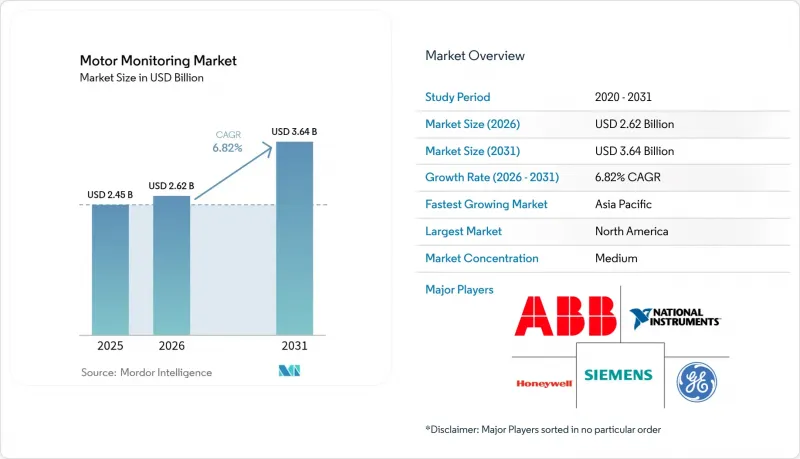
This report is Segmented by Offering (Hardware, Software, and More), Deployment, Monitoring Technique (Vibration Analysis, Motor Current Signature, and More), End-User Industry (Oil and Gas, Energy and Power, and More), Motor Type (AC Motors, DC Motors, and More), and by Geography. The Market Forecasts are Provided in Terms of Value (USD).
Global Motor Monitoring Market Trends and Insights
Rising Adoption of Predictive Maintenance Platforms
Predictive maintenance platforms now combine vibration, current, acoustic and thermal data with machine-learning models that deliver 91% anomaly detection accuracy and cut breakdowns by 30-50%. Steel makers have demonstrated 40-hour failure forecasts, and mining operators report nine-fold returns from averting unplanned stoppages. The economic case continues to sharpen as cloud analytics turn raw sensor feeds into prescriptive work orders that reduce spare-parts inventories and overtime labour.
Rapid Shift Toward Wireless, Battery-less Sensor Networks
Energy-harvesting designs that draw micro-watts from motor magnetic fields eliminate battery swaps and wiring, slashing lifetime ownership costs. Commercial modules such as TDK's i3 integrate on-board edge-AI to extend operating life by 50% while forming self-healing mesh networks over industrial campuses. These untethered nodes unlock monitoring in ship engine rooms and offshore rigs where access is costly and hazardous.
High Upfront CAPEX and ROI Uncertainty
Full-scale deployments often require USD 100,000 or more for sensors, gateways and integration, a burden that can deter mid-sized plants despite potential 10-40% maintenance savings. Case studies show early models may drift when equipment is modified, necessitating extra spend on algorithm retraining, which prolongs payback horizons. Vendors are responding with subscription-based offerings and staged pilots to mitigate financial risk for cost-sensitive buyers.
Other drivers and restraints analyzed in the detailed report include:
- Integration of IIoT and Digital Twin Architectures
- Stricter Global Motor-Efficiency Regulations
- Shortage of Domain-Skilled Reliability Engineers
For complete list of drivers and restraints, kindly check the Table Of Contents.
Segment Analysis
Services generated a 9.34% CAGR outlook as companies turn to external specialists for integration, analytics and lifecycle optimization. While hardware retained 68.45% of 2025 revenue, complex multivendor environments now prioritize data interpretation over sensor procurement. Emerson's USD 8.2 billion purchase of NI underscores the pivot toward higher-margin service revenue streams that embed continuous monitoring into broader automation contracts.
Hardware makers are repositioning as solution providers by bundling gateways, cloud connectors and managed dashboards. Regal Rexnord's Perceptiv platform integrates field sensors with analytics that reportedly cut expected failures by 55% and stretch machine life 40%. As value migrates to insights rather than components, hybrid commercial models encompassing equipment, software and support are becoming the norm across the motor monitoring market.
On-premises architectures kept 73.10% revenue share in 2025 because critical plants still favour local control for latency and data-sovereignty reasons. Nevertheless, cloud deployments hold the fastest 11.75% CAGR as cybersecurity standards mature and 5G networks lower backhaul costs. Honeywell's collaboration with Verizon embeds cellular intelligence in meters to stream usage data securely to analytics hubs, showcasing the hybrid edge-cloud approach gaining traction.
Academic research flags four common vulnerabilities in cloud-SCADA links-shared resources, insider threats, insecure protocols and connectivity gaps-yet the adoption of zero-trust architectures and network-based intrusion detection is mitigating risk. Manufacturers increasingly process safety-critical data locally while offloading deep-learning workloads and fleet benchmarking to the cloud, a pattern that boosts scalability without compromising uptime across the motor monitoring market.
Complete Report Scope:
- By Offering
- Hardware
- Software
- Services
- By Deployment
- On-Premise
- Cloud
- By Monitoring Technique
- Vibration Analysis
- Motor Current Signature
- Thermography
- Oil Analysis
- Ultrasound and Acoustic
- By Motor Type
- AC Motors
- DC Motors
- Servo and Stepper Motors
- By End-User Industry
- Oil and Gas
- Energy and Power
- Automotive
- Mining and Metals
- Food and Beverage
- Chemicals
- Aerospace and Defense
- Other Industries
- By Geography
- North America
- United States
- Canada
- Mexico
- Europe
- Germany
- United Kingdom
- France
- Rest of Europe
- Asia-Pacific
- China
- India
- Japan
- Rest of Asia-Pacific
- South America
- Brazil
- Argentina
- Rest of South America
- Middle East and Africa
- GCC
- Turkey
- South Africa
- Rest of Middle East and Africa
- North America
Geography Analysis
Asia-Pacific holds the strongest growth outlook at a 9.98% CAGR through 2031. Government policies such as China's Smart Manufacturing 2025 blueprint are incentivizing sensor retrofits, and domestic vendors are releasing cost-competitive platforms to capture local demand. New product lines under Siemens' "China Acceleration 2.0" and Mitsubishi Electric's "Lingling" brand exemplify tailored strategies for this market, reinforcing momentum within the motor monitoring market. North America remains the revenue leader with 34.70% share in 2025 due to strict energy-efficiency rules and investments in grid and data-center resiliency. Schneider Electric's USD 700 million expansion across five U.S. plants illustrates how suppliers are localizing production to support federal infrastructure programs that prioritize condition-based maintenance in energy, water and manufacturing sectors. Europe shows steady demand fuelled by sustainability mandates and circular-economy goals. SKF's Infinium bearings-capable of indefinite reuse through laser metal deposition-demonstrate how European suppliers align monitoring solutions with resource efficiency. Emerging regions in South America and Middle East and Africa are adopting monitoring technologies in mining and utility projects to enhance uptime amid harsh operating conditions, extending the global reach of the motor monitoring market.
- ABB Ltd.
- Siemens AG
- General Electric Co.
- Emerson Electric Co.
- Honeywell International Inc.
- Schneider Electric SE
- Rockwell Automation Inc.
- Mitsubishi Electric Corp.
- National Instruments Corp.
- Banner Engineering Corp.
- SKF Group (Baker Instrument Co.)
- Fluke Corp.
- Iris Power LP
- Dynapar Corp.
- Koncar Electrical Engineering Institute Inc.にし
- Baker Hughes Co.
- Artesis A.S.
- Analog Devices Inc.
- Teledyne FLIR LLC
- WEG S.A.
Additional Benefits:
- The market estimate (ME) sheet in Excel format
- 3 months of analyst support
TABLE OF CONTENTS
1 INTRODUCTION
- 1.1 Study Assumptions and Market Definition
- 1.2 Scope of the Study
2 RESEARCH METHODOLOGY
3 EXECUTIVE SUMMARY
4 MARKET LANDSCAPE
- 4.1 Market Overview
- 4.2 Market Drivers
- 4.2.1 Rising adoption of predictive maintenance platforms
- 4.2.2 Rapid shift toward wireless, battery-less sensor networks
- 4.2.3 Integration of IIoT and digital twin architectures
- 4.2.4 Stricter global motor-efficiency regulations
- 4.2.5 Edge-AI embedded diagnostic chips in sensors
- 4.2.6 Offshore wind turbines demand for continuous drivetrain surveillance
- 4.3 Market Restraints
- 4.3.1 High upfront CAPEX and ROI uncertainty
- 4.3.2 Shortage of domain-skilled reliability engineers
- 4.3.3 Cyber-security risk in cloud-based monitoring
- 4.3.4 Data-ownership / interoperability disputes across multi-vendor plants
- 4.4 Value / Supply-Chain Analysis
- 4.5 Regulatory Landscape
- 4.6 Technological Outlook
- 4.7 Porter's Five Forces Analysis
- 4.7.1 Threat of New Entrants
- 4.7.2 Bargaining Power of Buyers/Consumers
- 4.7.3 Bargaining Power of Suppliers
- 4.7.4 Threat of Substitute Products
- 4.7.5 Intensity of Competitive Rivalry
5 MARKET SIZE AND GROWTH FORECASTS (VALUE)
- 5.1 By Offering
- 5.1.1 Hardware
- 5.1.2 Software
- 5.1.3 Services
- 5.2 By Deployment
- 5.2.1 On-Premise
- 5.2.2 Cloud
- 5.3 By Monitoring Technique
- 5.3.1 Vibration Analysis
- 5.3.2 Motor Current Signature
- 5.3.3 Thermography
- 5.3.4 Oil Analysis
- 5.3.5 Ultrasound and Acoustic
- 5.4 By Motor Type
- 5.4.1 AC Motors
- 5.4.2 DC Motors
- 5.4.3 Servo and Stepper Motors
- 5.5 By End-User Industry
- 5.5.1 Oil and Gas
- 5.5.2 Energy and Power
- 5.5.3 Automotive
- 5.5.4 Mining and Metals
- 5.5.5 Food and Beverage
- 5.5.6 Chemicals
- 5.5.7 Aerospace and Defense
- 5.5.8 Other Industries
- 5.6 By Geography
- 5.6.1 North America
- 5.6.1.1 United States
- 5.6.1.2 Canada
- 5.6.1.3 Mexico
- 5.6.2 Europe
- 5.6.2.1 Germany
- 5.6.2.2 United Kingdom
- 5.6.2.3 France
- 5.6.2.4 Rest of Europe
- 5.6.3 Asia-Pacific
- 5.6.3.1 China
- 5.6.3.2 India
- 5.6.3.3 Japan
- 5.6.3.4 Rest of Asia-Pacific
- 5.6.4 South America
- 5.6.4.1 Brazil
- 5.6.4.2 Argentina
- 5.6.4.3 Rest of South America
- 5.6.5 Middle East and Africa
- 5.6.5.1 GCC
- 5.6.5.2 Turkey
- 5.6.5.3 South Africa
- 5.6.5.4 Rest of Middle East and Africa
- 5.6.1 North America
6 COMPETITIVE LANDSCAPE
- 6.1 Market Concentration
- 6.2 Strategic Moves
- 6.3 Market Share Analysis
- 6.4 Company Profiles (includes Global-level Overview, Market-level Overview, Core Segments, Financials as available, Strategic Information, Market Rank/Share, Products and Services, and Recent Developments)
- 6.4.1 ABB Ltd.
- 6.4.2 Siemens AG
- 6.4.3 General Electric Co.
- 6.4.4 Emerson Electric Co.
- 6.4.5 Honeywell International Inc.
- 6.4.6 Schneider Electric SE
- 6.4.7 Rockwell Automation Inc.
- 6.4.8 Mitsubishi Electric Corp.
- 6.4.9 National Instruments Corp.
- 6.4.10 Banner Engineering Corp.
- 6.4.11 SKF Group (Baker Instrument Co.)
- 6.4.12 Fluke Corp.
- 6.4.13 Iris Power LP
- 6.4.14 Dynapar Corp.
- 6.4.15 Koncar Electrical Engineering Institute Inc.にし
- 6.4.16 Baker Hughes Co.
- 6.4.17 Artesis A.S.
- 6.4.18 Analog Devices Inc.
- 6.4.19 Teledyne FLIR LLC
- 6.4.20 WEG S.A.
7 MARKET OPPORTUNITIES AND FUTURE OUTLOOK
- 7.1 White-space and Unmet-Need Assessment

