PUBLISHER: Mordor Intelligence | PRODUCT CODE: 2124100

PUBLISHER: Mordor Intelligence | PRODUCT CODE: 2124100
Polyvinylidene Chloride (PVDC) Coated Films - Market Share Analysis, Industry Trends & Statistics, Growth Forecasts (2026 - 2031)
According to Mordor Intelligence, the polyvinylidene chloride coated films market size was valued at USD 1.54 billion in 2025 and is estimated to grow from USD 1.58 billion in 2026 to reach USD 1.84 billion by 2031, at a CAGR of 3.04% during the forecast period (2026-2031).
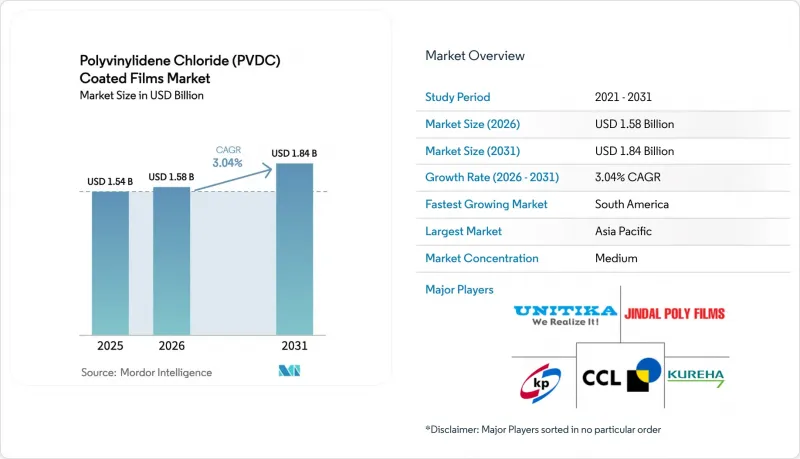
This report is Segmented by Film Substrate Type (BOPP, PET/BOPET, PVC, and Others), Application (Food Packaging and Pharmaceutical Blister Packaging), and Geography (Asia-Pacific, North America, Europe, South America, and Middle-East and Africa). Market Forecasts are Provided in Terms of Value (USD).
Global Polyvinylidene Chloride (PVDC) Coated Films Market Trends and Insights
Processed and Ready-to-Eat Food Boom
As urban incomes rise and lifestyles grow busier, there's a heightened demand for portion-controlled, shelf-stable meals. These meals need to remain fresh for an extended period during chilled distribution. PVDC-coated BOPP and PET films facilitate modified-atmosphere packaging, effectively curbing lipid oxidation and microbial spoilage. In response to surging orders from ready-meal brands in India and the Middle East, UFlex is ramping up production of barrier film in Karnataka. Brand owners are now opting for thinner coatings over traditional designs, achieving cost reductions while maintaining shelf life. While compliance with FDA 21 CFR 177.1980 and EU 10/2011 is essential, converters can gain a competitive advantage by certifying pasteurization durability at high temperatures.
Pharmaceutical Blister-Pack Adoption Surge
Producers of generic drugs in India and Eastern Europe are shifting from strip packs to thermoformed PVC/PVDC blisters. This move is to meet the ICH Q1A moisture-barrier criteria for active pharmaceutical ingredients (APIs) like aspirin and antibiotics. PVC laminated with PVDC ensures a longer shelf life even in Zone IVb climates. Despite undergoing a Chapter 11 restructuring, Klockner Pentaplast is doubling down on investments in pharmaceutical-grade PVC/PVDC. The company is keenly aware of the premium margins associated with ultra-high-barrier grades, which are essential for biologics. The European Medicines Agency's guidance on package-integrity testing has solidified PVDC's significance in the industry. This is especially true given that alternative ceramic-oxide coatings don't have robust long-term field data backing their efficacy.
Competition from EVOH and Metallized Barriers
Nine-layer blown EVOH films commissioned by Coveris in the United Kingdom provide sub-1 cm3/m2/day OTR in dry conditions and can be recycled within polyethylene waste streams. Falling EVOH resin prices and rising VDC costs are shrinking PVDC's historical cost edge, particularly in dry-goods packaging where absolute humidity is low. Metallized PET and AlOx-coated films additionally appeal to snack-food brands that demand a light barrier, although opacity restricts their use for fresh meat.
Other drivers and restraints analyzed in the detailed report include:
- Superior Gas and Moisture Barrier Performance
- Shift to Ultra-Thin (less than 15 µm) PVDC Coatings
- End-of-Life / Chlorine-Based Recycling Concerns
For complete list of drivers and restraints, kindly check the Table Of Contents.
Segment Analysis
BOPP claimed a 44% share of the PVDC-coated films market in 2025, reflecting its low resin cost and high run speeds on rotogravure coaters. Many converters adeptly process 20 µm BOPP bases at high speeds, achieving the tensile strength essential for bone-in meat packaging. BOPET, catering to premium trays subjected to mild pasteurization, commands a notable price premium. While PVC holds only a modest volume share, it will log the fastest 3.67% CAGR because of blister demand. The market size for PVDC-coated films linked to polyvinyl chloride is set to rise in the coming years. Additionally, specialty niches like polyamide sausage casings and PLA stand-up pouches contribute to the "others" category.
BOPP's lead faces challenges from recyclable mono-PP lidding, achieving low OTR without the need for PVDC. Should upcoming scale-up trials prove successful, downgauged mono-PP might threaten BOPP's market share in PVDC-coated films by decade's end. However, any transition depends on converters confirming barrier stability at high relative humidity, a benchmark currently favoring PVDC structures.
Complete Report Scope:
- By Film Substrate Type
- Bi-axially Oriented Polypropylene (BOPP)
- Polyethylene Terephthalate (PET/BOPET)
- Polyvinyl Chloride (PVC)
- Others (Polyethylene, polyamide,PLA, Cellulosics etc.)
- By Application
- Food Packaging
- Pharmaceutical Blister Packaging
- By Geography
- Asia-Pacific
- China
- India
- Japan
- South Korea
- Rest of Asia-Pacific
- North America
- United States
- Canada
- Mexico
- Europe
- Germany
- United Kingdom
- France
- Italy
- Rest of Europe
- South America
- Brazil
- Argentina
- Rest of South America
- Middle-East and Africa
- Saudi Arabia
- South Africa
- Rest of Middle-East and Africa
- Asia-Pacific
Geography Analysis
Asia-Pacific held 41.38% of the PVDC-coated films market revenue in 2025 on the back of India's and China's integrated film capacity and strong retail modernization. Jindal Poly Films and Cosmo Films run in-house PVDC coating that lets them tweak barrier properties to local humidity and distribution conditions. Rising blister exports from India to regulated markets further underpin demand.
South America, led by Brazil and Argentina, posts the fastest 3.57% regional CAGR to 2031. As supermarket penetration rises, converters upgrade from waxed wraps to PVDC high-barrier films that extend refrigerated shelf life. Domestic regulations are less stringent on recyclability, giving PVDC a window of opportunity even as European brand owners tighten specifications.
North America balances strong blister-pack growth with early extended-producer-responsibility (EPR) moves in California and Maine that penalize non-recyclable formats. Syensqo's recycling breakthrough could mitigate these fees if sortation systems accept PE/PVDC multilayers. Europe presents the stiffest challenge: the Packaging and Packaging Waste Regulation demands recyclability at scale by 2030 and levies plastic taxes on non-recyclables. Some municipal systems have begun to trial the Syensqo protocol, but acceptance is far from uniform. The Middle East and Africa remain small yet rising, with Saudi Arabia's premium dairy segment and South Africa's pharmaceutical imports driving niche demand.
- ACG
- Asahi Kasei Corporation
- Bilcare Limited
- Caprihans India Limited
- CCL Industries
- Cosmo Films
- Glenroy Inc.
- Huawei Pharma Foil Packaging
- Jindal Poly Films Limited
- Kaveri Metallising & Coating Ind. Private Limited
- Klockner Pentaplast
- KUREHA CORPORATION
- Liveo Research
- Perlen Packaging
- POLINAS
- Polyplex
- Qingdao Kingchuan Packaging
- RMCL
- Solvay
- Tekni-Plex Inc.
- Tipack Group
- Transparent Paper Ltd.
- UNITIKA LTD
- Valtec Italia SRL
- Vibac Group S.p.a.
Additional Benefits:
- The market estimate (ME) sheet in Excel format
- 3 months of analyst support
TABLE OF CONTENTS
1 Introduction
- 1.1 Study Assumptions and Market Definition
- 1.2 Scope of the Study
2 Research Methodology
3 Executive Summary
4 Market Landscape
- 4.1 Market Overview
- 4.2 Market Drivers
- 4.2.1 Processed and Ready-to-Eat Food Boom
- 4.2.2 Pharmaceutical Blister-Pack Adoption Surge
- 4.2.3 Superior Gas- and Moisture-Barrier Performance
- 4.2.4 Shift to Ultra-Thin (less than 15 µm) PVDC Coatings
- 4.2.5 Emergence of PFAS-Free Fluorine-Free PVDC Grades
- 4.3 Market Restraints
- 4.3.1 Competition from EVOH and Metallized Barriers
- 4.3.2 End-of-Life/Chlorine-based Recycling Concerns
- 4.3.3 VDC-Monomer Supply Volatility Amid Chlor-Alkali Decarbonisation
- 4.4 Value Chain Analysis
- 4.5 Porter's Five Forces
- 4.5.1 Threat of New Entrants
- 4.5.2 Bargaining Power of Suppliers
- 4.5.3 Bargaining Power of Buyers
- 4.5.4 Threat of Substitutes
- 4.5.5 Industry Rivalry
5 Market Size and Growth Forecasts (Value)
- 5.1 By Film Substrate Type
- 5.1.1 Bi-axially Oriented Polypropylene (BOPP)
- 5.1.2 Polyethylene Terephthalate (PET/BOPET)
- 5.1.3 Polyvinyl Chloride (PVC)
- 5.1.4 Others (Polyethylene, polyamide,PLA, Cellulosics etc.)
- 5.2 By Application
- 5.2.1 Food Packaging
- 5.2.2 Pharmaceutical Blister Packaging
- 5.3 By Geography
- 5.3.1 Asia-Pacific
- 5.3.1.1 China
- 5.3.1.2 India
- 5.3.1.3 Japan
- 5.3.1.4 South Korea
- 5.3.1.5 Rest of Asia-Pacific
- 5.3.2 North America
- 5.3.2.1 United States
- 5.3.2.2 Canada
- 5.3.2.3 Mexico
- 5.3.3 Europe
- 5.3.3.1 Germany
- 5.3.3.2 United Kingdom
- 5.3.3.3 France
- 5.3.3.4 Italy
- 5.3.3.5 Rest of Europe
- 5.3.4 South America
- 5.3.4.1 Brazil
- 5.3.4.2 Argentina
- 5.3.4.3 Rest of South America
- 5.3.5 Middle-East and Africa
- 5.3.5.1 Saudi Arabia
- 5.3.5.2 South Africa
- 5.3.5.3 Rest of Middle-East and Africa
- 5.3.1 Asia-Pacific
6 Competitive Landscape
- 6.1 Market Concentration
- 6.2 Strategic Moves
- 6.3 Market Share/Ranking Analysis
- 6.4 Company Profiles (includes Global Level Overview, Market Level Overview, Core Segments, Financials, Strategic Info, Market Rank/Share, Products and Services, Recent Developments)
- 6.4.1 ACG
- 6.4.2 Asahi Kasei Corporation
- 6.4.3 Bilcare Limited
- 6.4.4 Caprihans India Limited
- 6.4.5 CCL Industries
- 6.4.6 Cosmo Films
- 6.4.7 Glenroy Inc.
- 6.4.8 Huawei Pharma Foil Packaging
- 6.4.9 Jindal Poly Films Limited
- 6.4.10 Kaveri Metallising & Coating Ind. Private Limited
- 6.4.11 Klockner Pentaplast
- 6.4.12 KUREHA CORPORATION
- 6.4.13 Liveo Research
- 6.4.14 Perlen Packaging
- 6.4.15 POLINAS
- 6.4.16 Polyplex
- 6.4.17 Qingdao Kingchuan Packaging
- 6.4.18 RMCL
- 6.4.19 Solvay
- 6.4.20 Tekni-Plex Inc.
- 6.4.21 Tipack Group
- 6.4.22 Transparent Paper Ltd.
- 6.4.23 UNITIKA LTD
- 6.4.24 Valtec Italia SRL
- 6.4.25 Vibac Group S.p.a.
7 Market Opportunities and Future Outlook
- 7.1 White-Space and Unmet-Need Assessment

