PUBLISHER: Mordor Intelligence | PRODUCT CODE: 2124112

PUBLISHER: Mordor Intelligence | PRODUCT CODE: 2124112
Golf Cart - Market Share Analysis, Industry Trends & Statistics, Growth Forecasts (2026 - 2031)
According to Mordor Intelligence, the golf cart market size was valued at USD 2.32 billion in 2025 and estimated to grow from USD 2.44 billion in 2026 to reach USD 3.24 billion by 2031, at a CAGR of 5.81% during the forecast period (2026-2031).
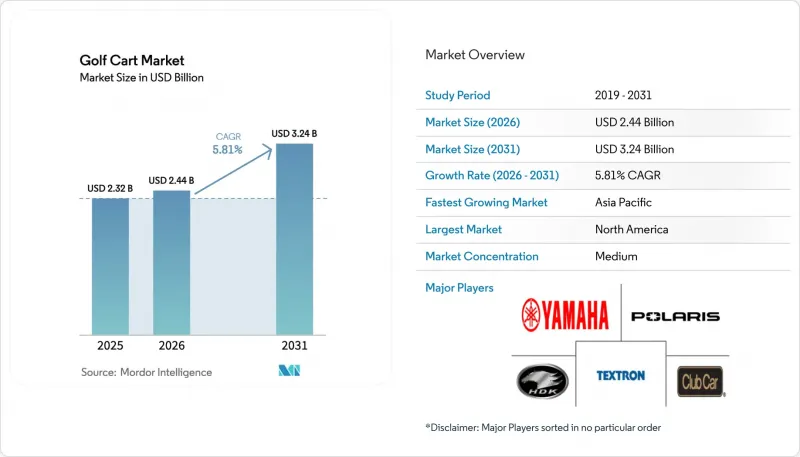
This report is Segmented by Propulsion Type (Electric, Gasoline, and Solar-Hybrid), Seating Capacity (2, 4, 6, and 8+ Seater), Vehicle Format (Open-Top and Enclosed), Application (Golf Courses and More), Sales Channel (Offline and Online), and Geography. Market Forecasts in Value (USD) and Volume (Units).
Global Golf Cart Market Trends and Insights
United States Retirement Communities Rapidly Adopting New Trends
In Florida, Arizona, and South Carolina, retirement communities have made carts a staple mode of transport. The Villages, a prominent player, operates a substantial number of units and boasts significant annual growth. In recent years, Florida dealers have experienced a considerable increase in cart sales. This growth is largely driven by younger retirees who are customizing their carts with features like lifted suspensions, LED lighting, and Bluetooth audio, ensuring they're street-legal. In Dunedin and Panama City, city ordinances have expanded low-speed vehicle zones, linking homes directly to retail areas and healthcare facilities. As a result, there's an increasing demand for four-seater carts, reflecting the needs of multigenerational households. Recently, the National Highway Traffic Safety Administration introduced updated safety standards, requiring the integration of seat belts, windshields, and turn signals in carts over the coming years, especially for those on public roads .
Planned Golf Townships Emerging in GCC Mega-Projects
Saudi Arabia's NEOM's Gidori and Qiddiya, along with the United Arab Emirates' Red Sea courses, are introducing enclosed, air-conditioned carts with varying seating capacities, designed to combat the sweltering desert heat. Qiddiya, aiming to attract a significant number of annual visitors in the coming years, is in dire need of high-capacity VIP fleets. These ambitious projects are fostering partnerships with suppliers, focusing on thermally managed batteries and solar-hybrid roofs, significantly reducing dependence on traditional generators .
Lithium-Ion Pack Cost Volatility
In recent years, battery pack prices have experienced a significant decline, reaching their lowest levels in over half a decade. Despite this reduction, the majority of cell production continues to be heavily concentrated in China, accounting for a substantial share of the global output. Import-dependent assemblers in regions such as Latin America and Africa face challenges due to disruptions in the supply chain, which have led to increased costs for imported components. According to the International Energy Agency, further cost reductions are anticipated in the coming years as advancements in lithium iron phosphate (LFP) and sodium-ion battery chemistries gain momentum and achieve greater scalability . Yamaha's upcoming electric cart model, scheduled for release in the middle of the decade, features an innovative in-house battery pack utilizing LFP chemistry. This new design is expected to deliver significantly improved energy efficiency compared to earlier models that relied on lead-acid batteries, providing a more stable and reliable solution amidst market volatility.
Other drivers and restraints analyzed in the detailed report include:
- OEM Bundled Financing for Community Fleets in India
- Caribbean Resorts Piloting Solar-Hybrid Carts
- Declining Golf Membership in Western Europe
For complete list of drivers and restraints, kindly check the Table Of Contents.
Segment Analysis
Electric carts dominate with 78.81% share, anchored by mature charging infrastructure at most courses. The golf cart market size for solar-hybrid models, however, is projected to grow at a 5.83% CAGR, catalyzed by off-grid resorts seeking autonomy. Los Naranjos Golf Club cut electricity costs by 40% by adding rooftop panels, validating a five-year payback. LFP batteries displace lead-acid, improving energy density and cycle life, while Yamaha's hydrogen fuel-cell concept hints at future diversification. Regulations such as EU 2023/1804 accelerate the pivot away from gasoline, narrowing long-term prospects for combustion carts.
Chinese suppliers offer CE-marked solar roofs bundled with 150 W trickle chargers priced under USD 400, making hybrids attractive for Southeast Asian and Caribbean operators. The golf cart market continues to absorb battery-reuse packs from end-of-life EVs, smoothing supply and lowering emissions footprints.
Two-seater units still hold the largest slice with 47.63% market share in 2025, yet four-seaters advance fastest on the back of Sun-belt residential adoption. The golf cart market size for four-seater models is forecast to expand 5.88% per year through 2031. Players like E-Z-GO's Liberty and Yamaha's five-seat G30Es bridge space efficiency with greater passenger accommodation.
Retirement communities retrofit rear-facing seats and cargo boxes, spurring aftermarket revenue. GCC mega-projects lean toward six- and eight-seater, air-conditioned carts for VIP and group play, shaping premium demand tiers.
Complete Report Scope:
- By Propulsion Type
- Electric Golf Carts
- Gasoline Golf Carts
- Solar-Hybrid Golf Carts
- By Seating Capacity
- 2 Seater
- 4 Seater
- 6 Seater
- 8+ Seater
- By Vehicle Format
- Open-Top
- Enclosed / Weather-proof
- By Application
- Golf Courses
- Personal / Residential Mobility
- Commercial Services (Resorts, Theme-Parks, Campuses)
- Industrial & Airport Utility
- By Sales Channel
- Offline (Dealers & Distributors)
- Online / Direct-to-Consumer
- By Geography
- North America
- United States
- Canada
- Rest of North America
- South America
- Brazil
- Argentina
- Rest of South America
- Europe
- Germany
- United Kingdom
- France
- Italy
- Spain
- Rest of Europe
- Asia Pacific
- China
- India
- Japan
- South Korea
- Rest of Asia Pacific
- Middle East and Africa
- United Arab Emirates
- Saudi Arabia
- South Africa
- Turkey
- Rest of Middle East and Africa
- North America
Geography Analysis
North America, with 38.71% revenue in 2025, remains the anchor due to entrenched retirement-community culture and extensive course networks. FMVSS 305a harmonizes safety compliance, likely raising average selling prices but also spurring replacement of older fleets. Canada's stricter fire codes add retrofit costs, while localized production by Club Car, Yamaha, and Textron ensures quick lead times and tailored service packages.
Asia Pacific is the fastest-rising region at a 5.87% CAGR. Thailand leads ASEAN adoption, supported by local manufacturers and tourism-driven cart demand. China's market, already USD 134.47 million in 2022, could double by 2029 as applications widen to parks and industrial campuses. Japan's preference for five-seat caddie carts pushes OEMs to integrate electromagnetic guidance for autonomous fairway loops. India's township fleets enter pilot stage, signaling potential scale once bundled financing solidifies.
Europe blends opportunity and risk. Electrification mandates guarantee replacement demand, yet United Kingdom, German, and French membership attrition reduces volume upside. Clubs in Spain and Italy offset power costs through solar roofs and battery-storage pairs, breaking even within five years. South America and the Middle East trail in absolute numbers but post the steepest percentage gains, with GCC mega-projects setting premium benchmarks for enclosed, cooled carts. Caribbean islands pioneer solar-hybrid adoption as battery-reuse labs in Barbados illustrate circular-economy gains.
- Club Car LLC
- Yamaha Golf-Car Company
- Textron Specialized Vehicles (E-Z-GO, Cushman)
- Columbia Vehicle Group (ParCar)
- HDK Electric Vehicles
- Suzhou Eagle EV Mfg. Co.
- JH Global Services (Star EV)
- Dongguan Excellence Golf & Sightseeing Car
- ICON EV
- Marshell Electric Vehicle
- Bintelli Electric Vehicles
- Xiamen Dalle Electric Car
- Polaris GEM (Polaris Inc.)
- Speedways Electric
- AgT Electric Cars
- CitEcar Electric Vehicles
- Kandi Technologies Group
- Tomberlin (Columbia)
- ELLWEE AB
Additional Benefits:
- The market estimate (ME) sheet in Excel format
- 3 months of analyst support
TABLE OF CONTENTS
1 Introduction
- 1.1 Study Assumptions and Market Definition
- 1.2 Scope of the Study
2 Research Methodology
3 Executive Summary
4 Market Landscape
- 4.1 Market Overview
- 4.2 Market Drivers
- 4.2.1 United States Retirement Communities, Especially in the Sun-belt States, are Rapidly Adopting New Trends
- 4.2.2 European Golf Courses and Country Clubs are Mandated to Electrify their Operations
- 4.2.3 Southeast Asian Islands are Integrating Micro-Mobility Programs Into their Resorts
- 4.2.4 Planned Golf Townships are Quickly Emerging as Part of Mega-projects in the GCC
- 4.2.5 OEM Bundled-Financing for Community Transport Fleets in India
- 4.2.6 Caribbean Resorts with Low Grid Access are Piloting Solar-hybrid Carts
- 4.3 Market Restraints
- 4.3.1 Lithium-Ion Pack Cost Volatility (Post-2023 Supply Shock)
- 4.3.2 Declining Golf Membership in Western Europe
- 4.3.3 Municipal Fire-Code Tightening for Cart Storage (United States and Canada)
- 4.3.4 Sparse Charging Infrastructure in Outlying Caribbean Islands
- 4.4 Value / Supply-Chain Analysis
- 4.5 Regulatory Landscape
- 4.6 Technological Outlook
- 4.7 Porter's Five Forces
- 4.7.1 Bargaining Power of Suppliers
- 4.7.2 Bargaining Power of Buyers
- 4.7.3 Threat of New Entrants
- 4.7.4 Threat of Substitutes
- 4.7.5 Competitive Rivalry
5 Market Size and Growth Forecasts (Value (USD) and Volume (Units))
- 5.1 By Propulsion Type
- 5.1.1 Electric Golf Carts
- 5.1.2 Gasoline Golf Carts
- 5.1.3 Solar-Hybrid Golf Carts
- 5.2 By Seating Capacity
- 5.2.1 2 Seater
- 5.2.2 4 Seater
- 5.2.3 6 Seater
- 5.2.4 8+ Seater
- 5.3 By Vehicle Format
- 5.3.1 Open-Top
- 5.3.2 Enclosed / Weather-proof
- 5.4 By Application
- 5.4.1 Golf Courses
- 5.4.2 Personal / Residential Mobility
- 5.4.3 Commercial Services (Resorts, Theme-Parks, Campuses)
- 5.4.4 Industrial & Airport Utility
- 5.5 By Sales Channel
- 5.5.1 Offline (Dealers & Distributors)
- 5.5.2 Online / Direct-to-Consumer
- 5.6 By Geography
- 5.6.1 North America
- 5.6.1.1 United States
- 5.6.1.2 Canada
- 5.6.1.3 Rest of North America
- 5.6.2 South America
- 5.6.2.1 Brazil
- 5.6.2.2 Argentina
- 5.6.2.3 Rest of South America
- 5.6.3 Europe
- 5.6.3.1 Germany
- 5.6.3.2 United Kingdom
- 5.6.3.3 France
- 5.6.3.4 Italy
- 5.6.3.5 Spain
- 5.6.3.6 Rest of Europe
- 5.6.4 Asia Pacific
- 5.6.4.1 China
- 5.6.4.2 India
- 5.6.4.3 Japan
- 5.6.4.4 South Korea
- 5.6.4.5 Rest of Asia Pacific
- 5.6.5 Middle East and Africa
- 5.6.5.1 United Arab Emirates
- 5.6.5.2 Saudi Arabia
- 5.6.5.3 South Africa
- 5.6.5.4 Turkey
- 5.6.5.5 Rest of Middle East and Africa
- 5.6.1 North America
6 Competitive Landscape
- 6.1 Market Concentration
- 6.2 Strategic Moves
- 6.3 Market Share Analysis
- 6.4 Company Profiles (Includes Global Level Overview, Market Level Overview, Core Segments, Financials as Available, Strategic Information, Market Rank/Share for Key Companies, Products and Services, SWOT Analysis, and Recent Developments)
- 6.4.1 Club Car LLC
- 6.4.2 Yamaha Golf-Car Company
- 6.4.3 Textron Specialized Vehicles (E-Z-GO, Cushman)
- 6.4.4 Columbia Vehicle Group (ParCar)
- 6.4.5 HDK Electric Vehicles
- 6.4.6 Suzhou Eagle EV Mfg. Co.
- 6.4.7 JH Global Services (Star EV)
- 6.4.8 Dongguan Excellence Golf & Sightseeing Car
- 6.4.9 ICON EV
- 6.4.10 Marshell Electric Vehicle
- 6.4.11 Bintelli Electric Vehicles
- 6.4.12 Xiamen Dalle Electric Car
- 6.4.13 Polaris GEM (Polaris Inc.)
- 6.4.14 Speedways Electric
- 6.4.15 AgT Electric Cars
- 6.4.16 CitEcar Electric Vehicles
- 6.4.17 Kandi Technologies Group
- 6.4.18 Tomberlin (Columbia)
- 6.4.19 ELLWEE AB
7 Market Opportunities and Future Outlook
- 7.1 White-space and Unmet-need Assessment

