PUBLISHER: Mordor Intelligence | PRODUCT CODE: 2124117

PUBLISHER: Mordor Intelligence | PRODUCT CODE: 2124117
Electrodeionization (EDI) Technology - Market Share Analysis, Industry Trends & Statistics, Growth Forecasts (2026 - 2031)
According to Mordor Intelligence, the electrodeionization technology market size is expected to increase from USD 0.9 billion in 2025 to USD 0.95 billion in 2026 and reach USD 1.32 billion by 2031, growing at a CAGR of 6.77% over 2026-2031.
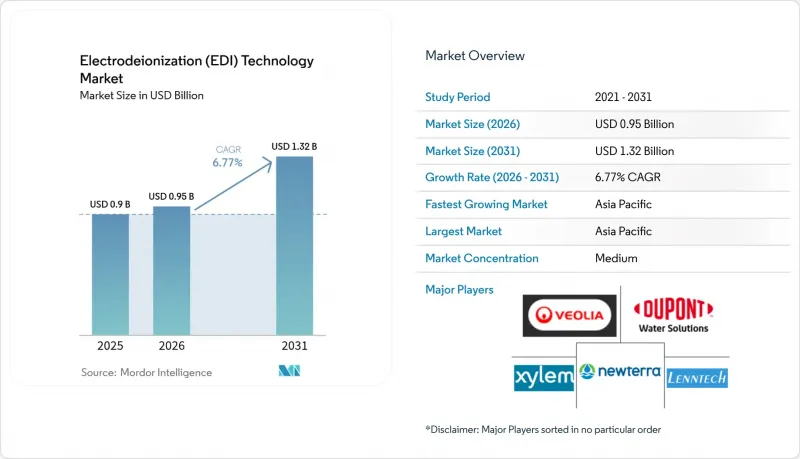
This report is Segmented by Application (Power Generation, Electronics and Semiconductors, Food and Beverage, Pharmaceuticals, and Other Applications), Product Type (Plate-And-Frame Module and Spiral Wound Module), and Geography (North America, Europe, Asia-Pacific, South America, and Middle East and Africa). The Market Forecasts are Provided in Terms of Value (USD).
Global Electrodeionization (EDI) Technology Market Trends and Insights
Green-Hydrogen Electrolyzer Demand for Ultrapure Water
Global electrolyzer rollouts mandate feedwater below 0.1 µS/cm, a band that only EDI can hold after RO polish. Germany set a 10 GW domestic target under its National Hydrogen Strategy, matching the United States Hydrogen Shot cost goal of USD 1/kg, and each MW of capacity needs roughly 1-1.5 m3/h of ultrapure water. Orsted and bp began pairing offshore wind with coastal hydrogen hubs in 2025, hard-wiring seawater desalination plus EDI into every gigawatt module. The IEA sees global electrolyzer nameplate exceeding 90 GW by 2030, a five-fold rise from 2024 that multiplies demand for compact electrodeionization stacks. With RO-EDI trains able to run chemical-free, developers cut logistics at remote renewables sites, lowering OPEX and permitting hurdles across the electrodeionization technology market.
Continuous Bioprocessing in Cell and Gene-Therapy Plants
The U.S. FDA endorsed continuous manufacturing for biologics in 2024, pushing drug makers toward single-use reactors that cannot tolerate regeneration acids or bases. Sartorius trials showed EDI-prepared buffers trimming total cycle times by 30% and reducing hold-step variability for CAR-T batches. Novo Nordisk and Eli Lilly enlarged fill-finish space in 2025 to meet surging GLP-1 demand, installing on-demand water-for-injection loops polished with EDI skids. As patient-specific therapies scale, every hour saved matters, making chemical-free EDI a default in new biologics suites. This shift funnels steady orders into the electrodeionization technology market through 2031.
Supply-Chain Risk for Fluoropolymer IEM Precursors
Chinese and EU crackdowns on PFAS production pushed Chemours and Solvay's lead times for membrane-grade resins from 12 to 20 weeks in early 2025. DuPont's 2024 filings note 8% cost inflation on Nafion inputs, costs that cascade to EDI assemblers. The European Chemicals Agency also weighs broad PFAS restrictions with only narrow carve-outs, making long-range supply contracts risky. While firms trial non-fluorinated polymers, chemical stability lags under EDI voltage swings, leaving upstream volatility a short-term brake on the electrodeionization technology market.
Other drivers and restraints analyzed in the detailed report include:
- Modular EDI Skids for Edge-Cloud Data Centers
- PFAS Discharge Limits Favour Chemical-Free Polishing
- Skilled-Labor Shortage for High-Pressure Commissioning
For complete list of drivers and restraints, kindly check the Table Of Contents.
Segment Analysis
Power generation accounted for 40.44% of revenue in 2025 as combined-cycle plants and supercritical boilers require feedwater conductivity below 0.2 µS/cm to protect turbines. However, incremental growth slows because gas turbines consume less makeup water than legacy coal. Pharmaceuticals will post the fastest 7.20% CAGR as regulators endorse continuous manufacturing and the United States Pharmacopeia chapter 643 fixes resistivity above 1 MΩ-cm. Biologics suites adopting single-use bioreactors install compact EDI trains that deliver water-for-injection on demand without chemical regenerants, expanding the electrodeionization technology market across high-margin life-science nodes.
Electronics and semiconductors trail next, driven by Taiwan Semiconductor Manufacturing Company fabs hitting 18.2 MΩ-cm purity for 3 nm nodes. Food and beverage demand stays steady where breweries and dairy plants value uptime over 10 µS/cm conductivity ceilings. Lab, aquarium, and cosmetic users form a mid-single-digit block with consistent replacement orders.
Complete Report Scope:
- By Application
- Power Generation (Power Plants)
- Electronics and Semiconductors
- Food and Beverage
- Pharmaceuticals
- Other Applications
- By Product Type
- Plate-and-frame Module
- Spiral Wound Module
- By Geography
- Asia-Pacific
- China
- India
- Japan
- South Korea
- Rest of Asia-Pacific
- North America
- United States
- Canada
- Mexico
- Europe
- Germany
- United Kingdom
- France
- Italy
- Rest of Europe
- South America
- Brazil
- Argentina
- Rest of South America
- Middle East and Africa
- Saudi Arabia
- South Africa
- Rest of Middle East and Africa
- Asia-Pacific
Geography Analysis
Asia-Pacific booked 41.69% of 2025 revenue, underpinned by 18 new Chinese fabs, India's USD 10 billion Production-Linked Incentives, and wave after wave of Singapore and Mumbai hyperscale builds. Taiwan Semiconductor's 20 nm lines consumed 63,000 tons/day of ultrapure water in 2024, each liter polished by EDI, while Samsung's Pyeongtaek plant recycles close to 90% of process water. Japan's USD 6.8 billion subsidy for advanced packaging funnels orders toward Kumamoto and Hokkaido nodes, adding another lift. China's 90% reuse mandate for electronics and chemical sites by 2030 embeds RO-EDI trains deep into coastal industrial parks, securing long-term demand across the electrodeionization technology market.
The North American market is driven by DOE Hydrogen Shot electrolyzer rollouts and semiconductor reinvestment. Intel's Arizona Fab 42 pushes 30,000 L/min through EDI loops. Eli Lilly's USD 2.1 billion Indiana campus couples single-use reactors with on-site electrodeionization skids. EPA's 4 ppt PFAS limit guides industrial dischargers to chemical-free polishing, strengthening aftermarket demand across the electrodeionization technology market.
Europe rides the REPowerEU target of 10 Mt green hydrogen by 2030. Gigawatt projects in Germany, the Netherlands, and Spain each need 1-1.5 m3/h of ultrapure water per MW, fixing electrodeionization into every process line. South America and Middle East and Africa remain low-double-digit today, but Chilean and Argentinian DLE plants plus Saudi Arabia's 4 GW NEOM electrolyzer site will bolt on hundreds of cubic meters per hour of RO-EDI trains by 2028. Power-grid reliability and skilled-labor gaps restrain broader uptake, yet once-through water bans in mining and petrochemicals tip more projects toward closed-loop electrodeionization technology market solutions.
- Applied Membranes Inc.
- Aqua Filsep water Treatment Pvt. Ltd
- Aquatech International LLC
- BWT Holding GmbH
- Deionx
- DuPont
- EUROWATER
- Lenntech B.V.
- MEGA AS
- Newterra
- Pure Water Group
- SnowPure LLC
- Veolia
- Xylem
Additional Benefits:
- The market estimate (ME) sheet in Excel format
- 3 months of analyst support
TABLE OF CONTENTS
1 Introduction
- 1.1 Study Assumptions and Market Definition
- 1.2 Scope of the Study
2 Research Methodology
3 Executive Summary
4 Market Landscape
- 4.1 Market Overview
- 4.2 Market Drivers
- 4.2.1 Green-Hydrogen Electrolyzer Demand for Ultrapure Water
- 4.2.2 Continuous Bioprocessing Adoption in Cell and Gene-Therapy Plants
- 4.2.3 Modular EDI Skids for Edge-Cloud Micro-Data-Centers
- 4.2.4 PFAS Discharge Limits Favoring Chemical-Free Polishing
- 4.2.5 Direct-Lithium-Extraction (DLE) Plants Requiring Ultra-Low-Conductivity Water
- 4.3 Market Restraints
- 4.3.1 Supply-Chain Risk for Fluoropolymer IEM Precursors
- 4.3.2 Skilled-Labor Shortage for High-Pressure EDI Commissioning
- 4.3.3 Upfront CAPEX Barrier for SMEs in Emerging Economies
- 4.4 Value Chain Analysis
- 4.5 Porter's Five Forces
- 4.5.1 Threat of New Entrants
- 4.5.2 Bargaining Power of Buyers
- 4.5.3 Bargaining Power of Suppliers
- 4.5.4 Threat of Substitute Products
- 4.5.5 Degree of Competition
5 Market Size and Growth Forecasts (Value)
- 5.1 By Application
- 5.1.1 Power Generation (Power Plants)
- 5.1.2 Electronics and Semiconductors
- 5.1.3 Food and Beverage
- 5.1.4 Pharmaceuticals
- 5.1.5 Other Applications
- 5.2 By Product Type
- 5.2.1 Plate-and-frame Module
- 5.2.2 Spiral Wound Module
- 5.3 By Geography
- 5.3.1 Asia-Pacific
- 5.3.1.1 China
- 5.3.1.2 India
- 5.3.1.3 Japan
- 5.3.1.4 South Korea
- 5.3.1.5 Rest of Asia-Pacific
- 5.3.2 North America
- 5.3.2.1 United States
- 5.3.2.2 Canada
- 5.3.2.3 Mexico
- 5.3.3 Europe
- 5.3.3.1 Germany
- 5.3.3.2 United Kingdom
- 5.3.3.3 France
- 5.3.3.4 Italy
- 5.3.3.5 Rest of Europe
- 5.3.4 South America
- 5.3.4.1 Brazil
- 5.3.4.2 Argentina
- 5.3.4.3 Rest of South America
- 5.3.5 Middle East and Africa
- 5.3.5.1 Saudi Arabia
- 5.3.5.2 South Africa
- 5.3.5.3 Rest of Middle East and Africa
- 5.3.1 Asia-Pacific
6 Competitive Landscape
- 6.1 Market Concentration
- 6.2 Strategic Moves
- 6.3 Market Share(%)/Ranking Analysis
- 6.4 Company Profiles (includes Global level Overview, Market level overview, Core Segments, Financials as available, Strategic Information, Products and Services, and Recent Developments)
- 6.4.1 Applied Membranes Inc.
- 6.4.2 Aqua Filsep water Treatment Pvt. Ltd
- 6.4.3 Aquatech International LLC
- 6.4.4 BWT Holding GmbH
- 6.4.5 Deionx
- 6.4.6 DuPont
- 6.4.7 EUROWATER
- 6.4.8 Lenntech B.V.
- 6.4.9 MEGA AS
- 6.4.10 Newterra
- 6.4.11 Pure Water Group
- 6.4.12 SnowPure LLC
- 6.4.13 Veolia
- 6.4.14 Xylem
7 Market Opportunities and Future Outlook
- 7.1 White-space and Unmet-Need Assessment

