PUBLISHER: Mordor Intelligence | PRODUCT CODE: 2124123

PUBLISHER: Mordor Intelligence | PRODUCT CODE: 2124123
Polyisobutylene (PIB) - Market Share Analysis, Industry Trends & Statistics, Growth Forecasts (2026 - 2031)
According to Mordor Intelligence, the polyisobutylene market size was valued at 1.08 Million tons in 2025 and is estimated to grow from 1.11 Million tons in 2026 to reach 1.32 Million tons by 2031, at a CAGR of 3.53% during the forecast period (2026-2031).
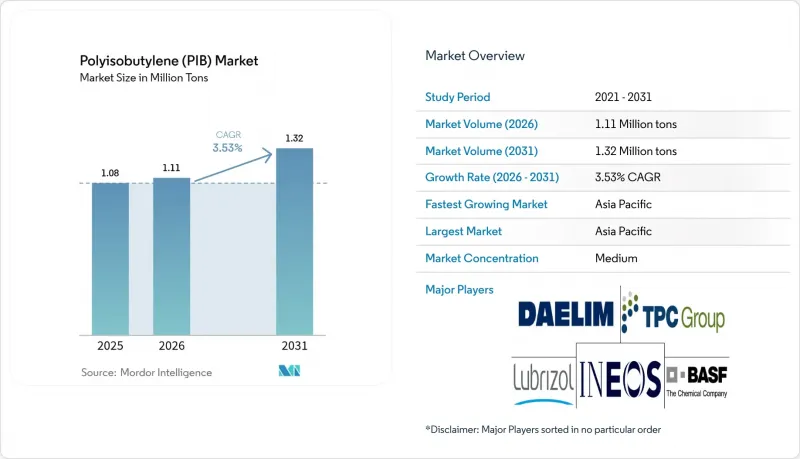
This report is Segmented by Application (Lubricants, Tire Tubes, and More), End-Use Industry (Automotive and Transportation, Industrial Machinery, Construction and Building Materials, Food, Pharma and Personal Care, and Electrical and Electronics), and Geography (Asia-Pacific, North America, Europe, South America, and Middle-East and Africa). The Market Forecasts are Provided in Terms of Volume (Tons).
Global Polyisobutylene (PIB) Market Trends and Insights
Growing Demand from Adhesives and Sealants
Construction and aftermarket adhesives increasingly specify polyisobutylene because moisture- and gas-barrier performance surpasses polyurethane and acrylic alternatives. H.B. Fuller's insulated-glass sealants, based on medium-Mn grades, exceed 25-year edge-seal durability under EN 1279 thermal cycling, which aligns with tighter European building-energy codes. Pressure-sensitive-tape makers blend low-Mn PIB with tackifiers to secure >=20 N/25 mm peel strength, satisfying packaging and automotive-trim requirements across humid Asian climates. ISO 11600 and ISO 9047 compliance opens international procurement channels for Chinese and Indian converters, allowing them to move beyond domestic sales without compromising performance. The polyisobutylene market therefore benefits doubly-from higher unit volumes in new construction and from premium pricing for long-life sealants. Capacity investments across Zhejiang and Guangdong are timed to catch this demand crest, amplifying Asia-Pacific's share in global shipments.
Rising Use in Tire Inner-Liners and Tubeless Compounds
Tire makers substitute conventional butyl inner-liners with halobutyl-PIB blends that lower air permeability by 30-40%, lengthening pressure-retention intervals and cutting rolling resistance to satisfy fuel-economy rules. ExxonMobil's Exxpro(TM) elastomer family achieves permeability coefficients below 20 X 10-12 cm3 cm/(cm2 s cmHg), now a baseline for electric-vehicle tires. Goodyear's 2024 filings add cold-flexibility enhancements, preserving liner integrity below -40 °C. China's GB/T 29042 labeling and India's 22% tire-export surge underpin Asia-Pacific volume growth, while Southeast Asian new entrants license technology from Daelim and ENEOS to supply OEM fleets. As a result, tire formulations inject fresh momentum into the polyisobutylene market, ensuring that volume growth keeps pace with vehicle electrification trends.
Feedstock Isobutylene Price Volatility
Isobutylene originates mainly from C4 refinery cuts and on-purpose isobutane dehydrogenation, exposing PIB producers to 75% spot-price swings between USD 800 and USD 1,400 per tonne during 2024-2025. EU carbon permits at EUR 80-100 per tonne of CO2 further tax European naphtha crackers, tilting the cost curve toward ethane-rich Middle-Eastern plants. On-purpose routes stabilize supply but entail catalyst and hydrogen-management costs that only large integrated sites can absorb. Bio-routes from Global Bioenergies and LanzaTech remain pilot-scale, with costs at 2-3X petrochemical pathways, constraining near-term relief. This volatility compresses margins and dampens capital planning across the polyisobutylene industry.
Other drivers and restraints analyzed in the detailed report include:
- Expanding Role as Viscosity Modifier in Next-Generation Lubricants
- Shift Toward Highly Reactive PIB for Fuel and Lubricant Additives
- Intrinsic UV Instability Demanding Costly Stabilizers
For complete list of drivers and restraints, kindly check the Table Of Contents.
Segment Analysis
Lubricants held 44.16% of 2025 volume, accounting for the largest slice of the polyisobutylene market. This segment will outpace the broader market at a 3.78% CAGR as automakers adopt 0W-16 and 0W-20 oils to reach U.S. 49 mpg fleet targets. HR-PIB-based dispersants maintain sludge control and shear stability, ensuring compliance with API SP and ILSAC GF-6. Additive suppliers leverage PIB's saturated backbone to resist oxidation, giving energy producers longer gear-oil drain intervals in offshore wind assets.
Conversely, fuel additives, consuming HR-PIB for PIBA detergents, remain a smaller but technologically intensive segment. Demand growth hinges on increased gasoline direct-injection penetration, especially in North America and Europe where over 50% of new cars employ GDI systems. Adhesives and sealants represent about one-fifth of volume, propelled by Asia-Pacific construction but tempered by VOC mandates in Europe. In chewing-gum and pharmaceutical closures, FDA-cleared low-Mn PIB remains irreplaceable for sensory neutrality. Electrical-insulation uses-cable compounds and potting materials-contribute a modest share yet realize steady growth as renewable-energy grids expand. Collectively, these niches stabilize baseline volume and diversify profit streams within the polyisobutylene market.
Complete Report Scope:
- By Application
- Lubricants
- Tire Tubes
- Adhesive and Sealants
- Plasticizers
- Fuel Additives
- Electrical Insulation
- Other Applications
- By End-use Industry
- Automotive and Transportation
- Industrial Machinery
- Construction and Building Materials
- Food, Pharma and Personal-Care
- Electrical and Electronics
- Geography
- Asia-Pacific
- China
- India
- Japan
- South Korea
- Malaysia
- Thailand
- Indonesia
- Vietnam
- Rest of Asia-Pacific
- North America
- United States
- Canada
- Mexico
- Europe
- Germany
- United Kingdom
- Italy
- France
- Russia
- Spain
- Turkey
- NORDIC Countries
- Rest of Europe
- South America
- Brazil
- Argentina
- Colombia
- Rest of South America
- Middle-East and Africa
- Saudi Arabia
- United Arab Emirates
- Qatar
- Egypt
- Nigeria
- South Africa
- Rest of Middle-East and Africa
- Asia-Pacific
Geography Analysis
Asia-Pacific dominated with 39.42% of 2025 volume and is the fastest-growing at 4.12% CAGR. China's 18% H1 2024 spike in tire output and India's cost-advantaged specialty-grade exports cement regional leadership. Japan and South Korea add technology heft via HR-PIB plants that feed global additive chains. Southeast Asian newcomers in Malaysia and Vietnam license halobutyl compounding lines to win OEM contracts, broadening intra-regional competition and expanding the polyisobutylene market footprint.
North America is expanding on shale-gas feedstock advantages. TPC Group's 27% Houston di-isobutylene augmentation and Lubrizol's Deer Park HR-PIB line cater to domestic and export customers. Canada and Mexico add incremental pulls through automotive-component factories tied to U.S. OEMs, while California's VOC rules drive early adoption of water-borne emulsions, nudging product-mix evolution.
In Europe, BASF's 25% Ludwigshafen expansion targets automotive and battery niches, while INEOS' Project ONE cracker promises lower-carbon feedstocks by 2027, potentially lifting regional cost competitiveness. However, REACH and Decopaint VOC caps prompt adhesive formulators to re-engineer toward hybrid or aqueous systems, a shift that restrains near-term growth but may unlock value for high-performance, compliant grades.
In South America, Brazil's vehicle production and Argentina's agricultural-equipment needs underpin adhesive and lubricant purchases. Middle-East and Africa demand is led by Saudi Aramco/Total and Daelim's 80 kt HR-PIB venture in Jubail, positioning the region as a low-cost export springboard. Emerging hydrogen corridors in the UAE and Saudi Arabia also create niche demand for PIB-based gasket materials, signaling future-ready diversification in the polyisobutylene market.
- BASF
- Braskem
- Chevron Oronite LLC
- Daelim Co., Ltd.
- Dowpol Corporation
- INEOS
- Group of companies Titan
- Infineum International Limited
- Kemipex
- Lubrizol
- TPC Group
- Zhejiang Shunda New Material Co.
Additional Benefits:
- The market estimate (ME) sheet in Excel format
- 3 months of analyst support
TABLE OF CONTENTS
1 Introduction
- 1.1 Study Assumptions and Market Definition
- 1.2 Scope of the Study
2 Research Methodology
3 Executive Summary
4 Market Landscape
- 4.1 Market Overview
- 4.2 Market Drivers
- 4.2.1 Growing demand from adhesives and sealants
- 4.2.2 Rising use in tire inner-liners and tubeless compounds
- 4.2.3 Expanding role as viscosity modifier in next-gen lubricants
- 4.2.4 Shift toward highly-reactive PIB for fuel/lube additives
- 4.2.5 Hydrogen infrastructure gaskets and seals requiring PIB barrier films
- 4.3 Market Restraints
- 4.3.1 Feedstock isobutylene price volatility
- 4.3.2 Intrinsic UV instability demanding costly stabilizers
- 4.3.3 Tightening VOC/REACH limits on solvent-borne PIB systems
- 4.4 Value Chain Analysis
- 4.5 Porter's Five Forces
- 4.5.1 Bargaining Power of Suppliers
- 4.5.2 Bargaining Power of Buyers
- 4.5.3 Threat of New Entrants
- 4.5.4 Threat of Substitutes
- 4.5.5 Degree of Competition
5 Market Size and Growth Forecasts (Volume)
- 5.1 By Application
- 5.1.1 Lubricants
- 5.1.2 Tire Tubes
- 5.1.3 Adhesive and Sealants
- 5.1.4 Plasticizers
- 5.1.5 Fuel Additives
- 5.1.6 Electrical Insulation
- 5.1.7 Other Applications
- 5.2 By End-use Industry
- 5.2.1 Automotive and Transportation
- 5.2.2 Industrial Machinery
- 5.2.3 Construction and Building Materials
- 5.2.4 Food, Pharma and Personal-Care
- 5.2.5 Electrical and Electronics
- 5.3 Geography
- 5.3.1 Asia-Pacific
- 5.3.1.1 China
- 5.3.1.2 India
- 5.3.1.3 Japan
- 5.3.1.4 South Korea
- 5.3.1.5 Malaysia
- 5.3.1.6 Thailand
- 5.3.1.7 Indonesia
- 5.3.1.8 Vietnam
- 5.3.1.9 Rest of Asia-Pacific
- 5.3.2 North America
- 5.3.2.1 United States
- 5.3.2.2 Canada
- 5.3.2.3 Mexico
- 5.3.3 Europe
- 5.3.3.1 Germany
- 5.3.3.2 United Kingdom
- 5.3.3.3 Italy
- 5.3.3.4 France
- 5.3.3.5 Russia
- 5.3.3.6 Spain
- 5.3.3.7 Turkey
- 5.3.3.8 NORDIC Countries
- 5.3.3.9 Rest of Europe
- 5.3.4 South America
- 5.3.4.1 Brazil
- 5.3.4.2 Argentina
- 5.3.4.3 Colombia
- 5.3.4.4 Rest of South America
- 5.3.5 Middle-East and Africa
- 5.3.5.1 Saudi Arabia
- 5.3.5.2 United Arab Emirates
- 5.3.5.3 Qatar
- 5.3.5.4 Egypt
- 5.3.5.5 Nigeria
- 5.3.5.6 South Africa
- 5.3.5.7 Rest of Middle-East and Africa
- 5.3.1 Asia-Pacific
6 Competitive Landscape
- 6.1 Market Concentration
- 6.2 Strategic Moves
- 6.3 Market Share (%)/Ranking Analysis
- 6.4 Company Profiles (includes Global-level Overview, Market-level Overview, Core Segments, Financials as available, Strategic Information, Products and Services, Recent Developments)
- 6.4.1 BASF
- 6.4.2 Braskem
- 6.4.3 Chevron Oronite LLC
- 6.4.4 Daelim Co., Ltd.
- 6.4.5 Dowpol Corporation
- 6.4.6 INEOS
- 6.4.7 Group of companies Titan
- 6.4.8 Infineum International Limited
- 6.4.10 Kemipex
- 6.4.11 Lubrizol
- 6.4.12 TPC Group
- 6.4.13 Zhejiang Shunda New Material Co.
7 Market Opportunities and Future Outlook
- 7.1 PIB as substitute for wool-fat in leather stuffing agents
- 7.2 PIB-based binder technologies for next-gen battery anodes
- 7.3 White-space and Unmet-Need Assessment

