PUBLISHER: Mordor Intelligence | PRODUCT CODE: 2124153

PUBLISHER: Mordor Intelligence | PRODUCT CODE: 2124153
Sales Enablement Platform - Market Share Analysis, Industry Trends & Statistics, Growth Forecasts (2026 - 2031)
According to Mordor Intelligence, the sales enablement platform market size was valued at USD 4.21 billion in 2025 and estimated to grow from USD 5.04 billion in 2026 to reach USD 12.35 billion by 2031, at a CAGR of 19.65% during the forecast period (2026-2031).
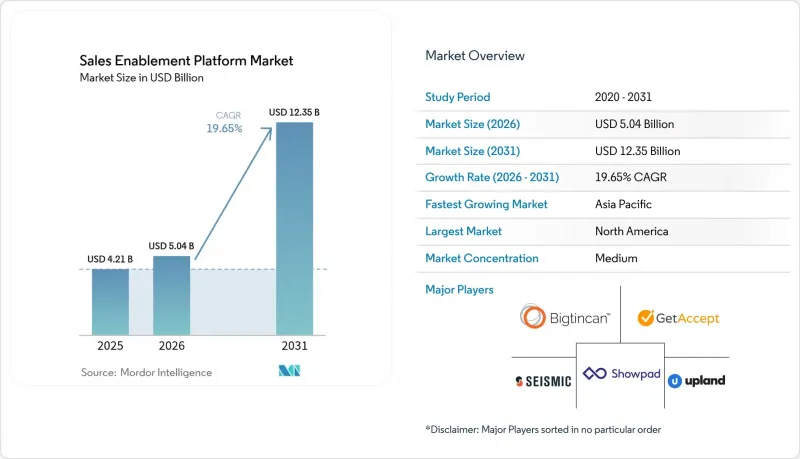
This report is Segmented by Component (Platform and Services), Organization Size, Deployment Mode, End-User (BFSI, Consumer Goods and Retail, and More), Functionality (Content Management, Sales Training and Coaching, and More), and by Geography. The Market Forecasts are Provided in Terms of Value (USD).
Global Sales Enablement Platform Market Trends and Insights
Rapid shift to insight-driven selling workflows
Revenue teams are retiring generic activity metrics and adopting AI insights that map seller actions to deal progress. Platforms ingest clickstream, CRM and conversation data to recommend next-best actions, boosting pipeline generation by 15% and seller efficiency by 33% for Docket AI clients. Adoption is strongest in technology, BFSI and professional-services firms where buyers demand data-grounded value propositions.
Surge in hybrid/remote sales teams post-COVID
Permanent hybrid models heighten demand for asynchronous enablement that spans time zones and devices. Platforms now embed micro-learning, role-based content tips and short video coaching that sellers can access on demand. Spekit deepened its "just-in-time enablement" play by acquiring Cquence to surface CRM-extracted insights mid-call. Flexible training reduces ramp time without sacrificing compliance tracking.
Budget compression amid SaaS rationalization
CFOs scrutinize software portfolios as SaaS inflation climbs to 11.3%. Vertice finds 45.7% of paid licenses idle, compelling finance teams to demand clear ROI before renewal. Enablement vendors now lead with revenue attribution dashboards showing lift in win-rates and cycle times.
Other drivers and restraints analyzed in the detailed report include:
- Integration of AI copilots and Gen-AI content automation
- Fragmented CRM and CMS ecosystems hamper data quality
For complete list of drivers and restraints, kindly check the Table Of Contents.
Segment Analysis
Platform software held 67.42% of the sales enablement platform market in 2025, reflecting enterprise preference for unified suites that embed content, engagement and analytics in one interface. Services revenue is growing at a 24.2% CAGR as organizations seek expertise in AI model tuning, workflow redesign and change management. Vendors increasingly bundle advisory retainers for continuous optimization, converting one-off projects into subscription-like annuities. This shift widens total contract value and deepens customer lock-in.
The services segment benefits from the complexity of generative-AI deployments that require careful prompt engineering, domain-specific model fine-tuning and ethical-use policies. Specialist partners now train client administrators on governing hallucination risk and interpreting model outputs. As a result, enterprises allocate larger enablement budgets to professional services, driving cross-sell opportunities for platform vendors and systems integrators.
Large enterprises account for 58.31% of revenue owing to complex multi-product sales motions that benefit most from AI analytics. SMEs, however, are the fastest-growing buyers at a 26.6% CAGR as subscription pricing removes historical CAPEX barriers. Tata Steel's 2,000-seller rollout of BigSpring's multilingual learning hub illustrates scale adoption beyond Fortune 500 boundaries.
SMEs favour vendor UX simplicity, rapid onboarding and pre-built integrations that reduce administrative overhead. Vendors that package "click-to-deploy" playbooks and offer outcome-based pricing win share among growth-stage tech startups and mid-market manufacturers that want enterprise-grade features without heavy IT lift. The momentum of SMEs will gradually dilute large-enterprise share, although absolute spend remains skewed toward global conglomerates.
Complete Report Scope:
- By Component
- Platform
- Services
- By Organization Size
- Large Enterprises
- Small and Medium-sized Enterprises
- By Deployment Mode
- Cloud-based
- On-premises
- By End-user Industry
- BFSI
- Consumer Goods and Retail
- IT and Telecom
- Media and Entertainment
- Healthcare and Life Sciences
- Manufacturing
- Others (Energy, Public Sector, etc.)
- By Functionality
- Content Management
- Sales Training and Coaching
- Analytics and Reporting
- Guided-Selling/Playbooks
- By Geography
- North America
- United States
- Canada
- Mexico
- Europe
- United Kingdom
- Germany
- France
- Italy
- Rest of Europe
- Asia-Pacific
- China
- Japan
- India
- South Korea
- Rest of Asia-Pacific
- Middle East
- Israel
- Saudi Arabia
- United Arab Emirates
- Turkey
- Rest of Middle East
- Africa
- South Africa
- Egypt
- Rest of Africa
- South America
- Brazil
- Argentina
- Rest of South America
- North America
Geography Analysis
North America generated 42.70% of global revenue in 2025 as multibillion-dollar enterprises prioritized AI-powered enablement to sustain quota attainment. Seismic alone counts 85 million-dollar-plus ARR customers in the region, highlighting the scale of deployments. Cloud maturity, venture-capital funding and early enterprise appetite for generative AI maintain North America's lead.
Asia-Pacific is the fastest-growing region at 21.8% CAGR through 2031, propelled by government incentives for digital transformation, surging cloud spend and abundant green-field SME demand. Tata Steel's multilingual enablement initiative underscores regional innovation in scaling training across diverse languages and time zones. India and Southeast Asia, in particular, leapfrog legacy tooling by adopting mobile-first, cloud-native platforms.
Europe's trajectory is shaped by stringent privacy regulations and emerging labour laws such as the right-to-disconnect, which drive uptake of asynchronous enablement. Vendors that offer granular data-sovereignty controls and localized language support gain advantage. Meanwhile, Latin America, the Middle East and Africa contribute smaller shares today but present long-term upside as multinationals expand and regional champions modernize sales operations.
- Seismic Software Inc.
- Highspot Inc.
- Bigtincan Holdings Ltd.
- Showpad NV
- Salesloft Inc.
- Outreach Corp.
- MindTickle Inc.
- GetAccept Inc.
- Upland Software Inc. (Altify)
- Mediafly Inc.
- ClearSlide (Corel Corp.)
- Accent Technologies Inc.
- Allego Inc.
- Quark Software Inc.
- Pitcher AG
- DocSend Inc. (Dropbox)
- Qstream Inc.
- Rallyware Inc.
- Enable.us Inc.
- Showell Oy
Additional Benefits:
- The market estimate (ME) sheet in Excel format
- 3 months of analyst support
TABLE OF CONTENTS
1 INTRODUCTION
- 1.1 Study Assumptions and Market Definition
- 1.2 Scope of the Study
2 RESEARCH METHODOLOGY
3 EXECUTIVE SUMMARY
4 MARKET LANDSCAPE
- 4.1 Market Overview
- 4.2 Market Drivers
- 4.2.1 Mainstream Rapid shift to insight-driven selling workflows
- 4.2.2 Mainstream Surge in hybrid/remote sales teams post-COVID
- 4.2.3 Mainstream Integration of AI copilots and Gen-AI content automation
- 4.2.4 Mainstream Vendor consolidation across martech and salestech stacks
- 4.2.5 Under-the-radar ISO/IEC 42001 AI-management standard de-risks adoption
- 4.2.6 Under-the-radar EU Right-to-disconnect laws amplify need for asynchronous seller enablement
- 4.3 Market Restraints
- 4.3.1 Mainstream Budget compression amid SaaS rationalization
- 4.3.2 Mainstream Fragmented CRM and CMS ecosystems hamper data quality
- 4.3.3 Under-the-radar Rising Gen-AI hallucination risk triggers stricter IT governance
- 4.3.4 Under-the-radar Seller resistance to in-workflow micro-coaching alerts
- 4.4 Value / Supply-Chain Analysis
- 4.5 Regulatory Landscape
- 4.6 Technological Outlook
- 4.7 Porter's Five Forces Analysis
- 4.7.1 Threat of New Entrants
- 4.7.2 Bargaining Power of Suppliers
- 4.7.3 Bargaining Power of Buyers
- 4.7.4 Threat of Substitutes
- 4.7.5 Rivalry Among Existing Competitors
- 4.8 Key Performance Indicators (KPIs)
5 MARKET SIZE AND GROWTH FORECASTS (VALUE)
- 5.1 By Component
- 5.1.1 Platform
- 5.1.2 Services
- 5.2 By Organization Size
- 5.2.1 Large Enterprises
- 5.2.2 Small and Medium-sized Enterprises
- 5.3 By Deployment Mode
- 5.3.1 Cloud-based
- 5.3.2 On-premises
- 5.4 By End-user Industry
- 5.4.1 BFSI
- 5.4.2 Consumer Goods and Retail
- 5.4.3 IT and Telecom
- 5.4.4 Media and Entertainment
- 5.4.5 Healthcare and Life Sciences
- 5.4.6 Manufacturing
- 5.4.7 Others (Energy, Public Sector, etc.)
- 5.5 By Functionality
- 5.5.1 Content Management
- 5.5.2 Sales Training and Coaching
- 5.5.3 Analytics and Reporting
- 5.5.4 Guided-Selling/Playbooks
- 5.6 By Geography
- 5.6.1 North America
- 5.6.1.1 United States
- 5.6.1.2 Canada
- 5.6.1.3 Mexico
- 5.6.2 Europe
- 5.6.2.1 United Kingdom
- 5.6.2.2 Germany
- 5.6.2.3 France
- 5.6.2.4 Italy
- 5.6.2.5 Rest of Europe
- 5.6.3 Asia-Pacific
- 5.6.3.1 China
- 5.6.3.2 Japan
- 5.6.3.3 India
- 5.6.3.4 South Korea
- 5.6.3.5 Rest of Asia-Pacific
- 5.6.4 Middle East
- 5.6.4.1 Israel
- 5.6.4.2 Saudi Arabia
- 5.6.4.3 United Arab Emirates
- 5.6.4.4 Turkey
- 5.6.4.5 Rest of Middle East
- 5.6.5 Africa
- 5.6.5.1 South Africa
- 5.6.5.2 Egypt
- 5.6.5.3 Rest of Africa
- 5.6.6 South America
- 5.6.6.1 Brazil
- 5.6.6.2 Argentina
- 5.6.6.3 Rest of South America
- 5.6.1 North America
6 COMPETITIVE LANDSCAPE
- 6.1 Market Concentration
- 6.2 Strategic Moves
- 6.3 Market Share Analysis
- 6.4 Company Profiles (includes Global level Overview, Market level overview, Core Segments, Financials as available, Strategic Information, Market Rank/Share for key companies, Products and Services, and Recent Developments)
- 6.4.1 Seismic Software Inc.
- 6.4.2 Highspot Inc.
- 6.4.3 Bigtincan Holdings Ltd.
- 6.4.4 Showpad NV
- 6.4.5 Salesloft Inc.
- 6.4.6 Outreach Corp.
- 6.4.7 MindTickle Inc.
- 6.4.8 GetAccept Inc.
- 6.4.9 Upland Software Inc. (Altify)
- 6.4.10 Mediafly Inc.
- 6.4.11 ClearSlide (Corel Corp.)
- 6.4.12 Accent Technologies Inc.
- 6.4.13 Allego Inc.
- 6.4.14 Quark Software Inc.
- 6.4.15 Pitcher AG
- 6.4.16 DocSend Inc. (Dropbox)
- 6.4.17 Qstream Inc.
- 6.4.18 Rallyware Inc.
- 6.4.19 Enable.us Inc.
- 6.4.20 Showell Oy
7 MARKET OPPORTUNITIES AND FUTURE OUTLOOK
- 7.1 White-space and Unmet-Need Assessment

