PUBLISHER: Mordor Intelligence | PRODUCT CODE: 2124170

PUBLISHER: Mordor Intelligence | PRODUCT CODE: 2124170
Chip Antenna - Market Share Analysis, Industry Trends & Statistics, Growth Forecasts (2026 - 2031)
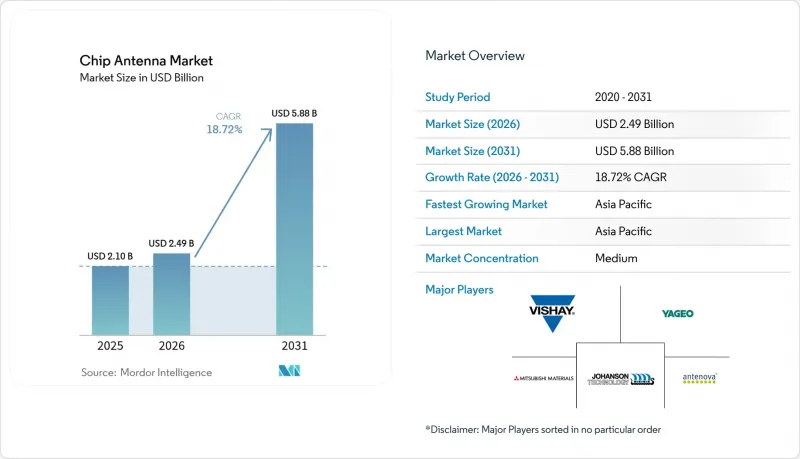
According to Mordor Intelligence, the chip antenna market size was valued at USD 2.10 billion in 2025 and estimated to grow from USD 2.49 billion in 2026 to reach USD 5.88 billion by 2031, at a CAGR of 18.72% during the forecast period (2026-2031).
This report is Segmented by Type ( LTCC [Low-Temperature Co-Fired Ceramic] Chip Antenna, Dielectric Chip Antenna, and Printed PCB-Embedded Chip Antenna), Application (WLAN/Wi-Fi, Bluetooth/BLE, Dual-Band/Multi-Band, GPS/GNSS, and LPWAN [NB-IoT, Lora, Sigfox]), End-User Industry (Automotive, Consumer Electronics, Healthcare and Medical Devices, IT and Telecommunications Infrastructure, and More), and Geography.
Global Chip Antenna Market Trends and Insights
Bluetooth-LE design wins for wearables in OEM clusters
Bluetooth Low Energy has become the de facto protocol for smart watches, fitness sensors, and emerging medical wearables. Tier-one OEMs have started standardizing antenna layouts across multiple product families, enabling economy-of-scale procurement and faster platform refresh cycles. Nordic Semiconductor's nRF54L series underscores the trend with a higher-efficiency radio and reference layout optimized for chip antennas. Annual Bluetooth LE device shipments exceeded 1.8 billion in 2024, a figure that keeps antenna suppliers on an upward capacity trajectory. The design convergence is spreading into industrial and medical categories where reliability, biocompatibility, and firmware-over-air updates add further performance requirements. Consequently, vendors are investing in tunable impedance networks and high-dielectric ceramics to balance size with efficiency.
LTCC antennas adopted in-cabin ADAS radar modules
Automakers increasingly embed radar units behind headliners and dashboards to monitor occupants. These locations demand antennas that withstand heat cycles and deliver stable gain at 76-81 GHz. LTCC substrates meet both needs through low loss tangent and dimensional stability. Johanson Technology's directional RHCP antenna combines AEC-Q200 qualification with a slim profile that resists detuning from plastic trim. Parallel R&D alliances, such as Indie Semiconductor with GlobalFoundries, target 77 GHz and 120 GHz radar SoCs that call for equally precise antenna arrays. These moves elevate chip antennas from discretionary items to safety-critical components governed by automotive PPAP and ISO 26262 workflows.
Efficiency gap vs. custom PCB/FPC antennas in mmWave AR glasses
Augmented-reality eyewear streams multi-gigabit data over 24 GHz and higher bands. Custom copper traces etched into curved FPCs still outperform discrete chip antennas by up to 2 dB in total radiated power, a gap that directly impacts battery life and graphics latency. Research into transparent slot-loop antennas etched on metal-mesh films shows promise, but mass adoption remains limited due to higher bill-of-materials costs and fragile substrates. Consequently, premium AR/VR brands continue to specify tailored feed structures, sidelining off-the-shelf chip antennas in this niche.
Other drivers and restraints analyzed in the detailed report include:
- Wi-Fi 6E reference designs mandate chip antennas in smart appliances
- Private 5G industrial networks driving sub-6 GHz sensor demand
- U.S. fractal-geometry IP litigation disrupting supply-chain diversification
For complete list of drivers and restraints, kindly check the Table Of Contents.
Segment Analysis
LTCC antennas held 57.35% of the chip antenna market share in 2025 due to their ability to operate at millimeter-wave frequencies with minimal performance drift under wide temperature swings. This dominance is reinforced by rising adoption in automotive radar modules that must endure up to +105 °C profiles on cabin roofs. Printed dielectric antennas trail in volume but post the fastest growth, riding a 19.86% CAGR as materials science innovations squeeze higher Q-factors into thinner substrates.
Demand is further bolstered by smartphone OEMs that value LTCC's co-fired multilayer capability, allowing integration of filtering and matching networks inside the same ceramic block. Conversely, PCB-embedded antennas remain an attractive choice for cost-sensitive IoT gateways where performance tolerances are broad and unit counts run into millions. Continuous miniaturization funnels R&D dollars into ultra-short monopole geometries, aiding penetration in medical capsules that require 2.4 GHz telemetry yet measure under 10 mm.
Complete Report Scope:
- By Type
- LTCC (Low-Temperature Co-fired Ceramic) Chip Antenna
- Dielectric Chip Antenna
- Printed PCB-Embedded Chip Antenna
- By Application
- WLAN/Wi-Fi
- Bluetooth/BLE
- Dual-Band/Multi-Band
- GPS/GNSS
- LPWAN (NB-IoT, LoRa, Sigfox)
- By End-User Industry
- Automotive
- Consumer Electronics
- Healthcare and Medical Devices
- IT and Telecommunications Infrastructure
- Industrial and Retail IoT
- Smart Grid and Smart Home
- By Geography
- North America
- United States
- Canada
- Mexico
- South America
- Brazil
- Argentina
- Rest of South America
- Europe
- Germany
- France
- United Kingdom
- Italy
- Spain
- Nordics
- Rest of Europe
- Middle East
- GCC
- Israel
- Turkey
- Rest of Middle East
- Africa
- South Africa
- Nigeria
- Rest of Africa
- Asia-Pacific
- China
- Japan
- South Korea
- India
- ASEAN
- Rest of Asia-Pacific
- North America
Geography Analysis
Asia Pacific controls 45.60% of the chip antenna market revenue and is expanding at a forecast 19.48% CAGR through 2031. China deploys more than 2.3 million 5G base stations, sustaining a high-volume procurement pipeline for small-form antennas used in CPE routers and UE modules. Japan's precision-manufacturing heritage positions local suppliers at the premium end of LTCC, cementing supply lines to tier-one automotive clients. South Korean conglomerates leverage in-house capabilities to embed custom multi-band antennas into smartphones and home appliances, reinforcing domestic vertical integration.
North America ranks second as telecom carriers refarm mid-band spectrum and EV makers push data-rich platforms that require robust sub-6 GHz links. The CHIPS and Science Act stimulates domestic substrate and packaging capacity, indirectly supporting antenna production in Arizona and Texas. Demand from defense and aerospace primes further incremental gains because SATCOM terminals and low-earth-orbit user equipment rely on phased arrays with ceramic feed networks.
Europe trails closely, anchored by Germany's automotive sector and the EU's strict EMC regulations that favor higher-quality dielectric solutions. The European Chips Act seeks to replicate parts of Asia's supply chain, providing funding that could catalyze regional antenna fabrication over the next five years. Regulatory harmonization across L-band GNSS and 6-GHz Wi-Fi also influences antenna tuning priorities for products intended for continental markets.
- Vishay Intertechnology Inc.
- Yageo Corporation
- Johanson Technology Inc.
- Fractus S.A.
- Antenova Ltd.
- Partron Co., Ltd.
- Inpaq Technology Co., Ltd.
- Mitsubishi Materials Corporation
- Taoglas Limited
- Fractus Antennas S.L.
- Murata Manufacturing Co., Ltd.
- KYOCERA AVX Components Corporation
- Molex LLC
- Linx Technologies Inc.
- Pulse Electronics Corp.
- TE Connectivity Ltd.
- Laird Connectivity
- Abracon LLC
- Amphenol Antcom
- Alps Alpine Co., Ltd.
Additional Benefits:
- The market estimate (ME) sheet in Excel format
- 3 months of analyst support
TABLE OF CONTENTS
1 INTRODUCTION
- 1.1 Study Assumptions and Market Definition
- 1.2 Scope of the Study
2 RESEARCH METHODOLOGY
3 EXECUTIVE SUMMARY
4 MARKET LANDSCAPE
- 4.1 Market Overview
- 4.2 Market Drivers
- 4.2.1 Bluetooth-LE design wins for wearables in OEM clusters
- 4.2.2 LTCC antennas adopted in-cabin ADAS radar modules
- 4.2.3 Wi-Fi 6E reference designs mandate chip antennas in smart appliances
- 4.2.4 Private-5G industrial networks driving sub-6 GHz sensor demand
- 4.3 Market Restraints
- 4.3.1 Efficiency gap vs. custom PCB/FPC antennas in mmWave AR glasses
- 4.3.2 U.S. fractal-geometry IP litigation disrupting supply-chain diversification
- 4.3.3 Multi-radio coexistence detuning in ultra-compact wearables
- 4.4 Value/Supply-Chain Analysis
- 4.5 Regulatory Outlook
- 4.6 Technological Outlook
- 4.7 Porter's Five Forces Analysis
- 4.7.1 Threat of New Entrants
- 4.7.2 Bargaining Power of Buyers
- 4.7.3 Bargaining Power of Suppliers
- 4.7.4 Threat of Substitute Products
- 4.7.5 Intensity of Competitive Rivalry
5 MARKET SIZE AND GROWTH FORECASTS (VALUE)
- 5.1 By Type
- 5.1.1 LTCC (Low-Temperature Co-fired Ceramic) Chip Antenna
- 5.1.2 Dielectric Chip Antenna
- 5.1.3 Printed PCB-Embedded Chip Antenna
- 5.2 By Application
- 5.2.1 WLAN/Wi-Fi
- 5.2.2 Bluetooth/BLE
- 5.2.3 Dual-Band/Multi-Band
- 5.2.4 GPS/GNSS
- 5.2.5 LPWAN (NB-IoT, LoRa, Sigfox)
- 5.3 By End-User Industry
- 5.3.1 Automotive
- 5.3.2 Consumer Electronics
- 5.3.3 Healthcare and Medical Devices
- 5.3.4 IT and Telecommunications Infrastructure
- 5.3.5 Industrial and Retail IoT
- 5.3.6 Smart Grid and Smart Home
- 5.4 By Geography
- 5.4.1 North America
- 5.4.1.1 United States
- 5.4.1.2 Canada
- 5.4.1.3 Mexico
- 5.4.2 South America
- 5.4.2.1 Brazil
- 5.4.2.2 Argentina
- 5.4.2.3 Rest of South America
- 5.4.3 Europe
- 5.4.3.1 Germany
- 5.4.3.2 France
- 5.4.3.3 United Kingdom
- 5.4.3.4 Italy
- 5.4.3.5 Spain
- 5.4.3.6 Nordics
- 5.4.3.7 Rest of Europe
- 5.4.4 Middle East
- 5.4.4.1 GCC
- 5.4.4.2 Israel
- 5.4.4.3 Turkey
- 5.4.4.4 Rest of Middle East
- 5.4.5 Africa
- 5.4.5.1 South Africa
- 5.4.5.2 Nigeria
- 5.4.5.3 Rest of Africa
- 5.4.6 Asia-Pacific
- 5.4.6.1 China
- 5.4.6.2 Japan
- 5.4.6.3 South Korea
- 5.4.6.4 India
- 5.4.6.5 ASEAN
- 5.4.6.6 Rest of Asia-Pacific
- 5.4.1 North America
6 COMPETITIVE LANDSCAPE
- 6.1 Market Concentration
- 6.2 Strategic Moves
- 6.3 Market Share Analysis
- 6.4 Company Profiles (includes Global level Overview, Market level overview, Core Segments, Financials as available, Strategic Information, Market Rank/Share for key companies, Products and Services, and Recent Developments)
- 6.4.1 Vishay Intertechnology Inc.
- 6.4.2 Yageo Corporation
- 6.4.3 Johanson Technology Inc.
- 6.4.4 Fractus S.A.
- 6.4.5 Antenova Ltd.
- 6.4.6 Partron Co., Ltd.
- 6.4.7 Inpaq Technology Co., Ltd.
- 6.4.8 Mitsubishi Materials Corporation
- 6.4.9 Taoglas Limited
- 6.4.10 Fractus Antennas S.L.
- 6.4.11 Murata Manufacturing Co., Ltd.
- 6.4.12 KYOCERA AVX Components Corporation
- 6.4.13 Molex LLC
- 6.4.14 Linx Technologies Inc.
- 6.4.15 Pulse Electronics Corp.
- 6.4.16 TE Connectivity Ltd.
- 6.4.17 Laird Connectivity
- 6.4.18 Abracon LLC
- 6.4.19 Amphenol Antcom
- 6.4.20 Alps Alpine Co., Ltd.
7 MARKET OPPORTUNITIES AND FUTURE OUTLOOK
- 7.1 White-space and Unmet-Need Assessment

