PUBLISHER: Mordor Intelligence | PRODUCT CODE: 2124171

PUBLISHER: Mordor Intelligence | PRODUCT CODE: 2124171
Magneto-resistive RAM (MRAM) - Market Share Analysis, Industry Trends & Statistics, Growth Forecasts (2026 - 2031)
According to Mordor Intelligence, the magneto-resistive RAM (MRAM) market size stands at USD 4.43 billion in 2026 and is projected to reach USD 18.24 billion by 2031, expanding at a 32.72% CAGR over the forecast period.
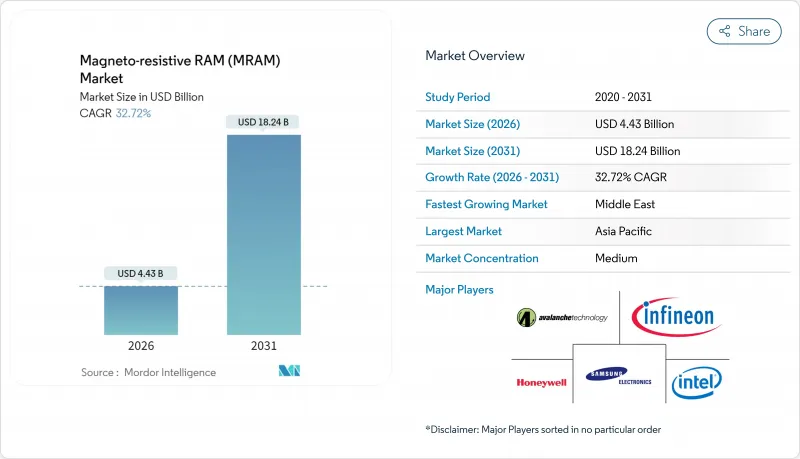
This report is Segmented by Type (Toggle MRAM, Spin-Transfer Torque MRAM, and More), Offering (Stand-Alone, Embedded, and More), Technology Node (<=28 Nm, 28-40 Nm, and More), Memory Density (Less Than 256 Kbit, 256 Kbit-1 Mbit, and More), Application (Consumer Electronics, Industrial Automation and Robotics, and More), and Geography. The Market Forecasts are Provided in Terms of Value (USD).
Global Magneto-resistive RAM (MRAM) Market Trends and Insights
Proliferation Of IoT and Edge Devices
Industrial automation, smart metering, and wearable health monitors now embed local processing to cut latency and protect data privacy. Octal-interface Magneto-resistive RAM (MRAM) parts deliver 400 MB/s throughput, replacing battery-backed SRAM and eliminating supercapacitors. Microcontroller makers cite 90% lower standby power versus flash, enabling five-year battery life for condition-monitoring sensors. High endurance means designers no longer provision wear-levelling firmware, saving precious ROM space. As component footprints shrink, more edge boards adopt MRAM arrays that share the supply rail with logic blocks, removing board-level voltage translators and trimming bill-of-materials cost.
Rising Adoption in Automotive Functional-Safety Systems
Powertrain and ADAS controllers must retain calibration data across ignition cycles without latency or wear-levelling overhead. Embedded MRAM in 16 nm FinFET microcontrollers supports ISO 26262 ASIL-D safety targets while operating from -40 °C to +125 °C. Unlimited write endurance avoids field failures that could trigger costly recalls. Electric-vehicle battery-management units write state-of-charge logs thousands of times per second, a duty cycle traditional flash cannot sustain. With automotive semiconductors moving to 22 nm and below, MRAM cells scale in lockstep, delivering multi-megabit densities within tightly constrained die areas.
High Fabrication Cost Of Perpendicular MTJ Process
Perpendicular magnetic tunnel junction stacks add up to 40 back-end-of-line steps, including ion-beam milling and ultra-high-vacuum MgO deposition. Tool sets cost millions of U.S. dollars and demand sub-angstrom surface control, pushing wafer-level costs to roughly twice that of embedded flash at comparable nodes. Only a handful of foundries have qualified these modules, limiting supply and keeping average selling prices elevated. Until equipment suppliers widen availability and second-source capacity emerges, OEMs remain cautious about single-sourcing critical memory.
Other drivers and restraints analyzed in the detailed report include:
- Miniaturization In Consumer Electronics
- On-Chip NVM Scratchpads For AI Accelerators
- Competition From Alternative NVM Technologies
For complete list of drivers and restraints, kindly check the Table Of Contents.
Segment Analysis
Spin-transfer torque devices captured 62.66% Magneto-resistive RAM (MRAM) market share in 2025 on the strength of qualified 22 nm and 28 nm flows that meet automotive and industrial reliability standards. Toggle MRAM persists in extreme-temperature systems, such as oil-field sensors, because its in-plane geometry tolerates 200 °C excursions. Voltage-controlled switching reduces write current by roughly 50%, a critical win for edge AI accelerators, and is forecast to clock a 33.21% CAGR through 2031. Spin-orbit torque remains in the research domain, but its decoupled read-write paths suggest write endurance exceeding 1015 cycles, positioning it as a long-term successor.
Adoption momentum proves two-tiered. Mainstream controllers favour mature STT-MRAM for near-term programs, whereas AI startups engage with research fabs to prototype voltage-controlled arrays that slash energy per inference. Industry roadmaps show pilot VC-MRAM lines at 14 nm by 2028. If yield ramps on schedule, the MRAM market could migrate to this topology for high-volume consumer processors, reinforcing the technology's twice-per-decade architecture refresh cadence.
Embedded variants accounted for 62.00% share of Magneto-resistive RAM (MRAM) market in 2025 because they integrate directly into logic wafers, eliminating external packages and boosting system reliability. Stand-alone serial parts still serve industrial retrofit boards that need a pin-compatible replacement for parallel SRAM. The MRAM market size for IP cores and design services, however, is projected to expand at a 33.83% CAGR, reflecting fabless demand to license hardened memory macros without owning masks. Controller IP firms bundle error-correction engines that mitigate bit-error-rate drift at sub-28 nm, easing qualification for automotive ASIL-D targets.
As more OEMs embrace chiplets and heterogeneous integration, MRAM macro IP can be dropped into a reticle on advanced interposers, shortening design cycles. Vendors thus pivot from component revenue toward annuity-style royalties, mirroring the shift ARM catalysed in CPU cores. This structural change underpins healthier gross margins despite falling per-bit prices in commodity densities.
Complete Report Scope:
- By Type
- Toggle MRAM
- Spin-Transfer Torque MRAM
- Voltage-Controlled MRAM
- Spin-Orbit Torque MRAM
- By Offering
- Stand-Alone
- Embedded
- IP Cores, Design Services
- By Technology Node
- Less than equal to 28 nm
- 28-40 nm
- 40-65 nm
- Greater than 65 nm
- By Memory Density
- Less than 256 Kbit
- 256 Kbit-1 Mbit
- 1-16 Mbit
- Greater than 16 Mbit
- By Application
- Consumer Electronics
- Industrial Automation and Robotics
- Enterprise Storage
- Automotive Electronics
- Aerospace and Defense
- Healthcare Devices
- IoT and Edge Computing Devices
- Smart Card and RFID
- By Geography
- North America
- United States
- Canada
- Mexico
- Europe
- United Kingdom
- Germany
- France
- Italy
- Rest of Europe
- Asia-Pacific
- China
- Japan
- India
- South Korea
- Rest of Asia
- Middle East
- Israel
- Saudi Arabia
- United Arab Emirates
- Turkey
- Rest of Middle East
- Africa
- South Africa
- Egypt
- Rest of Africa
- South America
- Brazil
- Argentina
- Rest of South America
- North America
Geography Analysis
Asia-Pacific generated 48.00% of Magneto-resistive RAM (MRAM) market revenue in 2025, reflecting deep foundry capacity in Taiwan and South Korea and surging automotive semiconductor demand in China. Government incentives, such as South Korea's USD 27 million program that funds 48 memory projects, accelerate process tweaks and mask re-spins. Japan's collaboration between a leading university and a regional foundry brings pilot production of voltage-controlled MRAM on-shore, reinforcing supply-chain resilience amid geopolitical uncertainty.
The Middle East is projected to post the highest regional CAGR at 34.52% between 2026-2031. Israel's vibrant fabless cluster anchors design talent, while Gulf nations channel sovereign funds into semiconductor parks that court memory startups. Defense-grade requirements for satellite constellations dovetail with MRAM's radiation tolerance, creating sticky demand even as cost curves improve.
North America remains pivotal for aerospace and data-center deployments. Arizona-based manufacturers logged double-digit revenue growth in 2025 from space-qualified parts, and the United States federal programs subsidize low-Earth-orbit component testing. Europe leverages its automotive supply chain in Germany and advanced R&D hubs in Belgium to pilot perpendicular MTJ stacks below 20 nm. Both regions jointly ensure that global sourcing of MRAM devices spans at least three continents, mitigating single region supply shocks.
- Avalanche Technology, Inc.
- Everspin Technologies, Inc.
- Samsung Electronics Co., Ltd.
- Intel Corporation
- NVE Corporation
- Qualcomm Incorporated
- Crocus Technology Inc.
- Honeywell International Inc.
- Tower Semiconductor Ltd.
- HFC Semiconductor (Wuxi) Co., Ltd.
- Spin Memory, Inc.
- Numem, Inc.
- GlobalFoundries Inc.
- Taiwan Semiconductor Manufacturing Company Limited
- STMicroelectronics N.V.
- Renesas Electronics Corporation
- International Business Machines Corporation
- SkyWater Technology, Inc.
- Fujitsu Limited
- NXP Semiconductors N.V.
Additional Benefits:
- The market estimate (ME) sheet in Excel format
- 3 months of analyst support
TABLE OF CONTENTS
1 INTRODUCTION
- 1.1 Study Assumptions and Market Definition
- 1.2 Scope of the Study
2 RESEARCH METHODOLOGY
3 EXECUTIVE SUMMARY
4 MARKET LANDSCAPE
- 4.1 Market Overview
- 4.2 Market Drivers
- 4.2.1 Proliferation of IoT and Edge Devices
- 4.2.2 Rising Adoption in Automotive Functional-Safety Systems
- 4.2.3 Increasing Miniaturization in Consumer Electronics
- 4.2.4 Deployment as Storage Class Memory in Data Centers
- 4.2.5 Defense-Grade Radiation Hardness for Satellite Edge Computing
- 4.2.6 On-Chip NVM Scratchpads for AI Accelerators
- 4.3 Market Restraints
- 4.3.1 High Fabrication Cost of Perpendicular MTJ Process
- 4.3.2 Competition from Alternative NVM Technologies
- 4.3.3 Yield Variability at Sub-28 nm Nodes
- 4.3.4 Tooling Supply-Chain Bottlenecks
- 4.4 Industry Value Chain Analysis
- 4.5 Regulatory Landscape
- 4.6 Technological Outlook
- 4.7 Impact of Macroeconomic Factors on the Market
- 4.8 Porter's Five Forces Analysis
- 4.8.1 Threat of New Entrants
- 4.8.2 Bargaining Power of Consumers
- 4.8.3 Bargaining Power of Suppliers
- 4.8.4 Threat of Substitute Products
- 4.8.5 Intensity of Competitive Rivalry
5 MARKET SIZE AND GROWTH FORECASTS (VALUE)
- 5.1 By Type
- 5.1.1 Toggle MRAM
- 5.1.2 Spin-Transfer Torque MRAM
- 5.1.3 Voltage-Controlled MRAM
- 5.1.4 Spin-Orbit Torque MRAM
- 5.2 By Offering
- 5.2.1 Stand-Alone
- 5.2.2 Embedded
- 5.2.3 IP Cores, Design Services
- 5.3 By Technology Node
- 5.3.1 Less than equal to 28 nm
- 5.3.2 28-40 nm
- 5.3.3 40-65 nm
- 5.3.4 Greater than 65 nm
- 5.4 By Memory Density
- 5.4.1 Less than 256 Kbit
- 5.4.2 256 Kbit-1 Mbit
- 5.4.3 1-16 Mbit
- 5.4.4 Greater than 16 Mbit
- 5.5 By Application
- 5.5.1 Consumer Electronics
- 5.5.2 Industrial Automation and Robotics
- 5.5.3 Enterprise Storage
- 5.5.4 Automotive Electronics
- 5.5.5 Aerospace and Defense
- 5.5.6 Healthcare Devices
- 5.5.7 IoT and Edge Computing Devices
- 5.5.8 Smart Card and RFID
- 5.6 By Geography
- 5.6.1 North America
- 5.6.1.1 United States
- 5.6.1.2 Canada
- 5.6.1.3 Mexico
- 5.6.2 Europe
- 5.6.2.1 United Kingdom
- 5.6.2.2 Germany
- 5.6.2.3 France
- 5.6.2.4 Italy
- 5.6.2.5 Rest of Europe
- 5.6.3 Asia-Pacific
- 5.6.3.1 China
- 5.6.3.2 Japan
- 5.6.3.3 India
- 5.6.3.4 South Korea
- 5.6.3.5 Rest of Asia
- 5.6.4 Middle East
- 5.6.4.1 Israel
- 5.6.4.2 Saudi Arabia
- 5.6.4.3 United Arab Emirates
- 5.6.4.4 Turkey
- 5.6.4.5 Rest of Middle East
- 5.6.5 Africa
- 5.6.5.1 South Africa
- 5.6.5.2 Egypt
- 5.6.5.3 Rest of Africa
- 5.6.6 South America
- 5.6.6.1 Brazil
- 5.6.6.2 Argentina
- 5.6.6.3 Rest of South America
- 5.6.1 North America
6 COMPETITIVE LANDSCAPE
- 6.1 Market Concentration
- 6.2 Strategic Moves
- 6.3 Market Share Analysis
- 6.4 Company Profiles (includes Global Level Overview, Market Level Overview, Core Segments, Financials as available, Strategic Information, Market Rank/Share for key companies, Products and Services, and Recent Developments)
- 6.4.1 Avalanche Technology, Inc.
- 6.4.2 Everspin Technologies, Inc.
- 6.4.3 Samsung Electronics Co., Ltd.
- 6.4.4 Intel Corporation
- 6.4.5 NVE Corporation
- 6.4.6 Qualcomm Incorporated
- 6.4.7 Crocus Technology Inc.
- 6.4.8 Honeywell International Inc.
- 6.4.9 Tower Semiconductor Ltd.
- 6.4.10 HFC Semiconductor (Wuxi) Co., Ltd.
- 6.4.11 Spin Memory, Inc.
- 6.4.12 Numem, Inc.
- 6.4.13 GlobalFoundries Inc.
- 6.4.14 Taiwan Semiconductor Manufacturing Company Limited
- 6.4.15 STMicroelectronics N.V.
- 6.4.16 Renesas Electronics Corporation
- 6.4.17 International Business Machines Corporation
- 6.4.18 SkyWater Technology, Inc.
- 6.4.19 Fujitsu Limited
- 6.4.20 NXP Semiconductors N.V.
7 MARKET OPPORTUNITIES AND FUTURE OUTLOOK
- 7.1 White-Space and Unmet-Need Assessment

