PUBLISHER: Mordor Intelligence | PRODUCT CODE: 2124175

PUBLISHER: Mordor Intelligence | PRODUCT CODE: 2124175
Rehabilitation Equipment - Market Share Analysis, Industry Trends & Statistics, Growth Forecasts (2026 - 2031)
According to Mordor Intelligence, the rehabilitation equipment market size expanded to USD 18.86 billion in 2025, is estimated to reach USD 20.16 billion in 2026, and is projected to grow to USD 28.12 billion by 2031, registering a CAGR of 6.88% between 2026 and 2031.
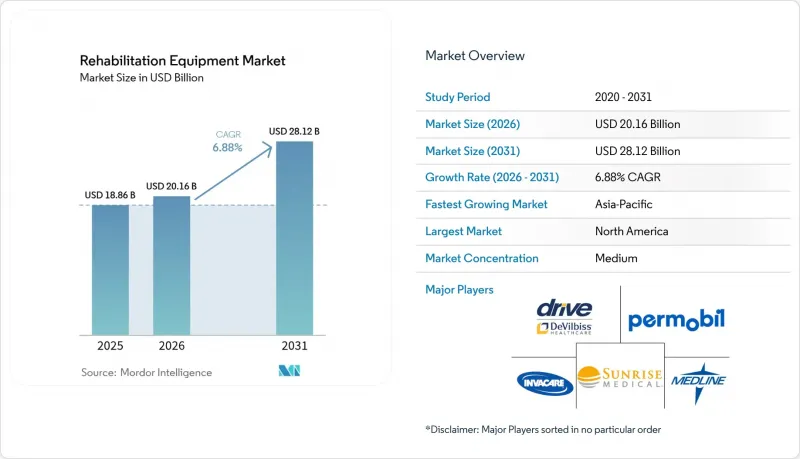
This report is Segmented by Product Type (Daily Living Aids [Medical Beds, and More], Mobility Equipment, Exercise Equipment, and Body Support Devices), Application (Physiotherapy, Occupational Therapy, Neuro-Rehabilitation, and More), End User (Hospitals, and More), and Geography (North America, Europe, Asia-Pacific, and More). The Market Forecasts are Provided in Terms of Value (USD).
Global Rehabilitation Equipment Market Trends and Insights
Rapid Growth of Post-Acute and Chronic-Disease Rehabilitation Demand
Hospitals are discharging patients sooner, shifting recovery workloads onto skilled nursing facilities, outpatient clinics, and homes. Stroke remains a pivotal public health concern, with roughly 795,000 annual events in the United States alone, each requiring months of intensive therapy. Orthopedic cases add volume, as hip and knee replacements climb among aging adults across developed markets. Diabetes, COPD, and heart failure add steady demand, since supervised exercise and education lower mortality by up to 30%. Value-based payment models reward fewer readmissions, pushing providers to adopt equipment that accelerates mobility gains and measures progress. Together, these factors are driving the rehabilitation equipment market toward data-rich devices that demonstrate improved outcomes.
Rising Adoption of AI-Powered and Robotic Exoskeleton Devices
FDA clearances and emerging billing codes are shifting exoskeletons from research labs to clinics. Ekso NR received U.S. clearance in 2024, enabling data-guided gait therapy that improves weight-bearing symmetry. Lifeward reported a 40% increase in hospital uptake for ReStore after Medicare introduced a dedicated G-code reimbursing up to USD 150 per session. Japan widened nursing-care insurance in 2025 to subsidize exoskeleton rentals, reducing caregiver injuries. AI algorithms now adjust resistance in real time, extending therapy sessions while lowering therapist fatigue. As batteries shrink and component prices fall, small centers and even select home programs begin leasing units, widening the footprint of the rehabilitation equipment market.
Other drivers and restraints analyzed in the detailed report include:
- Expansion of Home-Based Tele-Rehabilitation Ecosystems
- Surge in Ambulatory Surgery Centers Driving Portable Device Uptake
- High Upfront and Lifecycle Costs for Advanced Robotic Systems
- Fragmented Reimbursement for Home and Digital Therapies
For complete list of drivers and restraints, kindly check the Table Of Contents.
Segment Analysis
Robotic and smart systems are set to expand at a 12.85% CAGR through 2031, nearly double the overall rehabilitation equipment market. Mobility equipment retained a 37.55% share in 2025, underscoring durable demand for manual and powered wheelchairs. Manual chairs remain volume leaders for short-term needs, while powered variants gain ground as insurers now fund advanced seating that prevents pressure sores. Daily living aids such as smart beds with weight sensors alert caregivers to unassisted exits, lowering fall risk and extending independent living. Exercise equipment is evolving into connected platforms that gamify motion and feed adherence metrics to therapists.
Robotic exoskeletons, gait trainers, and upper-limb robots are shifting momentum. A 2025 meta-analysis recorded 18% greater motor recovery in stroke patients receiving robotic-assisted therapy compared with matched conventional doses. With clinical evidence accumulating, payers are opening dedicated billing codes, positioning robotics to capture a growing share of the rehabilitation equipment market by 2031. Traditional suppliers are responding through joint ventures and acquisitions aimed at embedding AI modules into wheelchairs, lifts, and beds, signaling an era where software usability competes with mechanical durability.
Complete Report Scope:
- By Product Type
- Daily Living Aids
- Medical Beds
- Bathroom & Toilet Assist Devices
- Reading, Writing & Computer Aids
- Other Daily Living Aids
- Mobility Equipment
- Walking Assist Devices
- Manual Wheelchairs
- Powered Wheelchairs & Mobility Scooters
- Exercise Equipment
- Upper-body Exercise Equipment
- Lower-body Exercise Equipment
- Body Support Devices
- Patient Lifts
- Medical Lifting Slings
- Robotic & Smart Rehabilitation Systems
- Daily Living Aids
- By Application
- Physiotherapy
- Occupational Therapy
- Neuro-rehabilitation
- Cardiopulmonary Rehabilitation
- Geriatric Rehabilitation
- By End-User
- Hospitals
- Rehabilitation Centers
- Home-care Settings
- Ambulatory Surgical Centers
- By Geography
- North America
- United States
- Canada
- Mexico
- Europe
- Germany
- United Kingdom
- France
- Italy
- Spain
- Rest of Europe
- Asia-Pacific
- China
- India
- Japan
- Australia
- South Korea
- Rest of Asia-Pacific
- Middle East and Africa
- GCC
- South Africa
- Rest of Middle East and Africa
- South America
- Brazil
- Argentina
- Rest of South America
- North America
Geography Analysis
North America preserved 42.52 of % rehabilitation equipment market share in 2025, led by the United States, where Medicare Advantage enrollment reached 31 million and bundled rehabilitation benefits encourage adoption of powered wheelchairs and connected exercise gear. Canada's provincial formularies fund mobility aids, while its tele-rehabilitation pilots bridge therapist gaps in rural zones. A competitive mix of legacy suppliers and robotics start-ups operates through hospital GPO contracts, home-health agencies, and direct web sales.
Europe exhibits diverse reimbursement climates. Germany updated its Hilfsmittelverzeichnis in 2024 to include exoskeletons, enabling statutory coverage when evidence shows they outperform conventional therapy. The United Kingdom grapples with budget ceilings, favoring lower-cost connected exercise equipment for community rehab teams. France covers up to 100% of device costs depending on severity, stimulating demand for smart beds and adaptive bathrooms. Spain and Italy witness private centers offering VR therapies ahead of public adoption. The Medical Device Regulation's stringent evaluation rules encourage consolidation, nudging small manufacturers toward partnerships.
Asia-Pacific leads in growth at a 9.12% CAGR. China's plan to open 10,000 rehabilitation hospitals by 2030 subsidizes 50-70% of qualifying equipment purchases. Japan's 2025 nursing-care reforms hike payments for robotic lifts to mitigate caregiver strain. India's Production Linked Incentive scheme supports domestic manufacturing, though the market still favors imported mid-range devices. Australia and South Korea exploit high broadband penetration to deploy tele-rehabilitation, while Middle East, Africa, and South America progress steadily through medical tourism and private hospital expansion. Across regions, localized manufacturing incentives and digital-health investments will continue to diversify rehabilitation equipment market demand patterns.
- AlterG Inc.
- Arjo AB
- Baxter, Inc. (Hill-Rom Services Inc.)
- Caremax Rehabilitation Equipment Co. Ltd.
- DJO Global
- Drive DeVilbiss Healthcare
- Dynatronics
- Ekso Bionics
- GF Health Products
- Handicare Group AB
- Hocoma
- Hospital Equipment Manufacturing Company
- Invacare
- Lifeward (Formerly ReWalk Robotics)
- Medline Industries
- Mettler Electronics
- Motus Nova LLC
- Ottobock
- Permobil AB
- Pride Mobility Products
- RECK-Technik GmbH & Co. KG
- Roma Medical Aids Ltd.
- Sunrise Medical
Additional Benefits:
- The market estimate (ME) sheet in Excel format
- 3 months of analyst support
TABLE OF CONTENTS
1 Introduction
- 1.1 Study Assumptions & Market Definition
- 1.2 Scope of the Study
2 Research Methodology
3 Executive Summary
4 Market Landscape
- 4.1 Market Overview
- 4.2 Market Drivers
- 4.2.1 Rapid Growth of Post-Acute and Chronic-Disease Rehabilitation Demand
- 4.2.2 Rising Adoption of AI-Powered and Robotic Exoskeleton Devices
- 4.2.3 Expansion of Home-Based Tele-Rehabilitation Ecosystems
- 4.2.4 Surge in Ambulatory Surgery Centers Driving Portable Device Uptake
- 4.2.5 Integration of VR And Gamified Therapy Boosting Adherence
- 4.3 Market Restraints
- 4.3.1 High Upfront and Lifecycle Costs for Advanced Robotic Systems
- 4.3.2 Fragmented Reimbursement for Home and Digital Therapies
- 4.3.3 Limited Therapist Skill Sets for Multidisciplinary Tech Integration
- 4.3.4 Low Awareness and Access in Rural and Low-Income Areas
- 4.4 Supply-Chain Analysis
- 4.5 Regulatory Landscape
- 4.6 Technological Outlook
- 4.7 Porter's Five Forces
- 4.7.1 Threat of New Entrants
- 4.7.2 Bargaining Power of Buyers
- 4.7.3 Bargaining Power of Suppliers
- 4.7.4 Threat of Substitute Products
- 4.7.5 Intensity of Competitive Rivalry
5 Market Size & Growth Forecasts (Value in USD)
- 5.1 By Product Type
- 5.1.1 Daily Living Aids
- 5.1.1.1 Medical Beds
- 5.1.1.2 Bathroom & Toilet Assist Devices
- 5.1.1.3 Reading, Writing & Computer Aids
- 5.1.1.4 Other Daily Living Aids
- 5.1.2 Mobility Equipment
- 5.1.2.1 Walking Assist Devices
- 5.1.2.2 Manual Wheelchairs
- 5.1.2.3 Powered Wheelchairs & Mobility Scooters
- 5.1.3 Exercise Equipment
- 5.1.3.1 Upper-body Exercise Equipment
- 5.1.3.2 Lower-body Exercise Equipment
- 5.1.4 Body Support Devices
- 5.1.4.1 Patient Lifts
- 5.1.4.2 Medical Lifting Slings
- 5.1.5 Robotic & Smart Rehabilitation Systems
- 5.1.1 Daily Living Aids
- 5.2 By Application
- 5.2.1 Physiotherapy
- 5.2.2 Occupational Therapy
- 5.2.3 Neuro-rehabilitation
- 5.2.4 Cardiopulmonary Rehabilitation
- 5.2.5 Geriatric Rehabilitation
- 5.3 By End-User
- 5.3.1 Hospitals
- 5.3.2 Rehabilitation Centers
- 5.3.3 Home-care Settings
- 5.3.4 Ambulatory Surgical Centers
- 5.4 By Geography
- 5.4.1 North America
- 5.4.1.1 United States
- 5.4.1.2 Canada
- 5.4.1.3 Mexico
- 5.4.2 Europe
- 5.4.2.1 Germany
- 5.4.2.2 United Kingdom
- 5.4.2.3 France
- 5.4.2.4 Italy
- 5.4.2.5 Spain
- 5.4.2.6 Rest of Europe
- 5.4.3 Asia-Pacific
- 5.4.3.1 China
- 5.4.3.2 India
- 5.4.3.3 Japan
- 5.4.3.4 Australia
- 5.4.3.5 South Korea
- 5.4.3.6 Rest of Asia-Pacific
- 5.4.4 Middle East and Africa
- 5.4.4.1 GCC
- 5.4.4.2 South Africa
- 5.4.4.3 Rest of Middle East and Africa
- 5.4.5 South America
- 5.4.5.1 Brazil
- 5.4.5.2 Argentina
- 5.4.5.3 Rest of South America
- 5.4.1 North America
6 Competitive Landscape
- 6.1 Market Concentration
- 6.2 Market Share Analysis
- 6.3 Company Profiles (includes Global level Overview, Market level overview, Core Segments, Financials as available, Strategic Information, Market Rank/Share for key companies, Products & Services, and Recent Developments)
- 6.3.1 AlterG Inc.
- 6.3.2 Arjo AB
- 6.3.3 Baxter, Inc. (Hill-Rom Services Inc.)
- 6.3.4 Caremax Rehabilitation Equipment Co. Ltd.
- 6.3.5 DJO Global (Enovis)
- 6.3.6 Drive DeVilbiss Healthcare
- 6.3.7 Dynatronics Corporation
- 6.3.8 Ekso Bionics Holdings Inc.
- 6.3.9 GF Health Products Inc.
- 6.3.10 Handicare Group AB
- 6.3.11 Hocoma AG
- 6.3.12 Hospital Equipment Manufacturing Company
- 6.3.13 Invacare Corporation
- 6.3.14 Lifeward (Formerly ReWalk Robotics)
- 6.3.15 Medline Industries LP
- 6.3.16 Mettler Electronics Corp.
- 6.3.17 Motus Nova LLC
- 6.3.18 Ottobock SE & Co. KGaA
- 6.3.19 Permobil AB
- 6.3.20 Pride Mobility Products Corp.
- 6.3.21 RECK-Technik GmbH & Co. KG
- 6.3.22 Roma Medical Aids Ltd.
- 6.3.23 Sunrise Medical LLC
7 Market Opportunities & Future Outlook
- 7.1 White-space & Unmet-need Assessment

