PUBLISHER: Mordor Intelligence | PRODUCT CODE: 2124210

PUBLISHER: Mordor Intelligence | PRODUCT CODE: 2124210
Cleanroom Consumables - Market Share Analysis, Industry Trends & Statistics, Growth Forecasts (2026 - 2031)
According to Mordor Intelligence, the cleanroom consumables market size was valued at USD 5.61 billion in 2025 and estimated to grow from USD 6.01 billion in 2026 to reach USD 8.51 billion by 2031, at a CAGR of 7.18% during the forecast period (2026-2031).
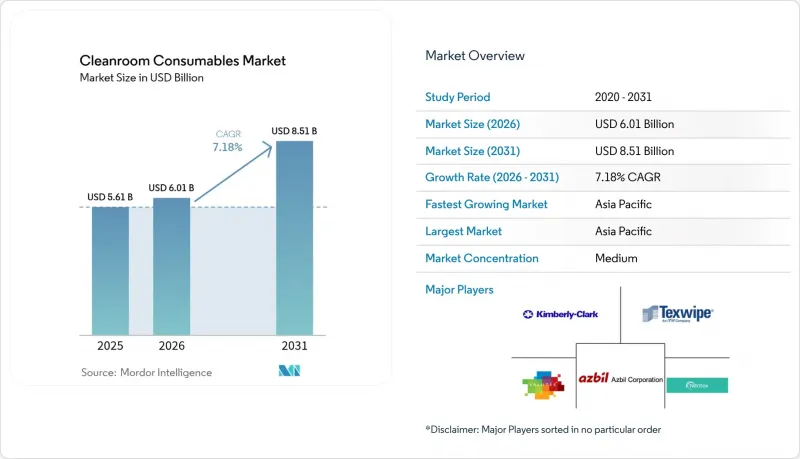
This report is Segmented by Product (Safety Consumables, Cleaning Consumables, and Cleanroom Stationery), Application (Semiconductor and Micro-Electronics, Pharmaceutical and Biotechnology Manufacturing, and More), and Geography (North America, Europe, South America, Asia-Pacific, and Middle East and Africa). Market Forecasts are Provided in Value (USD).
Global Cleanroom Consumables Market Trends and Insights
Semiconductor capacity expansion in Asia driving ultra-low-particulate consumable demand
Global wafer-fab capacity is set to rise 6% in 2024 and 7% in 2025, hitting 33.7 million wafers per month, and advanced 5 nm nodes alone are on track for 13% growth in 2024. Asia-Pacific fabs require ISO Class 1-3 environments, amplifying demand for gloves, garments, and wipes engineered for sub-micron particulate removal. Chinese capacity is forecast to climb 14% by 2025, while Taiwan and South Korea boost leading-edge lines. Memory makers scaling high-bandwidth DRAM for AI workloads reinforce a steady pull for barrier-grade consumables across the cleanroom consumables market.
Stringent EU GMP Annex 1 revisions elevating sterile-grade apparel adoption
The 59-page revision, effective August 2023, mandates contamination-control strategies, zero bioburden in Grade A areas, and wider use of RABS isolators. EU guidance prompts pharmaceutical sites worldwide to upgrade to validated disposable coveralls and aseptic wipes that meet microbial and particulate thresholds, shortening changeover times and easing documentation. Compliance timelines of one to two years have already catalyzed bulk orders for single-use gowns and pre-saturated wipers, reinforcing momentum within the cleanroom consumables market.
Volatility in nitrile and latex raw-material prices impacting glove margins
Nitrile butadiene rubber (NBR) shortages led the U.S. government to issue supply waivers for federal glove purchases, confirming domestic supply gaps lasting until late 2025. Price spikes - Top Glove's average selling price hit USD 70 per 1,000 pieces in 2024 - compress margins for distributors, complicating budgeting for high-volume semiconductor and pharma facilities. This uncertainty tempers order visibility within portions of the cleanroom consumables market.
Other drivers and restraints analyzed in the detailed report include:
- Ramp-up of cell and gene therapy suites requiring single-use wipes in North America
- Electrification of automotive industry spurring battery cleanrooms in Europe
- Energy-intensive laundering costs curtailing reusable garment adoption
For complete list of drivers and restraints, kindly check the Table Of Contents.
Segment Analysis
Safety consumables delivered 56.85% revenue in 2025 and will grow at 7.21% CAGR through 2031. Gloves alone represented 39.35% of the safety segment and are on track for 7.42% CAGR, reflecting strict particulate limits in advanced nodes and aseptic suites. At the segment level, safety commanded 56.85% of the cleanroom consumables market size in 2025, while adhesive mats are forecast to widen their presence within cleaning consumables, expanding at 8.29% CAGR as entry-point contamination controls harden.
Disposable nitrile glove demand continues to outstrip NBR supply, as U.S. federal orders for 55.5 million boxes highlight persistent shortages. Coveralls and frocks benefit from Annex 1's heightened barrier provisions that discourage textile permeation. Cleaning consumables account for roughly 35.00% of the cleanroom consumables market, with pre-saturated wipes holding a 42.30% share in that subset. Their convenience and cross-contamination safeguards resonate in cell-therapy work cells that require validated residue profiles. Niche stationery, such as ion-controlled journals and ESD-safe pens, safeguards lithography steppers and wafer-inspection stations from electrostatic excursions.
Complete Report Scope:
- By Product
- Safety Consumables
- Gloves
- Coveralls and Frocks
- Boot and Shoe Covers
- Bouffants and Hoods
- Face Masks and Goggles
- Other Safety Consumables
- Cleaning Consumables
- Pre-Saturated Wipes
- Dry Wipes
- Mops and Mop Buckets
- Squeegees and Wringers
- Validation Swabs
- Adhesive Mats
- Other Cleaning Consumables
- Cleanroom Stationery and Miscellaneous
- Papers and Notebooks
- Labels and Adhesive Pads
- Binders and Clipboards
- ESD-Safe Pens and Markers
- Other Stationery
- Safety Consumables
- By Application
- Semiconductor and Micro-electronics
- Pharmaceutical and Biotechnology Manufacturing
- Medical Device Production
- Food and Beverage Processing
- Aerospace and Defense Laboratories
- Automotive and Battery Manufacturing
- University and Government Research Labs
- By Geography
- North America
- United States
- Canada
- Mexico
- Europe
- Germany
- United Kingdom
- France
- Italy
- Spain
- Russia
- Rest of Europe
- Asia-Pacific
- China
- Japan
- South Korea
- India
- ASEAN
- Rest of Asia-Pacific
- South America
- Brazil
- Argentina
- Rest of South America
- Middle East
- Saudi Arabia
- United Arab Emirates
- Turkey
- Rest of Middle East
- Africa
- South Africa
- Rest of Africa
- North America
Geography Analysis
Asia-Pacific contributed 41.35% of 2025 turnover, sustained by Chinese, Taiwanese, and Korean fabs that together represent the bulk of leading-edge capacity. China alone is slated for 14% capacity growth in 2025. Government incentives under India's semiconductor mission funnel investment into new ISO Class 3 process halls, expanding the cleanroom consumables market footprint. Battery gigafactory roll-outs across Japan and Indonesia further thicken regional order pipelines for antistatic garments and ionic-filtered wipes.
North America ranks second, strengthening via domestic chip capacity gains funded through the CHIPS Act. Entegris' planned Colorado Springs FOUP factory illustrates vertical integration investments that secure contamination-control supply chains. The region's maturing cell-therapy cluster intensifies the flow of single-use gowns, gloves, and pre-saturated alcohol wipes that mitigate cross-batch vectors. A resilient regulatory environment inflates demand for third-party validated consumables that facilitate U.S. FDA and Health Canada inspections.
South America, though smaller, records the highest 8.49% CAGR to 2031 as Brazilian and Argentinian pharma plants align with WHO PIC/S guidance and EU authorizations. Cleanroom upgrades for biosimilar filling lines, alongside growing local semiconductor packaging interests, lift shipments of disposable coveralls and modular sticky mats. Europe sustains mid-single-digit growth, propelled by Annex 1 compliance and battery gigafactory programs in Germany, Spain, and Scandinavia. The Middle East and Africa exhibit gradual momentum hindered by scarce ISO Class 1 laundry capacity, pushing many operators toward imports of disposable kits and limiting local value capture in the cleanroom consumables market.
- DuPont de Nemours, Inc.
- Kimberly-Clark Corporation (Kimtech)
- Ansell Limited (Nitritex)
- Illinois Tool Works Inc. (Texwipe)
- Contec Inc.
- Valutek Inc.
- Berkshire Corporation
- Micronova Manufacturing Inc.
- Micronclean Ltd.
- Lakeland Industries Inc.
- Bunzl PLC (Cleanroomshop)
- Azbil Corporation
- SteriCycle Inc. (CleanMax)
- Thermo Fisher Scientific (Patheon) - Consumables Division
- Clean Air Products
- Aramark (Cleanroom Laundry)
- Helapet Ltd.
- Shield Scientific B.V.
- DuPont Personal Protection
- Foamtec International
Additional Benefits:
- The market estimate (ME) sheet in Excel format
- 3 months of analyst support
TABLE OF CONTENTS
1 INTRODUCTION
- 1.1 Study Assumptions and Market Definition
- 1.2 Scope of the Study
2 RESEARCH METHODOLOGY
3 EXECUTIVE SUMMARY
4 MARKET LANDSCAPE
- 4.1 Market Overview
- 4.2 Market Drivers
- 4.2.1 Semiconductor capacity Expansion in Asia Driving Ultra-Low-Particulate Consumable Demand
- 4.2.2 Stringent EU GMP Annex 1 Revisions Elevating Sterile-Grade Apparel Adoption
- 4.2.3 Ramp-Up of Cell and Gene Therapy Suites Requiring Single-Use Wipes in North America
- 4.2.4 Fast-Track COVID-19 Vaccine Facilities Accelerating Spend on Disposable Gloves in Emerging Markets
- 4.2.5 Electrification of Automotive Industry Spurring Battery Cleanrooms in Europe
- 4.2.6 Rising Outsourced Fill-Finish Services Boosting Sterile Packaging Consumables
- 4.3 Market Restraints
- 4.3.1 Volatility in Nitrile and Latex Raw Material Prices Impacting Glove Margins
- 4.3.2 Energy-Intensive Laundering Costs Curtailing Reusable Garment Adoption
- 4.3.3 Complex Multi-Jurisdictional ISO 14644 Certification Process for SMEs
- 4.3.4 Limited Availability of Class 1 Cleanroom Laundry Services in Africa and Oceania
- 4.4 Industry Ecosystem Analysis
- 4.5 Technological Outlook
- 4.5.1 Key Global Standards (ISO 14644, EU GMP Annex 1, USPLess than 797Above )
- 4.5.2 Automation and IoT in Consumable Dispensing Systems
- 4.6 Porter's Five Forces Analysis
- 4.6.1 Bargaining Power of Suppliers
- 4.6.2 Bargaining Power of Buyers
- 4.6.3 Threat of New Entrants
- 4.6.4 Threat of Substitutes
- 4.6.5 Intensity of Competitive Rivalry
5 MARKET SIZE AND GROWTH FORECASTS (VALUE)
- 5.1 By Product
- 5.1.1 Safety Consumables
- 5.1.1.1 Gloves
- 5.1.1.2 Coveralls and Frocks
- 5.1.1.3 Boot and Shoe Covers
- 5.1.1.4 Bouffants and Hoods
- 5.1.1.5 Face Masks and Goggles
- 5.1.1.6 Other Safety Consumables
- 5.1.2 Cleaning Consumables
- 5.1.2.1 Pre-Saturated Wipes
- 5.1.2.2 Dry Wipes
- 5.1.2.3 Mops and Mop Buckets
- 5.1.2.4 Squeegees and Wringers
- 5.1.2.5 Validation Swabs
- 5.1.2.6 Adhesive Mats
- 5.1.2.7 Other Cleaning Consumables
- 5.1.3 Cleanroom Stationery and Miscellaneous
- 5.1.3.1 Papers and Notebooks
- 5.1.3.2 Labels and Adhesive Pads
- 5.1.3.3 Binders and Clipboards
- 5.1.3.4 ESD-Safe Pens and Markers
- 5.1.3.5 Other Stationery
- 5.1.1 Safety Consumables
- 5.2 By Application
- 5.2.1 Semiconductor and Micro-electronics
- 5.2.2 Pharmaceutical and Biotechnology Manufacturing
- 5.2.3 Medical Device Production
- 5.2.4 Food and Beverage Processing
- 5.2.5 Aerospace and Defense Laboratories
- 5.2.6 Automotive and Battery Manufacturing
- 5.2.7 University and Government Research Labs
- 5.3 By Geography
- 5.3.1 North America
- 5.3.1.1 United States
- 5.3.1.2 Canada
- 5.3.1.3 Mexico
- 5.3.2 Europe
- 5.3.2.1 Germany
- 5.3.2.2 United Kingdom
- 5.3.2.3 France
- 5.3.2.4 Italy
- 5.3.2.5 Spain
- 5.3.2.6 Russia
- 5.3.2.7 Rest of Europe
- 5.3.3 Asia-Pacific
- 5.3.3.1 China
- 5.3.3.2 Japan
- 5.3.3.3 South Korea
- 5.3.3.4 India
- 5.3.3.5 ASEAN
- 5.3.3.6 Rest of Asia-Pacific
- 5.3.4 South America
- 5.3.4.1 Brazil
- 5.3.4.2 Argentina
- 5.3.4.3 Rest of South America
- 5.3.5 Middle East
- 5.3.5.1 Saudi Arabia
- 5.3.5.2 United Arab Emirates
- 5.3.5.3 Turkey
- 5.3.5.4 Rest of Middle East
- 5.3.6 Africa
- 5.3.6.1 South Africa
- 5.3.6.2 Rest of Africa
- 5.3.1 North America
6 COMPETITIVE LANDSCAPE
- 6.1 Market Concentration
- 6.2 Strategic Moves (M&A, Partnerships, capacity Expansions)
- 6.3 Market Share Analysis (2024)
- 6.4 Company Profiles (includes Global level Overview, Market level overview, Core Segments, Financials as available, Strategic Information, Market Rank/Share for key companies, Products and Services, and Recent Developments)
- 6.4.1 DuPont de Nemours, Inc.
- 6.4.2 Kimberly-Clark Corporation (Kimtech)
- 6.4.3 Ansell Limited (Nitritex)
- 6.4.4 Illinois Tool Works Inc. (Texwipe)
- 6.4.5 Contec Inc.
- 6.4.6 Valutek Inc.
- 6.4.7 Berkshire Corporation
- 6.4.8 Micronova Manufacturing Inc.
- 6.4.9 Micronclean Ltd.
- 6.4.10 Lakeland Industries Inc.
- 6.4.11 Bunzl PLC (Cleanroomshop)
- 6.4.12 Azbil Corporation
- 6.4.13 SteriCycle Inc. (CleanMax)
- 6.4.14 Thermo Fisher Scientific (Patheon) - Consumables Division
- 6.4.15 Clean Air Products
- 6.4.16 Aramark (Cleanroom Laundry)
- 6.4.17 Helapet Ltd.
- 6.4.18 Shield Scientific B.V.
- 6.4.19 DuPont Personal Protection
- 6.4.20 Foamtec International
7 MARKET OPPORTUNITIES AND FUTURE OUTLOOK
- 7.1 White-Space and Unmet-Need Assessment

