PUBLISHER: Mordor Intelligence | PRODUCT CODE: 2124227

PUBLISHER: Mordor Intelligence | PRODUCT CODE: 2124227
France Ridesharing - Market Share Analysis, Industry Trends & Statistics, Growth Forecasts (2026 - 2031)
According to Mordor Intelligence, the France ridesharing market size was valued at USD 2.64 billion in 2025 and estimated to grow from USD 2.88 billion in 2026 to reach USD 4.44 billion by 2031, at a CAGR of 9.05% during the forecast period (2026-2031).
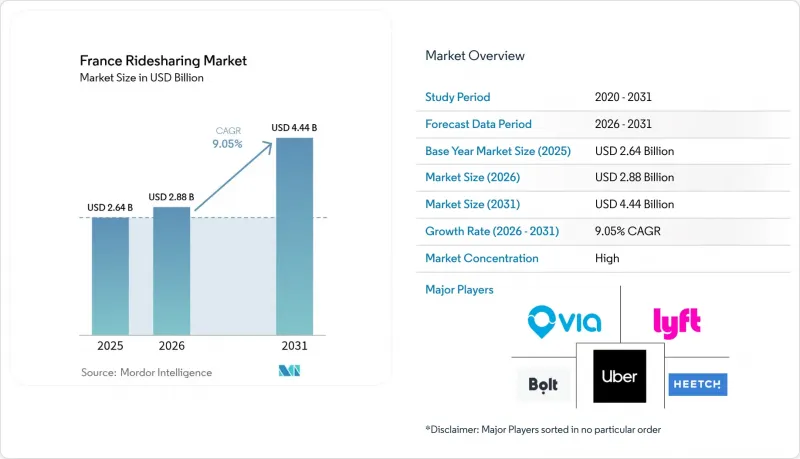
This report is Segmented by Service Type (Urban Ride-Hailing, Micro-Transit Shuttle, Subscription-Based Mobility Packages, and More), Vehicle Type (Cars, Two-Wheelers, Vans and MPVs, and More), End User (Individual Consumers and Business and Corporate Clients), Payment Mode (Card and Wallet, Cash, and Subscription Invoicing). The Market Forecasts are Provided in Terms of Value (USD).
France Ridesharing Market Trends and Insights
Government incentives for low-emission mobility
France channels EUR 50 million a year into its carpooling green fund, mandates 400,000 public chargers by 2030, and ties subsidies to Europe-assembled EVs. Platform fleets that meet zero-emission thresholds receive tax credits and EUR 100 driver bonuses per qualified shared ride, resulting in a 35% surge in BlaBlaCar registrations in 2024. Uber's volume deal with BYD locks in discounted European-assembled vehicles, ensuring eligibility for the ecological bonus. Crit'Air diesel bans, covering Paris and 10 other low-emission zones, will take effect from January 2025, compelling operators to replace 18,000 affected vehicles or face EUR 10,000 penalties per unit annually. The resulting cost differential between compliant EV fleets and legacy diesel assets amplifies early-mover advantages in driver recruitment, pricing flexibility, and securing corporate contracts.
Rising urban congestion charges push shared mobility
Paris tripled SUV parking fees to EUR 18 per hour and introduced a peripherique car-sharing lane, which is expected to reduce single-occupancy commuter traffic by 15%. Lyon added a EUR 5 daily fee for non-resident cars entering its Presqu'ile, exempting certified ride-hailing and carpooling trips. These local policies align with the EU Ambient Air Quality Directive, narrowing the economic gap between the operating costs of private cars and shared rides. Consumers now spend EUR 45 on a private trip from Paris's 15th arrondissement to Charles de Gaulle versus EUR 30 for a shared ride. As congestion fees expand to Bordeaux and Nice, price elasticity continues to tilt demand toward the France ridesharing market.
Stringent labor classification regulations on gig workers
The EU Platform Work Directive 2024/2831 introduces a rebuttable presumption of employment, and France has already lifted the minimum driver wage to EUR 9.00 per hour plus employer social security contributions. Uber set aside EUR 45 million for potential reclassification liabilities, and Bolt froze new-driver onboarding in Paris pending legal clarity. The Autorite de la concurrence's February 2025 opinion added further uncertainty by questioning collective-bargaining frameworks. Labor cost inflation of 20%-30% could lift average fares 12%-18%, compressing demand among price-sensitive riders and dampening the France ridesharing market's near-term growth trajectory.
Other drivers and restraints analyzed in the detailed report include:
- Widespread smartphone and 5G penetration
- Growing corporate adoption of mobility-as-a-service subscriptions
- Saturation in urban core markets limiting driver supply growth
For complete list of drivers and restraints, kindly check the Table Of Contents.
Segment Analysis
Subscription mobility packages are growing at a 10.05% CAGR, eclipsing the overall France ridesharing market. Urban ride-hailing services retained a 53.02% share in 2025, primarily driven by high utilization in Paris, Lyon, and Marseille. BlaBlaCar's long-distance carpooling continues to benefit from the national EUR 100 driver bonus, while micro-transit shuttles fill suburban gaps in Toulouse and Nantes.
Corporate demand reshapes volume distribution: firms replacing fleet allowances with ride credits pump steady traffic into subscription tiers, stabilizing revenue cycles and increasing operator bargaining power with vehicle lessors. In contrast, legacy on-demand taxi segments struggle under licensing caps. Subscription bundles that merge ride-hailing with rail and bus tickets are gaining traction inside public-transit apps, embedding France ridesharing market services into daily commuter routines.
Cars captured 71.55% of the France ridesharing market share in 2025, but electric bookings are accelerating at a 9.98% CAGR as Crit'Air bans remove older diesel vehicles. Two-wheeler shares spike during congestion peaks yet remain a niche at 8%. Vans and MPVs serve growing airport and corporate shuttle demand.
Subsidized EV leasing, guaranteed charger access, and lower maintenance costs tilt driver economics toward battery-electric options, while hydrogen taxis exploit five-minute refuels to maximize utilization. However, uneven fast-charging coverage keeps range anxiety high outside Paris. The mixed fleet composition is therefore likely to persist, although France ridesharing market size contributions from EV categories will continue to expand through 2031.
Complete Report Scope:
- By Service Type
- Urban Ride-Hailing
- Long-Distance Carpooling
- Micro-Transit Shuttle
- Subscription-Based Mobility Packages
- By Vehicle Type
- Cars
- Two-Wheelers
- Vans and MPVs
- Electric Vehicles
- By End User
- Individual Consumers
- Business and Corporate Clients
- By Payment Mode
- Card and Wallet
- Cash
- Subscription Invoicing
List of Companies Covered in this Report:
- Uber Technologies Inc.
- Heetch SAS
- Bolt Technology OU
- Intelligent Apps GmbH
- Via Transportation Inc.
- ANI Technologies Private Limited
- Lyft Inc.
- Gett Inc.
- Careem Networks FZ-LLC
- MLU B.V. (Yandex Taxi)
- Grab Holdings Limited
- PT Aplikasi Karya Anak Bangsa (Gojek)
- Maxi Mobility Spain SL (Cabify)
- Curb Mobility LLC
- Addison Lee Limited
- Wingz Inc.
- Poparide Inc.
- Drivy SAS (Getaround Europe)
- Kapten SAS
Additional Benefits:
- The market estimate (ME) sheet in Excel format
- 3 months of analyst support
TABLE OF CONTENTS
1 INTRODUCTION
- 1.1 Study Assumptions and Market Definition
- 1.2 Scope of the Study
2 RESEARCH METHODOLOGY
3 EXECUTIVE SUMMARY
4 MARKET LANDSCAPE
- 4.1 Market Overview
- 4.2 Market Drivers
- 4.2.1 Government Incentives For Low-Emission Mobility
- 4.2.2 Rising Urban Congestion Charges Push Shared Mobility
- 4.2.3 Widespread Smartphone And 5G Penetration
- 4.2.4 Growing Corporate Adoption Of Mobility-As-A-Service Subscriptions
- 4.2.5 Integration Of Ride-Hailing Platforms With Public Transit Apps
- 4.2.6 Expansion Of Electric Vehicle Fleets In Ridesharing
- 4.3 Market Restraints
- 4.3.1 Stringent Labor Classification Regulations On Gig Workers
- 4.3.2 Saturation In Urban Core Markets Limiting Driver Supply Growth
- 4.3.3 Escalating Insurance Premiums For Ridesharing Vehicles
- 4.3.4 High Competition From Micro-Mobility And Public Transport Upgrades
- 4.4 Industry Value Chain Analysis
- 4.5 Regulatory Landscape
- 4.6 Technological Outlook
- 4.7 Impact of Macroeconomic Factors
- 4.8 Porter's Five Forces Analysis
5 MARKET SIZE AND GROWTH FORECASTS (VALUE)
- 5.1 By Service Type
- 5.1.1 Urban Ride-Hailing
- 5.1.2 Long-Distance Carpooling
- 5.1.3 Micro-Transit Shuttle
- 5.1.4 Subscription-Based Mobility Packages
- 5.2 By Vehicle Type
- 5.2.1 Cars
- 5.2.2 Two-Wheelers
- 5.2.3 Vans and MPVs
- 5.2.4 Electric Vehicles
- 5.3 By End User
- 5.3.1 Individual Consumers
- 5.3.2 Business and Corporate Clients
- 5.4 By Payment Mode
- 5.4.1 Card and Wallet
- 5.4.2 Cash
- 5.4.3 Subscription Invoicing
6 COMPETITIVE LANDSCAPE
- 6.1 Market Concentration
- 6.2 Strategic Moves
- 6.3 Market Share Analysis
- 6.4 Company Profiles (includes Global Level Overview, Market Level Overview, Core Segments, Financials as available, Strategic Information, Market Rank/Share for key companies, Products and Services, and Recent Developments)
- 6.4.1 Uber Technologies Inc.
- 6.4.2 Heetch SAS
- 6.4.3 Bolt Technology OU
- 6.4.4 Intelligent Apps GmbH
- 6.4.5 Via Transportation Inc.
- 6.4.6 ANI Technologies Private Limited
- 6.4.7 Lyft Inc.
- 6.4.8 Gett Inc.
- 6.4.9 Careem Networks FZ-LLC
- 6.4.10 MLU B.V. (Yandex Taxi)
- 6.4.11 Grab Holdings Limited
- 6.4.12 PT Aplikasi Karya Anak Bangsa (Gojek)
- 6.4.13 Maxi Mobility Spain SL (Cabify)
- 6.4.14 Curb Mobility LLC
- 6.4.15 Addison Lee Limited
- 6.4.16 Wingz Inc.
- 6.4.17 Poparide Inc.
- 6.4.18 Drivy SAS (Getaround Europe)
- 6.4.19 Kapten SAS
7 MARKET OPPORTUNITIES AND FUTURE OUTLOOK
- 7.1 White-Space and Unmet-Need Assessment

