PUBLISHER: Mordor Intelligence | PRODUCT CODE: 2124273

PUBLISHER: Mordor Intelligence | PRODUCT CODE: 2124273
Debt Collection Software - Market Share Analysis, Industry Trends & Statistics, Growth Forecasts (2026 - 2031)
According to Mordor Intelligence, the debt collection software market is valued at USD 5.57 billion in 2026 and is forecast to reach USD 7.54 billion in 2031, expanding at a 6.24% CAGR.
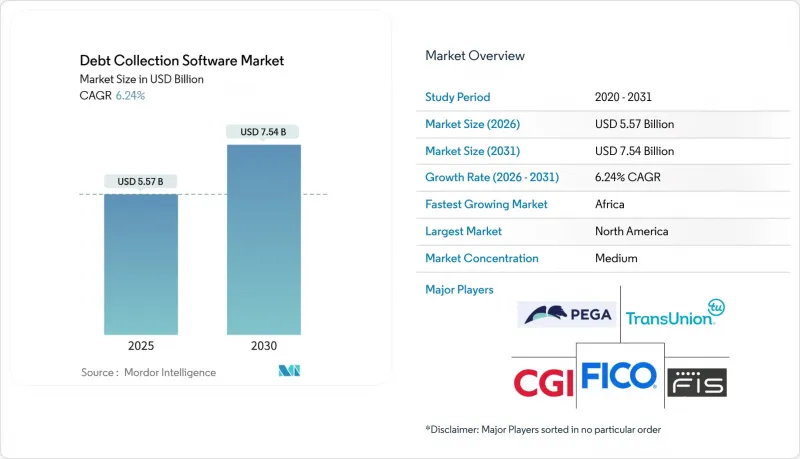
This report is Segmented by Component (Software, and Services), Deployment Mode (Cloud-Based, and On-Premises), Organization Size (Small and Medium-Sized Enterprises, and Large Enterprises), End-User Industry (Financial Institutions, Collection Agencies, and More), and Geography (North America, South America, and More). The Market Forecasts are Provided in Terms of Value (USD).
Global Debt Collection Software Market Trends and Insights
Rising Adoption of AI-Powered Predictive Analytics Among Collection Agencies
Creditors are replacing static segmentation with self-learning models that score portfolios based on propensity to pay, enabling the automated routing of high-yield accounts and lowering recovery costs per dollar collected. A major platform recorded 90% process automation and 79% payment rates in 2025, underscoring efficiency gains over manual workflows. Machine-learning engines ingest behavioral signals, payment histories, and real-time insolvency feeds to forecast roll rates and recommend optimal contact channels. Utilities that use predictive bankruptcy models reduce bad-debt expenses after identifying risk weeks earlier than rule-based systems. Dashboards visualize collection velocity, cash recovery, and agent productivity, allowing supervisors to adjust strategies daily. The competitive gap is widening, as vendors without embedded artificial intelligence struggle to meet the performance benchmarks of enterprises.
Growth in Buy-Now-Pay-Later Portfolios Driving Account Volume
Point-of-sale installment plans originated over USD 100 billion in 2024, but fragmented reporting led to duplicate borrowing and rising defaults. Merchants and fintech lenders now integrate buy-now-pay-later data feeds with their collection platforms to aggregate balances, detect over-extension, and negotiate early payment plans via mobile chatbots. Younger borrowers, who juggle multiple short-term obligations, trigger automated nudges at the first missed installment instead of the traditional 90-day cycle. In markets where buy-now-pay-later penetration among millennials tops 40%, specialized workflows align repayment schedules with wage frequency, reducing churn and preserving customer lifetime value. These capabilities enable the debt collection software market to capture sustained demand from retailers and e-commerce platforms seeking to reduce higher charge-off rates.
Data-Privacy Regulations Limiting Third-Party Data Enrichment in the EU
A 2024 ruling by the Court of Justice of the European Union requires transparent explanations of automated scoring logic, restricting external behavioral data use without explicit consent. Platforms servicing European creditors must embed consent orchestration, audit trails, and explainable artificial intelligence modules, inflating development costs. Stricter data-processing contracts and heavier documentation extend sales cycles and slow feature rollouts. Those regulatory frictions temper the regional expansion pace of the debt collection software market.
Other drivers and restraints analyzed in the detailed report include:
- Increasing Digital Payment Delinquencies From Gig-Economy Workers
- Integration of Collection APIs Into Core-Banking Modernization Programs
- High Switching Costs From Legacy Mainframe Collection Suites
For complete list of drivers and restraints, kindly check the Table Of Contents.
Segment Analysis
Software retained a 63.12% share of the debt collection software market in 2025, as configurable rule engines and omnichannel orchestration remained essential for managing large portfolios. However, services are projected to outpace software with an 8.18% CAGR because creditors increasingly outsource model tuning, regulatory updates, and integration to specialists. A leading provider processed more than USD 1 trillion in receivables across 370 implementations and now sells managed services that retrain models and calibrate compliance rules quarterly.
Ongoing data-privacy changes, contact-frequency caps, and the proliferation of new repayment channels elevate the complexity of maintaining in-house expertise. Implementation partners deliver skip-tracing data hygiene, empathetic agent coaching, and vulnerability screening, ensuring rapid time-to-value. This evolution from perpetual licenses to subscription-plus-services bundles aligns vendor incentives with recovery outcomes and lowers capital outlay for smaller creditors, supporting broader market penetration of debt collection software.
Cloud deployments held a 71.46% market share in 2025, reflecting the migration of utilities and telecom operators from on-premises mainframes to elastic software-as-a-service models that ingest smart meter telemetry, payment updates, and customer interaction logs without batch delays. One enterprise resource planning vendor links its receivables cloud with multi-bank connectors, enabling one-click settlements that reduce Days Sales Outstanding (DSO).
Seasonal spikes after holidays or extreme weather no longer require idle capacity provisioning, as cloud tenants scale computing on demand. Hybrid footprints persist among institutions bound by data-residency mandates, yet even they run analytic workloads in public clouds while retaining core ledgers on-premises. Infrastructure disparities moderate adoption, broadband coverage above 90% in North America supports near-ubiquitous cloud use, whereas intermittent connectivity limits software-as-a-service above 50% across Sub-Saharan Africa. Vendors respond with edge modules that cache workflows locally and synchronize during connectivity windows, extending the debt collection software market to bandwidth-constrained territories.
Complete Report Scope:
- By Component
- Software
- Services
- By Deployment Mode
- Cloud-Based
- On-Premises
- By Organization Size
- Small and Medium-Sized Enterprises (SMEs)
- Large Enterprises
- By End-User Industry
- Financial Institutions (Banks and NBFCs)
- Collection Agencies
- Healthcare Providers
- Government and Public Sector
- Telecom and Utilities
- Retail and E-Commerce
- Other End-User Industries
- By Geography
- North America
- United States
- Canada
- Mexico
- South America
- Brazil
- Argentina
- Rest of South America
- Europe
- United Kingdom
- Germany
- France
- Spain
- Italy
- Rest of Europe
- Asia Pacific
- China
- India
- Japan
- Australia
- South Korea
- Rest of Asia-Pacific
- Middle East and Africa
- Middle East
- Saudi Arabia
- United Arab Emirates
- Turkey
- Rest of Middle East
- Africa
- South Africa
- Kenya
- Rest of Africa
- Middle East
- North America
Geography Analysis
North America captured 34.51% of the debt collection software market share in 2025, driven by USD 17.9 trillion in household debt and strict enforcement of the Fair Debt Collection Practices Act, which compels end-to-end compliance orchestration. Regulation F caps outreach to seven attempts per week and mandates validation notices within five business days, prompting the use of embedded compliance engines. Platform launches, such as FIS Revenue Insight, blend predictive analytics with omnichannel outreach to meet these requirements. Canada and Mexico share similar statutes, driving demand for multi-jurisdictional modules.
Europe benefits from open-banking mandates that enable real-time checks for insolvency and payment initiation. Transparency rulings on automated scoring drive investments in explainable artificial intelligence, an area where vendors gain differentiation despite higher build costs. Energy arrears in the United Kingdom more than doubled between 2018 and 2023, pushing utilities toward vulnerability-aware segmentation.
The Asia-Pacific region exhibits rapid digital payment uptake, led by India's Unified Payments Interface, which has exceeded 10 billion monthly transactions. However, fragmented regulations across China, India, Japan, and Southeast Asia necessitate localized compliance layers. Africa is projected for a 7.32% CAGR as mobile-money ecosystems scale in Kenya and Nigeria, though rural cloud connectivity gaps limit software-as-a-service penetration. Vendors offset latency through edge caching, enabling microfinance institutions to participate in the debt collection software market. Middle Eastern growth accelerates under United Arab Emirates and Saudi Arabia mandates that formalize licensing and consumer-protection standards. Latin America faces 30-45-day payment delays on average, encouraging adoption of automated reminders and payment-plan negotiation tools.
- Fidelity National Information Services Inc. (FIS)
- CGI Inc.
- Fair Isaac Corporation (FICO)
- TransUnion LLC
- Pegasystems Inc.
- Temenos AG
- Intellect Design Arena Ltd.
- Nucleus Software Exports Ltd.
- Chetu Inc.
- Exotel Techcom Pvt. Ltd. (Ameyo)
- EXUS Ltd.
- KuhleKT Pty Ltd.
- Experian plc
- TietoEVRY Oyj
- Loxon Solutions
- Atradius Collections B.V.
- Gaviti Analytics Ltd.
- AgreeYa Solutions Inc. (Cogent)
- Katabat (Axiom Global)
- Indebted Pty Ltd.
- DebtPayPro (Urban FT)
- Collect! (Comtech Systems)
- Esendex Ltd. (VoiceSage Collect)
- Beyond ARM (Intellect)
- Quantrax Corporation Inc.
Additional Benefits:
- The market estimate (ME) sheet in Excel format
- 3 months of analyst support
TABLE OF CONTENTS
1 INTRODUCTION
- 1.1 Study Assumptions and Market Definition
- 1.2 Scope of the Study
2 RESEARCH METHODOLOGY
3 EXECUTIVE SUMMARY
4 MARKET LANDSCAPE
- 4.1 Market Overview
- 4.2 Market Drivers
- 4.2.1 Rising Adoption of AI-Powered Predictive Analytics Among Collection Agencies
- 4.2.2 Growth in Buy-Now-Pay-Later Portfolios Driving Account Volume
- 4.2.3 Increasing Digital Payment Delinquencies from Gig-Economy Workers
- 4.2.4 Integration of Collection APIs into Core-Banking Modernisation Programs
- 4.2.5 Open Banking-Powered Real-Time Insolvency Checks Reducing Skip Tracing Costs
- 4.2.6 Decentralised Identity Wallets Enabling Consent-Based Outreach
- 4.3 Market Restraints
- 4.3.1 Data-Privacy Regulations Limiting Third-Party Data Enrichment in the EU
- 4.3.2 High Switching Costs from Legacy Mainframe Collection Suites
- 4.3.3 Rising Consumer Litigation Driving Stricter Contact-Frequency Caps
- 4.3.4 Limited Cloud Connectivity in Sub-Saharan Africa Constraining SaaS Adoption
- 4.4 Industry Value Chain Analysis
- 4.5 Regulatory Outlook
- 4.6 Technological Outlook
- 4.7 Porter's Five Forces Analysis
- 4.7.1 Bargaining Power of Suppliers
- 4.7.2 Bargaining Power of Buyers
- 4.7.3 Threat of New Entrants
- 4.7.4 Threat of Substitutes
- 4.7.5 Intensity of Competitive Rivalry
- 4.8 Impact of Macroeconomic Factors on the Market
5 MARKET SIZE AND GROWTH FORECASTS (VALUES)
- 5.1 By Component
- 5.1.1 Software
- 5.1.2 Services
- 5.2 By Deployment Mode
- 5.2.1 Cloud-Based
- 5.2.2 On-Premises
- 5.3 By Organization Size
- 5.3.1 Small and Medium-Sized Enterprises (SMEs)
- 5.3.2 Large Enterprises
- 5.4 By End-User Industry
- 5.4.1 Financial Institutions (Banks and NBFCs)
- 5.4.2 Collection Agencies
- 5.4.3 Healthcare Providers
- 5.4.4 Government and Public Sector
- 5.4.5 Telecom and Utilities
- 5.4.6 Retail and E-Commerce
- 5.4.7 Other End-User Industries
- 5.5 By Geography
- 5.5.1 North America
- 5.5.1.1 United States
- 5.5.1.2 Canada
- 5.5.1.3 Mexico
- 5.5.2 South America
- 5.5.2.1 Brazil
- 5.5.2.2 Argentina
- 5.5.2.3 Rest of South America
- 5.5.3 Europe
- 5.5.3.1 United Kingdom
- 5.5.3.2 Germany
- 5.5.3.3 France
- 5.5.3.4 Spain
- 5.5.3.5 Italy
- 5.5.3.6 Rest of Europe
- 5.5.4 Asia Pacific
- 5.5.4.1 China
- 5.5.4.2 India
- 5.5.4.3 Japan
- 5.5.4.4 Australia
- 5.5.4.5 South Korea
- 5.5.4.6 Rest of Asia-Pacific
- 5.5.5 Middle East and Africa
- 5.5.5.1 Middle East
- 5.5.5.1.1 Saudi Arabia
- 5.5.5.1.2 United Arab Emirates
- 5.5.5.1.3 Turkey
- 5.5.5.1.4 Rest of Middle East
- 5.5.5.2 Africa
- 5.5.5.2.1 South Africa
- 5.5.5.2.2 Kenya
- 5.5.5.2.3 Rest of Africa
- 5.5.5.1 Middle East
- 5.5.1 North America
6 COMPETITIVE LANDSCAPE
- 6.1 Market Concentration
- 6.2 Strategic Moves
- 6.3 Market Share Analysis
- 6.4 Company Profiles (includes Global Level Overview, Market Level Overview, Core Segments, Financials as Available, Strategic Information, Market Rank/Share for Key Companies, Products and Services, and Recent Developments)
- 6.4.1 Fidelity National Information Services Inc. (FIS)
- 6.4.2 CGI Inc.
- 6.4.3 Fair Isaac Corporation (FICO)
- 6.4.4 TransUnion LLC
- 6.4.5 Pegasystems Inc.
- 6.4.6 Temenos AG
- 6.4.7 Intellect Design Arena Ltd.
- 6.4.8 Nucleus Software Exports Ltd.
- 6.4.9 Chetu Inc.
- 6.4.10 Exotel Techcom Pvt. Ltd. (Ameyo)
- 6.4.11 EXUS Ltd.
- 6.4.12 KuhleKT Pty Ltd.
- 6.4.13 Experian plc
- 6.4.14 TietoEVRY Oyj
- 6.4.15 Loxon Solutions
- 6.4.16 Atradius Collections B.V.
- 6.4.17 Gaviti Analytics Ltd.
- 6.4.18 AgreeYa Solutions Inc. (Cogent)
- 6.4.19 Katabat (Axiom Global)
- 6.4.20 Indebted Pty Ltd.
- 6.4.21 DebtPayPro (Urban FT)
- 6.4.22 Collect! (Comtech Systems)
- 6.4.23 Esendex Ltd. (VoiceSage Collect)
- 6.4.24 Beyond ARM (Intellect)
- 6.4.25 Quantrax Corporation Inc.
7 MARKET OPPORTUNITIES AND FUTURE OUTLOOK
- 7.1 White-Space and Unmet-Need Assessment

