PUBLISHER: Mordor Intelligence | PRODUCT CODE: 2124285

PUBLISHER: Mordor Intelligence | PRODUCT CODE: 2124285
Robo-advisory Services - Market Share Analysis, Industry Trends & Statistics, Growth Forecasts (2026 - 2031)
According to Mordor Intelligence, robo advisory services market size in 2026 is estimated at USD 18.52 billion, growing from 2025 value of USD 14.29 billion with 2031 projections showing USD 67.76 billion, growing at 29.63% CAGR over 2026-2031.
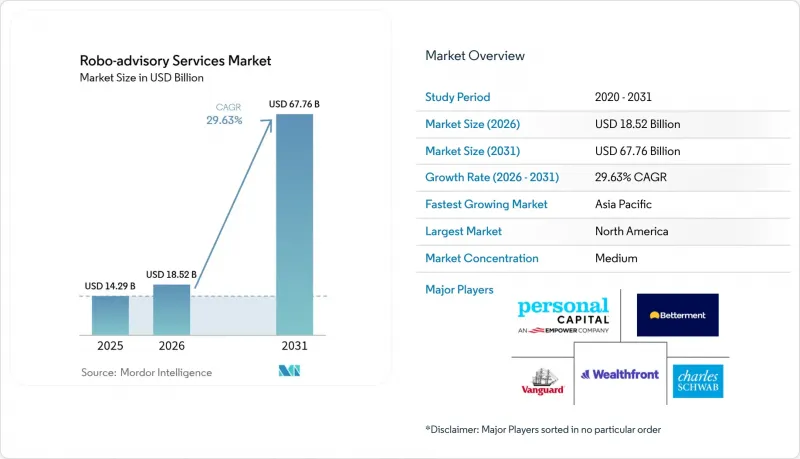
This report is Segmented by Business Model (Pure Robo-Advisor and Hybrid Robo-Advisor), Service Type (Investment Advisory, Wealth Management, and More), Provider Type (FinTech Firms, Banks and Credit Unions, and Traditional Wealth Managers/Broker-Dealers), End-User (Retail Investors, High-Net-Worth Individuals, and SMEs and Corporate Treasuries), and Geography.
Global Robo-advisory Services Market Trends and Insights
Digitisation of the BFSI industry
Cloud-native infrastructure and API-driven architectures are enabling banks to plug robo modules into legacy cores without wholesale rewrites. JPMorgan's AI-based cash-management tool cut manual processing by 90% for 2,500 clients, proving scalability for algorithmic advice. Siemens Treasury's digital migration shaved USD 20 million in yearly costs, underscoring how programmable payments and blockchain rails support real-time rebalancing. Europe's ESMA has issued AI guidance that clarifies compliance guardrails, fostering institutional uptake.
Cost-efficiency in personal finance management
Automated portfolios typically charge 0.25-0.50% versus 1-2% at traditional firms, a spread that unlocked more than USD 1 trillion in global robo assets in 2025. Betterment's tiered model illustrates margin leverage: the firm manages USD 50 billion while passing efficiency gains to users. BlackRock's Aperio platform executed 1.3 million trades and harvested USD 164 million in tax losses, turning algorithmic speed into after-tax alpha.
Other drivers and restraints analyzed in the detailed report include:
- Growing millennial and Gen-Z preference for DIY investing
- AI-powered hyper-personalised nudges boost engagement
- Lack of human touch and empathy
- Regulatory and fiduciary uncertainty across regions
For complete list of drivers and restraints, kindly check the Table Of Contents.
Segment Analysis
Hybrid advisers captured 60.10% of 2025 revenue, equal to the largest single slice of robo-advisory services market share, while pure robos are expanding at a 34.35% CAGR. Investors gravitate to the hybrid promise of low-cost efficiency with a human backstop during volatility.
Platforms increasingly segment by life stage rather than wealth tier. Robinhood's upcoming plain-vanilla robo uses algorithms for allocation but retains human security selection, illustrating a nuanced blend that meets SEC expectations and user comfort levels.
Wealth management services retained 38.15% of 2025 spending, representing the largest slice of the robo-advisory services market size at USD 5.45 billion. By contrast, tax-loss harvesting is accelerating at 33.20% CAGR, riding investor demand for after-tax alpha.
Direct indexing coupled with automated harvesting can add 1-2 percentage points of net returns. BlackRock's Aperio success shows that institutional-grade algorithms can now be delivered to affluent retail accounts, locking in loyalty ahead of the 2026 tax-code revisions.
Complete Report Scope:
- By Business Model
- Pure Robo-advisor
- Hybrid Robo-advisor
- By Service Type
- Investment Advisory
- Wealth Management
- Retirement Planning
- Tax-loss Harvesting
- Goal-based Planning
- By Provider Type
- FinTech Firms
- Banks and Credit Unions
- Traditional Wealth Managers/Broker-Dealers
- By End-user
- Retail Investors
- High-Net-Worth Individuals (HNWI)
- SMEs and Corporate Treasuries
- By Geography
- North America
- United States
- Canada
- Mexico
- South America
- Brazil
- Argentina
- Chile
- Rest of South America
- Europe
- Germany
- United Kingdom
- France
- Italy
- Spain
- Russia
- Rest of Europe
- Asia-Pacific
- China
- India
- Japan
- South Korea
- Singapore
- Malaysia
- Australia
- Rest of Asia-Pacific
- Middle East and Africa
- Middle East
- Saudi Arabia
- Turkey
- Israel
- Rest of Middle East
- Africa
- South Africa
- Nigeria
- Rest of Africa
- Middle East
- North America
Geography Analysis
North America retained 37.75% of global spending in 2025 on the back of regulatory clarity and early-mover platforms such as Betterment and Wealthfront. The region's shareholder-friendly tax frameworks and high digital-banking penetration sustain premium pricing models despite fierce fee compression.
Europe's MiFID II ecosystem promotes investor protection and transparency, encouraging cross-border expansion for digital advisers. ESMA's AI guidelines further standardize algorithmic disclosures, though firms must still reconcile data-privacy obligations country by country. Pan-European platforms like Scalable Capital are localizing language, risk questionnaires, and pension integrations to unlock addressable demand.
Asia-Pacific posts the highest 32.90% CAGR. Regulatory sandboxes in Singapore, Japan, and India let start-ups iterate rapidly, while rising middle-class savings pools drive AUM inflows. Revolut's Singapore robo launched with only USD 100 minimums, and Syfe's Hong Kong build-out signals a mass-affluent land grab. MUFG's WealthNavi acquisition validates the scalability of local champions and paves a path for cross-listing of robo ETFs on the Tokyo Stock Exchange.
- Vanguard Group Inc.
- Charles Schwab & Co. Inc. (Intelligent Portfolios)
- Empower Advisory Group Inc. (Personal Capital)
- Betterment LLC
- Wealthfront Corporation
- BlackRock Inc. (FutureAdvisor)
- FMR LLC (Fidelity Go)
- M1 Holdings Inc. (M1 Finance)
- Acorns Grow Inc.
- Stash Financial Inc.
- Robinhood Advisory LLC (Robinhood Portfolio)
- Ellevest Inc.
- SigFig Wealth Management LLC
- SoFi Technologies Inc. (SoFi Invest)
- Nutmeg Saving & Investment Ltd.
- Scalable Capital GmbH
- Raisin DS GmbH (WeltSparen Invest)
- Bambu Global Pte Ltd.
- Wahed Invest LLC
- Syfe Pte Ltd.
- Stockspot Pty Ltd.
- Groww (Nextbillion Technology Pvt Ltd.)
- Freetrade Ltd.
- SmartWealth (Emirates NBD)
- Revolut Ltd (Wealth & Trading)
Additional Benefits:
- The market estimate (ME) sheet in Excel format
- 3 months of analyst support
TABLE OF CONTENTS
1 INTRODUCTION
- 1.1 Study Assumptions and Market Definition
- 1.2 Scope of the Study
2 RESEARCH METHODOLOGY
3 EXECUTIVE SUMMARY
4 MARKET LANDSCAPE
- 4.1 Market Overview
- 4.2 Market Drivers
- 4.2.1 Digitisation of the BFSI industry
- 4.2.2 Cost-efficiency in personal finance management
- 4.2.3 Growing millennial and Gen-Z preference for DIY investing
- 4.2.4 AI-powered hyper-personalised nudges boost engagement
- 4.2.5 Embedded robo-advice within payroll/benefits platforms
- 4.3 Market Restraints
- 4.3.1 Lack of human touch and empathy
- 4.3.2 Regulatory and fiduciary uncertainty across regions
- 4.3.3 Algorithmic-bias risk creating compliance liabilities
- 4.4 Industry Value Chain Analysis
- 4.5 Regulatory Landscape
- 4.6 Technological Outlook
- 4.7 Industry Attractiveness - Porter's Five Forces Analysis
- 4.7.1 Bargaining Power of Suppliers
- 4.7.2 Bargaining Power of Buyers
- 4.7.3 Threat of New Entrants
- 4.7.4 Threat of Substitute Products
- 4.7.5 Intensity of Competitive Rivalry
- 4.8 Impact of Macroeconomic Factors on the Market
5 MARKET SIZE AND GROWTH FORECASTS (VALUES)
- 5.1 By Business Model
- 5.1.1 Pure Robo-advisor
- 5.1.2 Hybrid Robo-advisor
- 5.2 By Service Type
- 5.2.1 Investment Advisory
- 5.2.2 Wealth Management
- 5.2.3 Retirement Planning
- 5.2.4 Tax-loss Harvesting
- 5.2.5 Goal-based Planning
- 5.3 By Provider Type
- 5.3.1 FinTech Firms
- 5.3.2 Banks and Credit Unions
- 5.3.3 Traditional Wealth Managers/Broker-Dealers
- 5.4 By End-user
- 5.4.1 Retail Investors
- 5.4.2 High-Net-Worth Individuals (HNWI)
- 5.4.3 SMEs and Corporate Treasuries
- 5.5 By Geography
- 5.5.1 North America
- 5.5.1.1 United States
- 5.5.1.2 Canada
- 5.5.1.3 Mexico
- 5.5.2 South America
- 5.5.2.1 Brazil
- 5.5.2.2 Argentina
- 5.5.2.3 Chile
- 5.5.2.4 Rest of South America
- 5.5.3 Europe
- 5.5.3.1 Germany
- 5.5.3.2 United Kingdom
- 5.5.3.3 France
- 5.5.3.4 Italy
- 5.5.3.5 Spain
- 5.5.3.6 Russia
- 5.5.3.7 Rest of Europe
- 5.5.4 Asia-Pacific
- 5.5.4.1 China
- 5.5.4.2 India
- 5.5.4.3 Japan
- 5.5.4.4 South Korea
- 5.5.4.5 Singapore
- 5.5.4.6 Malaysia
- 5.5.4.7 Australia
- 5.5.4.8 Rest of Asia-Pacific
- 5.5.5 Middle East and Africa
- 5.5.5.1 Middle East
- 5.5.5.1.1 Saudi Arabia
- 5.5.5.1.2 Turkey
- 5.5.5.1.3 Israel
- 5.5.5.1.4 Rest of Middle East
- 5.5.5.2 Africa
- 5.5.5.2.1 South Africa
- 5.5.5.2.2 Nigeria
- 5.5.5.2.3 Rest of Africa
- 5.5.5.1 Middle East
- 5.5.1 North America
6 COMPETITIVE LANDSCAPE
- 6.1 Market Concentration
- 6.2 Strategic Moves
- 6.3 Market Share Analysis
- 6.4 Company Profiles (includes Global level Overview, Market level overview, Core Segments, Financials as available, Strategic Information, Market Rank/Share for key companies, Products and Services, and Recent Developments)
- 6.4.1 Vanguard Group Inc.
- 6.4.2 Charles Schwab & Co. Inc. (Intelligent Portfolios)
- 6.4.3 Empower Advisory Group Inc. (Personal Capital)
- 6.4.4 Betterment LLC
- 6.4.5 Wealthfront Corporation
- 6.4.6 BlackRock Inc. (FutureAdvisor)
- 6.4.7 FMR LLC (Fidelity Go)
- 6.4.8 M1 Holdings Inc. (M1 Finance)
- 6.4.9 Acorns Grow Inc.
- 6.4.10 Stash Financial Inc.
- 6.4.11 Robinhood Advisory LLC (Robinhood Portfolio)
- 6.4.12 Ellevest Inc.
- 6.4.13 SigFig Wealth Management LLC
- 6.4.14 SoFi Technologies Inc. (SoFi Invest)
- 6.4.15 Nutmeg Saving & Investment Ltd.
- 6.4.16 Scalable Capital GmbH
- 6.4.17 Raisin DS GmbH (WeltSparen Invest)
- 6.4.18 Bambu Global Pte Ltd.
- 6.4.19 Wahed Invest LLC
- 6.4.20 Syfe Pte Ltd.
- 6.4.21 Stockspot Pty Ltd.
- 6.4.22 Groww (Nextbillion Technology Pvt Ltd.)
- 6.4.23 Freetrade Ltd.
- 6.4.24 SmartWealth (Emirates NBD)
- 6.4.25 Revolut Ltd (Wealth & Trading)
7 MARKET OPPORTUNITIES AND FUTURE OUTLOOK
- 7.1 White-space and Unmet-need Assessment

