PUBLISHER: Mordor Intelligence | PRODUCT CODE: 2124295

PUBLISHER: Mordor Intelligence | PRODUCT CODE: 2124295
Work Order Management - Market Share Analysis, Industry Trends & Statistics, Growth Forecasts (2026 - 2031)
According to Mordor Intelligence, the work order management market size in 2026 is estimated at USD 0.98 billion, growing from 2025 value of USD 0.91 billion with 2031 projections showing USD 1.41 billion, growing at 7.52% CAGR over 2026-2031.
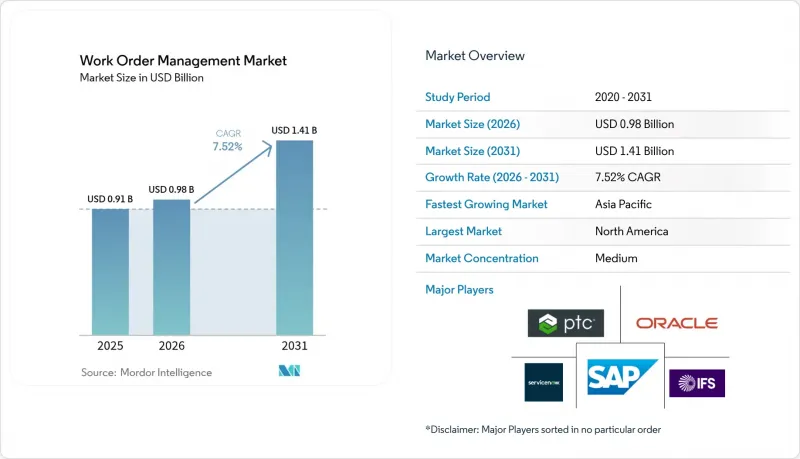
This report is Segmented by Component (Software and Services), Deployment Type (Cloud-Based, On-Premises, and Hybrid), Organization Size (Small and Medium Enterprises and Large Enterprises), End-Use Industry (Healthcare, IT and Telecom, and More), Application Module (Inventory Management, Preventive Maintenance, and More), and Geography. The Market Forecasts are Provided in Terms of Value (USD).
Global Work Order Management Market Trends and Insights
Rapid Adoption of Cloud-Based Field Service Platforms
Enterprises are migrating to multitenant software that eliminates the need for servers, backups, and annual maintenance fees. Subscription contracts scale technician seats on demand, enabling firms to flex capacity for seasonal workloads. Mobile synchronization became mandatory during the COVID-19 pandemic, cementing expectations for real-time visibility across geographically dispersed teams. Regulated utilities and defense agencies adopt hybrid deployment, keeping asset data on-premises while running scheduling logic in the cloud to strike a balance between security and mobility. Leading vendors report that more than three-quarters of new field service contracts specify cloud-only architecture.
Growing Demand for Predictive Maintenance Capabilities
Machine-learning models correlate sensor telemetry with historical work orders to forecast failures and schedule interventions before breakdowns. Avoiding a single unplanned shutdown can offset the annual cost of an enterprise platform. Vendors acquire IoT specialists to deliver end-to-end asset performance, as illustrated by PTC's integration of ServiceMax with ThingWorx. Regulatory agencies encourage utilities to deploy predictive maintenance to mitigate wildfire risk, thereby accelerating its adoption in the energy sector. The approach favors organizations with mature reliability teams, widening the gap between digital leaders and laggards.
Data Security and Privacy Concerns in Cloud Deployments
Ransomware incidents targeting field service providers rose sharply in 2024, highlighting vulnerabilities in third-party hosting environments. Healthcare organizations face fines exceeding USD 1 million per breach under HIPAA, prompting cautious migration paths. Vendors respond with SOC 2 Type II audits and end-to-end AES-256 encryption, yet buyer skepticism persists. New European NIS2 rules require essential service operators to report cyber events within 24 hours, adding compliance overhead. Consequently, some firms defer cloud adoption until internal security teams mature.
Other drivers and restraints analyzed in the detailed report include:
- Increasing Mobile Workforce and BYOD Policies
- Integration With IoT and Asset Sensors
- High Integration Complexity With Legacy ERP Systems
For complete list of drivers and restraints, kindly check the Table Of Contents.
Segment Analysis
Services contributed 33.90% of 2025 revenue, yet they are expanding at a 7.88% CAGR, faster than software. Implementation partners migrate legacy data, configure approval workflows, and link field applications to enterprise resource planning systems, activities that can span a full fiscal year for global manufacturers. Managed services appeal to firms that lack in-house IT staff, shifting the responsibility for upgrades and cybersecurity to vendors. Training budgets represent at least 15% of total project spend, which helps lift technician adoption and shorten payback periods. Consequently, services are a strategic lever for vendors to deepen account relationships.
Software remains the backbone of the work order management market, automating dispatch, mobile execution, and asset tracking through a unified interface. The segment benefits from steady subscription renewals and feature expansion, including artificial intelligence dispatch assistants. Vendors bundle adjacent modules, including inventory and customer management, to boost average contract value. Although software growth trails services, it remains the primary entry point for new customers and underpins the broader ecosystem.
Cloud platforms captured a 63.05% share in 2025 and are projected to grow at an 8.05% CAGR through 2031. Operating expenditure pricing eliminates capital budgets for servers, and automatic updates keep installations secure without manual patches. Vendors embed advanced analytics and natural-language interfaces that would be cost-prohibitive on premises. Hybrid models satisfy regulated sectors by keeping asset telemetry onsite while running scheduling algorithms in the cloud.
On-premises installations persist in defense and critical infrastructure, where data sovereignty and air-gapped networks remain non-negotiable. Nevertheless, their relative share will continue to decline as CIOs plan cloud-first roadmaps. The shift drives vendors to prioritize multitenant architectures and to sunset perpetual licenses, moving revenue recognition toward recurring subscription streams.
Complete Report Scope:
- By Component
- Software
- Services
- By Deployment Type
- Cloud-Based
- On-Premises
- Hybrid
- By Organization Size
- Small and Medium Enterprises (SMEs)
- Large Enterprises
- By End-Use Industry
- Manufacturing
- Energy and Utilities
- Healthcare
- IT and Telecom
- Transportation and Logistics
- Government
- Retail
- Other End-Use Industry
- By Application Module
- Work Order Management
- Asset Management
- Inventory Management
- Preventive Maintenance
- Scheduling and Dispatch
- Reporting and Analytics
- Customer Management
- By Geography
- North America
- United States
- Canada
- Mexico
- Europe
- Germany
- United Kingdom
- France
- Italy
- Rest of Europe
- Asia-Pacific
- China
- Japan
- India
- South Korea
- Australia
- Rest of Asia-Pacific
- Middle East and Africa
- Middle East
- Saudi Arabia
- United Arab Emirates
- Rest of Middle East
- Africa
- South Africa
- Egypt
- Rest of Africa
- Middle East
- South America
- Brazil
- Argentina
- Rest of South America
- North America
Geography Analysis
North America accounted for 38.20% of 2025 revenue, driven by the early adoption of cloud platforms, an extensive integrator ecosystem, and compliance requirements from OSHA that mandate the use of documented maintenance procedures. The United States drives the region, leveraging large installed resource-planning bases to cross-sell field service modules. Canada follows suit, especially in the energy sector, where operators coordinate maintenance across wide geographic areas. Mexico is emerging as a hub for nearshore manufacturing, requiring modern maintenance infrastructure.
The Asia Pacific is forecast to grow at an 8.65% CAGR through 2031, benefiting from government mandates that encourage industrial IoT deployment in China and smart city initiatives in India. Japan's aging workforce is accelerating the automation of field service dispatch, while investments in sensors across utilities and transportation are amplifying demand. Vendors localize solutions for language and regulatory compliance, positioning Asia Pacific as the primary growth engine.
Europe's stringent GDPR and data-sovereignty rules slow cloud migration but raise interest in hybrid deployments. Germany's automotive and machinery sectors generate strong demand for predictive maintenance, and the United Kingdom's utilities invest to meet Ofgem reliability targets. France and Russia adopt at a modest pace due to on-premises preferences. The Middle East is seeing momentum from mega-projects in Saudi Arabia and the United Arab Emirates, while South Africa leads African adoption in the mining sector. South America is a mixed region: Brazil invests in manufacturing and energy, whereas currency volatility restrains spending in Argentina and its neighboring markets.
- ServiceNow Inc.
- PTC Inc.
- IFS AB
- Oracle Corporation
- SAP SE
- Microsoft Corporation
- ClickSoftware Technologies Ltd.
- Infor Inc.
- IBM Corporation
- Verizon Communications Inc. (Verizon Connect)
- Trimble Inc.
- Fiix Software ULC
- UpKeep Technologies Inc.
- Dude Solutions Inc.
- MaintainX Inc.
- Limble Solutions Inc.
- Hippo CMMS (iOFFICE LP)
- eMaint Enterprises LLC
- Accruent LLC (Maintenance Connection)
- Praxedo SA
Additional Benefits:
- The market estimate (ME) sheet in Excel format
- 3 months of analyst support
TABLE OF CONTENTS
1 INTRODUCTION
- 1.1 Study Assumptions and Market Definition
- 1.2 Scope of the Study
2 RESEARCH METHODOLOGY
3 EXECUTIVE SUMMARY
4 MARKET LANDSCAPE
- 4.1 Market Overview
- 4.2 Market Drivers
- 4.2.1 Rapid Adoption of Cloud-Based Field Service Platforms
- 4.2.2 Growing Demand for Predictive Maintenance Capabilities
- 4.2.3 Increasing Mobile Workforce and BYOD Policies
- 4.2.4 Integration With IoT AND Asset Sensors
- 4.2.5 Shift Toward Outcome-Based Service Contracts in Industrial Verticals
- 4.2.6 ESG-Mandated Reporting of Maintenance-Related Carbon Footprint
- 4.3 Market Restraints
- 4.3.1 Data Security and Privacy Concerns in Cloud Deployments
- 4.3.2 High Integration Complexity With Legacy ERP Systems
- 4.3.3 Talent Shortage in AI-Enabled Dispatch Algorithm Development
- 4.3.4 Rising Satellite Internet Latency Costs in Remote Asset Locations
- 4.4 Industry Value Chain Analysis
- 4.5 Regulatory Landscape
- 4.6 Technological Outlook
- 4.7 Impact of Macroeconomic Factors
- 4.8 Porter's Five Forces Analysis
- 4.8.1 Threat of New Entrants
- 4.8.2 Bargaining Power of Suppliers
- 4.8.3 Bargaining Power of Buyers
- 4.8.4 Threat of Substitutes
- 4.8.5 Competitive Rivalry
5 MARKET SIZE AND GROWTH FORECASTS (VALUE)
- 5.1 By Component
- 5.1.1 Software
- 5.1.2 Services
- 5.2 By Deployment Type
- 5.2.1 Cloud-Based
- 5.2.2 On-Premises
- 5.2.3 Hybrid
- 5.3 By Organization Size
- 5.3.1 Small and Medium Enterprises (SMEs)
- 5.3.2 Large Enterprises
- 5.4 By End-Use Industry
- 5.4.1 Manufacturing
- 5.4.2 Energy and Utilities
- 5.4.3 Healthcare
- 5.4.4 IT and Telecom
- 5.4.5 Transportation and Logistics
- 5.4.6 Government
- 5.4.7 Retail
- 5.4.8 Other End-Use Industry
- 5.5 By Application Module
- 5.5.1 Work Order Management
- 5.5.2 Asset Management
- 5.5.3 Inventory Management
- 5.5.4 Preventive Maintenance
- 5.5.5 Scheduling and Dispatch
- 5.5.6 Reporting and Analytics
- 5.5.7 Customer Management
- 5.6 By Geography
- 5.6.1 North America
- 5.6.1.1 United States
- 5.6.1.2 Canada
- 5.6.1.3 Mexico
- 5.6.2 Europe
- 5.6.2.1 Germany
- 5.6.2.2 United Kingdom
- 5.6.2.3 France
- 5.6.2.4 Italy
- 5.6.2.5 Rest of Europe
- 5.6.3 Asia-Pacific
- 5.6.3.1 China
- 5.6.3.2 Japan
- 5.6.3.3 India
- 5.6.3.4 South Korea
- 5.6.3.5 Australia
- 5.6.3.6 Rest of Asia-Pacific
- 5.6.4 Middle East and Africa
- 5.6.4.1 Middle East
- 5.6.4.1.1 Saudi Arabia
- 5.6.4.1.2 United Arab Emirates
- 5.6.4.1.3 Rest of Middle East
- 5.6.4.2 Africa
- 5.6.4.2.1 South Africa
- 5.6.4.2.2 Egypt
- 5.6.4.2.3 Rest of Africa
- 5.6.4.1 Middle East
- 5.6.5 South America
- 5.6.5.1 Brazil
- 5.6.5.2 Argentina
- 5.6.5.3 Rest of South America
- 5.6.1 North America
6 COMPETITIVE LANDSCAPE
- 6.1 Market Concentration
- 6.2 Strategic Moves
- 6.3 Market Share Analysis
- 6.4 Company Profiles (includes Global Level Overview, Market Level Overview, Core Segments, Financials as Available, Strategic Information, Market Rank/Share for Key Companies, Products AND Services, and Recent Developments)
- 6.4.1 ServiceNow Inc.
- 6.4.2 PTC Inc.
- 6.4.3 IFS AB
- 6.4.4 Oracle Corporation
- 6.4.5 SAP SE
- 6.4.6 Microsoft Corporation
- 6.4.7 ClickSoftware Technologies Ltd.
- 6.4.8 Infor Inc.
- 6.4.9 IBM Corporation
- 6.4.10 Verizon Communications Inc. (Verizon Connect)
- 6.4.11 Trimble Inc.
- 6.4.12 Fiix Software ULC
- 6.4.13 UpKeep Technologies Inc.
- 6.4.14 Dude Solutions Inc.
- 6.4.15 MaintainX Inc.
- 6.4.16 Limble Solutions Inc.
- 6.4.17 Hippo CMMS (iOFFICE LP)
- 6.4.18 eMaint Enterprises LLC
- 6.4.19 Accruent LLC (Maintenance Connection)
- 6.4.20 Praxedo SA
7 MARKET OPPORTUNITIES AND FUTURE OUTLOOK
- 7.1 White-space and Unmet-Need Assessment

