PUBLISHER: Mordor Intelligence | PRODUCT CODE: 2124296

PUBLISHER: Mordor Intelligence | PRODUCT CODE: 2124296
Cryogenic Pump - Market Share Analysis, Industry Trends & Statistics, Growth Forecasts (2026 - 2031)
According to Mordor Intelligence, cryogenic pump market size in 2026 is estimated at USD 2.63 billion, growing from 2025 value of USD 2.5 billion with 2031 projections showing USD 3.37 billion, growing at 5.10% CAGR over 2026-2031.
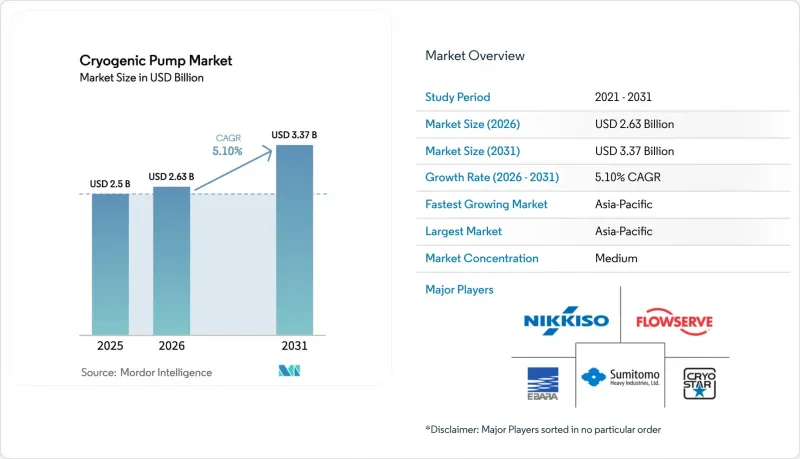
This report is Segmented by Type (Dynamic Pumps and Positive-Displacement Pumps), Cryogenic Gas (Nitrogen, Oxygen, Argon, LNG, Hydrogen, and Helium), End User (Energy and Power Generation, Chemicals and Petrochemicals, Healthcare and Biotechnology, Aerospace and Space Launch Services, and More), and Geography (North America, Europe, Asia-Pacific, South America, and Middle East and Africa).
Global Cryogenic Pump Market Trends and Insights
Surge in LNG Infrastructure Investments
Nearly 290 billion m3 per year of new LNG export capacity is slated to come online between 2025 and 2030, the largest wave in industry history. Projects such as Plaquemines, Corpus Christi Stage 3, and Qatar's North Field East underpin bulk demand for pumps rated down to -162 °C. In Europe, the Stade terminal hosts two 240,000 m3 storage tanks that require multi-stage centrifugal units sized for rapid ship-to-shore transfer. Vendors, including Nikkiso, have opened European service hubs to shorten overhaul cycles, while process licensors integrate variable-speed drives to trim power consumption by up to 7%. Contract backlogs are being locked in under long-term service agreements that guarantee availability thresholds exceeding 99% .
Rising Industrial-Gas Demand from Healthcare & Semiconductor Fabs
Helium demand is forecast to double by 2035, propelled by MRI installations and 2 nm semiconductor node transitions that need ultra-high-purity environments. The U.S. CHIPS Act channels USD 30 billion into new fabs, motivating EPC firms to bundle nitrogen, argon, and helium supply systems with turnkey cryogenic pump skids. Precision diaphragm pumps ensure oil-free delivery that meets ISO 14644-1 Class 1 cleanroom standards. In Asia, wafer capacity additions in Taiwan, South Korea, and mainland China are driving orders for high-head reciprocating pumps that recycle helium at 25 bar discharge pressure, cutting gas losses by 15% versus legacy loops .
High CAPEX & Maintenance Complexity
A submerged cryogenic pump skid can represent 4-6% of an LNG train's installed cost, while welders certified to American Society of Mechanical Engineers Section IX have commanded wage premiums surpassing 20% since 2021. The Golden Pass LNG project's delays, triggered by contractor insolvency, highlight budget exposure. Furthermore, pump repair windows require specialist tooling held by only a handful of service centers worldwide, extending turnaround intervals. Tariffs on cryogenic steel and Inconel exacerbated by geopolitical tensions inflate bills of material, prompting operators to negotiate vendor-managed inventory programs that amortize supply risk.
Other drivers and restraints analyzed in the detailed report include:
- Expansion of the Global Hydrogen Economy
- Replacement of Ageing ASUs in OECD Countries
- LNG Price Volatility Delaying Projects
For complete list of drivers and restraints, kindly check the Table Of Contents.
Segment Analysis
Dynamic kinetic designs, primarily centrifugal models, controlled 81.16% of the cryogenic pump market in 2025 because they deliver high volumetric flow with limited moving parts. LNG terminals favor between-bearings centrifugal pumps whose open-volute architecture minimizes NPSH requirements at -162 °C. The segment is forecast to maintain leadership as regasification capacity accelerates across Asia and Europe. Positive-displacement technology, by contrast, caters to precision dosing and high-pressure hydrogen service where flow stability outweighs capacity. These units are projected to post a 5.62% CAGR, buoyed by growth in liquid hydrogen distribution networks for mobility and distributed power.
Centrifugal models integrate vapor-return lines that reduce cavitation, extending overhaul intervals beyond 60,000 hours. Axial-flow variants target peak-shaving peak load LNG send-out, where differential pressures remain modest. Mixed-flow pumps provide hybrid performance for floating storage regasification units. Reciprocating pumps within the positive-displacement category employ oil-free piston rings that limit hydrocarbon contamination, a key metric for fuel-cell-grade hydrogen. Screw pumps support continuous duty in metallurgical argon service, whereas diaphragm pumps deliver particle-free flow for 3 nm semiconductor wet benches. Diversifying duty points ensures that every modality finds its niche, sustaining healthy competition across design paradigms. The segment's split also underpins after-market revenues, as different architectures require distinct seal kits and spare rotors, reinforcing OEM lifecycle engagement with plant operators.
Complete Report Scope:
- By Type
- Dynamic (Kinetic) Pumps
- Centrifugal
- Axial Flow
- Mixed Flow
- Positive-Displacement Pumps
- Reciprocating
- Screw
- Diaphragm
- Dynamic (Kinetic) Pumps
- By Cryogenic Gas
- Nitrogen
- Oxygen
- Argon
- LNG
- Hydrogen
- Helium
- By End User
- Energy and Power Generation
- Chemicals and Petrochemicals
- Healthcare and Biotechnology
- Metallurgy and Metal Processing
- Semiconductor and Electronics
- Aerospace and Space Launch Services
- By Geography
- North America
- United States
- Canada
- Mexico
- Europe
- Germany
- United Kingdom
- France
- Italy
- Russia
- Rest of Europe
- Asia-Pacific
- China
- India
- Japan
- South Korea
- ASEAN Countries
- Rest of Asia-Pacific
- South America
- Brazil
- Argentina
- Rest of South America
- Middle East and Africa
- Saudi Arabia
- United Arab Emirates
- South Africa
- Egypt
- Rest of Middle East and Africa
- North America
Geography Analysis
Asia Pacific led the cryogenic pump market in 2025 with 37.92% revenue share, anchored by China's 27 ongoing LNG terminals and aggressive hydrogen station rollouts. Regional CAGR is projected at 5.38% to 2031 as India, Japan, and South Korea accelerate clean-fuel imports and semiconductor capacity. Indigenous OEMs are scaling local assembly to cut logistics costs, while multinationals license IP to joint-venture partners to comply with procurement rules. China's Tangshan II terminal, featuring 584.4 bcf storage, typifies the massive duty points driving multi-stage pump demand. Simultaneously, the Xi'an small-scale LNG hub adds 1,400 ktpa liquefaction, boosting orders for skid-mounted pumps deployable in remote industrial parks.
North America maintains robust momentum backed by an 11.4 Bcf/d LNG export base forecast to reach 24.4 Bcf/d by 2028. Liquid hydrogen leadership, with 15 facilities producing 326 t/day, positions the region as a technology incubator. U.S. vendors leverage proximity to aerospace primes and hydrogen hub grants, embedding advanced vibration diagnostic analytics into pump offerings. Canada's emerging LH2 corridors link Prince Rupert to inland trucking fleets, spurring demand for mid-scale pumps optimized for trailer offloading. Mexico's industrial gas expansion in aerospace clusters further broadens regional opportunities.
Europe is pivoting toward import infrastructure to counter Russian gas shortfalls. Germany's Stade terminal integrates ammonia-ready baseload pumps, future-proofing against fuel transition. Scandinavian shipyards are trialing LH2 bunkering, requiring portable pump modules with rapid disconnect couplings. Middle East exporters continue capitalizing on cost-advantaged feedgas, but newer blue-hydrogen plants in Saudi Arabia and the UAE are incorporating LH2 logistics chains that necessitate ultra-low-temperature pumps. Africa and South America remain nascent yet are advancing small-scale LNG for off-grid power, laying the groundwork for incremental pump demand.
- Nikkiso Co., Ltd.
- Ebara Corporation
- Flowserve Corporation
- Sumitomo Heavy Industries, Ltd.
- Cryostar SAS
- Weir Group PLC
- Fives Group
- KSB SE & Co. KGaA
- Beijing Long March Tianmin Hi-Tech
- PHPK Technologies
- Atlas Copco (Leybold)
- Dover (PSG & Cryo-Mach)
- Chart Industries
- Ruhrpumpen Group
- Technex Ltd.
- Shinko NSE
- Cryomec AG
- CYY Energy
- Zhejiang Sanhuan Hi-Tech
- Barber-Nichols
- Trillium Flow Technologies
Additional Benefits:
- The market estimate (ME) sheet in Excel format
- 3 months of analyst support
TABLE OF CONTENTS
1 Introduction
- 1.1 Study Assumptions & Market Definition
- 1.2 Scope of the Study
2 Research Methodology
3 Executive Summary
4 Market Landscape
- 4.1 Market Overview
- 4.2 Market Drivers
- 4.2.1 Surge in LNG infrastructure investments
- 4.2.2 Rising industrial-gas demand from healthcare & semiconductor fabs
- 4.2.3 Expansion of the global hydrogen economy
- 4.2.4 Replacement of ageing ASUs in OECD countries
- 4.2.5 Cryogenic pumps for hyperscale quantum-computing data centers
- 4.2.6 Commercial space-launch propellant handling requirements
- 4.3 Market Restraints
- 4.3.1 High CAPEX & maintenance complexity
- 4.3.2 LNG price volatility delaying projects
- 4.3.3 Supply-chain shortages of specialty alloys
- 4.3.4 Regulatory uncertainty on ammonia as marine fuel
- 4.4 Supply-Chain Analysis
- 4.5 Regulatory Landscape
- 4.6 Technological Outlook
- 4.7 Porter's Five Forces
- 4.7.1 Bargaining Power of Suppliers
- 4.7.2 Bargaining Power of Consumers
- 4.7.3 Threat of New Entrants
- 4.7.4 Threat of Substitutes
- 4.7.5 Competitive Rivalry
5 Market Size & Growth Forecasts
- 5.1 By Type
- 5.1.1 Dynamic (Kinetic) Pumps
- 5.1.1.1 Centrifugal
- 5.1.1.2 Axial Flow
- 5.1.1.3 Mixed Flow
- 5.1.2 Positive-Displacement Pumps
- 5.1.2.1 Reciprocating
- 5.1.2.2 Screw
- 5.1.2.3 Diaphragm
- 5.1.1 Dynamic (Kinetic) Pumps
- 5.2 By Cryogenic Gas
- 5.2.1 Nitrogen
- 5.2.2 Oxygen
- 5.2.3 Argon
- 5.2.4 LNG
- 5.2.5 Hydrogen
- 5.2.6 Helium
- 5.3 By End User
- 5.3.1 Energy and Power Generation
- 5.3.2 Chemicals and Petrochemicals
- 5.3.3 Healthcare and Biotechnology
- 5.3.4 Metallurgy and Metal Processing
- 5.3.5 Semiconductor and Electronics
- 5.3.6 Aerospace and Space Launch Services
- 5.4 By Geography
- 5.4.1 North America
- 5.4.1.1 United States
- 5.4.1.2 Canada
- 5.4.1.3 Mexico
- 5.4.2 Europe
- 5.4.2.1 Germany
- 5.4.2.2 United Kingdom
- 5.4.2.3 France
- 5.4.2.4 Italy
- 5.4.2.5 Russia
- 5.4.2.6 Rest of Europe
- 5.4.3 Asia-Pacific
- 5.4.3.1 China
- 5.4.3.2 India
- 5.4.3.3 Japan
- 5.4.3.4 South Korea
- 5.4.3.5 ASEAN Countries
- 5.4.3.6 Rest of Asia-Pacific
- 5.4.4 South America
- 5.4.4.1 Brazil
- 5.4.4.2 Argentina
- 5.4.4.3 Rest of South America
- 5.4.5 Middle East and Africa
- 5.4.5.1 Saudi Arabia
- 5.4.5.2 United Arab Emirates
- 5.4.5.3 South Africa
- 5.4.5.4 Egypt
- 5.4.5.5 Rest of Middle East and Africa
- 5.4.1 North America
6 Competitive Landscape
- 6.1 Market Concentration
- 6.2 Strategic Moves (M&A, Partnerships, PPAs)
- 6.3 Market Share Analysis (Market Rank/Share for key companies)
- 6.4 Company Profiles (includes Global level Overview, Market level overview, Core Segments, Financials as available, Strategic Information, Products & Services, and Recent Developments)
- 6.4.1 Nikkiso Co., Ltd.
- 6.4.2 Ebara Corporation
- 6.4.3 Flowserve Corporation
- 6.4.4 Sumitomo Heavy Industries, Ltd.
- 6.4.5 Cryostar SAS
- 6.4.6 Weir Group PLC
- 6.4.7 Fives Group
- 6.4.8 KSB SE & Co. KGaA
- 6.4.9 Beijing Long March Tianmin Hi-Tech
- 6.4.10 PHPK Technologies
- 6.4.11 Atlas Copco (Leybold)
- 6.4.12 Dover (PSG & Cryo-Mach)
- 6.4.13 Chart Industries
- 6.4.14 Ruhrpumpen Group
- 6.4.15 Technex Ltd.
- 6.4.16 Shinko NSE
- 6.4.17 Cryomec AG
- 6.4.18 CYY Energy
- 6.4.19 Zhejiang Sanhuan Hi-Tech
- 6.4.20 Barber-Nichols
- 6.4.21 Trillium Flow Technologies
7 Market Opportunities & Future Outlook
- 7.1 White-Space & Unmet-Need Assessment

