PUBLISHER: Mordor Intelligence | PRODUCT CODE: 2124308

PUBLISHER: Mordor Intelligence | PRODUCT CODE: 2124308
Reservoir Analysis - Market Share Analysis, Industry Trends & Statistics, Growth Forecasts (2026 - 2031)
According to Mordor Intelligence, the reservoir analysis market size is expected to grow from USD 9.62 billion in 2025 to USD 10.09 billion in 2026 and is forecast to reach USD 12.84 billion by 2031 at 4.92% CAGR over 2026-2031.
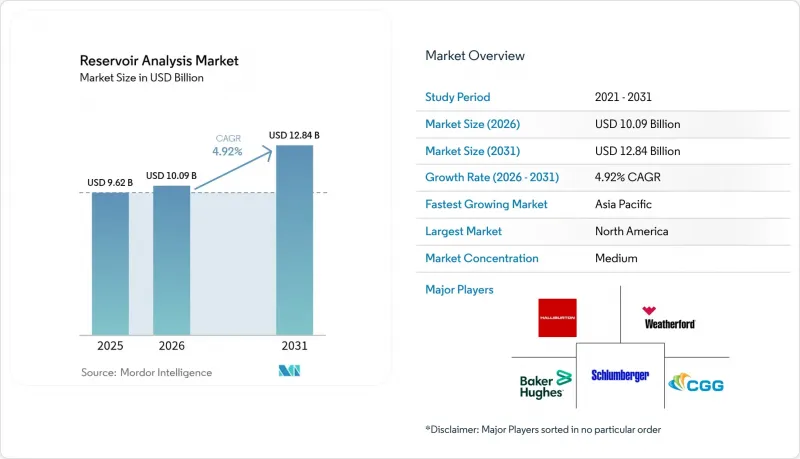
This report is Segmented by Service (Geo-Modelling, Reservoir Simulation, Data Acquisition and Monitoring, Reservoir Sampling, and More), Technology (Wireline Logging, Machine-Learning Assisted Analytics, and More), Reservoir Type (Conventional and Unconventional), Application (Onshore and Offshore), and Geography (North America, Europe, Asia-Pacific, South America, and Middle East and Africa).
Global Reservoir Analysis Market Trends and Insights
Rising unconventional hydrocarbon development
Rapid unconventional growth reshapes analytical requirements because shale reservoirs display multiphase flow regimes and artificial fracture networks that evade traditional models. Extra Trees machine-learning algorithms achieved an R2 value of 0.81 while forecasting Duvernay shale production, doubling the accuracy compared with legacy decline-curve techniques. Driven completion workflows enable operators to fine-tune fluid volumes and proppant concentration, often doubling early-life output. Such demonstrable gains fuel demand for advanced reservoir characterization, lifting the reservoir analysis market as unconventional assets mature.
Digital-oilfield adoption & advanced analytics integration
Edge AI, IoT sensors, and real-time platforms enable reservoir analysis to shift from episodic studies to continuous optimization. In Ecuador's Shushufindi Field, SLB's Agora edge AI prevented 12,000 barrels of deferred oil by predicting injection system failures.Automated fracture-stage evaluation now attains 99.7% event-detection accuracy, permitting on-the-fly pumping adjustments. These operational wins accelerate digital oilfield rollouts, reinforcing the steady expansion of the reservoir analysis market.
Oil-price volatility dampening E&P CAPEX
Despite firmer prices, producers maintain strict capital discipline, which prioritizes short-cycle studies over long-cycle ones. The Dallas Federal Reserve reports that companies are redirecting cash toward debt reduction and dividends rather than exploration budgets. Deferred projects shrink near-term spending on comprehensive reservoir studies, tempering the growth of the reservoir analysis market.
Other drivers and restraints analyzed in the detailed report include:
- Increasing offshore deep- / ultra-deepwater E&P spending
- Cloud-based collaborative reservoir models
- High service cost for HPHT & ultra-deepwater
For complete list of drivers and restraints, kindly check the Table Of Contents.
Segment Analysis
The reservoir analysis market size for geo-modeling reached its highest point in 2025, capturing a 37.74% share, due to its foundational role in field planning. Simulation, however, is forecast to post a 6.35% CAGR through 2031 as dynamic modelling supersedes static frameworks in unconventional settings. Operators leverage neural networks that outperform decline-curve forecasts by R2 margins exceeding 0.80 in Eagle Ford evaluations. Integrated reservoir management is gaining traction because single-vendor solutions reduce interface risk and shorten decision-making loops.
Data acquisition remains resilient as permanent downhole gauges enable continuous surveillance. Sampling services persist for fluid PVT quality control, although non-invasive spectroscopic tools are reducing the need for core-based tests. Emerging "others" services, digital twins, and automated inversion signal the next wave of analytics, reinforcing the reservoir analysis market as a strategic platform for multi-disciplinary optimisation.
Wireline logging retained a 42.98% share of the reservoir analysis market size in 2025, thanks to decades of field use. Machine-learning-assisted analytics, although smaller, are expected to accelerate at a 6.88% CAGR through 2031, as convolutional networks automate lithology classification. Hybrid workflows integrate gamma-ray, resistivity, and acoustic logs with AI models, reducing the interpretation cycle time by 60%. Fiber-optic distributed sensing, coupled with 4D seismic, furnishes real-time fracture diagnostics that augment completion design.
Operators value the fusion of trusted measurement and predictive intelligence, prompting service players to bundle AI software with legacy hardware. Baker Hughes' SureCONNECT FE fiber-optic wet-mate system, launched in January 2025, exemplifies this integration by enabling continuous monitoring in deepwater. This convergence feeds sustained value creation within the reservoir analysis market.
Complete Report Scope:
- By Service
- Geo-modelling
- Reservoir Simulation
- Data Acquisition and Monitoring
- Reservoir Sampling
- Integrated Reservoir Management
- Others
- By Technology
- Wireline Logging
- 3-D/4-D Seismic Imaging
- Fiber-Optic Distributed Sensing
- Machine-Learning Assisted Analytics
- By Reservoir Type
- Conventional
- Unconventional
- By Application
- Onshore
- Offshore
- By Geography
- North America
- United States
- Canada
- Mexico
- Europe
- Germany
- United Kingdom
- France
- Italy
- NORDIC Countries
- Russia
- Rest of Europe
- Asia-Pacific
- China
- India
- Japan
- South Korea
- ASEAN Countries
- Rest of Asia-Pacific
- South America
- Brazil
- Argentina
- Rest of South America
- Middle East and Africa
- Saudi Arabia
- United Arab Emirates
- South Africa
- Egypt
- Rest of Middle East and Africa
- North America
Geography Analysis
North America retains its leadership position with a 40.52% revenue share in 2025, driven by prolific shale drilling and the early adoption of digital oilfield technologies. Operators embed machine learning in every phase from completion design to decline diagnostics, reinforcing regional dominance. Collaborative efforts, such as the SLB-Nabors automation program, illustrate the ongoing technology upgrades that keep the reservoir analysis market vibrant in the region. Regulatory incentives for carbon capture and storage also stimulate new evaluation campaigns across the Gulf Coast.
The Asia-Pacific region posts a 7.31% CAGR, the fastest worldwide, driven by ambitious national energy security targets. China surpassed 400 million tons of oil and gas output in 2024, a milestone underpinned by advanced reservoir analytics that unlocked tight gas and deep carbonate resources. Australia's gas projects and India's CBM expansions further accelerate demand for simulation, seismic inversion, and production monitoring. Large-scale CCUS projects such as BP's Tangguh UCC in Indonesia add a parallel data stream focused on storage integrity.
Europe sustains a balanced market as operators extract more barrels from aging North Sea fields while pioneering the use of CO2 sequestration. Meanwhile, the Middle East and Africa channels capex into gas monetisation and offshore frontier plays, respectively. National oil companies in the region are increasingly stipulating integrated reservoir frameworks that bundle AI simulation with real-time surveillance, thereby widening the customer base for reservoir analysis market providers.
- Schlumberger
- Halliburton
- Baker Hughes
- Weatherford
- CGG
- Core Laboratories
- Emerson (Roxar)
- TGS
- Ikon Science
- Kongsberg Digital
- Resoptima
- Petroleum Experts
- Pason Systems
- Fugro
- Paradigm (Emerson)
- Trican Well Service
- TechnipFMC
- NOV
- Schlumberger Software (Petrel)
- Geolog
Additional Benefits:
- The market estimate (ME) sheet in Excel format
- 3 months of analyst support
TABLE OF CONTENTS
1 Introduction
- 1.1 Study Assumptions & Market Definition
- 1.2 Scope of the Study
2 Research Methodology
3 Executive Summary
4 Market Landscape
- 4.1 Market Overview
- 4.2 Market Drivers
- 4.2.1 Rising unconventional hydrocarbon development
- 4.2.2 Digital-oilfield adoption & advanced analytics integration
- 4.2.3 Increasing offshore deep-/ultra-deepwater E&P spending
- 4.2.4 Cloud-based collaborative reservoir models for real-time asset optimisation
- 4.2.5 Mandatory CCUS reservoir suitability studies
- 4.2.6 Geothermal repurposing of depleted fields
- 4.3 Market Restraints
- 4.3.1 Oil-price volatility dampening E&P CAPEX
- 4.3.2 High service cost for HPHT & ultra-deepwater reservoirs
- 4.3.3 Data-sovereignty & cybersecurity concerns limiting remote analytics
- 4.3.4 Shrinking pool of experienced petrotechnical professionals
- 4.4 Supply-Chain Analysis
- 4.5 Regulatory Landscape
- 4.6 Technological Outlook
- 4.7 Porters Five Forces
- 4.7.1 Bargaining Power of Suppliers
- 4.7.2 Bargaining Power of Buyers
- 4.7.3 Threat of New Entrants
- 4.7.4 Threat of Substitute Products & Services
- 4.7.5 Competitive Rivalry
5 Market Size & Growth Forecasts
- 5.1 By Service
- 5.1.1 Geo-modelling
- 5.1.2 Reservoir Simulation
- 5.1.3 Data Acquisition and Monitoring
- 5.1.4 Reservoir Sampling
- 5.1.5 Integrated Reservoir Management
- 5.1.6 Others
- 5.2 By Technology
- 5.2.1 Wireline Logging
- 5.2.2 3-D/4-D Seismic Imaging
- 5.2.3 Fiber-Optic Distributed Sensing
- 5.2.4 Machine-Learning Assisted Analytics
- 5.3 By Reservoir Type
- 5.3.1 Conventional
- 5.3.2 Unconventional
- 5.4 By Application
- 5.4.1 Onshore
- 5.4.2 Offshore
- 5.5 By Geography
- 5.5.1 North America
- 5.5.1.1 United States
- 5.5.1.2 Canada
- 5.5.1.3 Mexico
- 5.5.2 Europe
- 5.5.2.1 Germany
- 5.5.2.2 United Kingdom
- 5.5.2.3 France
- 5.5.2.4 Italy
- 5.5.2.5 NORDIC Countries
- 5.5.2.6 Russia
- 5.5.2.7 Rest of Europe
- 5.5.3 Asia-Pacific
- 5.5.3.1 China
- 5.5.3.2 India
- 5.5.3.3 Japan
- 5.5.3.4 South Korea
- 5.5.3.5 ASEAN Countries
- 5.5.3.6 Rest of Asia-Pacific
- 5.5.4 South America
- 5.5.4.1 Brazil
- 5.5.4.2 Argentina
- 5.5.4.3 Rest of South America
- 5.5.5 Middle East and Africa
- 5.5.5.1 Saudi Arabia
- 5.5.5.2 United Arab Emirates
- 5.5.5.3 South Africa
- 5.5.5.4 Egypt
- 5.5.5.5 Rest of Middle East and Africa
- 5.5.1 North America
6 Competitive Landscape
- 6.1 Market Concentration
- 6.2 Strategic Moves (M&A, Partnerships, PPAs)
- 6.3 Market Share Analysis (Market Rank/Share for key companies)
- 6.4 Company Profiles (includes Global level Overview, Market level overview, Core Segments, Financials as available, Strategic Information, Products & Services, and Recent Developments)
- 6.4.1 Schlumberger
- 6.4.2 Halliburton
- 6.4.3 Baker Hughes
- 6.4.4 Weatherford
- 6.4.5 CGG
- 6.4.6 Core Laboratories
- 6.4.7 Emerson (Roxar)
- 6.4.8 TGS
- 6.4.9 Ikon Science
- 6.4.10 Kongsberg Digital
- 6.4.11 Resoptima
- 6.4.12 Petroleum Experts
- 6.4.13 Pason Systems
- 6.4.14 Fugro
- 6.4.15 Paradigm (Emerson)
- 6.4.16 Trican Well Service
- 6.4.17 TechnipFMC
- 6.4.18 NOV
- 6.4.19 Schlumberger Software (Petrel)
- 6.4.20 Geolog
7 Market Opportunities & Future Outlook
- 7.1 White-space & Unmet-need Assessment

