PUBLISHER: Mordor Intelligence | PRODUCT CODE: 2124315

PUBLISHER: Mordor Intelligence | PRODUCT CODE: 2124315
IoT Device Management - Market Share Analysis, Industry Trends & Statistics, Growth Forecasts (2026 - 2031)
According to Mordor Intelligence, the IoT device management market size was valued at USD 8.79 billion in 2025 and estimated to grow from USD 10.66 billion in 2026 to reach USD 27.94 billion by 2031, at a CAGR of 21.26% during the forecast period (2026-2031).
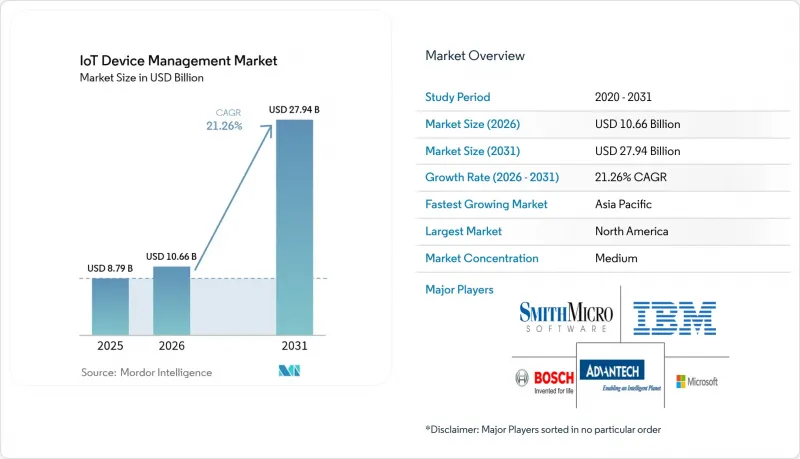
This report is Segmented by Component (Solutions and Services), Deployment Type (Cloud, On-Premise, and More), Connectivity Technology (Cellular [2G/3G/4G/5G], LPWAN [NB-IoT, Lorawan, Sigfox], and More), Organization Size (Small and Medium-Sized Enterprises and Large Enterprises), by End-User Vertical (Manufacturing, Transportation and Logistics, Healthcare and Life Sciences, and More), and Geography.
Global IoT Device Management Market Trends and Insights
Proliferation of IoT Endpoints Driving Lifecycle-Management Demand
Global connected-device counts will exceed 75 billion units by 2030, overwhelming traditional IT oversight models and elevating centralized orchestration as a board-level requirement. Factory floors now deploy thousands of heterogeneous sensors that demand automated provisioning, continuous observability, and over-the-air (OTA) firmware governance. Platform engineering teams are standardizing automation templates and security baselines in order to harmonize multi-vendor fleets and ensure auditability across jurisdictions.
Heightened Security and Compliance Mandates for Device Fleets
The EU Cyber Resilience Act, enacted in 2024, mandates secure-by-design principles, software bills of materials, and continuous vulnerability management, with non-compliance fines up to EUR 15 million. Parallel directives in the United States and Japan, combined with the average 5,200 monthly attacks on IoT endpoints, are steering buyers toward platforms that embed zero-trust architectures and real-time threat detection. Thales reports that 55% of organizations now rank IoT security among their top three enterprise risks.
Fragmented Interoperability Standards
Although initiatives such as Matter and OPC UA promote common schemas, the absence of universal frameworks across industrial, consumer, and municipal domains forces enterprises to juggle multiple device-management portals. An MDPI study finds that 67% of multi-vendor deployments still rely on bespoke APIs, inflating integration costs and elongating time-to-value.
Other drivers and restraints analyzed in the detailed report include:
- Edge-Cloud Shift Requiring Unified OTA and Remote Diagnostics
- 5G and LPWAN Roll-outs Unlocking Hyperscale Connection Volumes
- Cross-border Data-Sovereignty Constraints
For complete list of drivers and restraints, kindly check the Table Of Contents.
Segment Analysis
Solutions held a commanding 70.35% share in 2025, anchored by modules for security, provisioning, and analytics. The segment is on track for a 21.90% CAGR as enterprises re-architect brownfield assets into policy-driven, cloud-native frameworks. Security management modules are the breakout sub-category, reflecting relentless compliance pressure. Services, at 29.65%, are edging ahead in growth (22.10% CAGR) as brownfield retrofits require systems integration and as-a-service management. Managed services resonate with SMEs that lack embedded engineering teams, while professional services drive complex, multi-factory rollouts. The convergence of the two components signals commoditization at the core platform level and shifts differentiation to vertical accelerators and AI co-pilots.
Cloud continues to dominate with 67.85% share in 2025, but latency-critical workloads are pushing compute to factory floors, utility substations, and roadside cabinets. Edge-native deployments are forecast to log a 26% CAGR, propelled by 5G MEC nodes and GPU-equipped gateways. Hybrid blueprints blend global cloud scalability with deterministic local control, ensuring firmware governance and anomaly detection even during backhaul outages. AI inferencing at the edge reduces raw data backhaul up to 75%, shrinking carbon footprints and lowering carrier fees. Vendors are embedding Kubernetes-compatible runtimes, enabling DevOps-style CI/CD pipelines for OTA firmware and container updates.
Complete Report Scope:
- By Component
- Solutions
- Security Management
- Device Provisioning and On-boarding
- OTA Firmware and Software Updates
- Remote Monitoring and Diagnostics
- Data Management and Analytics
- Services
- Professional Services
- Managed Services
- Solutions
- By Deployment Type
- Cloud
- On-premise
- Hybrid
- Edge-native
- By Connectivity Technology
- Cellular (2G/3G/4G/5G)
- LPWAN (NB-IoT, LoRaWAN, Sigfox)
- Wi-Fi/Bluetooth
- Satellite and Others
- By Organization Size
- Small and Medium-sized Enterprises
- Large Enterprises
- By End-user Vertical
- Manufacturing
- Transportation and Logistics
- Healthcare and Life Sciences
- Retail and E-commerce
- Energy and Utilities
- Smart Cities and Public Safety
- Agriculture
- Others
- By Geography
- North America
- United States
- Canada
- Mexico
- South America
- Brazil
- Argentina
- Rest of South America
- Europe
- Germany
- United Kingdom
- France
- Italy
- Spain
- Rest of Europe
- Asia-Pacific
- China
- Japan
- India
- South Korea
- Rest of Asia-Pacific
- Middle East and Africa
- Middle East
- United Arab Emirates
- Saudi Arabia
- Turkey
- Rest of Middle East
- Africa
- South Africa
- Nigeria
- Kenya
- Rest of Africa
- Middle East
- North America
Geography Analysis
North America captured 31.75% revenue in 2025, leveraging mature cloud ecosystems and early adoption in aerospace, automotive, and healthcare. Federal funding for smart-grid resilience and the National Cybersecurity Strategy further stimulates platform upgrades. Asia Pacific is the primary growth engine, expanding at a 24.10% CAGR as governments subsidize factory automation and smart-city rollouts. IDC projects 38.9 billion connected devices in the region by 2030, underpinned by widespread 5G Stand-Alone deployments that simplify SIM provisioning.
China dominates absolute volumes, yet India and Indonesia are posting double-digit growth as carriers light up NB-IoT networks across industrial corridors. Japanese and South Korean OEMs are embedding eSIM/iSIM modules to support post-sale connectivity brokering, fueling regional demand for carrier-agnostic management consoles. Europe holds a substantial share due to GDPR and the Cyber Resilience Act, which obligate rigorous vulnerability patching regimes. These mandates favor vendors offering dependency mapping and cryptographically verifiable OTA pipelines.
Emerging regions in the Middle East and Africa are leapfrogging legacy M2M by adopting satellite-augmented LoRaWAN for oil-field telemetry and remote utility metering. South America's adoption curve is tied to spectrum liberalization and utility modernization programs, with Brazil piloting AMI projects covering six million smart meters. Across all geographies, sovereign-cloud requirements are driving localized control planes, spurring partnerships between global hyperscalers and in-country data-center operators.
- Microsoft
- Amazon Web Services (AWS)
- IBM
- PTC
- Software AG
- Bosch.IO
- Cisco Systems
- Oracle
- Google Cloud
- Telit Cinterion
- Advantech
- Smith Micro Software
- Aeris Communications
- AVSystem
- Samsung Knox (Samsung Electronics)
- KORE Wireless
- Eseye
- EdgeIQ
- Huawei Technologies
- Arm
- ATandT
Additional Benefits:
- The market estimate (ME) sheet in Excel format
- 3 months of analyst support
TABLE OF CONTENTS
1 INTRODUCTION
- 1.1 Study Assumptions and Market Definition
- 1.2 Scope of the Study
2 RESEARCH METHODOLOGY
3 EXECUTIVE SUMMARY
4 MARKET LANDSCAPE
- 4.1 Market Overview
- 4.2 Market Drivers
- 4.2.1 Proliferation of IoT endpoints driving lifecycle-management demand
- 4.2.2 Heightened security and compliance mandates for device fleets
- 4.2.3 Edge-cloud shift requiring unified OTA and remote diagnostics
- 4.2.4 5G and LPWAN roll-outs unlocking hyperscale connection volumes
- 4.2.5 eSIM/iSIM-enabled dynamic connectivity sourcing
- 4.2.6 AI-driven self-healing and predictive maintenance of devices
- 4.3 Market Restraints
- 4.3.1 Fragmented interoperability standards
- 4.3.2 Cross-border data-sovereignty constraints
- 4.3.3 Carbon-footprint scrutiny of cloud back-ends
- 4.3.4 Scarcity of OT-IT integration talent
- 4.4 Value/Supply-Chain Analysis
- 4.5 Regulatory Landscape
- 4.6 Technological Outlook
- 4.7 Porter's Five Forces Analysis
- 4.7.1 Bargaining Power of Suppliers
- 4.7.2 Bargaining Power of Buyers
- 4.7.3 Threat of New Entrants
- 4.7.4 Threat of Substitutes
- 4.7.5 Intensity of Competitive Rivalry
5 MARKET SIZE AND GROWTH FORECASTS (VALUE)
- 5.1 By Component
- 5.1.1 Solutions
- 5.1.1.1 Security Management
- 5.1.1.2 Device Provisioning and On-boarding
- 5.1.1.3 OTA Firmware and Software Updates
- 5.1.1.4 Remote Monitoring and Diagnostics
- 5.1.1.5 Data Management and Analytics
- 5.1.2 Services
- 5.1.2.1 Professional Services
- 5.1.2.2 Managed Services
- 5.1.1 Solutions
- 5.2 By Deployment Type
- 5.2.1 Cloud
- 5.2.2 On-premise
- 5.2.3 Hybrid
- 5.2.4 Edge-native
- 5.3 By Connectivity Technology
- 5.3.1 Cellular (2G/3G/4G/5G)
- 5.3.2 LPWAN (NB-IoT, LoRaWAN, Sigfox)
- 5.3.3 Wi-Fi/Bluetooth
- 5.3.4 Satellite and Others
- 5.4 By Organization Size
- 5.4.1 Small and Medium-sized Enterprises
- 5.4.2 Large Enterprises
- 5.5 By End-user Vertical
- 5.5.1 Manufacturing
- 5.5.2 Transportation and Logistics
- 5.5.3 Healthcare and Life Sciences
- 5.5.4 Retail and E-commerce
- 5.5.5 Energy and Utilities
- 5.5.6 Smart Cities and Public Safety
- 5.5.7 Agriculture
- 5.5.8 Others
- 5.6 By Geography
- 5.6.1 North America
- 5.6.1.1 United States
- 5.6.1.2 Canada
- 5.6.1.3 Mexico
- 5.6.2 South America
- 5.6.2.1 Brazil
- 5.6.2.2 Argentina
- 5.6.2.3 Rest of South America
- 5.6.3 Europe
- 5.6.3.1 Germany
- 5.6.3.2 United Kingdom
- 5.6.3.3 France
- 5.6.3.4 Italy
- 5.6.3.5 Spain
- 5.6.3.6 Rest of Europe
- 5.6.4 Asia-Pacific
- 5.6.4.1 China
- 5.6.4.2 Japan
- 5.6.4.3 India
- 5.6.4.4 South Korea
- 5.6.4.5 Rest of Asia-Pacific
- 5.6.5 Middle East and Africa
- 5.6.5.1 Middle East
- 5.6.5.1.1 United Arab Emirates
- 5.6.5.1.2 Saudi Arabia
- 5.6.5.1.3 Turkey
- 5.6.5.1.4 Rest of Middle East
- 5.6.5.2 Africa
- 5.6.5.2.1 South Africa
- 5.6.5.2.2 Nigeria
- 5.6.5.2.3 Kenya
- 5.6.5.2.4 Rest of Africa
- 5.6.5.1 Middle East
- 5.6.1 North America
6 COMPETITIVE LANDSCAPE
- 6.1 Market Concentration
- 6.2 Strategic Moves
- 6.3 Market Share Analysis
- 6.4 Company Profiles {(includes Global level Overview, Market level overview, Core Segments, Financials as available, Strategic Information, Market Rank/Share for key companies, Products and Services, and Recent Developments)}
- 6.4.1 Microsoft
- 6.4.2 Amazon Web Services (AWS)
- 6.4.3 IBM
- 6.4.4 PTC
- 6.4.5 Software AG
- 6.4.6 Bosch.IO
- 6.4.7 Cisco Systems
- 6.4.8 Oracle
- 6.4.9 Google Cloud
- 6.4.10 Telit Cinterion
- 6.4.11 Advantech
- 6.4.12 Smith Micro Software
- 6.4.13 Aeris Communications
- 6.4.14 AVSystem
- 6.4.15 Samsung Knox (Samsung Electronics)
- 6.4.16 KORE Wireless
- 6.4.17 Eseye
- 6.4.18 EdgeIQ
- 6.4.19 Huawei Technologies
- 6.4.20 Arm
- 6.4.21 ATandT
7 MARKET OPPORTUNITIES AND FUTURE OUTLOOK
- 7.1 White-space and Unmet-Need Assessment

