PUBLISHER: Mordor Intelligence | PRODUCT CODE: 2124325

PUBLISHER: Mordor Intelligence | PRODUCT CODE: 2124325
Automotive Ethernet - Market Share Analysis, Industry Trends & Statistics, Growth Forecasts (2026 - 2031)
According to Mordor Intelligence, the automotive ethernet market size was valued at USD 3.5 billion in 2025 and estimated to grow from USD 4.29 billion in 2026 to reach USD 11.93 billion by 2031, at a CAGR of 22.70% during the forecast period (2026-2031).
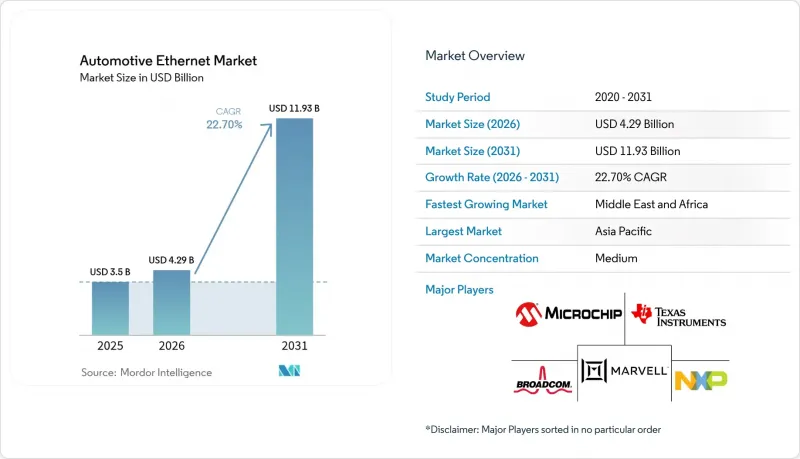
This report is Segmented by Component (Hardware, Software, and Services), Bandwidth/Operating Speed (10 Mbps [10BASE-T1S], 100 Mbps [100BASE-T1], and More), Application (ADAS and Autonomous Sensors, Infotainment and Telematics, Powertrain, and More), Vehicle Type (Passenger Cars, Light Commercial Vehicles, and More), and Geography. The Market Forecasts are Provided in Terms of Value (USD).
Global Automotive Ethernet Market Trends and Insights
Surging Infotainment & ADAS Bandwidth Demand
Advanced camera, radar, and LiDAR arrays can stream up to 40 Gbps of raw data that must reach centralized processors with minimal latency. Ethernet backbones scaling from 100 Mbps to 10 Gbps are therefore replacing legacy buses capped at 10 Mbps, enabling high-resolution mapping and immersive cabin experiences. Luxury brands already equip roughly 60% of premium models with Ethernet infotainment links, a pattern expected to cascade to volume segments over the forecast window. Real-time multi-sensor fusion is also accelerating the shift to gigabit-class links because safety algorithms require deterministic latency budgets. Together, these forces keep network throughput on an upward trajectory and underpin continuous chipset innovation.
Rapid Adoption of Low-Cost Single-Pair Ethernet
Single-pair Ethernet eliminates two differential pairs, cutting harness weight by up to 40% and wiring cost by nearly 20%, benefits that directly extend the range of electric vehicles. 10BASE-T1S supports multidrop topologies, allowing multiple edge sensors to share a single twisted pair without complex gateways. Leading OEM programs in China are already releasing pre-production vehicles with SPE to connect door, seat, and lighting modules, while suppliers such as Analog Devices offer PHYs with integrated MACsec to simplify security compliance. Early deployments confirm that simplified cabling accelerates zonal architecture rollouts and scales cost-sensitive platforms.
Interoperability & Legacy ECU Compatibility Issues
Many mass-production platforms still rely on CAN or LIN domains that do not disappear overnight. Bridging gateways must translate protocols while safeguarding timing constraints, adding bill-of-materials cost and software complexity. The Automotive Central Gateway Module market, valued at USD 2.1 billion in 2025, highlights the scale of this interim architecture. Chinese OEMs such as Chery have thus designed Ethernet gateways tailored to coexist with instrument-cluster CAN buses, proving that transition strategies can mitigate but not fully erase integration pain. Over the next two years, these gateways will remain essential as fleets slowly migrate toward full Ethernet zones.
Other drivers and restraints analyzed in the detailed report include:
- EV & Autonomous Platforms Shift to Zonal E/E Architectures
- OEM Standardization via OPEN Alliance & IEEE TSN Profiles
- Vehicle-Level Cybersecurity & Functional-Safety Certification Hurdles
For complete list of drivers and restraints, kindly check the Table Of Contents.
Segment Analysis
The hardware segment held 62.35% of 2025 revenue, led by PHY transceivers, switches, and controllers that anchor every in-vehicle network. Multi-generation roadmaps from vendors such as Microchip add 100 Mbps to 1 Gbps capabilities on a single die, underscoring performance-per-dollar improvements. The services sub-segment, though smaller in absolute revenue, is the fastest riser at a 26.95% CAGR because OEMs increasingly outsource compliance, TSN tuning, and deep packet inspection. Keysight's automated compliance suits accelerate IEEE conformance, reflecting how test expertise commands premium fees. Collectively, this dynamic positions services as a strategic growth lever even as silicon volumes remain the revenue anchor.
In parallel, software stacks that support secure boot, network orchestration, and over-the-air configuration gain relevance as zonal architectures mature. Real-time operating systems suppliers bundle ISO 26262 certification artifacts to simplify adoption, proving that the Automotive Ethernet market rewards turnkey solutions over discrete components. As data volumes rise, cloud-linked analytics platforms will likely emerge as an adjacent services layer, further diversifying revenue pools in the Automotive Ethernet industry.
100BASE-T1 retains a 41.10% share in 2025, serving body control and infotainment needs that top out below 100 Mbps. Its mature cost curve and OPEN Alliance interoperability profile sustain its appeal, balancing throughput against price. The 2.5/5/10 Gbps class exhibits the strongest upside with a 36.60% CAGR through 2031, moving the Automotive Ethernet market size for high-speed links into the multi-billion-dollar range by the end of the forecast window. Supply-chain readiness is improving as switch silicon integrates 10GBASE-T1 PHYs, allowing single-package zonal backbones.
10BASE-T1S addresses edge sensor connectivity by providing 10 Mbps multidrop capability, removing gateway cost where deterministic latency is less critical. Meanwhile, 1000BASE-T1 plays an intermediate role, bridging today's needs and tomorrow's zonal ambitions. Overall, the shift toward gigabit and multi-gigabit tiers unlocks new software-defined features, including real-time object classification and high-definition cabin streaming, reinforcing the Automotive Ethernet market expansion.
Complete Report Scope:
- By Component
- Hardware
- Software
- Services
- By Bandwidth/Operating Speed
- 10 Mbps (10BASE-T1S)
- 100 Mbps (100BASE-T1)
- 1 Gbps (1000BASE-T1)
- 2.5/5/10 Gbps Multi-Gig (2.5G/5G/10GBASE-T1)
- By Application
- ADAS and Autonomous Sensors
- Infotainment and Telematics
- Powertrain
- Chassis and Safety
- Body and Comfort
- Diagnostics and OTA Updates
- By Vehicle Type
- Passenger Cars
- Light Commercial Vehicles
- Heavy Commercial/Truck and Bus
- Off-Highway and Agriculture
- By Geography
- North America
- United States
- Canada
- Mexico
- South America
- Brazil
- Argentina
- Rest of South America
- Europe
- Germany
- France
- United Kingdom
- Italy
- Spain
- Russia
- Rest of Europe
- Asia-Pacific
- China
- Japan
- India
- South Korea
- Australia
- Rest of Asia-Pacific
- Middle East and Africa
- Middle East
- Saudi Arabia
- UAE
- Turkey
- Rest of Middle East
- Africa
- South Africa
- Egypt
- Nigeria
- Rest of Africa
- Middle East
- North America
Geography Analysis
Asia-Pacific commands 47.60% of global 2025 demand, anchored by China's rapid transition to connected and automated vehicles. The Chinese Automotive Ethernet market size is projected to surpass RMB 12 billion (USD 1.7 billion) in 2025 as national standards such as GB/T 45503-2025 define ECU compliance test methods. Local silicon champions shorten design cycles, benefiting domestic OEMs that iterate quickly on zonal prototypes. Japan and South Korea extend regional dominance through vertically integrated electronics and automotive supply chains, deploying SPE production lines by 2025.
North America leverages its software ecosystem and venture-capital pipeline to pilot advanced software-defined vehicles. Regulatory bodies emphasize cybersecurity, as the U.S. Department of Commerce weighs restrictions on suspect semiconductor inputs in connected vehicles. OEMs in Detroit and Silicon Valley accelerate OTA frameworks, fostering demand for gigabit backbones. Trade frictions with China inject supply-chain risk around PHY chip logistics, prompting near-shoring strategies and dual-sourcing agreements to sustain program schedules.
The Middle East & Africa holds a smaller base but exhibits the fastest regional growth at 24.75% CAGR through 2031. Governments in Saudi Arabia and the UAE incentivize local assembly and electric-vehicle uptake, encouraging global OEMs to import Ethernet-enabled premium models. Smart-city deployments complement high-speed vehicle networks, allowing traffic-signal priority and V2X safety features to flourish. Premium European brands leverage free-trade zones to position their latest models, further accelerating Ethernet penetration across the region.
- Broadcom Inc.
- NXP Semiconductors N.V.
- Marvell Technology Group Ltd.
- Microchip Technology Inc.
- Texas Instruments Inc.
- Molex Incorporated
- TE Connectivity Ltd.
- Cadence Design Systems Inc.
- Keysight Technologies Inc.
- TTTech Auto AG
- AMD Xilinx
- Analog Devices Inc.
- Renesas Electronics Corp.
- Realtek Semiconductor Corp.
- Rohde and Schwarz GmbH
- Vector Informatik GmbH
- Aptiv PLC
- Infineon Technologies AG
- Continental AG
- HMS Networks AB
- Aeonsemi Corp.
- Aukua Systems Inc.
- Spirent Communications PLC
Additional Benefits:
- The market estimate (ME) sheet in Excel format
- 3 months of analyst support
TABLE OF CONTENTS
1 Introduction
- 1.1 Study Assumptions and Market Definition
- 1.2 Scope of the Study
2 Research Methodology
3 Executive Summary
4 Market Landscape
- 4.1 Market Overview
- 4.2 Market Drivers
- 4.2.1 Surging infotainment and ADAS bandwidth demand
- 4.2.2 Rapid adoption of low-cost single-pair Ethernet (SPE)
- 4.2.3 EV and autonomous platforms shifting to zonal E/E architectures
- 4.2.4 OEM standardisation via OPEN Alliance and IEEE TSN profiles
- 4.2.5 OEM push for end-to-end OTA software pipelines needing GbE backbones
- 4.2.6 Weight-reduction incentives in EU/China favouring Ethernet over CAN-FD
- 4.3 Market Restraints
- 4.3.1 Interoperability and legacy ECU compatibility issues
- 4.3.2 Vehicle-level cyber-security and functional-safety certification hurdles
- 4.3.3 Multi-gig EMC/EMI compliance costs above 5 Gbps
- 4.3.4 US-China tariff volatility on PHY chip supply chains
- 4.4 Value/Supply-Chain Analysis
- 4.5 Regulatory Landscape
- 4.6 Technological Outlook (TSN, Multi-Gig, PoDL, Zonal)
- 4.7 Porter's Five Forces Analysis
- 4.7.1 Bargaining Power of Suppliers
- 4.7.2 Bargaining Power of Consumers
- 4.7.3 Threat of New Entrants
- 4.7.4 Threat of Substitutes
- 4.7.5 Intensity of Competitive Rivalry
- 4.8 Impact of Macroeconomic Trends on the Market
5 Market Size and Growth Forecasts (VALUE)
- 5.1 By Component
- 5.1.1 Hardware
- 5.1.2 Software
- 5.1.3 Services
- 5.2 By Bandwidth/Operating Speed
- 5.2.1 10 Mbps (10BASE-T1S)
- 5.2.2 100 Mbps (100BASE-T1)
- 5.2.3 1 Gbps (1000BASE-T1)
- 5.2.4 2.5/5/10 Gbps Multi-Gig (2.5G/5G/10GBASE-T1)
- 5.3 By Application
- 5.3.1 ADAS and Autonomous Sensors
- 5.3.2 Infotainment and Telematics
- 5.3.3 Powertrain
- 5.3.4 Chassis and Safety
- 5.3.5 Body and Comfort
- 5.3.6 Diagnostics and OTA Updates
- 5.4 By Vehicle Type
- 5.4.1 Passenger Cars
- 5.4.2 Light Commercial Vehicles
- 5.4.3 Heavy Commercial/Truck and Bus
- 5.4.4 Off-Highway and Agriculture
- 5.5 By Geography
- 5.5.1 North America
- 5.5.1.1 United States
- 5.5.1.2 Canada
- 5.5.1.3 Mexico
- 5.5.2 South America
- 5.5.2.1 Brazil
- 5.5.2.2 Argentina
- 5.5.2.3 Rest of South America
- 5.5.3 Europe
- 5.5.3.1 Germany
- 5.5.3.2 France
- 5.5.3.3 United Kingdom
- 5.5.3.4 Italy
- 5.5.3.5 Spain
- 5.5.3.6 Russia
- 5.5.3.7 Rest of Europe
- 5.5.4 Asia-Pacific
- 5.5.4.1 China
- 5.5.4.2 Japan
- 5.5.4.3 India
- 5.5.4.4 South Korea
- 5.5.4.5 Australia
- 5.5.4.6 Rest of Asia-Pacific
- 5.5.5 Middle East and Africa
- 5.5.5.1 Middle East
- 5.5.5.1.1 Saudi Arabia
- 5.5.5.1.2 UAE
- 5.5.5.1.3 Turkey
- 5.5.5.1.4 Rest of Middle East
- 5.5.5.2 Africa
- 5.5.5.2.1 South Africa
- 5.5.5.2.2 Egypt
- 5.5.5.2.3 Nigeria
- 5.5.5.2.4 Rest of Africa
- 5.5.5.1 Middle East
- 5.5.1 North America
6 Competitive Landscape
- 6.1 Market Concentration
- 6.2 Strategic Moves
- 6.3 Market Share Analysis
- 6.4 Company Profiles (includes Global level Overview, Market level overview, Core Segments, Financials as available, Strategic Information, Market Rank/Share, Products and Services, Recent Developments)
- 6.4.1 Broadcom Inc.
- 6.4.2 NXP Semiconductors N.V.
- 6.4.3 Marvell Technology Group Ltd.
- 6.4.4 Microchip Technology Inc.
- 6.4.5 Texas Instruments Inc.
- 6.4.6 Molex Incorporated
- 6.4.7 TE Connectivity Ltd.
- 6.4.8 Cadence Design Systems Inc.
- 6.4.9 Keysight Technologies Inc.
- 6.4.10 TTTech Auto AG
- 6.4.11 AMD Xilinx
- 6.4.12 Analog Devices Inc.
- 6.4.13 Renesas Electronics Corp.
- 6.4.14 Realtek Semiconductor Corp.
- 6.4.15 Rohde and Schwarz GmbH
- 6.4.16 Vector Informatik GmbH
- 6.4.17 Aptiv PLC
- 6.4.18 Infineon Technologies AG
- 6.4.19 Continental AG
- 6.4.20 HMS Networks AB
- 6.4.21 Aeonsemi Corp.
- 6.4.22 Aukua Systems Inc.
- 6.4.23 Spirent Communications PLC
7 Market Opportunities and Future Outlook
- 7.1 White-space and Unmet-Need Assessment

