PUBLISHER: Mordor Intelligence | PRODUCT CODE: 2124329

PUBLISHER: Mordor Intelligence | PRODUCT CODE: 2124329
Solid Electrolyte - Market Share Analysis, Industry Trends & Statistics, Growth Forecasts (2026 - 2031)
According to Mordor Intelligence, the solid electrolyte market size is expected to grow from USD 33.89 million in 2025 to USD 39.18 million in 2026 and is forecast to reach USD 80.94 million by 2031 at 15.62% CAGR over 2026-2031.
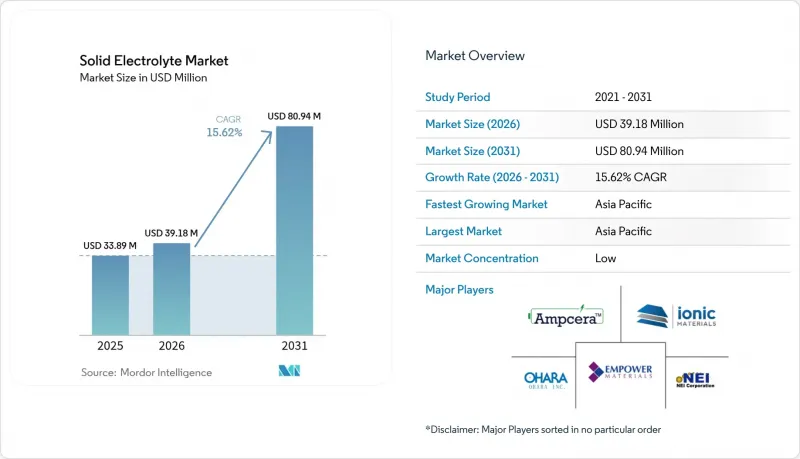
This report is Segmented by Material Type (Sulfide Ceramics, Halide Ceramics, and More), Battery Type (EV Traction Batteries, and More), Manufacturing Method (Tape Casting/Cold Pressing, Additive Manufacturing/3-D Printing, and More), Thickness (Below 25µm, 25 To 100µm, and Above 100µm), End-Use Industry (Automotive, Medical Devices, and More), and Geography (North America, Europe, Asia-Pacific, and More).
Global Solid Electrolyte Market Trends and Insights
EV Safety Regulations Shifting Toward Solid-State Chemistry
New battery directives in the European Union require stringent thermal runaway prevention, a criterion that is met more readily by solid electrolytes than by liquid-filled lithium-ion cells. Japan issued safety approvals for Toyota's solid-state EV program in late 2024, signalling regulatory comfort with ceramic separators in high-energy applications. In aviation, the Federal Aviation Administration is evaluating solid electrolytes to meet low-flammability targets for next-gen aircraft power systems.These actions align global regulators behind a common safety rationale that elevates solid-state chemistry from optional to essential in upcoming platform designs. Automakers therefore integrate solid electrolytes not only for performance but also to secure future type approval across markets.
OEM R&D Race for >500 Wh/kg Batteries
Breakthrough energy densities around 500 Wh/kg, showcased by CATL's condensed-state cell prototypes in 2024, validate solid electrolytes as the enabling architecture for ultra-light vehicle packs. Subsequent lab demonstrations, climbing toward 711 Wh/kg, underscore a rapidly expanding theoretical ceiling. The pursuit encompasses charge-rate targets of sub-15 minutes, which demand high-temperature tolerance that ceramic or halide electrolytes provide. Competing OEMs now view the chemistry as central to their 2027-2030 product cycles, intensifying procurement of sulfide, halide, and oxide materials and stimulating multibillion-dollar supply contracts.
High Sintering & Deposition CAPEX
Conventional sulfide and oxide ceramics often require furnace cycles above 900 °C, driving equipment outlays that can exceed USD 50 million for a mid-scale line. Penn State's cold-sinter method lowers process temperature to 150 °C, cutting both energy demand and kiln investment [PSU.EDU]. Early techno-economic assessments place the thin lithium-metal anode cost at USD 4.3 m2 against a USD 2.1 m2 target, illustrating the economic gap manufacturers seek to bridge. The adoption of VAT photopolymerisation for LLZO geometries further reduces infrastructure needs by printing parts near-net shape, thereby bypassing multiple grinding and polishing steps.
Other drivers and restraints analyzed in the detailed report include:
- Venture-Capital Inflows & Pilot-Line Scale-Ups
- Consumer Micro-Devices Needing Ultra-Thin Cells
- Ceramic Processing Yield Losses
For complete list of drivers and restraints, kindly check the Table Of Contents.
Segment Analysis
Sulfide ceramics delivered 42.12% solid electrolyte market share in 2025 on the strength of Li6PS5Cl conductivities surpassing 1 mS cm-1 and well-understood tape-casting routes. The segment nevertheless faces cost and moisture sensitivity challenges that encourage the parallel development of halide and oxide options. Halide ceramics, although holding a modest base in 2025, are expected to register the fastest 18.74% CAGR through 2031, as their superior oxidative stability simplifies high-voltage cathode pairing. R&D focuses on Cl-, Br-, and F-rich frameworks that maintain high conductivity without hygroscopic degradation.
Manufacturers weigh oxidative tolerance, raw-material availability, and processing yield when selecting chemistries for specific end uses. Oxide garnets, such as Ta-doped LLZO, retain relevance where the risk of moisture ingress is high, despite their higher sintering temperatures. Polymer and glass-ceramic hybrids serve niche flexible electronics but remain secondary volume drivers. The cumulative effect keeps the overall solid electrolyte market size diversified across at least four main chemistries, ensuring supply resilience while fuelling intellectual-property competition.
EV traction packs captured 52.40% of the solid electrolyte market size in 2025 and are expected to expand at an 18.52% CAGR as global automakers schedule solid-state models for late-decade launch windows. The scale requirements of 60-100 kWh vehicle packs compel suppliers to target gigawatt-hour factories, which in turn subsidise cost learning, benefiting smaller segments. Consumer electronics continue to hold a steady share, with smartphones, laptops, and AR devices leading the way, aided by form-factor advantages and stringent safety standards for passenger-carried batteries.
Stationary energy storage, aerospace, medical implants, and industrial IoT collectively compose the remainder, each valuing specific attributes-cycle life, temperature resilience, biocompatibility, or miniaturisation. Technology spill-over from automotive R&D thus accelerates performance gains in these secondary arenas, reinforcing the dominant role of EV programmes in dictating material supply and equipment standards throughout the broader solid electrolyte market.
Complete Report Scope:
- By Material Type
- Oxide Ceramics (LLZO, LIPON, Perovskite, LISICON)
- Sulfide Ceramics (Argyrodite, LGPS family, Thio-LISICON)
- Phosphate Ceramics (NASICON, LISICON-P)
- Halide Ceramics
- Polymer Electrolytes (PEO, PAN, PVDF, PBI, etc.)
- Composite/Biphasic Electrolytes
- Glass and Glass-Ceramics (LIPON, LiPON-Si)
- Others
- By Battery Type
- Consumer Electronics Batteries
- EV Traction Batteries
- Energy-Storage System Batteries
- Aerospace and Defence Batteries
- Medical Implant Batteries
- Industrial and IoT Sensor Batteries
- By Manufacturing Method
- Tape Casting/Cold Pressing
- Hot Pressing and Sinter-HIP
- Atomic/Molecular Layer Deposition
- Solvent/Doctor-Blade Casting
- Additive Manufacturing/3-D Printing
- By Thickness
- Below 25 µm
- 25 to 100 µm
- Above 100 µm
- By End-use Industry
- Automotive
- Consumer Electronics
- Stationary Energy Storage
- Aerospace and Defence
- Medical Devices
- Industrial Equipment
- By Geography
- North America
- United States
- Canada
- Mexico
- Europe
- Germany
- United Kingdom
- France
- Italy
- NORDIC Countries
- Russia
- Rest of Europe
- Asia-Pacific
- China
- India
- Japan
- South Korea
- ASEAN Countries
- Rest of Asia-Pacific
- South America
- Brazil
- Argentina
- Rest of South America
- Middle East and Africa
- Saudi Arabia
- United Arab Emirates
- South Africa
- Egypt
- Rest of Middle East and Africa
- North America
Geography Analysis
The Asia-Pacific region controlled 57.75% of the revenue in 2025 and is forecast to realize an 17.65% CAGR, driven by vertically integrated supply chains, encompassing raw lithium refining, ceramic powder synthesis, cell assembly, and module integration, co-located within China, Japan, and South Korea. CATL, Panasonic, LG Energy Solution, and a suite of material makers coordinate investment pipelines that keep regional cost floors low. Government programmes such as South Korea's USD 35 billion battery initiative reinforce the region's trajectory.
North America is accelerating on the back of the U.S. Inflation Reduction Act and Department of Energy grants, promoting the construction of ceramic separator and sulfide powder plants that are eligible for tax credits. Partnerships uniting automakers with university spin-offs focus on closing process-yield gaps and qualifying domestic raw material streams. By 2030, the region could host multiple multi-gigawatt solid electrolyte lines, raising its contribution to global supply from the current single digits toward the low-20% range.
Europe pursues strategic autonomy through the European Battery Regulation and joint-venture factories underwritten by national governments. Volkswagen's battery arm, PowerCo, licenses solid electrolyte intellectual property to anchor planned German and Swedish plants capable of 40 GWh annual output. The policy emphasis on sustainability, circular economy, and local supply chains makes solid-state chemistry attractive due to its longer service life and improved recyclability. Combined, these moves indicate a rebalancing in which Asia retains primacy but faces credible trans-Atlantic challengers.
- Toyota Motor Corp (Solid-State Program)
- QuantumScape Corp
- Solid Power Inc.
- ProLogium Technology Co. Ltd
- CATL (Contemporary Amperex Technology Co.)
- Samsung SDI
- LG Energy Solution
- Panasonic Energy
- Ilika plc
- NEI Corporation
- Ohara Inc.
- Ampcera Corp
- Ionic Materials Inc.
- Empower Materials
- Tosoh Corporation
- Murata Manufacturing Co.
- GS Yuasa Corp
- Hitachi Zosen Corporation
- BYD Co. Ltd
- SK On Co. Ltd
- Mitsubishi Chemical Group
- Toshima Manufacturing Co. Ltd
Additional Benefits:
- The market estimate (ME) sheet in Excel format
- 3 months of analyst support
TABLE OF CONTENTS
1 Introduction
- 1.1 Study Assumptions & Market Definition
- 1.2 Scope of the Study
2 Research Methodology
3 Executive Summary
4 Market Landscape
- 4.1 Market Overview
- 4.2 Market Drivers
- 4.2.1 EV safety regulations shifting toward solid-state chemistry
- 4.2.2 OEM R&D race for >500 Wh/kg batteries
- 4.2.3 Venture-capital inflows & pilot-line scale-ups
- 4.2.4 Consumer micro-devices needing ultra-thin cells
- 4.2.5 Sodium solid electrolytes for grid-scale storage
- 4.2.6 Defence requirement for -50 °C to +150 °C power packs
- 4.3 Market Restraints
- 4.3.1 High sintering & deposition CAPEX
- 4.3.2 Ceramic processing yield losses
- 4.3.3 Li-metal dendrite breach in sulfide matrices
- 4.3.4 Scarce Li2S & high-purity P2S5 supply chain
- 4.4 Supply-Chain Analysis
- 4.5 Regulatory Landscape
- 4.6 Technological Outlook
- 4.7 Porter's Five Forces
- 4.7.1 Bargaining Power of Suppliers
- 4.7.2 Bargaining Power of Consumers
- 4.7.3 Threat of New Entrants
- 4.7.4 Threat of Substitutes
- 4.7.5 Intensity of Competitive Rivalry
5 Market Size & Growth Forecasts
- 5.1 By Material Type
- 5.1.1 Oxide Ceramics (LLZO, LIPON, Perovskite, LISICON)
- 5.1.2 Sulfide Ceramics (Argyrodite, LGPS family, Thio-LISICON)
- 5.1.3 Phosphate Ceramics (NASICON, LISICON-P)
- 5.1.4 Halide Ceramics
- 5.1.5 Polymer Electrolytes (PEO, PAN, PVDF, PBI, etc.)
- 5.1.6 Composite/Biphasic Electrolytes
- 5.1.7 Glass and Glass-Ceramics (LIPON, LiPON-Si)
- 5.1.8 Others
- 5.2 By Battery Type
- 5.2.1 Consumer Electronics Batteries
- 5.2.2 EV Traction Batteries
- 5.2.3 Energy-Storage System Batteries
- 5.2.4 Aerospace and Defence Batteries
- 5.2.5 Medical Implant Batteries
- 5.2.6 Industrial and IoT Sensor Batteries
- 5.3 By Manufacturing Method
- 5.3.1 Tape Casting/Cold Pressing
- 5.3.2 Hot Pressing and Sinter-HIP
- 5.3.3 Atomic/Molecular Layer Deposition
- 5.3.4 Solvent/Doctor-Blade Casting
- 5.3.5 Additive Manufacturing/3-D Printing
- 5.4 By Thickness
- 5.4.1 Below 25 µm
- 5.4.2 25 to 100 µm
- 5.4.3 Above 100 µm
- 5.5 By End-use Industry
- 5.5.1 Automotive
- 5.5.2 Consumer Electronics
- 5.5.3 Stationary Energy Storage
- 5.5.4 Aerospace and Defence
- 5.5.5 Medical Devices
- 5.5.6 Industrial Equipment
- 5.6 By Geography
- 5.6.1 North America
- 5.6.1.1 United States
- 5.6.1.2 Canada
- 5.6.1.3 Mexico
- 5.6.2 Europe
- 5.6.2.1 Germany
- 5.6.2.2 United Kingdom
- 5.6.2.3 France
- 5.6.2.4 Italy
- 5.6.2.5 NORDIC Countries
- 5.6.2.6 Russia
- 5.6.2.7 Rest of Europe
- 5.6.3 Asia-Pacific
- 5.6.3.1 China
- 5.6.3.2 India
- 5.6.3.3 Japan
- 5.6.3.4 South Korea
- 5.6.3.5 ASEAN Countries
- 5.6.3.6 Rest of Asia-Pacific
- 5.6.4 South America
- 5.6.4.1 Brazil
- 5.6.4.2 Argentina
- 5.6.4.3 Rest of South America
- 5.6.5 Middle East and Africa
- 5.6.5.1 Saudi Arabia
- 5.6.5.2 United Arab Emirates
- 5.6.5.3 South Africa
- 5.6.5.4 Egypt
- 5.6.5.5 Rest of Middle East and Africa
- 5.6.1 North America
6 Competitive Landscape
- 6.1 Market Concentration
- 6.2 Strategic Moves (M&A, Partnerships, PPAs)
- 6.3 Market Share Analysis (Market Rank/Share for key companies)
- 6.4 Company Profiles (includes Global level Overview, Market level overview, Core Segments, Financials as available, Strategic Information, Products & Services, and Recent Developments)
- 6.4.1 Toyota Motor Corp (Solid-State Program)
- 6.4.2 QuantumScape Corp
- 6.4.3 Solid Power Inc.
- 6.4.4 ProLogium Technology Co. Ltd
- 6.4.5 CATL (Contemporary Amperex Technology Co.)
- 6.4.6 Samsung SDI
- 6.4.7 LG Energy Solution
- 6.4.8 Panasonic Energy
- 6.4.9 Ilika plc
- 6.4.10 NEI Corporation
- 6.4.11 Ohara Inc.
- 6.4.12 Ampcera Corp
- 6.4.13 Ionic Materials Inc.
- 6.4.14 Empower Materials
- 6.4.15 Tosoh Corporation
- 6.4.16 Murata Manufacturing Co.
- 6.4.17 GS Yuasa Corp
- 6.4.18 Hitachi Zosen Corporation
- 6.4.19 BYD Co. Ltd
- 6.4.20 SK On Co. Ltd
- 6.4.21 Mitsubishi Chemical Group
- 6.4.22 Toshima Manufacturing Co. Ltd
7 Market Opportunities & Future Outlook
- 7.1 White-Space & Unmet-Need Assessment

