PUBLISHER: Mordor Intelligence | PRODUCT CODE: 2124334

PUBLISHER: Mordor Intelligence | PRODUCT CODE: 2124334
Commerce Cloud - Market Share Analysis, Industry Trends & Statistics, Growth Forecasts (2026 - 2031)
According to Mordor Intelligence, the commerce cloud market size was valued at USD 36.32 billion in 2025 and estimated to grow from USD 42.17 billion in 2026 to reach USD 89.04 billion by 2031, at a CAGR of 16.12% during the forecast period (2026-2031).
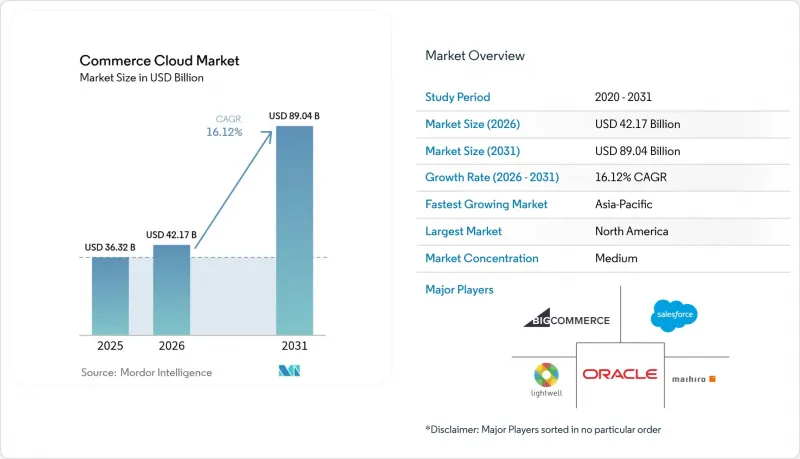
[1] Salesforce Newsroom, "Salesforce Announces Q1 FY25 Results," salesforce.com Robust growth reflects enterprises' rapid move toward API-first designs that support hyper-personalized shopping, real-time data activation, and generative-AI services. This report is Segmented by End-User Industry (Fashion and Apparel, Travel and Tourism, Food and Beverage, and More), Platform (B2C Commerce, B2B Commerce, and More), Deployment Model (Public Cloud, Private Cloud, and More), Organization Size (Small and Medium Enterprises and Large Enterprises), and Geography. The Market Forecasts are Provided in Terms of Value (USD).
Global Commerce Cloud Market Trends and Insights
Hyper-personalization via GenAI and real-time CDP integration
Generative AI fused with customer data platforms is raising click-through and conversion by 13%, as shown by Alibaba's AIGI service that renders photorealistic products from text before production. Target's AI grocery push lifted conversion 6.2% and took digital grocery to 13.2% of revenue. Real-time data feeds also enable predictive inventory and dynamic pricing, turning the commerce cloud market into a strategic engine for competitive edge. Yet data-quality dependency and skill gaps place smaller firms at risk of falling behind market leaders.
Omnichannel order-management mandates from major retailers
Retailers now demand granular visibility across stores, warehouses, and last-mile partners. PLUS Supermarkets' shift to composable commerce cut online friction by 89% and boosted site speed up to 70%. Barbeques Galore trimmed excess stock 30% and halved order-processing time after adding Fluent Order Management. Suppliers that lag on these capabilities face delisting or costly manual processes, which is accelerating commerce cloud adoption.
High technical debt and migration costs from monolithic stacks.
Sixty-one percent of B2B sellers plan to launch a new platform due to legacy limitations, yet dual-run periods can inflate costs and increase risk. Oracle ATG migrations can take 18 months and require specialized change management. Yet, 90% of recent migrants report increased sales, with 30% experiencing growth in the top tier, underscoring their long-term worth.
Other drivers and restraints analyzed in the detailed report include:
- API-first and headless architectures shortening time-to-market
- Growing preference for composable microservice stacks
- Shortage of cloud-native commerce talent
For complete list of drivers and restraints, kindly check the Table Of Contents.
Segment Analysis
Fashion and Apparel held 37.45% of the commerce cloud market share in 2025, thanks to its early adoption of personalization and complex inventory orchestration. Sephora's unified data model demonstrates how style brands deliver premium experiences, driving wallet-share growth. Electronics follow due to product-configurator needs and dealer integrations. Beauty and Personal Care rides virtual try-ons, with L'Oreal launching 60 DTC sites on Salesforce in weeks. The commerce cloud market size for Grocery and Pharmaceuticals is projected to expand at an 18.12% CAGR through 2031 as same-day delivery drives system upgrades. Travel, Automotive, and Home and Furniture are emerging plays as AR and connected-car commerce mature.Smaller industries are now adopting the platform because the cost has fallen, and specialized templates are available.
Subscription models in the Food and beverage industry, as well as same-day drug fulfillment, demonstrate how even regulated categories are moving online. Growth in these niches maintains high momentum in the overall commerce cloud market, despite macroeconomic volatility.
B2C commerce accounted for 63.10% of 2025 revenue, reflecting the company's deep DTC roots and continued investment in UX. Target's AI shopper segmentation underpins the plateau. Marketplace-as-a-Service is racing ahead with a 20.75% CAGR, as brands open third-party stalls to monetize traffic. The commerce cloud market size allocated to B2B is expanding steadily because manufacturers need dealer portals and punch-out catalogs. D2C streams grow as labels bypass resellers to lift margins. Multi-model suites now enable one backend to support B2C, B2B, and marketplace flows, thereby reducing stack sprawl.
Vendor roadmaps favor unified checkout, flexible commission rules, and embedded financing. These capabilities keep the commerce cloud market attractive for firms seeking new revenue without investing in new infrastructure.
Complete Report Scope:
- By End-user Industry
- Fashion and Apparel
- Grocery and Pharmaceuticals
- Electronics and Appliances
- Food and Beverage
- Beauty and Personal Care
- Travel and Tourism
- Automotive and Spare Parts
- Home and Furniture
- By Platform
- B2C Commerce
- B2B Commerce
- D2C Commerce
- Marketplace-as-a-Service
- By Deployment Model
- Public Cloud
- Private Cloud
- Hybrid Cloud
- Composable / Micro-service
- By Organization Size
- Small and Medium Enterprises
- Large Enterprises
- By Geography
- North America
- United States
- Canada
- Mexico
- South America
- Brazil
- Argentina
- Chile
- Rest of South America
- Europe
- United Kingdom
- Germany
- France
- Italy
- Spain
- Netherlands
- Russia
- Rest of Europe
- Asia Pacific
- China
- India
- Japan
- South Korea
- ASEAN
- Rest of Asia Pacific
- Middle East and Africa
- Middle East
- United Arab Emirates
- Saudi Arabia
- Turkey
- Rest of Middle East
- Africa
- South Africa
- Nigeria
- Kenya
- Rest of Africa
- Middle East
- North America
Geography Analysis
North America retained 40.55% of 2025 revenue due to early adoption of headless solutions and dense hyperscaler footprints. Walmart's 18% e-commerce mix shows persistent digital momentum. Skill shortages and rising cloud bills temper growth, prompting a shift to remote hiring and the adoption of FinOps. The commerce cloud market size in the Asia Pacific is expanding at a 16.22% CAGR as emerging markets leapfrog to mobile-first commerce. Government digital agendas and B2B modernization spark volume, especially in India and China.Latin America benefits from a record USD 224.579 billion in foreign direct investment and the arrival of cloud data centers by Microsoft, AWS, and Oracle. Europe focuses on sovereign cloud, with 37% of firms already investing to meet region-specific regulations. The
The Middle East and Africa are reporting a rise in digital payments and supportive national programs that are widening the commerce cloud market. Vendors that localize compliance functions and payment rails capture a disproportionately large share.
- Salesforce Inc
- SAP SE
- Oracle Corporation
- Shopify Inc.
- BigCommerce Holdings Inc.
- Adobe Inc. (Adobe Commerce)
- IBM Corp. (HCL and Lightwell)
- Optimizely (Episerver)
- Amazon Web Services Inc.
- Conga (Apttus)
- VTEX
- Commercetools GmbH
- Elastic Path Software Inc.
- Sitecore
- Kibo Commerce
- Mirakl
- Sana Commerce
- Zoho Commerce
- Wix eCommerce
Additional Benefits:
- The market estimate (ME) sheet in Excel format
- 3 months of analyst support
TABLE OF CONTENTS
1 INTRODUCTION
- 1.1 Study Assumptions and Market Definition
- 1.2 Scope of the Study
2 RESEARCH METHODOLOGY
3 EXECUTIVE SUMMARY
4 MARKET LANDSCAPE
- 4.1 Market Overview
- 4.2 Market Drivers
- 4.2.1 Hyper-personalization via GenAI and real-time CDP integration
- 4.2.2 Omnichannel order-management mandates from major retailers
- 4.2.3 API-first and headless architectures shortening time-to-market
- 4.2.4 Growing preference for composable / micro-service commerce stacks
- 4.2.5 Accelerating B2B digital migration post-COVID
- 4.2.6 Green-cloud commitments influencing vendor selection
- 4.3 Market Restraints
- 4.3.1 High technical debt and migration costs from monolithic stacks
- 4.3.2 Data-sovereignty and cross-border privacy regulations
- 4.3.3 Vendor lock-in fears around proprietary PaaS ecosystems
- 4.3.4 Shortage of cloud-native commerce talent
- 4.4 Value Chain Analysis
- 4.5 Regulatory Landscape
- 4.6 Technological Outlook
- 4.7 Porter's Five Forces Analysis
- 4.7.1 Bargaining Power of Suppliers
- 4.7.2 Bargaining Power of Buyers
- 4.7.3 Threat of New Entrants
- 4.7.4 Threat of Substitutes
- 4.7.5 Intensity of Competitive Rivalry
5 MARKET SIZE AND GROWTH FORECASTS (VALUE)
- 5.1 By End-user Industry
- 5.1.1 Fashion and Apparel
- 5.1.2 Grocery and Pharmaceuticals
- 5.1.3 Electronics and Appliances
- 5.1.4 Food and Beverage
- 5.1.5 Beauty and Personal Care
- 5.1.6 Travel and Tourism
- 5.1.7 Automotive and Spare Parts
- 5.1.8 Home and Furniture
- 5.2 By Platform
- 5.2.1 B2C Commerce
- 5.2.2 B2B Commerce
- 5.2.3 D2C Commerce
- 5.2.4 Marketplace-as-a-Service
- 5.3 By Deployment Model
- 5.3.1 Public Cloud
- 5.3.2 Private Cloud
- 5.3.3 Hybrid Cloud
- 5.3.4 Composable / Micro-service
- 5.4 By Organization Size
- 5.4.1 Small and Medium Enterprises
- 5.4.2 Large Enterprises
- 5.5 By Geography
- 5.5.1 North America
- 5.5.1.1 United States
- 5.5.1.2 Canada
- 5.5.1.3 Mexico
- 5.5.2 South America
- 5.5.2.1 Brazil
- 5.5.2.2 Argentina
- 5.5.2.3 Chile
- 5.5.2.4 Rest of South America
- 5.5.3 Europe
- 5.5.3.1 United Kingdom
- 5.5.3.2 Germany
- 5.5.3.3 France
- 5.5.3.4 Italy
- 5.5.3.5 Spain
- 5.5.3.6 Netherlands
- 5.5.3.7 Russia
- 5.5.3.8 Rest of Europe
- 5.5.4 Asia Pacific
- 5.5.4.1 China
- 5.5.4.2 India
- 5.5.4.3 Japan
- 5.5.4.4 South Korea
- 5.5.4.5 ASEAN
- 5.5.4.6 Rest of Asia Pacific
- 5.5.5 Middle East and Africa
- 5.5.5.1 Middle East
- 5.5.5.1.1 United Arab Emirates
- 5.5.5.1.2 Saudi Arabia
- 5.5.5.1.3 Turkey
- 5.5.5.1.4 Rest of Middle East
- 5.5.5.2 Africa
- 5.5.5.2.1 South Africa
- 5.5.5.2.2 Nigeria
- 5.5.5.2.3 Kenya
- 5.5.5.2.4 Rest of Africa
- 5.5.5.1 Middle East
- 5.5.1 North America
6 COMPETITIVE LANDSCAPE
- 6.1 Market Concentration
- 6.2 Strategic Moves
- 6.3 Market Share Analysis
- 6.4 Company Profiles (includes Global level Overview, Market level overview, Core Segments, Financials as available, Strategic Information, Market Rank/Share for key companies, Products and Services, and Recent Developments)
- 6.4.1 Salesforce Inc
- 6.4.2 SAP SE
- 6.4.3 Oracle Corporation
- 6.4.4 Shopify Inc.
- 6.4.5 BigCommerce Holdings Inc.
- 6.4.6 Adobe Inc. (Adobe Commerce)
- 6.4.7 IBM Corp. (HCL and Lightwell)
- 6.4.8 Optimizely (Episerver)
- 6.4.9 Amazon Web Services Inc.
- 6.4.10 Conga (Apttus)
- 6.4.11 VTEX
- 6.4.12 Commercetools GmbH
- 6.4.13 Elastic Path Software Inc.
- 6.4.14 Sitecore
- 6.4.15 Kibo Commerce
- 6.4.16 Mirakl
- 6.4.17 Sana Commerce
- 6.4.18 Zoho Commerce
- 6.4.19 Wix eCommerce
7 MARKET OPPORTUNITIES AND FUTURE OUTLOOK
- 7.1 White-space and Unmet-need Assessment

