PUBLISHER: Mordor Intelligence | PRODUCT CODE: 2124372

PUBLISHER: Mordor Intelligence | PRODUCT CODE: 2124372
US Cold Chain Logistics - Market Share Analysis, Industry Trends & Statistics, Growth Forecasts (2026 - 2031)
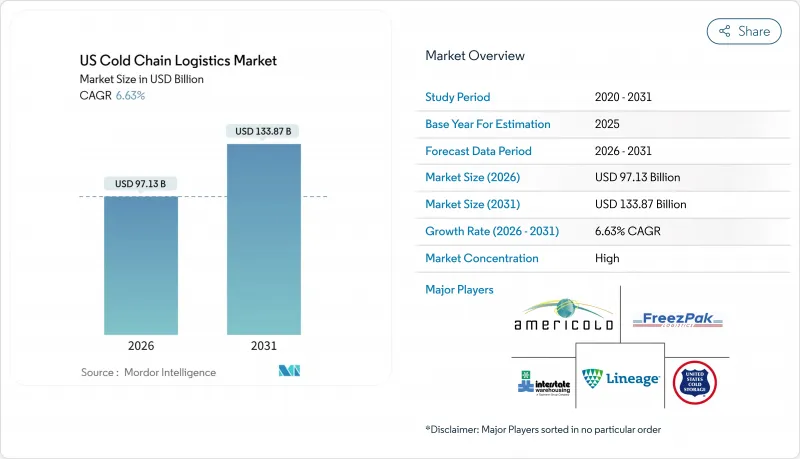
According to Mordor Intelligence, the US cold chain logistics market size is estimated at USD 97.13 billion in 2026, and is expected to reach USD 133.87 billion by 2031, at a CAGR of 6.63% during the forecast period (2026-2031).
This report is Segmented by Service Type (Refrigerated Storage, Refrigerated Transportation, Value-Added Services), by Temperature Type (Chilled, Frozen and More), by Application (Fruits & Vegetables, Meat & Poultry, Dairy, Pharmaceuticals & Biologics, Vaccines, Other Perishables), and by Region (Northeast, Midwest, Southeast, Southwest, West). Market Forecasts are in Value (USD).
US Cold Chain Logistics Market Trends and Insights
E-Grocery and Meal-Kit Volumes Surge
Online grocery penetration reached 17% of food retail in 2025, and temperature-controlled last-mile delivery complexity expanded faster than ambient e-commerce Individual order dispersion across neighborhoods is forcing micro-fulfilment centers with multi-zone rooms to locate within 10 miles of dense households, inflating real-estate costs in urban cores where vacancy stands near 6.9%. Meal-kit providers add sequencing pressure by cross-docking frozen proteins, chilled produce, and ambient items inside four-hour windows to meet delivery promises. Together, these models lift demand for flexible, small-footprint facilities that can pick, pack, and dispatch within narrow cut-offs. Operators able to integrate route optimization software with real-time refrigeration monitoring have captured new contracts, even as profit margins tighten for legacy facilities lacking value-added capabilities. Growth remains strongest in the top 50 metro areas, reinforcing a hub-and-spoke distribution build-out rather than national uniformity.
Pharma Biologics and Cell-Gene Therapy Boom
Personalized medicines such as CAR-T require point-to-point cryogenic transport, validated storage below -150 °C, and rapid release back to treatment centers, shifting emphasis from bulk storage to patient-specific orchestration. DHL's commitment to invest EUR 1 billion (USD 1.17 billion) in healthcare logistics across the Americas by 2030 underscores the profitability of premium temperature-controlled lanes. The economic calculus differs from food: a single deviation can erase USD 500,000 in biologics value, compared to USD 5,000 for produce. Consequently, shippers prioritize redundant power, real-time telemetry, and chain-of-custody blockchain, selecting providers on compliance record rather than lowest rate. Capacity shortfalls in Boston, Philadelphia, and Raleigh have spurred speculative ultra-low builds despite 3-4X higher construction costs, signaling sustained demand tailwinds.
HFC Phase-Down Retrofit Costs
EPA rules compel operators to replace high-GWP refrigerants such as R-404A, raising conversion costs to USD 2-4 million per site while production caps tighten 40% by 2028. Facilities constructed in the 2000s retain useful structural life yet face escalating refrigerant prices that have tripled since 2024. Smaller owners struggle to amortize engineering studies and downtime, accelerating consolidation as they exit scale players who spread costs across multiple locations. Retrofit timing also collides with broader capacity expansion plans, forcing capital rationing and delaying other modernization projects.
Other drivers and restraints analyzed in the detailed report include:
- Port-Adjacent Automated Mega-Warehouses
- Rail-Integrated Inland Cold Hubs
- Labor Scarcity in Sub-Zero Operations
For complete list of drivers and restraints, kindly check the Table Of Contents.
Segment Analysis
Refrigerated storage captured 57.53% of the US cold chain logistics market share in 2025, reflecting the pivotal role fixed infrastructure plays in linking producers and consumers. Within this segment, automated public warehouses are gaining share as food companies outsource specialists who distribute fixed costs across multiple tenants. Private storage remains critical for pharmaceuticals, where compliance and security justify single-tenant models. Road transport retains volume leadership, yet capacity headwinds from driver shortages and fuel volatility are steering long-haul frozen goods toward rail-intermodal solutions that offer 30-40% savings. Airfreight's 13.23% CAGR through 2031 embodies a parallel network optimized for high-value, low-volume therapies that tolerate neither delay nor temperature deviation, cementing premium yields for carriers and handlers. Value-added services - kitting, labeling, and quality testing - have grown by double digits, diversifying revenue streams beyond storage and haulage.
Automation's impact is multifaceted. Facilities employing AS/RS systems operate with up to 70% fewer floor workers and deliver higher throughput per ft3, mitigating wage inflation and labor scarcity. Energy efficiency gains of 10-15% stem from compact racking and reduced infiltration. As a result, investors funnel capital toward projects exceeding 40 million ft3, supported by ESG-linked financing. Conversely, legacy manual facilities struggle to fund HFC conversions and technology retrofits, pushing industry consolidation as scale operators acquire sub-scale warehouses to redevelop them into automated nodes.
Complete Report Scope:
- By Service Type
- Refrigerated Storage
- Refrigerated Transportation
- Road
- Rail
- Sea
- Air
- Value-Added Services
- By Temperature Type
- Chilled (0-5 °C)
- Frozen (-18-0 °C)
- Ambient
- Deep-Frozen / Ultra-Low (More than 20 °C)
- By Application
- Fruits & Vegetables
- Meat & Poultry
- Fish & Seafood
- Dairy & Frozen Desserts
- Bakery & Confectionery
- Ready-to-Eat Meals
- Pharmaceuticals & Biologics
- Vaccines & Clinical Trial Materials
- Chemicals & Specialty Materials
- Other Perishables
- By Region (United States)
- Northeast
- Midwest
- Southeast
- Southwest
- West
List of Companies Covered in this Report:
- Lineage Logistics Holdings, LLC
- Americold Logistics, LLC
- United States Cold Storage, Inc.
- Vertical Cold
- DHL Supply Chain
- FedEx Cold Chain Logistics
- UPS Healthcare
- NewCold Advanced Cold Logistics
- AGRO Merchants Group
- AIT Worldwide Logistics
- Cloverleaf Cold Storage
- Interstate Warehousing, Inc.
- RLS Logistics
- Penske Logistics (Cold Chain)
- Ryder System, Inc. (SCS)
- FreezPak Logistics
- Congebec Logistics
- Cold Summit Development
- Nordic Cold Storage, LLC
- J.B. Hunt Transport Services, Inc. (Refrigerated)
- Schneider National, Inc. (Reefer)
Additional Benefits:
- The market estimate (ME) sheet in Excel format
- 3 months of analyst support
TABLE OF CONTENTS
1 Introduction
- 1.1 Study Assumptions & Market Definition
- 1.2 Scope of the Study
2 Research Methodology
3 Executive Summary
4 Market Landscape
- 4.1 Market Overview
- 4.2 Market Drivers
- 4.2.1 E-grocery & meal-kit volumes surge
- 4.2.2 Pharma biologics & cell-gene therapy boom
- 4.2.3 Port-adjacent automated mega-warehouses
- 4.2.4 Rail-integrated inland cold hubs (CPKC)
- 4.2.5 ESG-linked financing accelerates upgrades
- 4.2.6 USDA food-waste mandate pressure
- 4.3 Market Restraints
- 4.3.1 HFC phase-down retrofit costs
- 4.3.2 Labor scarcity in sub-zero operations
- 4.3.3 Power-price volatility risk
- 4.3.4 Port & canal climate disruptions
- 4.4 Value / Supply-Chain Analysis
- 4.5 Regulatory Outlook
- 4.6 Technological Outlook
- 4.7 Porters Five Forces
- 4.7.1 Threat of New Entrants
- 4.7.2 Bargaining Power of Suppliers
- 4.7.3 Bargaining Power of Buyers
- 4.7.4 Threat of Substitutes
- 4.7.5 Competitive Rivalry
5 Market Size & Growth Forecasts (Value, USD)
- 5.1 By Service Type
- 5.1.1 Refrigerated Storage
- 5.1.2 Refrigerated Transportation
- 5.1.2.1 Road
- 5.1.2.2 Rail
- 5.1.2.3 Sea
- 5.1.2.4 Air
- 5.1.3 Value-Added Services
- 5.2 By Temperature Type
- 5.2.1 Chilled (0-5 °C)
- 5.2.2 Frozen (-18-0 °C)
- 5.2.3 Ambient
- 5.2.4 Deep-Frozen / Ultra-Low (More than 20 °C)
- 5.3 By Application
- 5.3.1 Fruits & Vegetables
- 5.3.2 Meat & Poultry
- 5.3.3 Fish & Seafood
- 5.3.4 Dairy & Frozen Desserts
- 5.3.5 Bakery & Confectionery
- 5.3.6 Ready-to-Eat Meals
- 5.3.7 Pharmaceuticals & Biologics
- 5.3.8 Vaccines & Clinical Trial Materials
- 5.3.9 Chemicals & Specialty Materials
- 5.3.10 Other Perishables
- 5.4 By Region (United States)
- 5.4.1 Northeast
- 5.4.2 Midwest
- 5.4.3 Southeast
- 5.4.4 Southwest
- 5.4.5 West
6 Competitive Landscape
- 6.1 Market Concentration
- 6.2 Strategic Moves
- 6.3 Market Share Analysis
- 6.4 Company Profiles (includes Global level Overview, Market level overview, Core Segments, Financials as available, Strategic Information, Market Rank/Share for key companies, Products & Services, and Recent Developments)
- 6.4.1 Lineage Logistics Holdings, LLC
- 6.4.2 Americold Logistics, LLC
- 6.4.3 United States Cold Storage, Inc.
- 6.4.4 Vertical Cold
- 6.4.5 DHL Supply Chain
- 6.4.6 FedEx Cold Chain Logistics
- 6.4.7 UPS Healthcare
- 6.4.8 NewCold Advanced Cold Logistics
- 6.4.9 AGRO Merchants Group
- 6.4.10 AIT Worldwide Logistics
- 6.4.11 Cloverleaf Cold Storage
- 6.4.12 Interstate Warehousing, Inc.
- 6.4.13 RLS Logistics
- 6.4.14 Penske Logistics (Cold Chain)
- 6.4.15 Ryder System, Inc. (SCS)
- 6.4.16 FreezPak Logistics
- 6.4.17 Congebec Logistics
- 6.4.18 Cold Summit Development
- 6.4.19 Nordic Cold Storage, LLC
- 6.4.20 J.B. Hunt Transport Services, Inc. (Refrigerated)
- 6.4.21 Schneider National, Inc. (Reefer)
7 Market Opportunities & Future Outlook

