PUBLISHER: Mordor Intelligence | PRODUCT CODE: 2125731

PUBLISHER: Mordor Intelligence | PRODUCT CODE: 2125731
Thailand Cold Chain Logistics - Market Share Analysis, Industry Trends & Statistics, Growth Forecasts (2026 - 2031)
According to Mordor Intelligence, the Thailand cold chain logistics market size is expected to grow from USD 2.31 billion in 2025 to USD 2.4 billion in 2026 and is forecast to reach USD 2.89 billion by 2031 at 3.79% CAGR over 2026-2031.
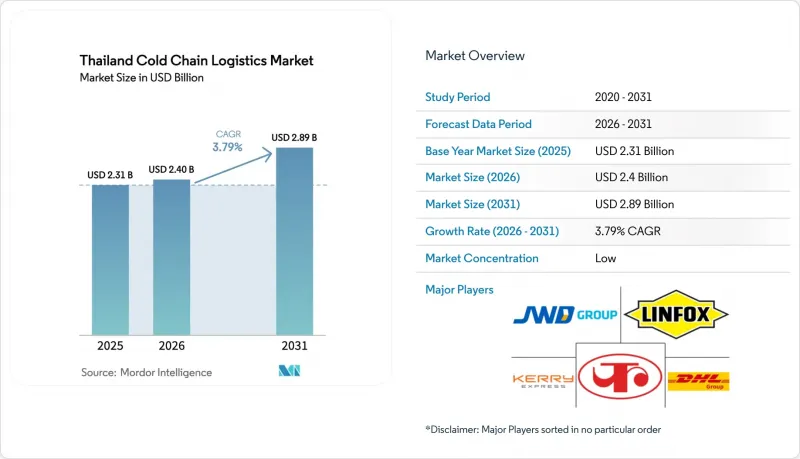
This report is Segmented by Service Type (Refrigerated Storage, Refrigerated Transportation, and Value-Added Services), Temperature Type (Chilled, Frozen, Ambient, and Deep-Frozen/Ultra-Low), Application (Fruits & Vegetables, Meat & Poultry, Fish & Seafood, Dairy & Frozen Desserts, and More), Region (Central, Eastern, Northern, and More). The Market Forecasts are Provided in Terms of Value (USD).
Thailand Cold Chain Logistics Market Trends and Insights
Boom in Online Grocery & Meal-Kit Delivery
E-commerce adoption has accelerated the Thailand cold chain logistics market, especially for chilled and frozen grocery orders delivered within metropolitan Bangkok and EEC industrial towns. Reduced electricity charges under the tariff cut create margin headroom for last-mile couriers operating energy-intensive hubs. Kerry Express and Betagro now co-brand the "Kerry Cool" network, letting retailers ship poultry, ready-to-eat meals, and desserts in insulated shippers overnight to 77 provinces. A rebound in Chinese tourist arrivals has lifted demand for meal-kit services catering to condo rentals and hotels, widening the addressable base. Ongoing Thai FDA consultations around beverage and ice labeling signal tighter hygiene oversight, which in turn boosts requirements for traceable, temperature-verified supply chains. Operators such as WICE Logistics are investing in cloud-based transport management systems and handheld scanners to deliver item-level visibility from dock to doorstep.
Expansion of Vaccine & Biologics Distribution Network
Thailand's ambition to become a regional vaccine exporter aligns squarely with the Thailand cold chain logistics market. UPS Healthcare, DHL, and Logisteed have rolled out -20 °C freezers, 2-8 °C coolers, and -80 °C ultra-cold bays that comply with WHO GDP guidelines. The National Vaccine Policy's 2023-2027 action plan positions domestic makers such as Siam Bioscience and BioNet Asia to scale biologic output, amplifying ultra-low demand in Central-region science parks. Real-time IoT sensors, pioneered locally by DataKind pilot programs, transmit humidity and shock alerts directly to qualified persons in charge, cutting excursion risk for live-virus formulations. DHL Supply Chain has doubled dedicated healthcare pallet spots near Suvarnabhumi Airport, bundling customs brokerage, validated packaging, and final-mile dispatch. Economic modeling shows routine dengue vaccination could curb symptomatic cases by 41%-57%, underscoring the social payoff of resilient sub-zero infrastructure.
High Electricity Tariffs & Fuel Surcharges
Energy still commands as much as 30% of warehouse operating cost despite the tariff cut, and EGAT's debt overhang may force surcharge reinstatements after 2026. Switching to CO2 systems cuts kilowatt-hour consumption but entails a USD 0.5 million retrofit for a 10,000-pallet site, a hurdle for SMEs. Betagro sidesteps this by coupling rooftop solar with ice-bank thermal storage to shave peak-hour demand. Haulers face similar fuel surcharges, with biodiesel B20 adoption providing only marginal cost relief.
Other drivers and restraints analyzed in the detailed report include:
- Government EEC Infrastructure Subsidies
- Automation & IoT for Real-Time Temperature Visibility
- Cold-Room Equipment Breakdown & Downtime Risk
For complete list of drivers and restraints, kindly check the Table Of Contents.
Segment Analysis
Refrigerated Storage accounted for 40.62% of Thailand's cold chain logistics market share in 2025, underpinning nationwide distribution hubs that feed retail, food-service, and healthcare channels. Warehousing landlords capitalize on land-use incentives near the EEC, where MOL's OMEGA 1 Bang Na will add multi-temperature bays across 100,000 sqm by 2027. Users demand racking to -25 °C, cross-docks with 12-meter clear heights, and shuttle-based carton retrieval to accelerate SKU churn.
Value-Added Services, although only 9.12% of 2025 revenue, will expand at a 4.63% CAGR through 2031, the fastest within the Thailand cold chain logistics market. Services such as kitting, blast-freezing, labeling for halal certification, and GDP documentation command 20%-plus gross margins, enticing 3PLs to bundle them into existing contracts. Retailers lean on these ancillary streams to localize product assortment without committing capex.
Complete Report Scope:
- By Service Type
- Refrigerated Storage
- Public Warehousing
- Private Warehousing
- Refrigerated Transportation
- Road
- Rail
- Sea
- Air
- Value-Added Services
- Refrigerated Storage
- By Temperature Type
- Chilled (0-5 °C)
- Frozen (-18-0 °C)
- Ambient
- Deep-Frozen / Ultra-Low (less than-20 °C)
- By Application
- Fruits & Vegetables
- Meat & Poultry
- Fish & Seafood
- Dairy & Frozen Desserts
- Bakery & Confectionery
- Ready-to-Eat Meals
- Pharmaceuticals & Biologics
- Vaccines & Clinical Trial Materials
- Chemicals & Specialty Materials
- Other Perishables
- By Region (Thailand)
- Central
- Eastern
- Northern
- North-Eastern
- Southern
List of Companies Covered in this Report:
- JWD Group
- Thai Yokorei Cold Storage
- Linfox Thailand
- DHL Supply Chain
- Kerry Express
- M-SENKO Logistics
- Thai Max Cold Storage
- Konoike Cool Logistics Co., Ltd.
- Logisteed Thailand
- Yusen Logistics
- Nichirei Logistics Group Inc.
- Chomthana (Cool Train Co., Ltd)
- Thai Global Logistics
- Integrated Logistics Services (ILS)
- FuzePost
- Inter Express Logistic
- Thai Rath Logistics Co., Ltd
- Sumisho Global Logistics Co., Ltd.
- WICE Logistics Public Company Limited
- Piti Cold Storage
Additional Benefits:
- The market estimate (ME) sheet in Excel format
- 3 months of analyst support
TABLE OF CONTENTS
1 Introduction
- 1.1 Study Assumptions & Market Definition
- 1.2 Scope of the Study
2 Research Methodology
3 Executive Summary
4 Market Landscape
- 4.1 Market Overview
- 4.2 Market Drivers
- 4.2.1 Boom in online grocery & meal-kit delivery
- 4.2.2 Expansion of vaccine & biologics distribution network
- 4.2.3 Government EEC infrastructure subsidies
- 4.2.4 Automation & IoT for real-time temperature visibility
- 4.2.5 Rapid-freeze protocols demanded by China fruit import rules
- 4.2.6 Net-zero warehousing incentives (rooftop solar + ammonia/CO2 systems)
- 4.3 Market Restraints
- 4.3.1 High electricity tariffs & fuel surcharges
- 4.3.2 Cold-room equipment breakdown & downtime risk
- 4.3.3 Shortage of certified refrigeration technicians
- 4.3.4 Costly retrofit to low-GWP refrigerants
- 4.4 Value / Supply-Chain Analysis
- 4.5 Regulatory Landscape
- 4.6 Technological Outlook
- 4.7 Porter's Five Forces
- 4.7.1 Threat of New Entrants
- 4.7.2 Bargaining Power of Buyers/Consumers
- 4.7.3 Bargaining Power of Suppliers
- 4.7.4 Threat of Substitute Products
- 4.7.5 Intensity of Competitive Rivalry
5 Market Size & Growth Forecasts (Value)
- 5.1 By Service Type
- 5.1.1 Refrigerated Storage
- 5.1.1.1 Public Warehousing
- 5.1.1.2 Private Warehousing
- 5.1.2 Refrigerated Transportation
- 5.1.2.1 Road
- 5.1.2.2 Rail
- 5.1.2.3 Sea
- 5.1.2.4 Air
- 5.1.3 Value-Added Services
- 5.1.1 Refrigerated Storage
- 5.2 By Temperature Type
- 5.2.1 Chilled (0-5 °C)
- 5.2.2 Frozen (-18-0 °C)
- 5.2.3 Ambient
- 5.2.4 Deep-Frozen / Ultra-Low (less than-20 °C)
- 5.3 By Application
- 5.3.1 Fruits & Vegetables
- 5.3.2 Meat & Poultry
- 5.3.3 Fish & Seafood
- 5.3.4 Dairy & Frozen Desserts
- 5.3.5 Bakery & Confectionery
- 5.3.6 Ready-to-Eat Meals
- 5.3.7 Pharmaceuticals & Biologics
- 5.3.8 Vaccines & Clinical Trial Materials
- 5.3.9 Chemicals & Specialty Materials
- 5.3.10 Other Perishables
- 5.4 By Region (Thailand)
- 5.4.1 Central
- 5.4.2 Eastern
- 5.4.3 Northern
- 5.4.4 North-Eastern
- 5.4.5 Southern
6 Competitive Landscape
- 6.1 Market Concentration
- 6.2 Strategic Moves
- 6.3 Market Share Analysis
- 6.4 Company Profiles (includes Global level Overview, Market level overview, Core Segments, Financials as available, Strategic Information, Market Rank/Share for key companies, Products & Services, and Recent Developments)
- 6.4.1 JWD Group
- 6.4.2 Thai Yokorei Cold Storage
- 6.4.3 Linfox Thailand
- 6.4.4 DHL Supply Chain
- 6.4.5 Kerry Express
- 6.4.6 M-SENKO Logistics
- 6.4.7 Thai Max Cold Storage
- 6.4.8 Konoike Cool Logistics Co., Ltd.
- 6.4.9 Logisteed Thailand
- 6.4.10 Yusen Logistics
- 6.4.11 Nichirei Logistics Group Inc.
- 6.4.12 Chomthana (Cool Train Co., Ltd)
- 6.4.13 Thai Global Logistics
- 6.4.14 Integrated Logistics Services (ILS)
- 6.4.15 FuzePost
- 6.4.16 Inter Express Logistic
- 6.4.17 Thai Rath Logistics Co., Ltd
- 6.4.18 Sumisho Global Logistics Co., Ltd.
- 6.4.19 WICE Logistics Public Company Limited
- 6.4.20 Piti Cold Storage
7 Market Opportunities & Future Outlook
- 7.1 White-space & Unmet-need Assessment

