PUBLISHER: Mordor Intelligence | PRODUCT CODE: 2124375

PUBLISHER: Mordor Intelligence | PRODUCT CODE: 2124375
Content Services Platforms - Market Share Analysis, Industry Trends & Statistics, Growth Forecasts (2026 - 2031)
According to Mordor Intelligence, content services platforms market size in 2026 is estimated at USD 88.25 billion, growing from 2025 value of USD 78.14 billion with 2031 projections showing USD 162.16 billion, growing at 12.94% CAGR over 2026-2031.
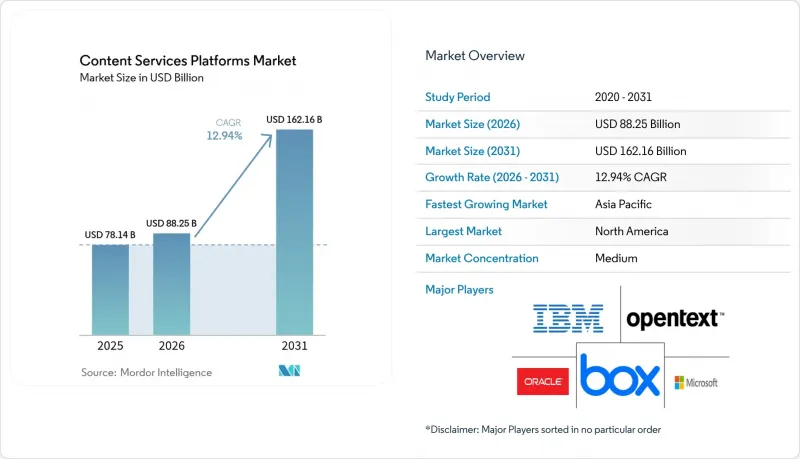
This report is Segmented by Component (Solutions, and Services), Deployment Model (On-Premises, and Cloud), End-User Enterprise Size (Small and Medium-Sized Enterprises, and Large Enterprises), End-User Industry Vertical (BFSI, Government and Public Sector, Healthcare and Life Sciences, IT and Telecom, and More), and Geography. The Market Forecasts are Provided in Terms of Value (USD).
Global Content Services Platforms Market Trends and Insights
Cloud-Native Adoption Momentum
Enterprises migrating to cloud-native platforms gain scalability and unified access while reducing infrastructure costs by up to 40% through exemplars such as Microsoft SharePoint Online and OneDrive. Remote work trends amplify demand because API-first architectures handle distributed collaboration with minimal latency. Mid-market firms, once priced out of robust document management solutions, now deploy feature-rich SaaS offerings without the need for capital-intensive servers. Cloud providers' continuous delivery enables quarterly AI feature refreshes, ensuring compliance with frameworks such as SOC 2 and ISO 27001, which increasingly prioritize full-stack cloud solutions. Disaster recovery built into hyperscale data centers further encourages wholesale retirement of aging on-premises repositories.
Surging Unstructured Data Volumes
Video meetings, IoT sensors, and omnichannel customer touchpoints are expected to inflate unstructured data to an estimated 80% of enterprise totals by 2025, overwhelming traditional file shares. Modern platforms integrate NLP and computer vision, transforming contracts, emails, and images into searchable intelligence, enabling healthcare providers to maintain HIPAA compliance while surfacing valuable clinical insights. Automated tagging, versioning, and retention schedules help satisfy audit demands in litigation-heavy sectors. As data footprints swell, algorithmic classification limits storage spend by moving obsolete records to cold tiers and preventing the proliferation of duplicative content.
Data-Privacy and Cyber-Security Concerns
The 2024 Change Healthcare breach, exposing records of over 100 million patients, heightened scrutiny of cloud repositories. Regulated sectors now demand zero-trust postures, field-level encryption, and regional data residency, which elongate vendor evaluations and raise deployment costs. "Right to be forgotten" clauses force platforms to automate granular deletion across distributed caches, adding architectural complexity. Boards allocate larger cyber budgets, yet the specter of reputational damage continues to sustain cautious rollouts, especially in defense and public safety domains.
Other drivers and restraints analyzed in the detailed report include:
- Heightened Regulatory-Compliance Pressure
- Generative-AI Powered Autonomous Content Workflows
- Legacy-System Integration Complexity
For complete list of drivers and restraints, kindly check the Table Of Contents.
Segment Analysis
Solutions maintain a commanding market leadership position with a 67.82% share in 2025, encompassing document management, workflow automation, data capture, and security governance modules that form the core functionality of content services platforms. However, services represent the fastest-growing component, with a 17.12% CAGR through 2031, driven by increasing demand for specialized integration, consulting, and support capabilities as organizations deploy AI-powered content workflows. Integration and deployment services, particularly those involved in connecting modern content platforms with legacy enterprise systems, benefit from the complexity of this task. Meanwhile, consulting services expand as organizations require expertise in AI taxonomy development and regulatory compliance frameworks.
Document and records management solutions dominate the software segment, providing foundational capabilities for content storage, version control, and lifecycle management that remain essential across all industry verticals. Workflow management and case management solutions show strong growth as organizations automate manual processes and implement intelligent routing based on content analysis and business rules. Information security and governance solutions gain prominence as data protection regulations intensify and organizations require sophisticated policy enforcement capabilities that can adapt to evolving compliance requirements across global markets.
Cloud deployment models are expected to command a 78.05% market share in 2025 and maintain the strongest growth trajectory at a 19.21% CAGR through 2031, reflecting an enterprise preference for scalable, cost-effective solutions that eliminate infrastructure management overhead. The cloud advantage intensifies as vendors integrate advanced AI capabilities that require significant computational resources and frequent model updates that are impractical for on-premises deployments. Box Inc.'s Multi-tenant SaaS architectures enable rapid feature rollouts and automatic security updates, reducing the IT burden while providing access to cutting-edge functionality, including generative AI, advanced analytics, and intelligent automation.
On-premises deployments persist in highly regulated industries and government agencies where data sovereignty requirements mandate local control over sensitive content repositories. However, even traditional on-premises customers are increasingly adopting hybrid architectures that leverage cloud services for non-sensitive content while maintaining critical data within their private infrastructure. The deployment model choice often correlates with organizational size, as large enterprises with dedicated IT resources maintain on-premises capabilities while small and medium enterprises overwhelmingly prefer cloud solutions that provide enterprise-grade functionality without requiring specialized technical expertise.
Complete Report Scope:
- By Component
- Solutions / Software
- Document and Records Management
- Data Capture
- Workflow Management
- Information Security and Governance
- Case Management
- Other Solutions / Software
- Services
- Integration and Deployment
- Consulting
- Support and Maintenance
- Solutions / Software
- By Deployment Model
- On-Premises
- Cloud
- By End-user Enterprise Size
- Small and Medium-sized Enterprises
- Large Enterprises
- By End-user Industry Vertical
- Banking, Financial Services and Insurance (BFSI)
- Government and Public Sector
- Healthcare and Life Sciences
- Information Technology and elecom
- Transportation and Logistics
- Other End-user Industry Verticals
- By Geography
- North America
- United States
- Canada
- Mexico
- Europe
- Germany
- United Kingdom
- France
- Russia
- Rest of Europe
- Asia-Pacific
- China
- Japan
- India
- South Korea
- Australia
- Rest of Asia-Pacific
- Middle East and Africa
- Middle East
- Saudi Arabia
- United Arab Emirates
- Rest of Middle East
- Africa
- South Africa
- Egypt
- Rest of Africa
- South America
- Brazil
- Argentina
- Rest of South America
- Middle East
- North America
Geography Analysis
North America generated 38.05% of global revenue in 2025, primarily driven by the United States, where cloud-first mandates and aggressive AI adoption are fueling high-value projects. Deep partner ecosystems enable Fortune 500 firms to integrate content intelligence into their ERP, CRM, and analytics stacks, while federal data-governance directives expand public-sector adoption. Canadian financial institutions are embracing platforms for anti-money laundering documentation, and Mexico's export manufacturers are digitizing quality records to meet U.S. import audits.
Europe sustains solid momentum as GDPR fines motivate enterprises to automate data-subject-access workflows and deletion procedures. Germany leads industrial deployments aligned with Industry 4.0, whereas the United Kingdom's City institutions prioritize real-time regulatory filings. France's digital-services agenda injects demand for sovereign-cloud options, and the Nordics favor carbon-neutral data centers, influencing vendor hosting roadmaps. The region's multilingual landscape further boosts AI-driven translation and summarization modules.
Asia-Pacific, projected to grow at 13.88% CAGR, benefits from ambitious national digitization programs, expanding broadband and mobile penetration. China's "Made in China 2025" policy accelerates smart-factory rollouts that embed quality-control documentation in unified repositories. India's public-sector initiatives, under the Digital India umbrella, foster e-governance platforms built on localized content taxonomies. Japan's aging workforce spurs automation of knowledge capture, while Australia and Singapore serve as regional hubs for multinational compliance operations. This momentum is expected to narrow the gap with North America by 2030, further elevating the content services platforms market profile in emerging economies.
- International Business Machines Corporation
- Microsoft Corporation
- OpenText Corporation
- Box, Inc.
- Oracle Corporation
- Hyland Software, Inc.
- Laserfiche
- Micro Focus International plc
- Adobe Inc.
- M-Files Corporation
- Newgen Software Technologies Limited
- Fabasoft AG
- Everteam Global Services
- DocuWare GmbH
- Alfresco Software, Inc.
- SERgroup Holding International GmbH
- Objective Corporation Limited
- iManage, LLC
- Nuxeo Corporation
- Kyocera Document Solutions Inc.
- GRM Information Management Services, Inc.
- Xerox Holdings Corporation
Additional Benefits:
- The market estimate (ME) sheet in Excel format
- 3 months of analyst support
TABLE OF CONTENTS
1 INTRODUCTION
- 1.1 Study Assumptions and Market Definition
- 1.2 Scope of the Study
2 RESEARCH METHODOLOGY
3 EXECUTIVE SUMMARY
4 MARKET LANDSCAPE
- 4.1 Market Overview
- 4.2 Market Drivers
- 4.2.1 Cloud-native adoption momentum
- 4.2.2 Surging unstructured data volumes
- 4.2.3 Heightened regulatory compliance pressure
- 4.2.4 Generative-AI powered autonomous content workflows
- 4.2.5 Low-code industry accelerators for CSP rollout
- 4.2.6 M and A-driven platform consolidation
- 4.3 Market Restraints
- 4.3.1 Data-privacy and cyber-security concerns
- 4.3.2 Legacy-system integration complexity
- 4.3.3 Hyperscaler bundling squeezing independent vendors
- 4.3.4 Scarcity of AI-taxonomy skillsets
- 4.4 Industry Ecosystem Analysis
- 4.5 Regulatory Landscape
- 4.6 Technological Outlook
- 4.7 Porter's Five Forces Analysis
- 4.7.1 Bargaining Power of Suppliers
- 4.7.2 Bargaining Power of Buyers
- 4.7.3 Threat of New Entrants
- 4.7.4 Threat of Substitutes
- 4.7.5 Intensity of Rivalry
- 4.8 Investment Analysis
5 MARKET SIZE AND GROWTH FORECASTS (VALUE)
- 5.1 By Component
- 5.1.1 Solutions / Software
- 5.1.1.1 Document and Records Management
- 5.1.1.2 Data Capture
- 5.1.1.3 Workflow Management
- 5.1.1.4 Information Security and Governance
- 5.1.1.5 Case Management
- 5.1.1.6 Other Solutions / Software
- 5.1.2 Services
- 5.1.2.1 Integration and Deployment
- 5.1.2.2 Consulting
- 5.1.2.3 Support and Maintenance
- 5.1.1 Solutions / Software
- 5.2 By Deployment Model
- 5.2.1 On-Premises
- 5.2.2 Cloud
- 5.3 By End-user Enterprise Size
- 5.3.1 Small and Medium-sized Enterprises
- 5.3.2 Large Enterprises
- 5.4 By End-user Industry Vertical
- 5.4.1 Banking, Financial Services and Insurance (BFSI)
- 5.4.2 Government and Public Sector
- 5.4.3 Healthcare and Life Sciences
- 5.4.4 Information Technology and elecom
- 5.4.5 Transportation and Logistics
- 5.4.6 Other End-user Industry Verticals
- 5.5 By Geography
- 5.5.1 North America
- 5.5.1.1 United States
- 5.5.1.2 Canada
- 5.5.1.3 Mexico
- 5.5.2 Europe
- 5.5.2.1 Germany
- 5.5.2.2 United Kingdom
- 5.5.2.3 France
- 5.5.2.4 Russia
- 5.5.2.5 Rest of Europe
- 5.5.3 Asia-Pacific
- 5.5.3.1 China
- 5.5.3.2 Japan
- 5.5.3.3 India
- 5.5.3.4 South Korea
- 5.5.3.5 Australia
- 5.5.3.6 Rest of Asia-Pacific
- 5.5.4 Middle East and Africa
- 5.5.4.1 Middle East
- 5.5.4.1.1 Saudi Arabia
- 5.5.4.1.2 United Arab Emirates
- 5.5.4.1.3 Rest of Middle East
- 5.5.4.2 Africa
- 5.5.4.2.1 South Africa
- 5.5.4.2.2 Egypt
- 5.5.4.2.3 Rest of Africa
- 5.5.4.3 South America
- 5.5.4.3.1 Brazil
- 5.5.4.3.2 Argentina
- 5.5.4.3.3 Rest of South America
- 5.5.4.1 Middle East
- 5.5.1 North America
6 COMPETITIVE LANDSCAPE
- 6.1 Market Concentration
- 6.2 Strategic Moves
- 6.3 Market Share Analysis
- 6.4 Company Profiles (includes Global level Overview, Market level overview, Core Segments, Financials as available, Strategic Information, Market Rank/Share for key companies, Products and Services, and Recent Developments)
- 6.4.1 International Business Machines Corporation
- 6.4.2 Microsoft Corporation
- 6.4.3 OpenText Corporation
- 6.4.4 Box, Inc.
- 6.4.5 Oracle Corporation
- 6.4.6 Hyland Software, Inc.
- 6.4.7 Laserfiche
- 6.4.8 Micro Focus International plc
- 6.4.9 Adobe Inc.
- 6.4.10 M-Files Corporation
- 6.4.11 Newgen Software Technologies Limited
- 6.4.12 Fabasoft AG
- 6.4.13 Everteam Global Services
- 6.4.14 DocuWare GmbH
- 6.4.15 Alfresco Software, Inc.
- 6.4.16 SERgroup Holding International GmbH
- 6.4.17 Objective Corporation Limited
- 6.4.18 iManage, LLC
- 6.4.19 Nuxeo Corporation
- 6.4.20 Kyocera Document Solutions Inc.
- 6.4.21 GRM Information Management Services, Inc.
- 6.4.22 Xerox Holdings Corporation
7 MARKET OPPORTUNITIES AND FUTURE OUTLOOK
- 7.1 White-space and Unmet-Need Assessment

