PUBLISHER: Mordor Intelligence | PRODUCT CODE: 2124450

PUBLISHER: Mordor Intelligence | PRODUCT CODE: 2124450
Vacuum Interrupter - Market Share Analysis, Industry Trends & Statistics, Growth Forecasts (2026 - 2031)
According to Mordor Intelligence, vacuum interrupter market size in 2026 is estimated at USD 3.24 billion, growing from 2025 value of USD 3.07 billion with 2031 projections showing USD 4.22 billion, growing at 5.42% CAGR over 2026-2031.
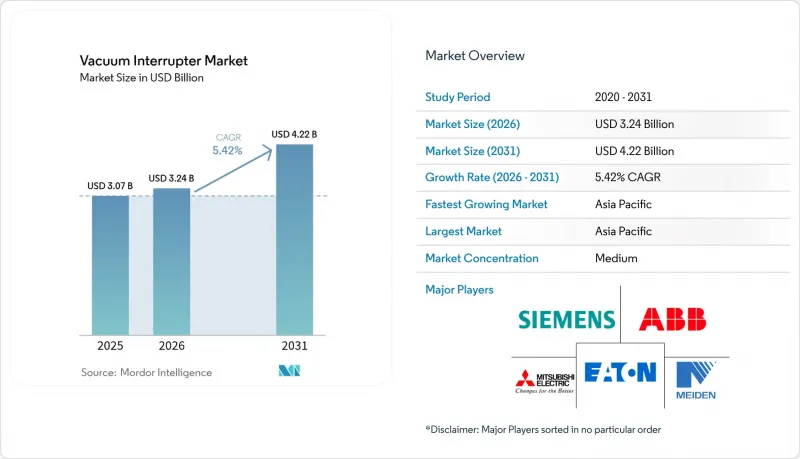
This report is Segmented by Application (Circuit Breaker, Contactor, Recloser, and More), Voltage Class (15 KV, 15. 1-27 KV, 27. 1-38 KV, and Above 38 KV), End-User Industry (Utilities, Industrial, Renewables and IPP, and Commercial and Data Centers), Installation Type (Indoor Switchgear and Outdoor Pole-Mounted), and Geography.
Global Vacuum Interrupter Market Trends and Insights
Smart-grid rollout and MV switchgear demand
Proliferating distributed energy resources require switchgear that supports frequent on-load operations and instantaneous fault isolation. Utilities in the United States and Western Europe, therefore, prioritize vacuum interrupter-based switchgear for advanced feeder automation, driving a meaningful share of incremental orders in the vacuum interrupter market. Adoption accelerates where regulators link performance incentives to outage duration, and where federal stimulus packages finance grid resilience. Digital sensors embedded in modern interrupters provide utilities with the operational visibility needed for self-healing networks, while the maintenance-free vacuum device design trims lifecycle costs. These benefits collectively underpin a visible order pipeline that extends through 2028, particularly for 15 kV-27 kV feeder classes.
Aging T&D infrastructure replacements
North American and European utilities face equipment fleets averaging more than four decades, turning asset-management programs into sizable procurement funnels for the vacuum interrupter market. Operators retiring oil-filled or SF6-based breakers now specify vacuum devices to limit greenhouse-gas exposure and to reduce service truck rolls. Deferred maintenance backlogs compound the replacement cycle, and multiyear capital-expenditure plans already in execution point to stable retrofit volumes that stretch well beyond 2030. Higher-voltage multi-break designs are making inroads into 72 kV and 145 kV substations, boosting average selling prices and lifting the value mix toward premium contact-material alloys.
High unit cost at above 40 kV ratings
Above 40 kV, designs require multiple interruption gaps and sophisticated voltage-grading capacitors, which push capital cost to two-to-three times that of single-break formats. Utilities in Latin America and Africa-regions still price-sensitive-therefore stick with conventional air-insulated gear, muting volume growth for the high-voltage slice of the vacuum interrupter market. Although manufacturers pursue economies of scale at new Asian plants, significant price parity may not arrive before 2029, keeping this restraint in play through the forecast horizon.
Other drivers and restraints analyzed in the detailed report include:
- Rapid expansion of data-center power networks
- Electrification of railway feeders in Asia
- Substitution threat from solid-state breakers
For complete list of drivers and restraints, kindly check the Table Of Contents.
Segment Analysis
Circuit breakers constitute the largest slice of the vacuum interrupter market size, retaining 35.62% of 2025 revenues. The category serves primary distribution substations where utilities value long electrical life and low maintenance cycles. Growth, however, tilts toward reclosers, which post a 5.72% CAGR through 2031 as distribution automation spreads. Utilities deploy reclosers on lateral feeders with rooftop solar and electric-vehicle loading, where rapid fault isolation and auto-reenergization boost reliability indices. Advanced microprocessor controls now allow multiple-shot profiles adapted to inverter-based resources, securing vacuum devices as the preferred arc-quenching core. Contactors and load-break switches deliver steady industrial demand, chiefly from motor control centers and capacitor-bank switching in cement, metals, and oil-refining complexes. These niches add resilience to the overall vacuum interrupter market because their order cycles correlate with general industrial capital expenditure.
The high duty cycle inherent to recloser operation underscores the superiority of vacuum contacts versus oil or SF6 puffer mechanisms, whose mechanical linkages degrade under repetitive trips. Field data from US Midwest utilities show maintenance call-outs per recloser dropping by 60% after migration to vacuum designs, directly lowering operating expenditure. That demonstrable cost advantage underpins vendor order books and propels software-enabled feeder automation solutions bundled with vacuum interrupter cores. As a result, the vacuum interrupter market continues to capture incremental feeder retrofit budgets even where overall capital plans remain flat.
The 15.1 kV-27 kV bracket remains the workhorse, commanding 47.65% of 2025 revenues. Distribution-level feeders and industrial campuses typically fall in this range, and utilities prefer standardized footprints for quick truck roll replacements. Nevertheless, the above-38 kV segment is the fastest climber at a 6.21% CAGR, buoyed by renewable-rich transmission corridors. Multi-break 72 kV and 145 kV prototypes have proven dielectric strength in European climate chambers, and a 252 kV platform recently passed short-circuit tests at KEMA Laboratories, widening market scope. Where regional grid codes now ban new SF6 gas gear in 145 kV rings starting 2031, network owners pivot early to vacuum alternatives, inflating the premium end of the vacuum interrupter market.
Voltage scaling depends on refined CuCr50 contact alloys that resist high-energy arcing; patent filings suggest nanocrystalline microstructures cut cathode erosion by 35% compared with conventional formulations. Suppliers owning these alloys enjoy pricing power, further skewing revenue toward high-voltage SKUs. Meanwhile, the sub-15 kV slice caters to panel builders for commercial buildings and rooftop solar farms, a segment with shorter sales cycles that cushions cyclical swings in utility capital budgets. Overall, diverse voltage demand maintains a balanced growth profile across the vacuum interrupter market.
Complete Report Scope:
- By Application
- Circuit Breaker
- Contactor
- Recloser
- Load Break Switch
- Others (Capacitor bank, Earthing)
- By Voltage Class
- 15 kV
- 15.1-27 kV
- 27.1-38 kV
- above 38 kV
- By End-User Industry
- Utilities
- Industrial (Oil and Gas, Mining, Cement)
- Renewables and IPP
- Commercial and Data Centers
- By Installation Type
- Indoor Switchgear
- Outdoor Pole-mounted
- By Geography
- North America
- United States
- Canada
- Mexico
- Europe
- Germany
- United Kingdom
- France
- Italy
- Spain
- Russia
- Rest of Europe
- Asia-Pacific
- China
- Japan
- India
- South Korea
- ASEAN
- Australia and New Zealand
- Rest of Asia-Pacific
- South America
- Brazil
- Argentina
- Rest of South America
- Middle East and Africa
- Middle East
- Saudi Arabia
- UAE
- Turkey
- Rest of Middle East
- Africa
- South Africa
- Nigeria
- Rest of Africa
- Middle East
- North America
Geography Analysis
Asia-Pacific retained 41.05% of global revenue in 2025 and is expanding at 5.88% CAGR, benefiting from China's internal grid reinforcement, India's localization push, and Southeast Asia's metro-rail build-outs. Government-backed manufacturing incentives cut procurement lead times for domestic utilities, enhancing the region's self-sufficiency and undergirding regional demand. Localization is especially pronounced in India, where performance-linked incentive schemes reimburse up to 4% of ex-works value for indigenous switchgear, steering multinational suppliers toward joint ventures and licensing deals with local metal-clad panel fabricators.
North America shows steady replacement spending as equipment exceeding 40 years approaches the end of its life. Federal funding in the United States earmarks USD 13 billion for grid resilience, and parts of that allocation flow into medium-voltage breakers. Extreme-weather events in Texas, Louisiana, and California accelerate sectionalizer and recloser deployment, while hyperscale data-center clustering in Virginia and Ohio drives private capital spending. Consequently, the region preserves a healthy slice of the vacuum interrupter market despite lower headline growth.
Europe aligns policy with net-zero objectives, outlawing newly installed SF6 gear up to 24 kV from 2026 and above 52 kV from 2031, thereby mandating vacuum solutions for both distribution and transmission. Pilot installations at 420 kV prove technical feasibility, and multi-utility procurement consortia tender frameworks for million-euro contracts extending to 2029. South America and the Middle East, and Africa together account for a smaller base but deliver above-average percentage growth thanks to rural electrification, industrial diversification in the Gulf, and mining expansion in Chile and Peru. Each region's demand profile relies on durable equipment that minimizes service visits, embedding long-life vacuum interrupters at the core of tender specifications.
- ABB Ltd
- Siemens AG
- Eaton Corporation plc
- Toshiba Corp.
- Mitsubishi Electric Corp.
- Meidensha Corp.
- Schneider Electric SE
- General Electric (GE Grid Solutions)
- CG Power and Industrial Solutions
- LS ELECTRIC Co., Ltd.
- Hitachi Energy
- Hyundai Electric and Energy Systems
- Kirloskar Electric Co. Ltd.
- Wuhan Feite Electric Co. Ltd.
- Shaanxi Joyelectric Intl. Co. Ltd.
- Zhejiang Xuhong Vacuum Electric Appliance
- Vacuum Interrupters Inc.
- Bilcare Electric (China)
- Changzhou Huaguang Vacuum Electric
- Allied Power Products (US)
Additional Benefits:
- The market estimate (ME) sheet in Excel format
- 3 months of analyst support
TABLE OF CONTENTS
1 INTRODUCTION
- 1.1 Study Assumptions and Market Definition
- 1.2 Scope of the Study
2 RESEARCH METHODOLOGY
3 EXECUTIVE SUMMARY
4 MARKET LANDSCAPE
- 4.1 Market Overview
- 4.2 Market Drivers
- 4.2.1 Smart-grid rollout and MV switchgear demand
- 4.2.2 Aging TandD infrastructure replacements
- 4.2.3 Rapid expansion of data-center power networks
- 4.2.4 Electrification of railway feeders in Asia
- 4.2.5 Shift to SF6-free eco-designs by utilities
- 4.2.6 Localization mandates in India and MENA
- 4.3 Market Restraints
- 4.3.1 High unit cost at above 40 kV ratings
- 4.3.2 Substitution threat from solid-state breakers
- 4.3.3 IP issues on contact material alloys
- 4.3.4 Supply-chain fragility of ceramic envelopes
- 4.4 Supply Chain Analysis
- 4.5 Technological Outlook
- 4.6 Porter's Five Forces Analysis
- 4.6.1 Bargaining Power of Buyers
- 4.6.2 Bargaining Power of Suppliers
- 4.6.3 Threat of New Entrants
- 4.6.4 Threat of Substitutes
- 4.6.5 Intensity of Competitive Rivalry
- 4.7 Assessment of the Impact of Macroeconomic Trends on the Market
5 MARKET SIZE AND GROWTH FORECASTS (VALUE)
- 5.1 By Application
- 5.1.1 Circuit Breaker
- 5.1.2 Contactor
- 5.1.3 Recloser
- 5.1.4 Load Break Switch
- 5.1.5 Others (Capacitor bank, Earthing)
- 5.2 By Voltage Class
- 5.2.1 15 kV
- 5.2.2 15.1-27 kV
- 5.2.3 27.1-38 kV
- 5.2.4 above 38 kV
- 5.3 By End-User Industry
- 5.3.1 Utilities
- 5.3.2 Industrial (Oil and Gas, Mining, Cement)
- 5.3.3 Renewables and IPP
- 5.3.4 Commercial and Data Centers
- 5.4 By Installation Type
- 5.4.1 Indoor Switchgear
- 5.4.2 Outdoor Pole-mounted
- 5.5 By Geography
- 5.5.1 North America
- 5.5.1.1 United States
- 5.5.1.2 Canada
- 5.5.1.3 Mexico
- 5.5.2 Europe
- 5.5.2.1 Germany
- 5.5.2.2 United Kingdom
- 5.5.2.3 France
- 5.5.2.4 Italy
- 5.5.2.5 Spain
- 5.5.2.6 Russia
- 5.5.2.7 Rest of Europe
- 5.5.3 Asia-Pacific
- 5.5.3.1 China
- 5.5.3.2 Japan
- 5.5.3.3 India
- 5.5.3.4 South Korea
- 5.5.3.5 ASEAN
- 5.5.3.6 Australia and New Zealand
- 5.5.3.7 Rest of Asia-Pacific
- 5.5.4 South America
- 5.5.4.1 Brazil
- 5.5.4.2 Argentina
- 5.5.4.3 Rest of South America
- 5.5.5 Middle East and Africa
- 5.5.5.1 Middle East
- 5.5.5.1.1 Saudi Arabia
- 5.5.5.1.2 UAE
- 5.5.5.1.3 Turkey
- 5.5.5.1.4 Rest of Middle East
- 5.5.5.2 Africa
- 5.5.5.2.1 South Africa
- 5.5.5.2.2 Nigeria
- 5.5.5.2.3 Rest of Africa
- 5.5.5.1 Middle East
- 5.5.1 North America
6 COMPETITIVE LANDSCAPE
- 6.1 Market Concentration
- 6.2 Strategic Moves
- 6.3 Market Share Analysis
- 6.4 Company Profiles (includes Global level Overview, Market level overview, Core Segments, Financials as available, Strategic Information, Market Rank/Share, Products and Services, Recent Developments)
- 6.4.1 ABB Ltd
- 6.4.2 Siemens AG
- 6.4.3 Eaton Corporation plc
- 6.4.4 Toshiba Corp.
- 6.4.5 Mitsubishi Electric Corp.
- 6.4.6 Meidensha Corp.
- 6.4.7 Schneider Electric SE
- 6.4.8 General Electric (GE Grid Solutions)
- 6.4.9 CG Power and Industrial Solutions
- 6.4.10 LS ELECTRIC Co., Ltd.
- 6.4.11 Hitachi Energy
- 6.4.12 Hyundai Electric and Energy Systems
- 6.4.13 Kirloskar Electric Co. Ltd.
- 6.4.14 Wuhan Feite Electric Co. Ltd.
- 6.4.15 Shaanxi Joyelectric Intl. Co. Ltd.
- 6.4.16 Zhejiang Xuhong Vacuum Electric Appliance
- 6.4.17 Vacuum Interrupters Inc.
- 6.4.18 Bilcare Electric (China)
- 6.4.19 Changzhou Huaguang Vacuum Electric
- 6.4.20 Allied Power Products (US)
7 MARKET OPPORTUNITIES AND FUTURE OUTLOOK
- 7.1 White-space and Unmet-need Assessment

