PUBLISHER: Mordor Intelligence | PRODUCT CODE: 2124456

PUBLISHER: Mordor Intelligence | PRODUCT CODE: 2124456
India Laser - Market Share Analysis, Industry Trends & Statistics, Growth Forecasts (2026 - 2031)
According to Mordor Intelligence, the India laser market size is projected to expand from USD 1.83 billion in 2025 and USD 2.16 billion in 2026 to USD 4.93 billion by 2031, registering a CAGR of 17.94% between 2026 and 2031.
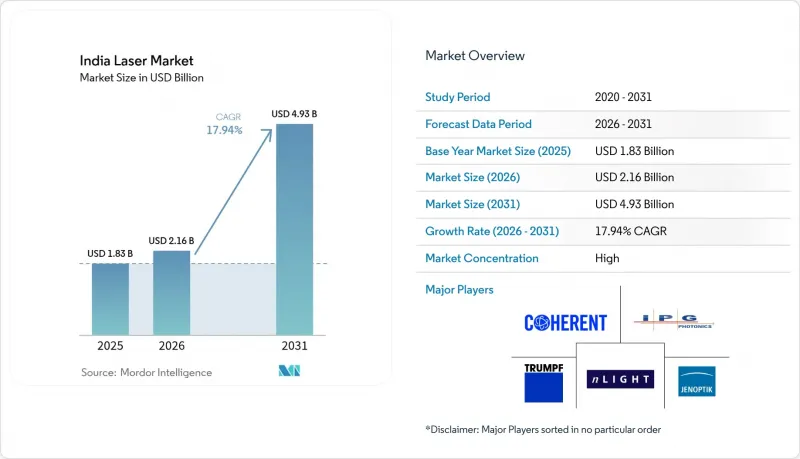
This report is Segmented by Laser Type (Fiber, Solid-State, CO2, Diode, Excimer, and More), Power Output (Low-Power, Medium-Power, and High-Power), Application (Material Processing, Communication, and More), End-User Industry (Automotive, Aerospace and Defense, Electronics and Semiconductors, Healthcare, and More). Market Forecasts are Provided in Terms of Value (USD).
India Laser Market Trends and Insights
Government Incentives For Semiconductor Fabs
Policy support under the India Semiconductor Mission approved 10 fabs with INR 1.6 lakh crore (USD 19.2 billion) committed, each embedding laser dicing, marking and scribing tools that must run at sub-micron tolerances. Zero-duty imports under the Export Promotion Capital Goods window cut ownership cost by 18%-22%, compressing payback periods on high-uptime fiber platforms. Micron's Sanand plant alone will require several dozen laser-based inspection and marking stations once operations commence. Collectively, the fab build-out implies a 15-fold scale-up in installed laser base by 2030, locking in long-tail service and consumables demand.
Rapid Adoption of EV And Battery Fabrication Lines
The Advanced Chemistry Cell PLI of INR 18,100 crore (USD 2.2 billion) creates a 50 GWh battery capacity pipeline that favors laser welding for aluminum-to-copper joints, cutting joint resistance by 18% relative to spot welding. Subsidies under the PM E-DRIVE scheme support 1.6 million electric two-wheelers and 0.5 million three-wheelers, each battery pack relying on laser seam welds to meet AIS-156 crash norms. Automotive OEMs adapting remote laser welding have recorded 30 % faster roof-seam cycles versus resistance methods. Growing line densities are therefore shifting high-power demand from plasma cutters to multi-kilowatt continuous-wave fiber units.
High Capex Of High-Power Fiber Lasers
Multi-kilowatt units priced between USD 150,000 and USD 400,000 strain balance sheets of job shops operating on 12%-18% net margins. Lease finance penetration is below 25% versus 60%-70% in Germany, forcing buyers into working-capital loans at 9%-11% interest, stretching paybacks beyond four years. The absence of a secondary market for refurbished lasers doubles the net outlay, while deferred purchases pressured IPG's India revenue to fall 8% year-over-year in 2025. SME adopters in tier-3 cities also lack access to application labs, raising perceived technical risk and slowing order conversion.
Other drivers and restraints analyzed in the detailed report include:
- Surge In Domestic Electronics Manufacturing Clusters
- PLI For Solar Module Lines Requiring Laser Scribing
- Rupee Volatility Vs USD/CNY
For complete list of drivers and restraints, kindly check the Table Of Contents.
Segment Analysis
Fiber platforms dominated 41.23 % of 2025 revenue, underlining their fit for sheet-metal cutting, battery tab welding and PCB marking. The india laser market size for fiber systems is projected to expand by more than four-fold as fabs, EV lines and solar plants race to standardize on single-mode sources with wall-plug efficiencies exceeding 40%. Ultrafast fiber lasers, though just a niche today, are climbing at a 19.18% CAGR on the back of femtosecond micro-machining in medical devices and transparent-substrate drilling for smartphone cover glass. Solid-state Nd-YAG and diode-pumped variants keep resonance in jewelry welding and watchmaking, protected by installed-base familiarity rather than raw performance. CO2 units still cut acrylic, wood and leather, yet many job shops are shedding dual-wavelength setups to streamline maintenance under tighter delivery windows.
In research and defense, excimer, ultraviolet and emerging terahertz sources fill specialized roles. ISRO's December 2025 tender for a harmonics-enabled femtosecond system underscores how national labs are staking claims in quantum optics and high-energy experiments. The Council of Scientific and Industrial Research procured frequency-stabilized helium-neon lasers for metrology, hinting at enduring demand for low-power but ultrastable benches. Dye and free-electron configurations remain academic curiosities, yet breakthroughs here often migrate to commercial wavelengths within a decade, ensuring that innovation cycles continue to refresh the india laser market long after the present forecast horizon.
Medium-power lasers between 1 and 100 watts accounted for 48.67 % of 2025 revenue, covering serial-number marking, selective soldering and thin-metal cutting tasks that populate most Indian workshops. Their plug-and-play air cooling, 220-volt compatibility and 48-hour nationwide service reach keep total downtime below 2 %, a critical selling point for SMEs. The india laser market share for high-power systems above 100 watts is rising fast, tied to multi-kilowatt weld cells that fuse aluminum battery enclosures and 20-millimeter ship-steel blanks at speeds unattainable by plasma. TRUMPF's Pune factory, opened in August 2025, now assembles 6 kW through 12 kW disk and fiber sources locally, slicing lead times to 8-10 weeks and comforting OEMs wary of shipment uncertainty.
System integrators still confront a skills gap. Only three in ten can program six-axis robots to the sub-0.1 mm path accuracy that remote welding demands, limiting provincial roll-outs. Conversely, the low-power tier below 1 watt keeps volume leadership in barcode scanners, smartphone depth sensors and alignment modules. ASP compression, however, means this tier contributes a minor fraction of india laser market size, even as shipment counts explode alongside handset assembly.
Complete Report Scope:
- By Laser Type
- Fiber Laser
- Solid-State Laser (Nd-YAG, DPSS etc.)
- CO2 Laser
- Diode / Direct Semiconductor Laser
- Excimer / UV Laser
- Ultrafast Fiber Laser
- Other Laser Types
- By Power Output
- Low-Power (less than 1 W)
- Medium-Power (1-100 W)
- High-Power (above 100 W)
- By Application
- Material Processing (Cutting, Welding, Marking)
- Communication and Optical Storage
- Medical and Aesthetic
- Instrumentation and Measurement
- Defense and Security
- Research and Development
- Consumer Electronics
- Other Applications
- By End-User Industry
- Automotive
- Aerospace and Defense
- Electronics and Semiconductors
- Healthcare
- Telecommunications
- Research Institutions
- Other End-User Industries
List of Companies Covered in this Report:
- IPG Photonics Corporation
- Coherent Corp.
- TRUMPF SE + Co. KG
- nLIGHT, Inc.
- Jenoptik AG
- Lumentum Holdings Inc.
- MKS Instruments, Inc. (Spectra-Physics)
- Han's Laser Technology Industry Group Co., Ltd.
- Wuhan Raycus Fiber Laser Technologies Co., Ltd.
- Synrad Inc. (Novanta Inc.)
- SPI Lasers UK Ltd.
- Laserline GmbH
- Maxphotonics Co., Ltd.
- EKSPLA UAB
- EdgeWave GmbH
- Toptica Photonics AG
- Amplitude Laser Group (Amplitude SAS)
- Light Conversion UAB
- Bystronic Laser AG
- Litron Lasers Ltd.
- HUBNER Photonics GmbH
- Epilog Corporation
- Universal Laser Systems, Inc.
- JPT Opto-electronics Co., Ltd.
- IPG Laser India Pvt. Ltd.
- Sahajanand Laser Technology Ltd. (SLTL Group)
- Additive India Tech Pvt. Ltd.
- Laser Technologies Pvt. Ltd.
Additional Benefits:
- The market estimate (ME) sheet in Excel format
- 3 months of analyst support
TABLE OF CONTENTS
1 INTRODUCTION
- 1.1 Study Assumptions and Market Definition
- 1.2 Scope of the Study
2 RESEARCH METHODOLOGY
3 EXECUTIVE SUMMARY
4 MARKET LANDSCAPE
- 4.1 Market Overview
- 4.2 Market Drivers
- 4.2.1 Surge in Domestic Electronics Manufacturing Clusters
- 4.2.2 Rapid Adoption of EV and Battery Fabrication Lines
- 4.2.3 Government Incentives for Semiconductor Fabs
- 4.2.4 Expansion of Laser-Based Additive Manufacturing Startups
- 4.2.5 Rising Procurement of Laser-Based LiDAR Sensors by Smart-City Projects
- 4.2.6 PLI for Solar Module Lines Requiring Laser Scribing
- 4.3 Market Restraints
- 4.3.1 High Capex of High-Power Fiber Lasers
- 4.3.2 Rupee Volatility vs USD/CNY
- 4.3.3 Inter-State GST Credit Delays on Capital Machinery
- 4.3.4 Limited Local Supply Chain for High-Precision Optical Isolators
- 4.4 Industry Value Chain Analysis
- 4.5 Regulatory Landscape
- 4.6 Technological Outlook
- 4.7 Impact of Macroeconomic Factors on the Market
- 4.8 Porter's Five Forces Analysis
- 4.8.1 Bargaining Power of Suppliers
- 4.8.2 Bargaining Power of Buyers
- 4.8.3 Threat of New Entrants
- 4.8.4 Threat of Substitutes
- 4.8.5 Competitive Rivalry
5 MARKET SIZE AND GROWTH FORECASTS (VALUE)
- 5.1 By Laser Type
- 5.1.1 Fiber Laser
- 5.1.2 Solid-State Laser (Nd-YAG, DPSS etc.)
- 5.1.3 CO2 Laser
- 5.1.4 Diode / Direct Semiconductor Laser
- 5.1.5 Excimer / UV Laser
- 5.1.6 Ultrafast Fiber Laser
- 5.1.7 Other Laser Types
- 5.2 By Power Output
- 5.2.1 Low-Power (less than 1 W)
- 5.2.2 Medium-Power (1-100 W)
- 5.2.3 High-Power (above 100 W)
- 5.3 By Application
- 5.3.1 Material Processing (Cutting, Welding, Marking)
- 5.3.2 Communication and Optical Storage
- 5.3.3 Medical and Aesthetic
- 5.3.4 Instrumentation and Measurement
- 5.3.5 Defense and Security
- 5.3.6 Research and Development
- 5.3.7 Consumer Electronics
- 5.3.8 Other Applications
- 5.4 By End-User Industry
- 5.4.1 Automotive
- 5.4.2 Aerospace and Defense
- 5.4.3 Electronics and Semiconductors
- 5.4.4 Healthcare
- 5.4.5 Telecommunications
- 5.4.6 Research Institutions
- 5.4.7 Other End-User Industries
6 COMPETITIVE LANDSCAPE
- 6.1 Market Concentration
- 6.2 Strategic Moves
- 6.3 Market Share Analysis
- 6.4 Company Profiles (includes Global Level Overview, Market Level Overview, Core Segments, Financials as Available, Strategic Information, Market Rank/Share for Key Companies, Products and Services, and Recent Developments)
- 6.4.1 IPG Photonics Corporation
- 6.4.2 Coherent Corp.
- 6.4.3 TRUMPF SE + Co. KG
- 6.4.4 nLIGHT, Inc.
- 6.4.5 Jenoptik AG
- 6.4.6 Lumentum Holdings Inc.
- 6.4.7 MKS Instruments, Inc. (Spectra-Physics)
- 6.4.8 Han's Laser Technology Industry Group Co., Ltd.
- 6.4.9 Wuhan Raycus Fiber Laser Technologies Co., Ltd.
- 6.4.10 Synrad Inc. (Novanta Inc.)
- 6.4.11 SPI Lasers UK Ltd.
- 6.4.12 Laserline GmbH
- 6.4.13 Maxphotonics Co., Ltd.
- 6.4.14 EKSPLA UAB
- 6.4.15 EdgeWave GmbH
- 6.4.16 Toptica Photonics AG
- 6.4.17 Amplitude Laser Group (Amplitude SAS)
- 6.4.18 Light Conversion UAB
- 6.4.19 Bystronic Laser AG
- 6.4.20 Litron Lasers Ltd.
- 6.4.21 HUBNER Photonics GmbH
- 6.4.22 Epilog Corporation
- 6.4.23 Universal Laser Systems, Inc.
- 6.4.24 JPT Opto-electronics Co., Ltd.
- 6.4.25 IPG Laser India Pvt. Ltd.
- 6.4.26 Sahajanand Laser Technology Ltd. (SLTL Group)
- 6.4.27 Additive India Tech Pvt. Ltd.
- 6.4.28 Laser Technologies Pvt. Ltd.
7 MARKET OPPORTUNITIES AND FUTURE OUTLOOK
- 7.1 White-Space and Unmet-Need Assessment

