PUBLISHER: Mordor Intelligence | PRODUCT CODE: 2124828

PUBLISHER: Mordor Intelligence | PRODUCT CODE: 2124828
High Power Laser Systems - Market Share Analysis, Industry Trends & Statistics, Growth Forecasts (2026 - 2031)
According to Mordor Intelligence, the high power laser systems market size is expected to grow from USD 11.9 billion in 2025 to USD 12.56 billion in 2026 and is forecast to reach USD 16.46 billion by 2031 at 5.55% CAGR over 2026-2031.
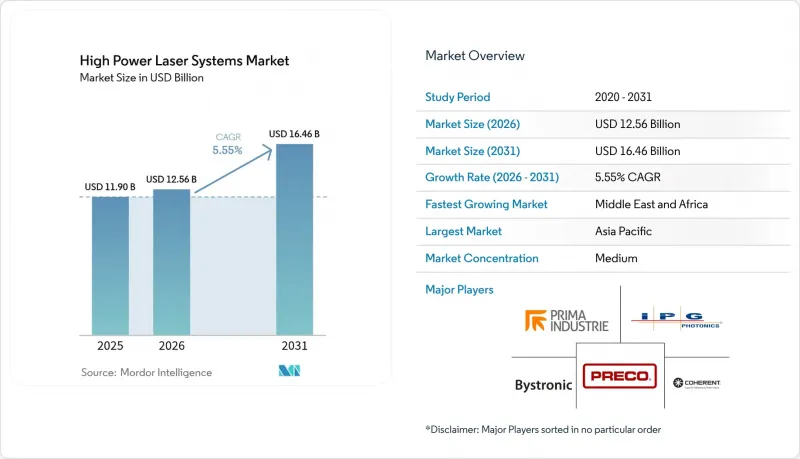
This report is Segmented by Laser Source Type (Fiber Laser, Disk Laser, Diode Laser, and More), Power Output (1-2 KW, 2-6 KW, and Above 6 KW), Application (Cutting, Welding, Cladding, and More), End-User Industry (Automotive, Aerospace and Defense, and More), Mode of Operation (Continuous-Wave, Pulsed, and Ultrafast), and Geography. The Market Forecasts are Provided in Terms of Value (USD).
Global High Power Laser Systems Market Trends and Insights
Shift-to-EV Body-in-White Ultra-High-Power Cutting Lines
Electric-vehicle platforms require aluminum space frames and mixed-material assemblies that demand laser accuracy of 0.1 mm while limiting thermal load near lithium-ion cells. Tesla's Austin plant uses 6 kW+ fiber systems to weld battery enclosures at production speeds above 15 m/min. Chinese makers BYD and CATL extend the trend, with BYD's Blade Battery lines deploying 10 kW equipment for 3.2 mm steel housings. The resulting order flow locks in multi-year contracts for system integrators and diode suppliers.
Post-Pandemic Reshoring Driving Fiber-Laser Automation Investments
Global supply-chain shocks pushed semiconductor, aerospace, and medical manufacturers to reshore production. The CHIPS and Science Act directs USD 52 billion toward U.S. fab capacity, each facility integrating laser dicing, drilling, and welding cells. Coherent's SmartSense+ platform delivers AI process monitoring that reduces operator intervention and supports consistent quality at higher throughput. Similar moves in Europe use laser automation to offset higher labor costs, sustaining equipment demand beyond initial plant buildouts.
Cap-ex payback More than 4 yrs for SMEs in low-volume fabrication
Total turnkey costs for a 4 kW fiber cell approach USD 500,000, driving payback periods beyond 4 years when utilization falls below 60%. Financing programs from Bystronic and regional banks lower entry barriers by shifting payments to operating budgets, yet risk perceptions remain high in emerging markets where order visibility is limited.
Other drivers and restraints analyzed in the detailed report include:
- Demand for sub-50 μm kerf aerospace micro-welding
- AI-enabled closed-loop beam tuning lowers scrap and energy costs
- Gallium-Based Diode Supply Volatility
For complete list of drivers and restraints, kindly check the Table Of Contents.
Segment Analysis
Fiber lasers captured 61.25% revenue in 2025 on the strength of 50% wall-plug efficiency and sealed-fiber reliability. Ultrafast fiber variants advance at a 6.95% CAGR, addressing semiconductor and medical components that require minimal heat-affected zones. CO2 systems persist in thick non-metal and wood cutting, while disk lasers serve niche automotive welding, where top-hat beam profiles aid penetration. Diode direct-emission platforms grow in surface hardening lines, yet their 5 kW ceiling limits broader uptake. The high power laser systems market size for fiber platforms is expected to rise to USD 10.08 billion by 2031 as automation spreads beyond leading OEMs.
Competitive presses from Chinese vendors compress ASPs, but intellectual property in beam-combining, mode control, and real-time monitoring helps market leaders defend positions. Safety standards such as IEC 60825 favor fibers due to lower divergence, supporting factory-floor integration without large protective enclosures. Continuous R&D around kilowatt-class single-emitter diodes would unlock new source architectures, but commercialization is unlikely before 2027.
Systems in the 2-6 kW window commanded 48.35% of the high power laser systems market share in 2025, fitting automotive steel gauges and delivering cut speeds above 15 m/min with stable edge quality. Above-6 kW units are projected to post a 7.12% CAGR to 2031 as shipbuilding, heavy equipment, and defense HEL programs require deeper penetration and thicker plate processing. Han's Laser validated 150 kW multibeam products for ship subassembly panels, demonstrating the upper power limit in commercial deployment.
Thermal management remains a bottleneck beyond 10 kW, driving innovations in micro-channel coolers and phase-change materials that maintain beam quality. In contrast, 1-2 kW sources dominate electronics and medical tooling, where low heat input avoids component distortion. Technology roadmaps indicate continued power scaling paired with adaptive beam shaping that splits energy across multiple spots, enabling parallel processing and higher line takt times.
Complete Report Scope:
- By Laser Source Type
- Fiber Laser
- Disk Laser
- Diode Laser
- CO2 Laser
- Other Laser Source Types
- By Power Output
- 1 - 2 kW
- 2 - 6 kW
- Above 6 kW
- By Application
- Cutting
- Welding
- Cladding
- Hardening
- Cleaning and Ablation
- By End-user Industry
- Automotive
- Aerospace and Defense
- Electronics and Semiconductor
- Medical Devices
- Energy and Power
- Other End-user Industries
- By Mode of Operation
- Continuous-Wave
- Pulsed
- Ultrafast (ps/fs)
- By Geography
- North America
- United States
- Canada
- Mexico
- South America
- Brazil
- Argentina
- Colombia
- Rest of South America
- Europe
- United Kingdom
- Germany
- France
- Italy
- Spain
- Rest of Europe
- Asia-Pacific
- China
- Japan
- South Korea
- India
- Rest of Asia-Pacific
- Middle East and Africa
- Middle East
- Saudi Arabia
- United Arab Emirates
- Rest of Middle East
- Africa
- South Africa
- Egypt
- Rest of Africa
- Middle East
- North America
Geography Analysis
Asia-Pacific generated 38.60% of 2025 revenue, coupling China's scale with Japan's precision equipment capabilities. Beijing's "Made in China 2025" agenda spurs adoption as domestic automakers electrify fleets, while Wuhan HG Laser and Raycus provide cost-effective platforms that shorten ROI for local fabricators. Japanese producers such as FANUC integrate advanced beam control that aligns with semiconductor lithography requirements, reinforcing regional leadership in ultrafast niches.
Europe ranks second in value yet leads policy-driven segments. The Net-Zero Industry Act subsidizes laser cleaning and welding to reduce the environmental impact of chemicals, supporting uptake in Germany, France, and Italy. European defense agencies co-fund HEL demonstrators, creating spill-over to civilian manufacturing through shared supplier bases. Skilled-labor shortages remain a constraint, elevating interest in AI-assisted machines that reduce operator specialization.
Middle East and Africa represent the fastest trajectory with a 8.78% CAGR to 2031. Saudi Arabia's Vision 2030 pushes aviation, renewable energy, and local steel projects, each reliant on high-power laser systems market solutions for precision fabrication. The United Arab Emirates invests in maintenance-repair-overhaul hubs adopting laser cladding for turbine blade refurbishment. Limited domestic component supply urges partnerships with European and Asian integrators, shaping a hybrid ecosystem of imported machinery and localized service.
- TRUMPF SE + Co. KG
- IPG Photonics Corporation
- Coherent Corp.
- Han's Laser Technology Industry Group Co., Ltd.
- Bystronic AG
- Prima Industrie S.p.A.
- EL.EN. S.p.A.
- Preco Inc.
- HSG Laser
- Amada Co., Ltd.
- Mitsubishi Electric Corporation
- Wuhan HG Laser Engineering Co., Ltd.
- Raycus Fiber Laser Technologies Co., Ltd.
- nLIGHT, Inc.
- Lumentum Operations LLC
- Jenoptik AG
- Mazak Optonics Corp.
- FANUC Corporation
- Trotec Laser GmbH
- Universal Laser Systems, Inc.
Additional Benefits:
- The market estimate (ME) sheet in Excel format
- 3 months of analyst support
TABLE OF CONTENTS
1 INTRODUCTION
- 1.1 Study Assumptions and Market Definition
- 1.2 Scope of the Study
2 RESEARCH METHODOLOGY
3 EXECUTIVE SUMMARY
4 MARKET LANDSCAPE
- 4.1 Market Overview
- 4.2 Market Drivers
- 4.2.1 Shift-to-EV body-in-white ultra-high-power cutting lines
- 4.2.2 Post-pandemic reshoring driving fiber-laser automation investments
- 4.2.3 Demand for sub-50 µm kerf aerospace micro-welding
- 4.2.4 AI-enabled closed-loop beam tuning lowers scrap and energy costs
- 4.2.5 Defense HEL upgrade programs (Greater than 100 kW) accelerate procurement
- 4.2.6 EU "Net-Zero Industry Act" incentives for green laser processing
- 4.3 Market Restraints
- 4.3.1 Cap-ex payback More than 4 yrs for SMEs in low-volume fabrication
- 4.3.2 High-power beam safety regulations tightening (IEC 60825-5)
- 4.3.3 Gallium-based diode supply volatility
- 4.3.4 Skilled laser-process engineering talent shortage
- 4.4 Industry Supply Chain Analysis
- 4.5 Regulatory Landscape
- 4.6 Technological Outlook
- 4.7 Porter's Five Forces Analysis
- 4.7.1 Bargaining Power of Suppliers
- 4.7.2 Bargaining Power of Consumers
- 4.7.3 Threat of New Entrants
- 4.7.4 Intensity of Competitive Rivalry
- 4.7.5 Threat of Substitute Products
5 MARKET SIZE AND GROWTH FORECASTS (VALUE)
- 5.1 By Laser Source Type
- 5.1.1 Fiber Laser
- 5.1.2 Disk Laser
- 5.1.3 Diode Laser
- 5.1.4 CO2 Laser
- 5.1.5 Other Laser Source Types
- 5.2 By Power Output
- 5.2.1 1 - 2 kW
- 5.2.2 2 - 6 kW
- 5.2.3 Above 6 kW
- 5.3 By Application
- 5.3.1 Cutting
- 5.3.2 Welding
- 5.3.3 Cladding
- 5.3.4 Hardening
- 5.3.5 Cleaning and Ablation
- 5.4 By End-user Industry
- 5.4.1 Automotive
- 5.4.2 Aerospace and Defense
- 5.4.3 Electronics and Semiconductor
- 5.4.4 Medical Devices
- 5.4.5 Energy and Power
- 5.4.6 Other End-user Industries
- 5.5 By Mode of Operation
- 5.5.1 Continuous-Wave
- 5.5.2 Pulsed
- 5.5.3 Ultrafast (ps/fs)
- 5.6 By Geography
- 5.6.1 North America
- 5.6.1.1 United States
- 5.6.1.2 Canada
- 5.6.1.3 Mexico
- 5.6.2 South America
- 5.6.2.1 Brazil
- 5.6.2.2 Argentina
- 5.6.2.3 Colombia
- 5.6.2.4 Rest of South America
- 5.6.3 Europe
- 5.6.3.1 United Kingdom
- 5.6.3.2 Germany
- 5.6.3.3 France
- 5.6.3.4 Italy
- 5.6.3.5 Spain
- 5.6.3.6 Rest of Europe
- 5.6.4 Asia-Pacific
- 5.6.4.1 China
- 5.6.4.2 Japan
- 5.6.4.3 South Korea
- 5.6.4.4 India
- 5.6.4.5 Rest of Asia-Pacific
- 5.6.5 Middle East and Africa
- 5.6.5.1 Middle East
- 5.6.5.1.1 Saudi Arabia
- 5.6.5.1.2 United Arab Emirates
- 5.6.5.1.3 Rest of Middle East
- 5.6.5.2 Africa
- 5.6.5.2.1 South Africa
- 5.6.5.2.2 Egypt
- 5.6.5.2.3 Rest of Africa
- 5.6.5.1 Middle East
- 5.6.1 North America
6 COMPETITIVE LANDSCAPE
- 6.1 Market Concentration
- 6.2 Strategic Moves
- 6.3 Market Share Analysis
- 6.4 Company Profiles (includes Global level Overview, Market level overview, Core Segments, Financials as available, Strategic Information, Market Rank/Share, Products and Services, Recent Developments)
- 6.4.1 TRUMPF SE + Co. KG
- 6.4.2 IPG Photonics Corporation
- 6.4.3 Coherent Corp.
- 6.4.4 Han's Laser Technology Industry Group Co., Ltd.
- 6.4.5 Bystronic AG
- 6.4.6 Prima Industrie S.p.A.
- 6.4.7 EL.EN. S.p.A.
- 6.4.8 Preco Inc.
- 6.4.9 HSG Laser
- 6.4.10 Amada Co., Ltd.
- 6.4.11 Mitsubishi Electric Corporation
- 6.4.12 Wuhan HG Laser Engineering Co., Ltd.
- 6.4.13 Raycus Fiber Laser Technologies Co., Ltd.
- 6.4.14 nLIGHT, Inc.
- 6.4.15 Lumentum Operations LLC
- 6.4.16 Jenoptik AG
- 6.4.17 Mazak Optonics Corp.
- 6.4.18 FANUC Corporation
- 6.4.19 Trotec Laser GmbH
- 6.4.20 Universal Laser Systems, Inc.
7 MARKET OPPORTUNITIES AND FUTURE OUTLOOK
- 7.1 White-space and Unmet-need Assessment

