PUBLISHER: Mordor Intelligence | PRODUCT CODE: 2124470

PUBLISHER: Mordor Intelligence | PRODUCT CODE: 2124470
North America Gaming - Market Share Analysis, Industry Trends & Statistics, Growth Forecasts (2026 - 2031)
According to Mordor Intelligence, the North America gaming market size is projected to expand from USD 73.88 billion in 2025 and USD 80.67 billion in 2026 to USD 120.86 billion by 2031, registering a CAGR of 8.42% between 2026 to 2031.
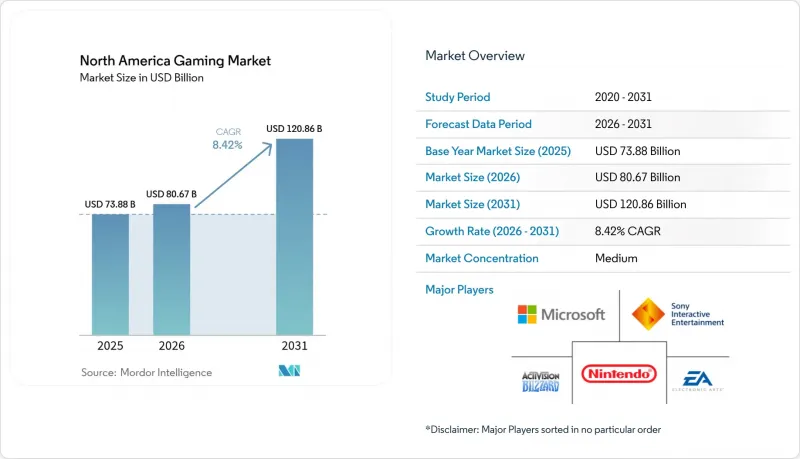
This report is Segmented by Platform (Console Gaming, PC Gaming, Mobile Gaming, Cloud Gaming and Streaming), Revenue Model (Premium, Free-to-Play/Micro-Transactions, Subscription Services, and Advertising and In-Game Purchases), Genre (Shooter, Sports, and More), Gamer Type (Casual Gamers, and More), and Geography. The Market Forecasts are Provided in Terms of Value (USD).
North America Gaming Market Trends and Insights
Surge in Mobile-First Casual Gaming Spend
Mobile platforms captured 46.31% of 2025 regional revenue, yet in-app purchase values on United States iOS devices fell 3.47% year-over-year, while advertising income jumped 26.7%, proving that reach now trumps microtransaction depth. Mexico mirrors this pattern, with 78 million gamers delivering USD 2.2 billion in 2024 value at a 9.8% growth clip thanks to mobile usage exceeding 73% of players. Publishers therefore treat lightweight titles as acquisition funnels, inserting rewarded video and subscription upsells that lifted the top 100 United States mobile games' direct-to-consumer receipts 46% year-over-year.
Subscription Services Gaining ARPU via Price-Tier Stacking
Subscription revenue is tracking a 9.11% CAGR as operators add ad-supported starter tiers beneath premium plans. Xbox Game Pass surpassed 35 million users by mid-2025, and a July 2024 price hike showed no material churn, pushing average revenue per user higher. Hybrid monetization now captures 61.7% of gaming spend because it simultaneously monetizes committed enthusiasts and price-sensitive casual players. North America's disposable-income profile supports premium tiers, while ad-subsidized options extend reach into Mexico's fast-growing mobile cohort.
Hardware Refresh Slump Post-COVID and Macro Headwinds
PlayStation 5 shipments fell 27.3% in 2024 to 15.8 million units, and Xbox hardware revenue slipped 29% in fiscal Q2 2025 as inflation tempered premium hardware demand. A lengthening console cycle caps the addressable audience for USD 70 titles, pressuring publishers to support legacy devices and cloud outlets, which in turn dilutes the visual leap that once justified new silicon.
Other drivers and restraints analyzed in the detailed report include:
- Cross-Platform Engine and Live-Ops Tool Adoption Lowering Development Cycles
- Esports Sponsorship Inflows and Media-Rights Escalation
- Rising Acquisition Costs and Ad-Signal Loss on Mobile
For complete list of drivers and restraints, kindly check the Table Of Contents.
Segment Analysis
Mobile retained 46.31% share of overall 2025 revenue, yet the North America gaming market size narrative is shifting as advertising replaced shrinking iOS in-app purchase spend, which dipped 3.47% year-over-year. Console performance softened alongside a 27.3% PlayStation 5-unit decline and a 29% Xbox hardware revenue drop, signalling install-base stagnation. Cloud gaming, projected to jump from USD 1.4 billion in 2025 to USD 18.3 billion by 2030, delivers AAA experiences without USD 500 consoles, helping Mexico's fast-rising cohort and lifting regional growth.
Cross-platform engines let studios amortize assets across console, PC, mobile and cloud, but this convergence increases QA complexity and platform-holder revenue-share exposure. Multiplatform launches rose 40% between 2021-2024; small teams saw a 71% surge, proving that tooling democratization undercuts the moat once enjoyed by major publishers. The North America gaming market now rewards agile studios that optimize UI and balance for heterogeneous screens while leveraging first-party storefronts to escape 30% mobile tariffs.
Hybrid ecosystems blending subscriptions, ads and microtransactions now generate 61.7% of total spend, dwarfing one-off sales. The North America gaming market share for free-to-play and microtransactions sat at 49.87% in 2025, but subscriptions are the fastest component with a 9.11% CAGR outlook. Game Pass's 35 million base validates multilevel pricing, while a 2024 fee hike confirmed pricing power.
High-spending whales still skew economics 0.02% of global installs created 20% of worldwide gaming revenue in 2025 yet ad-supported starter tiers broaden funnels before premium upsells. Direct-to-consumer storefronts grew 46% year-over-year as publishers chase higher takes versus platform fees. Over time, the North America gaming industry expects revenue to cluster around subscription bundles enriched by cosmetic microtransactions that stretch spending arcs well beyond launch month.
Complete Report Scope:
- By Platform
- Console Gaming
- PC Gaming
- Mobile Gaming
- Cloud Gaming and Streaming
- By Revenue Model
- Premium (Full-Priced)
- Free-to-Play/Micro-transactions
- Subscription Services
- Advertising and In-Game Purchases
- By Genre
- Shooter
- Sports
- Role-Playing/Adventure
- Strategy
- Puzzle and Casual
- Casino and Social Casino
- By Gamer Type
- Casual Gamers
- Competitive/Esports Gamers
- Hardcore/Core Gamers
- Social Gamers
- By Country
- United States
- Canada
- Mexico
List of Companies Covered in this Report:
- Activision Blizzard, Inc.
- Electronic Arts Inc.
- Microsoft Corporation
- Sony Interactive Entertainment LLC
- Nintendo Co., Ltd.
- Take-Two Interactive Software, Inc.
- Ubisoft Entertainment SA
- Valve Corporation
- Epic Games, Inc.
- Riot Games, Inc.
- Roblox Corporation
- Square Enix Holdings Co., Ltd.
- Bandai Namco Holdings Inc.
- NetEase, Inc.
- Tencent Holdings Ltd. (North-America studios)
- CD PROJEKT S.A.
- SEGA Corporation
- Warner Bros. Games Inc.
- Bethesda Softworks LLC
- Zynga Inc.
- Capcom Co., Ltd.
Additional Benefits:
- The market estimate (ME) sheet in Excel format
- 3 months of analyst support
TABLE OF CONTENTS
1 INTRODUCTION
- 1.1 Study Assumptions and Market Definition
- 1.2 Scope of the Study
2 RESEARCH METHODOLOGY
3 EXECUTIVE SUMMARY
4 MARKET LANDSCAPE
- 4.1 Market Overview
- 4.2 Market Drivers
- 4.2.1 Surge in mobile-first casual gaming spend
- 4.2.2 Subscription services gaining ARPU via price-tier stacking
- 4.2.3 Cross-platform engine and live-ops tool adoption lowering development cycles
- 4.2.4 Esports sponsorship inflows and media-rights escalation
- 4.2.5 Cloud/edge infrastructure cuts hardware barriers for AAA experiences
- 4.2.6 AI-driven user-acquisition and retention modelling boosts LTV
- 4.3 Market Restraints
- 4.3.1 Hardware refresh slump post-COVID and macro headwinds
- 4.3.2 Rising acquisition costs and ad-signal loss on mobile
- 4.3.3 Regulatory scrutiny on loot-boxes and data privacy
- 4.3.4 Talent layoffs eroding institutional knowledge and delaying releases
- 4.4 Industry Value Chain Analysis
- 4.5 Regulatory Landscape
- 4.6 Technological Outlook
- 4.7 Porter's Five Forces Analysis
- 4.7.1 Threat of New Entrants
- 4.7.2 Bargaining Power of Suppliers
- 4.7.3 Bargaining Power of Consumers
- 4.7.4 Intensity of Competitive Rivalry
- 4.7.5 Threat of Substitutes
- 4.8 Impact of Macroeconomic Trends on the Market
5 MARKET SIZE AND GROWTH FORECASTS (VALUES)
- 5.1 By Platform
- 5.1.1 Console Gaming
- 5.1.2 PC Gaming
- 5.1.3 Mobile Gaming
- 5.1.4 Cloud Gaming and Streaming
- 5.2 By Revenue Model
- 5.2.1 Premium (Full-Priced)
- 5.2.2 Free-to-Play/Micro-transactions
- 5.2.3 Subscription Services
- 5.2.4 Advertising and In-Game Purchases
- 5.3 By Genre
- 5.3.1 Shooter
- 5.3.2 Sports
- 5.3.3 Role-Playing/Adventure
- 5.3.4 Strategy
- 5.3.5 Puzzle and Casual
- 5.3.6 Casino and Social Casino
- 5.4 By Gamer Type
- 5.4.1 Casual Gamers
- 5.4.2 Competitive/Esports Gamers
- 5.4.3 Hardcore/Core Gamers
- 5.4.4 Social Gamers
- 5.5 By Country
- 5.5.1 United States
- 5.5.2 Canada
- 5.5.3 Mexico
6 COMPETITIVE LANDSCAPE
- 6.1 Market Concentration
- 6.2 Strategic Moves
- 6.3 Market Share Analysis
- 6.4 Company Profiles (includes Global level overview, Market level overview, Core segments, Financials, Strategic information, Market rank/share, Products and Services, Recent developments)
- 6.4.1 Activision Blizzard, Inc.
- 6.4.2 Electronic Arts Inc.
- 6.4.3 Microsoft Corporation
- 6.4.4 Sony Interactive Entertainment LLC
- 6.4.5 Nintendo Co., Ltd.
- 6.4.6 Take-Two Interactive Software, Inc.
- 6.4.7 Ubisoft Entertainment SA
- 6.4.8 Valve Corporation
- 6.4.9 Epic Games, Inc.
- 6.4.10 Riot Games, Inc.
- 6.4.11 Roblox Corporation
- 6.4.12 Square Enix Holdings Co., Ltd.
- 6.4.13 Bandai Namco Holdings Inc.
- 6.4.14 NetEase, Inc.
- 6.4.15 Tencent Holdings Ltd. (North-America studios)
- 6.4.16 CD PROJEKT S.A.
- 6.4.17 SEGA Corporation
- 6.4.18 Warner Bros. Games Inc.
- 6.4.19 Bethesda Softworks LLC
- 6.4.20 Zynga Inc.
- 6.4.21 Capcom Co., Ltd.
7 MARKET OPPORTUNITIES AND FUTURE OUTLOOK
- 7.1 White-space and Unmet-Need Assessment

