PUBLISHER: Mordor Intelligence | PRODUCT CODE: 2124657

PUBLISHER: Mordor Intelligence | PRODUCT CODE: 2124657
Middle East Gaming - Market Share Analysis, Industry Trends & Statistics, Growth Forecasts (2026 - 2031)
According to Mordor Intelligence, the Middle East gaming market size in 2026 is estimated at USD 5.14 billion, growing from 2025 value of USD 4.56 billion with 2031 projections showing USD 9.32 billion, growing at 12.66% CAGR over 2026-2031.
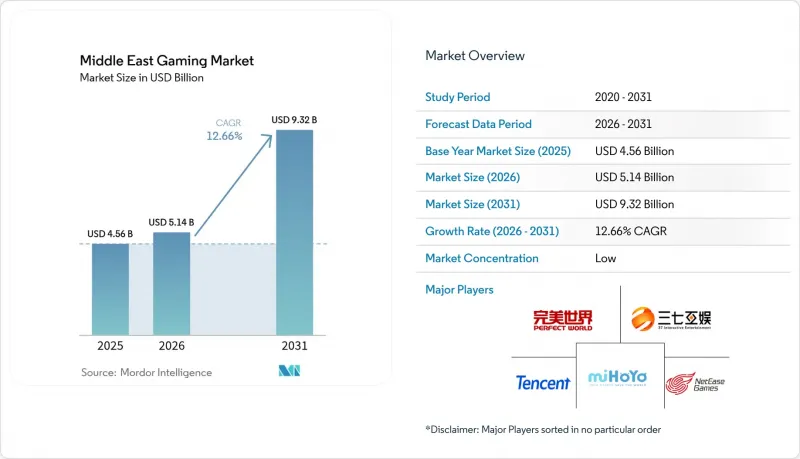
This report is Segmented by Platform (Mobile, Cloud/Streaming, Console, PC), Revenue Model (Free-To-Play, Pay-to-Play/Premium, Subscription/Game-Pass), Gamer Type (Casual, Mid-Core, Professional/E-Sports), Genre (Action/Adventure, Shooter/Battle Royale, RPG/MMORPG, Sports/Racing, Others), and Country. The Market Forecasts are Provided in Terms of Value (USD).
Middle East Gaming Market Trends and Insights
Rapid Adoption of 5G and Fiber Broadband Among GCC Nations Enabling High-Quality Mobile Gaming
Record 5G downstream speeds of 30.5 Gbps, achieved by eand in 2024, demonstrate the bandwidth now underpinning real-time multiplayer, 4K-streamed sessions and ultra-low-latency esports matches. As Zain Bahrain sunsets 3G, spectrum is refarmed to boost 5G capacity, allowing operators to promise 20 ms round-trip latency. Network-slicing pilots dedicate isolated bandwidth to gaming traffic, improving jitter and leading to premium data packs bundled with publishers' subscription passes. Edge nodes deployed inside carrier facilities shorten content-delivery hops, up-lifting conversion rates for cloud-gaming trials. Taken together, connectivity modernization is shortening session-start times and encouraging longer average play per day, directly accelerating in-game monetization.
Rising Government Investments in Esports Infrastructure in Saudi Arabia and UAE
Saudi Arabia earmarked USD 38 billion for gaming under Vision 2030 and targets 250 local studios by 2030, validating the sector as a pillar of economic diversification. The Kingdom's inaugural Esports World Cup features a record USD 70 million purse, amplifying global viewership and sponsorship inflow. Complementing this, Abu Dhabi's USD 40 million partnership with Ninjas in Pyjamas embeds talent academies and broadcast studios, turning esports into a vocational track . Venue construction and production spending ripple into hospitality and media sectors, reinforcing governments' non-oil GDP aspirations.
Fragmented Regulations on Loot Boxes and In-Game Gambling Across GCC
Legal definitions of chance-based rewards differ across Saudi Arabia, the UAE and Qatar, forcing publishers to maintain multiple codebases or disable monetization mechanics altogether. The UAE's distinction between skill and chance means a single patch can trigger re-classification, exposing developers to penalties. Iran's past blocking of Google Play, which slashed local studio revenue by up to 40%, underscores the volatility. For smaller studios the compliance cost erodes margins, delaying regional launches and limiting content variety.
Other drivers and restraints analyzed in the detailed report include:
- Increase in Arabic-Localized AAA and Indie Content Driving Gen-Z Engagement
- Proliferation of Digital Wallets and Carrier Billing Boosting In-Game Microtransactions
- High Console Hardware Import Duties in Turkey and Iran
For complete list of drivers and restraints, kindly check the Table Of Contents.
Segment Analysis
Mobile captured 61.30% of the Middle East gaming market in 2025 on the back of ubiquitous smartphones, affordable data bundles and low entry barriers. Cloud services are set to outpace all other formats at a 16.74% CAGR, bridging handset convenience with console-grade visuals by off-loading computation to regional GPU clusters. Console growth lags where import tariffs persist, while PC maintains a stable share through esports and free-to-play ecosystems. The mobile contribution to the Middle East gaming market size is projected to remain above USD 4.8 billion by 2031, even as cloud siphons premium spend. Cross-play via single sign-on keeps players inside publisher ecosystems, boosting lifetime value.
Consumer hours spent on tablets are also climbing as larger screens improve control accuracy for strategy and MOBA titles. Meanwhile, smart-TV and set-top-box apps act as secondary access points for family gaming, illustrating how platform lines blur in a cloud-first future. For telcos, bundling unlimited gaming data with 5G home broadband reinforces churn-reduction strategies.
Free-to-play still commanded 62.10% revenue share in 2025, but game-pass subscriptions are sprinting at an 17.65% CAGR as exclusive libraries and zero-ads tiers gain traction. The Middle East gaming market size for subscriptions could exceed USD 1.92 billion by 2031 if current uptake persists. Microtransaction success is fueled by carrier billing, with operators taking single-digit revenue shares in exchange for frictionless payments. Hybrid monetization is emerging: titles launch as F2P, then upsell cosmetic passes or PvE expansions via monthly packs.
Advertising-only models decline as privacy regulation curtails third-party tracking. Instead, rewarded video formats and in-house ad networks fill gaps, keeping CPI acquisition costs manageable for indie studios.
Complete Report Scope:
- By Platform
- Mobile (Smartphone, Tablet)
- Cloud / Streaming
- Console
- PC (Browser, Download/Box)
- By Revenue Model
- Free-to-Play (F2P)
- Pay-to-Play / Premium
- Subscription and Game-Pass
- By Gamer Type
- Casual Gamers
- Mid-Core Gamers
- Professional / E-Sports Athletes
- By Genre
- Action/Adventure
- Shooter and Battle Royale
- Role-Playing (RPG/MMORPG)
- Sports and Racing
- Others
- By Country
- Saudi Arabia
- United Arab Emirates
- Turkey
- Iran
- Kuwait
- Rest of Middle East (Bahrain, Qatar, Oman, Jordan, Lebanon, Iraq, Yemen)
List of Companies Covered in this Report:
- Sony Group Corporation
- Microsoft Corporation
- Tencent Holdings Ltd.
- Apple Inc.
- Electronic Arts Inc.
- Activision Blizzard Inc.
- NetEase Inc.
- Ubisoft Entertainment SA
- Epic Games Inc.
- Valve Corporation
- Sega Sammy Holdings Inc.
- Square Enix Holdings Co. Ltd.
- Take-Two Interactive Software Inc.
- Krafton Inc.
- Zynga Inc.
- Niantic Inc.
- Embracer Group AB
- Tamatem Games (Jordan)
- Peak Games (Turkey)
- Boss Bunny Games FZ-LLC (UAE)
Additional Benefits:
- The market estimate (ME) sheet in Excel format
- 3 months of analyst support
TABLE OF CONTENTS
1 INTRODUCTION
- 1.1 Study Assumptions and Market Definition
- 1.2 Scope of the Study
2 RESEARCH METHODOLOGY
3 EXECUTIVE SUMMARY
4 MARKET LANDSCAPE
- 4.1 Market Overview
- 4.2 Market Drivers
- 4.2.1 Rapid Adoption of 5G and Fiber Broadband Among GCC Nations Enabling High-Quality Mobile Gaming
- 4.2.2 Rising Government Investments in E-Sports Infrastructure in Saudi Arabia and UAE
- 4.2.3 Increase in Arabic-Localized AAA and Indie Content Driving Gen Z Engagement
- 4.2.4 Proliferation of Digital Wallets and Carrier Billing Boosting In-Game Microtransactions
- 4.2.5 High Smartphone Penetration Coupled with Falling Data Prices in Iran and Turkey
- 4.2.6 TelcoTech Cloud-Gaming Alliances (e.g., Etisalat-Nvidia) Accelerating Service Uptake
- 4.3 Market Restraints
- 4.3.1 Fragmented Regulations on Loot Boxes and In-Game Gambling Across GCC
- 4.3.2 High Console-Hardware Import Duties in Turkey and Iran
- 4.3.3 Energy-Subsidy Reforms Raising Regional Data-Center Opex
- 4.4 Regulatory Outlook
- 4.5 Portes Five Forces Analysis
- 4.5.1 Bargaining Power of Suppliers
- 4.5.2 Bargaining Power of Consumers
- 4.5.3 Threat of New Entrants
- 4.5.4 Threat of Substitute Products
- 4.5.5 Intensity of Competitive Rivalry
- 4.6 Cloud Gaming Landscape in the Middle East
- 4.6.1 Current Market Scenario
- 4.6.2 Addressable Cloud-Gaming Market Sizing
- 4.6.3 Major Stakeholders (Etisalat, PlayPod, PlayKey, Nvidia GeForce Now, Google Stadia)
- 4.6.4 Country-level Adoption Enablers and Barriers (focus on Turkey, KSA, UAE)
- 4.6.5 Market Outlook
5 MARKET SIZE AND GROWTH FORECASTS (VALUE)
- 5.1 By Platform
- 5.1.1 Mobile (Smartphone, Tablet)
- 5.1.2 Cloud / Streaming
- 5.1.3 Console
- 5.1.4 PC (Browser, Download/Box)
- 5.2 By Revenue Model
- 5.2.1 Free-to-Play (F2P)
- 5.2.2 Pay-to-Play / Premium
- 5.2.3 Subscription and Game-Pass
- 5.3 By Gamer Type
- 5.3.1 Casual Gamers
- 5.3.2 Mid-Core Gamers
- 5.3.3 Professional / E-Sports Athletes
- 5.4 By Genre
- 5.4.1 Action/Adventure
- 5.4.2 Shooter and Battle Royale
- 5.4.3 Role-Playing (RPG/MMORPG)
- 5.4.4 Sports and Racing
- 5.4.5 Others
- 5.5 By Country
- 5.5.1 Saudi Arabia
- 5.5.2 United Arab Emirates
- 5.5.3 Turkey
- 5.5.4 Iran
- 5.5.5 Kuwait
- 5.5.6 Rest of Middle East (Bahrain, Qatar, Oman, Jordan, Lebanon, Iraq, Yemen)
6 COMPETITIVE LANDSCAPE
- 6.1 Strategic Developments
- 6.2 Vendor Positioning Analysis
- 6.3 Company Profiles (includes Market-level Overview, Core Segments, Financials, Strategic Information, Products and Services, Recent Developments)
- 6.3.1 Sony Group Corporation
- 6.3.2 Microsoft Corporation
- 6.3.3 Tencent Holdings Ltd.
- 6.3.4 Apple Inc.
- 6.3.5 Electronic Arts Inc.
- 6.3.6 Activision Blizzard Inc.
- 6.3.7 NetEase Inc.
- 6.3.8 Ubisoft Entertainment SA
- 6.3.9 Epic Games Inc.
- 6.3.10 Valve Corporation
- 6.3.11 Sega Sammy Holdings Inc.
- 6.3.12 Square Enix Holdings Co. Ltd.
- 6.3.13 Take-Two Interactive Software Inc.
- 6.3.14 Krafton Inc.
- 6.3.15 Zynga Inc.
- 6.3.16 Niantic Inc.
- 6.3.17 Embracer Group AB
- 6.3.18 Tamatem Games (Jordan)
- 6.3.19 Peak Games (Turkey)
- 6.3.20 Boss Bunny Games FZ-LLC (UAE)
7 MARKET OPPORTUNITIES AND FUTURE OUTLOOK
- 7.1 White-Space and Unmet-Need Assessment

