PUBLISHER: Mordor Intelligence | PRODUCT CODE: 2124501

PUBLISHER: Mordor Intelligence | PRODUCT CODE: 2124501
Middle East Programmable Logic Controller - Market Share Analysis, Industry Trends & Statistics, Growth Forecasts (2026 - 2031)
According to Mordor Intelligence, Middle East programmable logic controller market size in 2026 is estimated at USD 803.93 million, growing from 2025 value of USD 760 million with 2031 projections showing USD 1.06 billion, growing at 5.78% CAGR over 2026-2031.
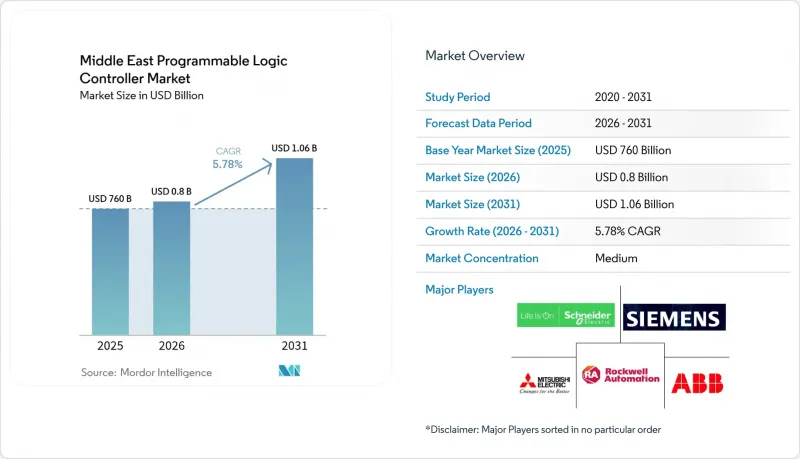
This report is Segmented by Component (Hardware, Software, and Services), PLC Type (Nano PLC, Micro PLC, and More), Architecture (Fixed/Compact PLC, and Modular/Rack-Mounted PLC), End-User Industry (Oil and Gas, Chemical and Petrochemical, and More), and Country (United Arab Emirates, Saudi Arabia, and More). The Market Forecasts are Provided in Terms of Value (USD).
Middle East Programmable Logic Controller Market Trends and Insights
Expanding Oil and Gas Digitalisation Projects
National oil firms are embedding PLC-centric digital twins to compress drilling cycles and defer new-well capital outlays. ADNOC's Neuron 5 platform lowered unplanned shutdowns by 50% and extended maintenance intervals by 20% across offshore and onshore assets. Saudi Aramco's RoboWell system fuses downhole telemetry with surface PLCs to optimize bit weight and rotary speed, trimming non-productive time by 30%. Qatar's North Field LNG expansion mandates IEC 61511 SIL-3-certified safety PLCs, creating a multi-year hardware and software pipeline. These deployments underscore why software revenue is outpacing hardware despite hardware's large base. As analytics shift to the edge, the Middle East programmable logic controller market benefits from recurring software updates layered onto existing racks.
Surge in Brownfield Automation Retrofits
Aging refineries and petrochemical plants commissioned in the 1980s and 1990s face tighter emissions standards, prompting modular PLC upgrades that cut energy use and add remote diagnostics. ADNOC Gas replaced pneumatic actuators with rack PLCs at Habshan-5, reducing energy consumption by 15%. Saudi Aramco's Yanbu modernization integrated Siemens S7-1500 PLCs compliant with IEC 62443 cyber-security guidelines. Brownfield operators prefer modular racks because hot-swappable I/O cards limit downtime to weekend cutovers. With installed capacity above 10 million barrels per day across Saudi and UAE refineries, retrofit momentum sustains steady hardware demand even as software margins grow.
Import Tariffs on Industrial Automation Hardware Outside GCC
Non-GCC states apply import duties ranging from 10% to 25% on PLCs, power supplies, and I/O cards, whereas intra-GCC trade remains tariff-free under the Unified Customs Law. Egyptian decree 465/2024 raised the duty on programmable controllers to 20%, immediately inflating project budgets for wastewater-treatment upgrades in Cairo and Alexandria. Lebanon and Jordan maintain similar levies to protect nascent local assembly, yet neither hosts semiconductor fabrication or high-precision PCB production, forcing integrators to import anyway. The higher landed cost compels end users to defer non-essential retrofits and reduces order sizes, trimming 0.4% from near-term CAGR potential. Vendors resort to bundling programming software at no charge to offset hardware sticker shock, but margin erosion persists.
Other drivers and restraints analyzed in the detailed report include:
- Accelerating Gulf Data-Center Construction
- Wastewater Reuse Mandates in Water-Stressed Economies
- Freight Congestion Through Red Sea and Strait of Hormuz
For complete list of drivers and restraints, kindly check the Table Of Contents.
Segment Analysis
Hardware controlled 70.62% of 2025 revenue, yet software's 6.71% CAGR shows operators layering analytics and cyber-security modules onto installed assets. TAQA's USD 26 million AI SCADA rollout placed machine-learning models directly on Siemens S7-1500 PLCs, cutting chemical use 18% and deferring capital on new reverse-osmosis trains. Services revenue gained 5.5% as long-term agreements converted capex into opex. The Middle East programmable logic controller market size for software components is expected to reach USD 0.32 billion by 2031, reflecting rising subscription adoption.
Edge analytics explains software's momentum. Rockwell Automation reported that 87% of surveyed manufacturers in Saudi and the UAE run at least one AI model at the PLC layer, supporting quality inspection and anomaly detection. Vendors monetize this shift through annual licenses rather than one-time hardware margins, broadening total contract value even when new unit shipments plateau.
Medium PLCs held 34.15% of Middle East programmable logic controller market share in 2025 thanks to legacy dominance in food, beverage, and cement. Safety PLCs, however, post a 7.26% CAGR as GCC regulators enforce IEC 61511 certification for new and retrofitted systems. Qatar Petrochemical Company's SIL-3 deployment achieved 99.9% availability and third-party TUV validation. The Middle East programmable logic controller market size for safety units is forecast to double to USD 0.13 billion by 2031, fueled by LNG, hydrogen, and high-pressure gas projects.
Safety PLCs carry higher per-unit prices yet remain under 10% of shipments, indicating long runway for mix shift. Vendors bundle firmware-level OT security, shortening lead times and aligning with integrated cyber certification mandates.
Complete Report Scope:
- By Component
- Hardware
- Software
- Services
- By PLC Type
- Nano PLC
- Micro PLC
- Medium PLC
- Large PLC
- Safety PLC
- By Architecture
- Fixed/Compact PLC
- Modular/Rack-Mounted PLC
- By End-User Industry
- Oil and Gas
- Chemical and Petrochemical
- Energy and Utilities
- Food, Tobacco, and Beverage
- Automotive
- Pharmaceutical
- Other End-User Industries
- By Country
- United Arab Emirates
- Saudi Arabia
- Israel
- Oman
- Qatar
- Kuwait
- Bahrain
- Rest of Middle East
List of Companies Covered in this Report:
- Siemens AG
- ABB Ltd
- Schneider Electric SE
- Rockwell Automation Inc.
- Mitsubishi Electric Corporation
- Honeywell International Inc.
- Omron Corporation
- Emerson Electric Co.
- Hitachi Ltd.
- HIMA Paul Hildebrandt GmbH
- Yokogawa Electric Corporation
- Vista Automation LLC
- Control Tech Automation LLC
Additional Benefits:
- The market estimate (ME) sheet in Excel format
- 3 months of analyst support
TABLE OF CONTENTS
1 INTRODUCTION
- 1.1 Study Assumptions and Market Definition
- 1.2 Scope of the Study
2 RESEARCH METHODOLOGY
3 EXECUTIVE SUMMARY
4 MARKET LANDSCAPE
- 4.1 Market Overview
- 4.2 Market Drivers
- 4.2.1 Expanding Oil and Gas Digitalisation Projects
- 4.2.2 Surge in Brownfield Automation Retrofits
- 4.2.3 Growing GCC Vision-Driven Manufacturing Hubs
- 4.2.4 Mandatory Functional-Safety Compliance in Energy Sector
- 4.2.5 Hydrogen Economy Pilot Investments in the Region
- 4.2.6 AI-Enabled Predictive Maintenance Adoption in Desalination Plants
- 4.3 Market Restraints
- 4.3.1 Supply Chain Volatility for Advanced ICs
- 4.3.2 Limited Local System-Integrator Skill Pool
- 4.3.3 High Cyber-Security Certification Costs
- 4.3.4 Preference for DCS in Large Greenfield Petrochemical Complexes
- 4.4 Industry Value Chain Analysis
- 4.5 Porter's Five Forces Analysis
- 4.5.1 Bargaining Power of Suppliers
- 4.5.2 Bargaining Power of Consumers
- 4.5.3 Threat of New Entrants
- 4.5.4 Intensity of Competitive Rivalry
- 4.5.5 Threat of Substitutes
- 4.6 Impact of Macroeconomic Factors on the Market
5 MARKET SIZE AND GROWTH FORECASTS (VALUE)
- 5.1 By Component
- 5.1.1 Hardware
- 5.1.2 Software
- 5.1.3 Services
- 5.2 By PLC Type
- 5.2.1 Nano PLC
- 5.2.2 Micro PLC
- 5.2.3 Medium PLC
- 5.2.4 Large PLC
- 5.2.5 Safety PLC
- 5.3 By Architecture
- 5.3.1 Fixed/Compact PLC
- 5.3.2 Modular/Rack-Mounted PLC
- 5.4 By End-User Industry
- 5.4.1 Oil and Gas
- 5.4.2 Chemical and Petrochemical
- 5.4.3 Energy and Utilities
- 5.4.4 Food, Tobacco, and Beverage
- 5.4.5 Automotive
- 5.4.6 Pharmaceutical
- 5.4.7 Other End-User Industries
- 5.5 By Country
- 5.5.1 United Arab Emirates
- 5.5.2 Saudi Arabia
- 5.5.3 Israel
- 5.5.4 Oman
- 5.5.5 Qatar
- 5.5.6 Kuwait
- 5.5.7 Bahrain
- 5.5.8 Rest of Middle East
6 COMPETITIVE LANDSCAPE
- 6.1 Market Concentration
- 6.2 Strategic Moves
- 6.3 Market Share Analysis
- 6.4 Company Profiles (includes Global level Overview, Market level overview, Core Segments, Financials as available, Strategic Information, Market Rank/Share for key companies, Products and Services, and Recent Developments)
- 6.4.1 Siemens AG
- 6.4.2 ABB Ltd
- 6.4.3 Schneider Electric SE
- 6.4.4 Rockwell Automation Inc.
- 6.4.5 Mitsubishi Electric Corporation
- 6.4.6 Honeywell International Inc.
- 6.4.7 Omron Corporation
- 6.4.8 Emerson Electric Co.
- 6.4.9 Hitachi Ltd.
- 6.4.10 HIMA Paul Hildebrandt GmbH
- 6.4.11 Yokogawa Electric Corporation
- 6.4.12 Vista Automation LLC
- 6.4.13 Control Tech Automation LLC
7 MARKET OPPORTUNITIES AND FUTURE OUTLOOK
- 7.1 White-Space and Unmet-Need Assessment

