PUBLISHER: Mordor Intelligence | PRODUCT CODE: 2124953

PUBLISHER: Mordor Intelligence | PRODUCT CODE: 2124953
Asia-Pacific Programmable Logic Controller - Market Share Analysis, Industry Trends & Statistics, Growth Forecasts (2026 - 2031)
According to Mordor Intelligence, the Asia-Pacific programmable logic controller market size is expected to grow from USD 4.96 billion in 2025 to USD 5.21 billion in 2026 and is forecast to reach USD 6.67 billion by 2031 at 5.05% CAGR over 2026-2031.
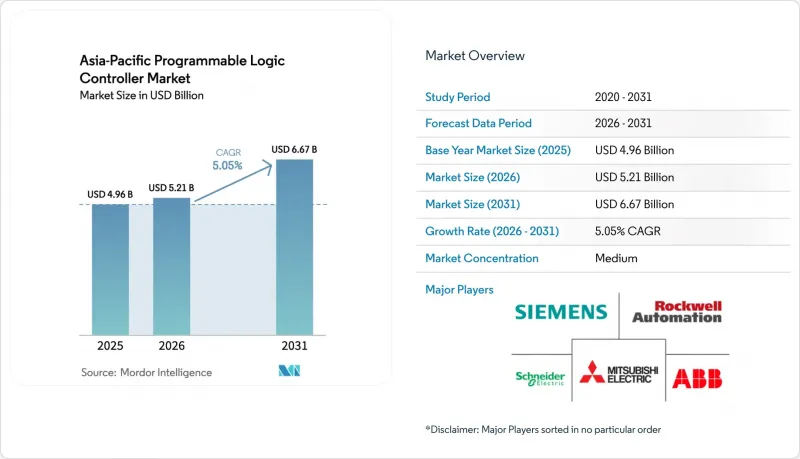
This report is Segmented by Type (Hardware and Software and Services), Architecture (Compact PLC, Modular PLC, and More), End-User (Automotive, Food, Tobacco and Beverage, Chemical and Petrochemical, and More), Input/Output Type (Digital I/O, Analog I/O, and Mixed I/O), and Country. The Market Forecasts are Provided in Terms of Value (USD).
Asia-Pacific Programmable Logic Controller Market Trends and Insights
Surge in Automotive E-mobility Production Lines
Electric-vehicle assembly requires precise temperature management of the battery pack, coordination of multi-axis motor windings, and certified functional safety controls. China's OEMs have established reference automation templates that neighboring markets are now replicating, compelling PLC vendors to incorporate higher-speed processing and expanded communication stacks. ISO 26262 mandates further raising technical entry barriers as e-mobility expands beyond China. Localized line-builders in India and Southeast Asia source modular PLCs to shorten deployment times. Vendor differentiation is therefore shifting from hardware density to integrated motion libraries and EV-specific diagnostics. Continuous product updates, aligning with evolving battery chemistries, sustain long-term demand for controllers.
Government-led Smart Manufacturing Subsidies
Strategic programs such as China's "Made in China 2025," Japan's Society 5.0, and South Korea's K-Digital New Deal inject funding that accelerates automation procurement. Subsidy-linked deadlines compress project timelines, benefiting suppliers with turnkey service capabilities. Tax credits and low-interest loans lower payback thresholds, drawing small and medium manufacturers into the Asia-Pacific programmable logic controller market. However, pull-forward demand risks post-incentive slowdowns. India's Production Linked Incentive scheme fosters domestic assembly, potentially altering import patterns. Clustering of subsidized plants also enhances ecosystem knowledge transfer, reinforcing regional growth momentum.
High Upfront Integration and Training Costs
Total project outlays can triple the hardware price due to system design, wiring, commissioning, and operator upskilling. SMEs in India and Southeast Asia struggle to secure financing, which delays automation despite its attractive paybacks. Shortages of qualified integrators inflate labor costs and extend timelines. Legacy equipment interfacing often requires custom gateways, which raises implementation risk. Manufacturers wary of prolonged shutdowns opt for partial or no automation, tempering near-term demand for programmable logic controllers in the Asia-Pacific market. Vendors respond with pre-engineered templates and remote training modules to compress learning curves.
Other drivers and restraints analyzed in the detailed report include:
- Rapid Expansion of Low-cost Modular PLCs
- Migration to Industry 4.0 Cyber-secure PLC Platforms
- Prolonged Semiconductor Supply Constraints
For complete list of drivers and restraints, kindly check the Table Of Contents.
Segment Analysis
Services generated the highest incremental revenue, expanding at a 6.05% CAGR, as manufacturers prioritize integration expertise, predictive maintenance, and lifecycle optimization over standalone hardware. Hardware and software components continued to dominate the Asia-Pacific programmable logic controller market share, accounting for 75.05% in 2025, reflecting ongoing capacity expansions in China and India. Services revenue benefits from multi-year contracts, delivering steadier cash flows than cyclical hardware sales. Remote monitoring and cloud-based analytics underpin this shift, reducing unplanned downtime and justifying premium service fees.
System integrators leverage domain know-how to bridge legacy equipment with modern controllers, compressing deployment timelines. Over-the-air firmware updates and flexible licensing enhance scalability, mitigating capital-expenditure hurdles. Large installations in petrochemical plants still rely on high-end hardware, but nano- and microcontrollers with SaaS packages are gaining traction in dispersed IoT nodes. Consequently, vendors reorient portfolios toward outcome-based models, expanding the Asia-Pacific programmable logic controller market's recurring-revenue proportion.
Modular PLCs retained 55.10% revenue leadership in 2025, favored for their expandability in complex lines. Nonetheless, soft PLC platforms posted a 6.68% CAGR, eroding incumbents' share as virtualization delivers deterministic performance on industrial PCs. Early adopters in automotive battery lines deploy containerized control applications to enable rapid recipe changes and centralized version management. Rack-mount configurations address dense I/O needs in process industries, whereas compact units cater to skid-mounted equipment and OEM machinery.
Edge gateways integrate programmable logic, data aggregation, and AI inference on a single board, thereby blurring the boundaries between different functions. Vendors differentiate through real-time hypervisors, secure boot sequences, and compatibility with IT orchestration tools. As a result, buyers evaluate total system architecture rather than discrete controller models, reshaping procurement criteria within the Asia-Pacific programmable logic controller market. Continued maturation of the soft platform will likely compress hardware refresh cycles, encouraging subscription-based upgrades.
Complete Report Scope:
- By Type
- Hardware and Software
- Large PLC
- Nano PLC
- Small PLC
- Medium PLC
- Software
- Other Types
- Services
- Hardware and Software
- By Architecture
- Compact PLC
- Modular PLC
- Rack-mount PLC
- Soft PLC (PC-based)
- By End-User
- Automotive
- Food, Tobacco and Beverage
- Chemical and Petrochemical
- Energy and Utilities
- Oil and Gas
- Water and Wastewater Treatment
- Pharmaceutical
- Pulp and Paper
- Other End-Users
- By Input / Output Type
- Digital I/O
- Analog I/O
- Mixed I/O
- By Country
- China
- Japan
- India
- South Korea
- South-East Asia
- Rest of Asia Pacific
List of Companies Covered in this Report:
- ABB Ltd.
- Mitsubishi Electric Corporation
- Schneider Electric SE
- Rockwell Automation Inc.
- Siemens AG
- Honeywell International Inc.
- Omron Corporation
- Panasonic Holdings Corporation
- Robert Bosch GmbH
- Emerson Electric Co.
- Hitachi Ltd.
- Toshiba International Corporation
- Delta Electronics Inc.
- Beckhoff Automation GmbH and Co. KG
- LS Electric Co., Ltd.
- Fuji Electric Co., Ltd.
- B and R Industrial Automation GmbH
- IDEC Corporation
- Yokogawa Electric Corporation
- WAGO Kontakttechnik GmbH and Co. KG
Additional Benefits:
- The market estimate (ME) sheet in Excel format
- 3 months of analyst support
TABLE OF CONTENTS
1 INTRODUCTION
- 1.1 Study Assumptions and Market Definition
- 1.2 Scope of the Study
2 RESEARCH METHODOLOGY
3 EXECUTIVE SUMMARY
4 MARKET LANDSCAPE
- 4.1 Market Overview
- 4.2 Impact of Macroeconomic Factors
- 4.3 Market Drivers
- 4.3.1 Surge in automotive e-mobility production lines
- 4.3.2 Government-led smart-manufacturing subsidies
- 4.3.3 Rapid expansion of low-cost modular PLCs
- 4.3.4 Migration to Industry 4.0 cyber-secure PLC platforms
- 4.3.5 Demand for energy-efficient utility automation
- 4.3.6 Emerging 5G-enabled time-sensitive networking (TSN)
- 4.4 Market Restraints
- 4.4.1 High upfront integration and training costs
- 4.4.2 Prolonged semiconductor supply constraints
- 4.4.3 Availability of low-code soft-PLC substitutes
- 4.4.4 Rising cyber-security compliance expenditures
- 4.5 Industry Value Chain Analysis
- 4.6 Regulatory Landscape
- 4.7 Technological Outlook
- 4.8 Porter's Five Forces Analysis
- 4.8.1 Bargaining Power of Suppliers
- 4.8.2 Bargaining Power of Buyers
- 4.8.3 Threat of New Entrants
- 4.8.4 Threat of Substitutes
- 4.8.5 Intensity of Competitive Rivalry
5 MARKET SIZE AND GROWTH FORECASTS (VALUE)
- 5.1 By Type
- 5.1.1 Hardware and Software
- 5.1.1.1 Large PLC
- 5.1.1.2 Nano PLC
- 5.1.1.3 Small PLC
- 5.1.1.4 Medium PLC
- 5.1.1.5 Software
- 5.1.1.6 Other Types
- 5.1.2 Services
- 5.1.1 Hardware and Software
- 5.2 By Architecture
- 5.2.1 Compact PLC
- 5.2.2 Modular PLC
- 5.2.3 Rack-mount PLC
- 5.2.4 Soft PLC (PC-based)
- 5.3 By End-User
- 5.3.1 Automotive
- 5.3.2 Food, Tobacco and Beverage
- 5.3.3 Chemical and Petrochemical
- 5.3.4 Energy and Utilities
- 5.3.5 Oil and Gas
- 5.3.6 Water and Wastewater Treatment
- 5.3.7 Pharmaceutical
- 5.3.8 Pulp and Paper
- 5.3.9 Other End-Users
- 5.4 By Input / Output Type
- 5.4.1 Digital I/O
- 5.4.2 Analog I/O
- 5.4.3 Mixed I/O
- 5.5 By Country
- 5.5.1 China
- 5.5.2 Japan
- 5.5.3 India
- 5.5.4 South Korea
- 5.5.5 South-East Asia
- 5.5.6 Rest of Asia Pacific
6 COMPETITIVE LANDSCAPE
- 6.1 Market Concentration
- 6.2 Strategic Moves
- 6.3 Market Share Analysis
- 6.4 Company Profiles (includes Global level overview, Market level overview, Core segments, Financials as available, Strategic information, Market rank/share for key companies, Products and services, and Recent developments)
- 6.4.1 ABB Ltd.
- 6.4.2 Mitsubishi Electric Corporation
- 6.4.3 Schneider Electric SE
- 6.4.4 Rockwell Automation Inc.
- 6.4.5 Siemens AG
- 6.4.6 Honeywell International Inc.
- 6.4.7 Omron Corporation
- 6.4.8 Panasonic Holdings Corporation
- 6.4.9 Robert Bosch GmbH
- 6.4.10 Emerson Electric Co.
- 6.4.11 Hitachi Ltd.
- 6.4.12 Toshiba International Corporation
- 6.4.13 Delta Electronics Inc.
- 6.4.14 Beckhoff Automation GmbH and Co. KG
- 6.4.15 LS Electric Co., Ltd.
- 6.4.16 Fuji Electric Co., Ltd.
- 6.4.17 B and R Industrial Automation GmbH
- 6.4.18 IDEC Corporation
- 6.4.19 Yokogawa Electric Corporation
- 6.4.20 WAGO Kontakttechnik GmbH and Co. KG
7 MARKET OPPORTUNITIES AND FUTURE OUTLOOK
- 7.1 White-space and Unmet-Need Assessment

