PUBLISHER: Mordor Intelligence | PRODUCT CODE: 2124507

PUBLISHER: Mordor Intelligence | PRODUCT CODE: 2124507
Managed Pressure Drilling Services - Market Share Analysis, Industry Trends & Statistics, Growth Forecasts (2026 - 2031)
According to Mordor Intelligence, the managed pressure drilling services market size is expected to grow from USD 4.58 billion in 2025 to USD 4.77 billion in 2026 and is forecast to reach USD 5.87 billion by 2031 at 4.22% CAGR over 2026-2031.
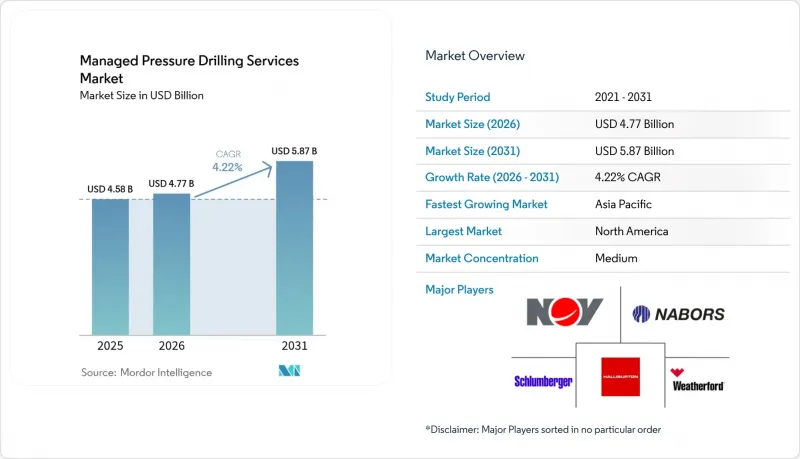
This report is Segmented by Technology (Constant Bottom-Hole Pressure, and More), Service Type (Equipment Rental, Operations & Execution, and More), Pressure Regime (Low-Pressure and High-Pressure), Well Type (Production, Exploration, and Work-Over), Environment (Conventional, Unconventional, and More), Application (Onshore and Offshore), and Geography (North America, Asia-Pacific, and More)
Global Managed Pressure Drilling Services Market Trends and Insights
Accelerating Deep-water CAPEX Rebound
Sanctioned deepwater budgets have exceeded USD 200 billion annually since 2022, reversing the 2015-2020 investment drought and fuelling fresh demand for managed pressure drilling services market deployments. Chevron's USD 5.7 billion Anchor project illustrates the shift, employing 20,000 psi systems that rely on sophisticated MPD to drill safely in ultra-narrow windows. Drillship utilisation nearing 97% in 2025 prioritises rigs fitted with advanced pressure control, allowing contractors to command premium dayrates. Each sanctioned deepwater campaign typically entails multiple MPD-enabled wells across exploration, appraisal, and production phases, compounding service demand. Technology differentiation remains a pivotal competitive lever for service providers positioning for multi-year contract backlogs.
Surge in HPHT Well Development in MENA
National oil companies across the Middle East and North Africa target reservoirs exceeding 15,000 psi and 350 °F, where managed pressure drilling services market solutions become indispensable for safe wellbore construction. Automated rotary and slide drilling executed in Oman by Halliburton and Nabors underscores how AI-enhanced MPD is fast becoming standard operating practice . Regulatory frameworks in Saudi Arabia, the UAE, and Qatar now require MPD on wells surpassing defined pressure thresholds, accelerating adoption. As HPHT projects proliferate, service providers with proven HPHT toolkits and crew availability enjoy a clear advantage.
Volatile Rig-day Rates Squeezing MPD Budgets
Harsh-environment semisubs commanded USD 390,000-510,000 per day in 2024, a nine-year high that narrowed discretionary drilling spend. MPD services typically add 15-25% to total well costs, so sudden rate spikes lead operators to defer or downgrade deployments. Ownership models such as TotalEnergies' majority stake in a high-spec drillship highlight efforts to tame escalating costs. While rig rates are expected to ease modestly by 2026, the boom-bust cycle underpins cautious MPD budgeting.
Other drivers and restraints analyzed in the detailed report include:
- Post-2025 Shale Refrac Wave in North America
- AI-driven Downhole Pressure Automation
- Limited Global Pool of Certified MPD Crews
For complete list of drivers and restraints, kindly check the Table Of Contents.
Segment Analysis
Constant bottom-hole pressure methods contributed 46.10% to the managed pressure drilling services market size in 2025, reflecting their broad applicability across shelf, HPHT, and onshore wells. However, dual-gradient systems are climbing at a 5.95% CAGR to 2031 as deepwater operators exploit their ability to decouple mudweight from riser pressure, lowering downhole stress and improving kick tolerance.
The dual-gradient surge coincides with integrated seabed pump deployments synchronizing with surface control loops for rapid pressure corrections. AI-linked sensors fine-tune bottomhole pressure analytics, cutting wellbore ballooning events. Mud-cap drilling remains niche for total-loss scenarios, and return-flow control methods serve laterals in shale plays, yet both benefit from the broader automation wave permeating the managed pressure drilling services market.
Equipment rental held 47.70% revenue in 2025 as operators avoided capital commitments tied to specialised manifolds, chokes, and rotating control devices. The managed pressure drilling services market size for operations and execution packages is forecast to rise faster at a 5.55% CAGR, propelled by crew scarcity and risk-sharing incentives.
Integrated contracts bundle hardware with certified personnel, real-time analytics, and performance guarantees, letting operators transfer execution risk while accessing the latest toolsets. Design and engineering services maintain a stable demand, particularly for frontier HPHT and CCS wells requiring bespoke hydraulics modelling. Training and support demand is swelling as contractors race to certify national crews and enable remote operations centres.
Complete Report Scope:
- By Technology
- Constant Bottom-Hole Pressure
- Mud-Cap Drilling
- Dual-Gradient Drilling
- Return-Flow Control Drilling
- Other Emerging Techniques
- By Service Type
- Design and Engineering
- Equipment Rental
- Operations and Execution
- Training and Support
- By Pressure Regime
- Low-Pressure/Narrow Window
- High-Pressure/High-Temperature (HPHT)
- By Well Type
- Wildcat/Exploration
- Development Production
- Work-over and Re-entry
- By Drilling Environment
- Conventional Hydrocarbon
- Unconventional (Shale, Tight, CBM)
- Geothermal
- CCS and Hydrogen Storage
- By Application
- Onshore
- Offshore
- By Geography
- North America
- United States
- Canada
- Mexico
- Europe
- Germany
- United Kingdom
- France
- Italy
- Spain
- Russia
- Rest of Europe
- Asia-Pacific
- China
- India
- Japan
- South Korea
- ASEAN Countries
- Rest of Asia-Pacific
- South America
- Brazil
- Argentina
- Rest of South America
- Middle East and Africa
- Saudi Arabia
- United Arab Emirates
- South Africa
- Egypt
- Rest of Middle East and Africa
- North America
Geography Analysis
North America preserved a 38.10% revenue lead in 2025 as shale refracs, Permian HPHT horizontals, and Gulf of Mexico ultra-deepwater wells collectively boosted MPD demand. Early adoption of AI-enabled pressure automation and an established training infrastructure keeps service costs competitive. Mexico's Trion field, backed by SLB's integrated drilling contract, signals deeper regional penetration of MPD for national oil companies.
Asia-Pacific is the fastest-growing managed pressure drilling services market segment, set for a 6.82% CAGR to 2031. China's push into 8-km deep Shunbei wells and Sichuan over-pressured shales requires precise pressure envelopes to avoid H2S influx. India's rig count is projected to rise from 111 in 2024 to 142 by 2028, creating incremental MPD demand for offshore KG basin HPHT wells and onshore Rajasthan appraisal campaigns. Southeast Asia revives deepwater gas prospects in Malaysia and Indonesia, while Australia preps CCS pilot wells aligned with net-zero targets.
Europe shows steady growth fuelled by North Sea HPHT wells, Baltic CCS pilots, and geothermal hotspots in Germany and France. The EU's stringent well-integrity rules embed MPD in licensing conditions for geothermal and CCS wells, reinforcing technology pull. Norway's full-field MPD adoption standard further diffuses best practice across the continent.
The Middle East and Africa benefit from HPHT carbonate developments in Saudi Arabia and Qatar, plus emerging deepwater campaigns in Namibia and Angola. National oil company mandates and HPHT targets underpin robust demand, though crew localisation remains a bottleneck. Brazil's pre-salt and Argentina's unconventional Vaca Muerta drive anchor South America's growth.
- Halliburton Company
- Schlumberger Ltd
- Weatherford International plc
- NOV Inc.
- Nabors Industries Ltd
- Global MPD Services
- Ensign Energy Services Inc.
- Air Drilling Associates Inc.
- Blade Energy Partners Ltd
- Exceed (XCD) Holdings Ltd
- Pruitt MPD
- Beyond Energy Services & Technology
- Scientific Drilling International
- Secure Drilling (Petrofac)
- Wild Well Control
- Archer Ltd
- Helmerich & Payne (MPD unit)
- Welltec A/S
- Cougar Drilling Solutions
- GOSCO Drilling Solutions
Additional Benefits:
- The market estimate (ME) sheet in Excel format
- 3 months of analyst support
TABLE OF CONTENTS
1 Introduction
- 1.1 Study Assumptions & Market Definition
- 1.2 Scope of the Study
2 Research Methodology
3 Executive Summary
4 Market Landscape
- 4.1 Market Overview
- 4.2 Market Drivers
- 4.2.1 Accelerating deep-water CAPEX rebound
- 4.2.2 Surge in HPHT well development in MENA
- 4.2.3 Post-2025 shale refrac wave in North America
- 4.2.4 AI-driven downhole pressure automation
- 4.2.5 CCS & hydrogen-ready well design standards
- 4.2.6 Mandatory MPD adoption for geothermal wells in EU
- 4.3 Market Restraints
- 4.3.1 Volatile rig-day rates squeezing MPD budgets
- 4.3.2 Limited global pool of certified MPD crews
- 4.3.3 Persistent data-ownership disputes in JV wells
- 4.3.4 Stricter drilling-fluid discharge limits in offshore Arctic
- 4.4 Supply-Chain Analysis
- 4.5 Regulatory Landscape
- 4.6 Technological Outlook
- 4.7 Porter's Five Forces
- 4.7.1 Bargaining Power of Suppliers
- 4.7.2 Bargaining Power of Buyers
- 4.7.3 Threat of New Entrants
- 4.7.4 Threat of Substitutes
- 4.7.5 Intensity of Rivalry
5 Market Size & Growth Forecasts
- 5.1 By Technology
- 5.1.1 Constant Bottom-Hole Pressure
- 5.1.2 Mud-Cap Drilling
- 5.1.3 Dual-Gradient Drilling
- 5.1.4 Return-Flow Control Drilling
- 5.1.5 Other Emerging Techniques
- 5.2 By Service Type
- 5.2.1 Design and Engineering
- 5.2.2 Equipment Rental
- 5.2.3 Operations and Execution
- 5.2.4 Training and Support
- 5.3 By Pressure Regime
- 5.3.1 Low-Pressure/Narrow Window
- 5.3.2 High-Pressure/High-Temperature (HPHT)
- 5.4 By Well Type
- 5.4.1 Wildcat/Exploration
- 5.4.2 Development Production
- 5.4.3 Work-over and Re-entry
- 5.5 By Drilling Environment
- 5.5.1 Conventional Hydrocarbon
- 5.5.2 Unconventional (Shale, Tight, CBM)
- 5.5.3 Geothermal
- 5.5.4 CCS and Hydrogen Storage
- 5.6 By Application
- 5.6.1 Onshore
- 5.6.2 Offshore
- 5.7 By Geography
- 5.7.1 North America
- 5.7.1.1 United States
- 5.7.1.2 Canada
- 5.7.1.3 Mexico
- 5.7.2 Europe
- 5.7.2.1 Germany
- 5.7.2.2 United Kingdom
- 5.7.2.3 France
- 5.7.2.4 Italy
- 5.7.2.5 Spain
- 5.7.2.6 Russia
- 5.7.2.7 Rest of Europe
- 5.7.3 Asia-Pacific
- 5.7.3.1 China
- 5.7.3.2 India
- 5.7.3.3 Japan
- 5.7.3.4 South Korea
- 5.7.3.5 ASEAN Countries
- 5.7.3.6 Rest of Asia-Pacific
- 5.7.4 South America
- 5.7.4.1 Brazil
- 5.7.4.2 Argentina
- 5.7.4.3 Rest of South America
- 5.7.5 Middle East and Africa
- 5.7.5.1 Saudi Arabia
- 5.7.5.2 United Arab Emirates
- 5.7.5.3 South Africa
- 5.7.5.4 Egypt
- 5.7.5.5 Rest of Middle East and Africa
- 5.7.1 North America
6 Competitive Landscape
- 6.1 Market Concentration
- 6.2 Strategic Moves (M&A, Partnerships, PPAs)
- 6.3 Market Share Analysis (Market Rank/Share for key companies)
- 6.4 Company Profiles (includes Global level Overview, Market level overview, Core Segments, Financials as available, Strategic Information, Products & Services, and Recent Developments)
- 6.4.1 Halliburton Company
- 6.4.2 Schlumberger Ltd
- 6.4.3 Weatherford International plc
- 6.4.4 NOV Inc.
- 6.4.5 Nabors Industries Ltd
- 6.4.6 Global MPD Services
- 6.4.7 Ensign Energy Services Inc.
- 6.4.8 Air Drilling Associates Inc.
- 6.4.9 Blade Energy Partners Ltd
- 6.4.10 Exceed (XCD) Holdings Ltd
- 6.4.11 Pruitt MPD
- 6.4.12 Beyond Energy Services & Technology
- 6.4.13 Scientific Drilling International
- 6.4.14 Secure Drilling (Petrofac)
- 6.4.15 Wild Well Control
- 6.4.16 Archer Ltd
- 6.4.17 Helmerich & Payne (MPD unit)
- 6.4.18 Welltec A/S
- 6.4.19 Cougar Drilling Solutions
- 6.4.20 GOSCO Drilling Solutions
7 Market Opportunities & Future Outlook
- 7.1 White-space & Unmet-need Assessment

