PUBLISHER: Mordor Intelligence | PRODUCT CODE: 2124514

PUBLISHER: Mordor Intelligence | PRODUCT CODE: 2124514
Blockchain Supply Chain - Market Share Analysis, Industry Trends & Statistics, Growth Forecasts (2026 - 2031)
According to Mordor Intelligence, the blockchain supply chain market size was valued at USD 1.20 billion in 2025 and estimated to grow from USD 1.77 billion in 2026 to reach USD 12.41 billion by 2031, at a CAGR of 47.65% during the forecast period (2026-2031).
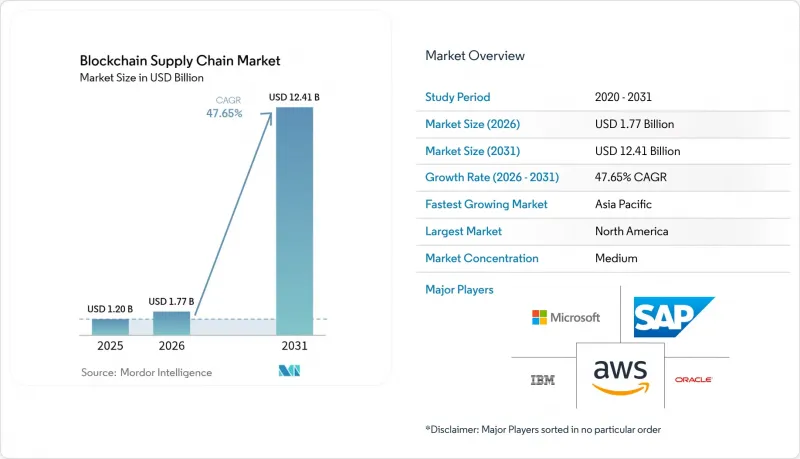
This report is Segmented by Component (Platform, Services), Blockchain Type (Public, Private, Consortium, Hybrid), Deployment Model (Cloud, On-Premise), Organization Size (Large Enterprises, Smes), Application (Payment and Settlement, Product Traceability, and More), and Geography. The Market Forecasts are Provided in Terms of Value (USD).
Global Blockchain Supply Chain Market Trends and Insights
Augmented Demand for Secure, Tamper-Proof Supply-Chain Transactions
Renault's XCEED initiative processes more than 1 million compliance documents at up to 500 TPS, illustrating how immutable ledgers shift regulatory reporting from static spreadsheets to real-time verification . The network spans multiple tier-one suppliers, cutting audit preparation cycles and strengthening collective risk oversight. Real-time certification reduces disruption response intervals, and embedded smart contracts eliminate roughly 40% of manual reconciliations. Confidential data is safeguarded through granular cryptographic keys, proving that privacy and transparency can co-exist on production-scale blockchains.
Need for End-to-End Transparency in Multi-Tier Supply Chains
Walmart's food-safety program trimmed contamination source tracing from days to seconds, demonstrating how immutable records enhance recall accuracy and brand trust. DNV's "My Story" QR codes link verified sustainability and quality data to individual items, giving consumers on-demand provenance proof . The approach allows brands to transform transparency into a competitive advantage while regulators gain continuous visibility into high-risk nodes across product life cycles.
Limited Interoperability Across Blockchain Networks
Supply-chain partners often operate disparate ledgers that fail to communicate natively, forcing costly middleware builds. Hyperledger Cacti and other cross-chain frameworks are advancing, yet the absence of universally accepted validation rules and dispute mechanisms prolongs deployment timelines. Enterprises with diverse vendor ecosystems remain wary of vendor lock-in, making interoperability a strategic prerequisite before large-scale rollouts.
Other drivers and restraints analyzed in the detailed report include:
- Cost-Saving Push from Tokenized Asset Tracking and Automated Reconciliation
- Convergence of IoT Sensors and Blockchain for Real-Time Asset Tracking
- Regulatory Uncertainty on Cross-Border Data/Crypto Rules
For complete list of drivers and restraints, kindly check the Table Of Contents.
Segment Analysis
Platform offerings accounted for 56.62% of the blockchain supply chain market size in 2025, underscoring enterprise appetite for scalable backbones that serve multiple use cases. Vendor roadmaps emphasize modular APIs, AI-powered analytics, and integration accelerators that embed blockchain into existing MES, WMS, and ERP systems. Services, projected to rise at a 48.10% CAGR, include architecture design, data migration, change management, and managed operations packages. As pilot programs graduate to production, enterprises redirect budgets from experimentation to long-term operational support.
Implementation proof points such as IBM Food Trust highlight how unified platforms condense deployment cycles and foster network effects among suppliers and regulators. The blockchain supply chain market size tied to professional services is further amplified by partner ecosystems that bundle cybersecurity, tokenomics, and continuous-compliance modules, creating recurring revenue streams for system integrators.
Public architectures held 42.10% revenue share in 2025, owing to open validation and easy onboarding for diverse partners. Yet sensitivity around pricing models, supplier lists, and contract terms drives many corporates toward hybrid frameworks combining on-chain transparency with permissioned data enclaves. The hybrid sub-segment is projected to register a 49.20% CAGR, reflecting the balance between network reach and data privacy.
VeChain's weighted delegated proof-of-stake update, rolled out via its StarGate program, epitomizes this shift. The design gives enterprise nodes governance influence while preserving public verification guarantees. As national data-residency laws tighten, hybrid deployments allow regional segmentation without sacrificing global synchronization, promoting adoption in industries with sensitive formulation or defense supply chains.
Complete Report Scope:
- By Component
- Platform
- Services
- By Blockchain Type
- Public
- Private
- Consortium
- Hybrid
- By Deployment Model
- Cloud
- On-premise
- By Organization Size
- Large Enterprises
- SMEs
- By Application
- Payment and Settlement
- Product Traceability
- Counterfeit Detection
- Smart Contracts
- Risk and Compliance Management
- Other Applications
- By Geography
- North America
- United States
- Canada
- Mexico
- South America
- Brazil
- Argentina
- Rest of South America
- Europe
- Germany
- United Kingdom
- France
- Spain
- Russia
- Rest of Europe
- Asia Pacific
- China
- Japan
- India
- Australia
- South Korea
- Rest of Asia Pacific
- Middle East
- United Arab Emirates
- Saudi Arabia
- Turkey
- Rest of the Middle East
- Africa
- South Africa
- Nigeria
- Rest of Africa
- North America
Geography Analysis
North America secured 39.15% of 2025 revenue, energized by early-mover enterprises, robust venture funding, and comparatively clear legal frameworks. Walmart, Home Depot, and major automotive OEMs anchor multi-tier networks that funnel adoption down their supply chains. US regulators have issued guidance clarifying digital record admissibility, easing auditor concerns. Canada emphasizes natural-resource traceability, whereas Mexico leverages blockchain for near-shoring logistics transparency.
Asia-Pacific is on track for a 50.30% CAGR, driven by China's state-backed Belt and Road blockchain trade corridors, Japan's Society 5.0 digitization blueprint, and India's PLI-backed manufacturing expansion. Government-sponsored sandboxes fast-track pilots in cross-border duties, e-invoice authentication, and carbon-credit clearinghouses. Australia's mining exporters adopt ledger-anchored emissions reporting to satisfy global buyers' ESG scrutiny.
Europe's momentum comes from stringent sustainability legislation. Digital Product Passport mandates require granular lifecycle data, steering manufacturers toward blockchain-enabled traceability. Germany's Industry 4.0 clusters integrate blockchains with IoT and 5G factory networks, while the United Kingdom focuses on supply-chain finance tokenization aligned to its fintech strengths. Emerging hubs in the Middle East, South America, and Africa adopt ledger solutions to streamline customs processing and boost trade-port competitiveness.
- IBM Corporation
- Oracle Corporation
- Microsoft Corporation
- SAP SE
- Amazon Web Services, Inc.
- Huawei Technologies Co., Ltd.
- TIBCO Software Inc.
- Vechain Foundation San Marino S.r.l.
- GuardTime OU
- Accenture PLC
- Auxesis Group
- Omnichain Solutions, Inc.
- BTL Group Limited
- Bitfury Holding B.V.
- CargoSmart Limited
- Chainlink Labs Inc.
- Everledger Limited
Additional Benefits:
- The market estimate (ME) sheet in Excel format
- 3 months of analyst support
TABLE OF CONTENTS
1 INTRODUCTION
- 1.1 Study Assumptions and Market Definition
- 1.2 Scope of the Study
2 RESEARCH METHODOLOGY
3 EXECUTIVE SUMMARY
4 MARKET LANDSCAPE
- 4.1 Market Overview
- 4.2 Market Drivers
- 4.2.1 Augmented demand for secure, tamper-proof supply-chain transactions
- 4.2.2 Need for end-to-end transparency in multi-tier supply chains
- 4.2.3 Cost-saving push from tokenized asset tracking and automated reconciliation
- 4.2.4 Convergence of IoT sensors and blockchain for real-time asset tracking
- 4.2.5 ESG-driven provenance auditing requirements
- 4.2.6 Smart-insurance and parametric pay-outs for logistics
- 4.3 Market Restraints
- 4.3.1 Limited interoperability across blockchain networks
- 4.3.2 Regulatory uncertainty on cross-border data/crypto rules
- 4.3.3 Scalability and energy-use concerns in public chains
- 4.3.4 Shortage of Web3 talent for enterprise projects
- 4.4 Value Chain Analysis
- 4.5 Regulatory Landscape
- 4.6 Technological Outlook (DIDs, Zero-Knowledge Proofs, L2 roll-ups, and others)
- 4.7 Porter's Five Forces Analysis
- 4.7.1 Bargaining Power of Buyers
- 4.7.2 Bargaining Power of Suppliers
- 4.7.3 Threat of New Entrants
- 4.7.4 Threat of Substitutes
- 4.7.5 Intensity of Competitive Rivalry
- 4.8 Impact of Macroeconomic Factors on the Market
5 MARKET SIZE AND GROWTH FORECASTS (VALUE)
- 5.1 By Component
- 5.1.1 Platform
- 5.1.2 Services
- 5.2 By Blockchain Type
- 5.2.1 Public
- 5.2.2 Private
- 5.2.3 Consortium
- 5.2.4 Hybrid
- 5.3 By Deployment Model
- 5.3.1 Cloud
- 5.3.2 On-premise
- 5.4 By Organization Size
- 5.4.1 Large Enterprises
- 5.4.2 SMEs
- 5.5 By Application
- 5.5.1 Payment and Settlement
- 5.5.2 Product Traceability
- 5.5.3 Counterfeit Detection
- 5.5.4 Smart Contracts
- 5.5.5 Risk and Compliance Management
- 5.5.6 Other Applications
- 5.6 By Geography
- 5.6.1 North America
- 5.6.1.1 United States
- 5.6.1.2 Canada
- 5.6.1.3 Mexico
- 5.6.2 South America
- 5.6.2.1 Brazil
- 5.6.2.2 Argentina
- 5.6.2.3 Rest of South America
- 5.6.3 Europe
- 5.6.3.1 Germany
- 5.6.3.2 United Kingdom
- 5.6.3.3 France
- 5.6.3.4 Spain
- 5.6.3.5 Russia
- 5.6.3.6 Rest of Europe
- 5.6.4 Asia Pacific
- 5.6.4.1 China
- 5.6.4.2 Japan
- 5.6.4.3 India
- 5.6.4.4 Australia
- 5.6.4.5 South Korea
- 5.6.4.6 Rest of Asia Pacific
- 5.6.5 Middle East
- 5.6.5.1 United Arab Emirates
- 5.6.5.2 Saudi Arabia
- 5.6.5.3 Turkey
- 5.6.5.4 Rest of the Middle East
- 5.6.6 Africa
- 5.6.6.1 South Africa
- 5.6.6.2 Nigeria
- 5.6.6.3 Rest of Africa
- 5.6.1 North America
6 COMPETITIVE LANDSCAPE
- 6.1 Market Concentration
- 6.2 Strategic Moves
- 6.3 Market Share Analysis
- 6.4 Company Profiles (includes Global level Overview, Market level Overview, Core Segments, Financials as available, Strategic Information, Market Rank/Share, Products and Services, Recent Developments)
- 6.4.1 IBM Corporation
- 6.4.2 Oracle Corporation
- 6.4.3 Microsoft Corporation
- 6.4.4 SAP SE
- 6.4.5 Amazon Web Services, Inc.
- 6.4.6 Huawei Technologies Co., Ltd.
- 6.4.7 TIBCO Software Inc.
- 6.4.8 Vechain Foundation San Marino S.r.l.
- 6.4.9 GuardTime OU
- 6.4.10 Accenture PLC
- 6.4.11 Auxesis Group
- 6.4.12 Omnichain Solutions, Inc.
- 6.4.13 BTL Group Limited
- 6.4.14 Bitfury Holding B.V.
- 6.4.15 CargoSmart Limited
- 6.4.16 Chainlink Labs Inc.
- 6.4.17 Everledger Limited
7 MARKET OPPORTUNITIES AND FUTURE OUTLOOK
- 7.1 White-space and Unmet-Need Assessment

