PUBLISHER: Mordor Intelligence | PRODUCT CODE: 2124526

PUBLISHER: Mordor Intelligence | PRODUCT CODE: 2124526
IT Connector - Market Share Analysis, Industry Trends & Statistics, Growth Forecasts (2026 - 2031)
According to Mordor Intelligence, IT connector market size in 2026 is estimated at USD 8.14 billion, growing from 2025 value of USD 7.72 billion with 2031 projections showing USD 10.58 billion, growing at 5.39% CAGR over 2026-2031.
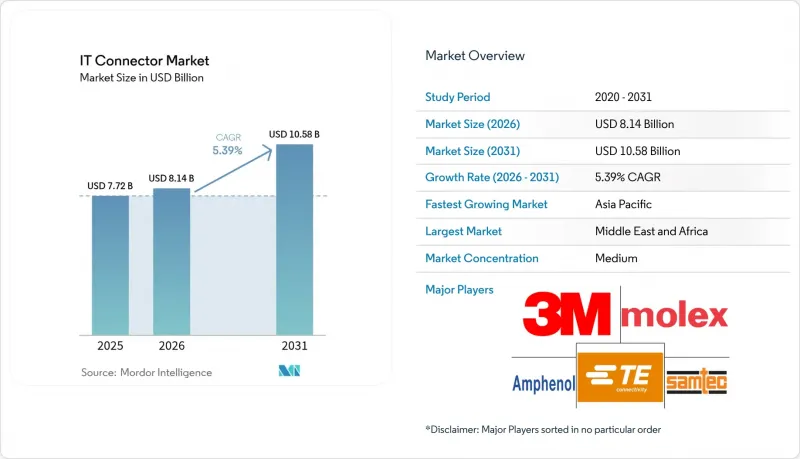
This report is Segmented by Connector Type (PCB Connectors, IDC Connectors, and More), Mounting Configuration (Board-To-Board, and More), Data-Rate Class (<=10 Gbps, 10-25 Gbps, and More), End-User Industry (IT and Telecom, and More), Application (Servers and Storage, and More), Materials (Standard Thermoplastics, Halogen-Free Compounds), and Geography. The Market Forecasts are Provided in Terms of Value (USD).
Global IT Connector Market Trends and Insights
Surging demand for high-speed interconnects in hyperscale data centers
Bandwidth-hungry AI clusters are transitioning beyond 224 Gbps per lane, forcing connector designers to mitigate insertion loss and thermal rise inside cramped server trays. Molex cites rapid uptake of optical transceivers for 224 Gbps PAM4 links, noting that heat removal is now as critical as signal integrity. Activities range from evaluating PAM-6 / PAM-8 modulation to deploying co-packaged copper and optics that shorten electrical channels. Hyperscalers plan to bring 120-130 new sites online every year, compressing build schedules to six weeks and favoring high-density connector systems that can be kitted and assembled rapidly.
Rapid 5G / 6G network roll-outs elevating RF connector adoption
Spectrum auctions in markets such as Vietnam for the 2.6 GHz and 3.5 GHz bands are fueling mid-band macro and small-cell deployments. Massive-MIMO radios are scaling from 4T4R to 32T32R, spurring the shift to compact VSFF interfaces that compress fiber counts. Connector vendors are responding with SN-class footprints that quadruple port density inside front-haul shelves, while carrier-neutral host operators expand distributed antenna systems valued at USD 8.7 billion by 2028.
Copper and rare-metal price volatility raising BOM costs
Surging copper and palladium prices have triggered multiple component price notices, such as Panasonic's January 2025 flex PCB increase. High-speed connectors use thick copper alloys and precious-metal platings, so even a 5% upswing can erode gross margins. Vendors are locking annual supply contracts, qualifying alternative platings, and redesigning contact beams to lower mass without compromising insertion cycles.
Other drivers and restraints analyzed in the detailed report include:
- Automotive zonal EE architectures boosting high-speed connectors
- Growth of co-packaged optics accelerating IO connector innovation
- Thermal-mechanical reliability limits at high data rates
For complete list of drivers and restraints, kindly check the Table Of Contents.
Segment Analysis
PCB connectors accounted for 44.60% of the IT connector market size in 2025, reflecting their ubiquity across motherboards, storage planes, and industrial controllers. Robust pin integrity, proven mating cycles, and broad component ecosystems keep this category entrenched in volume applications. The segment still benefits from the CHIPS Act-driven reshoring of PCB assembly, which lifts domestic demand for fine-pitch mezzanine formats.
The IO/high-speed backplane-and-pluggable group is forecast to grow at 5.55% CAGR, propelled by data center upgrades to QSFP-DD 800 and OSFP Xtreme cages capable of 112 Gbps per channel. RF/VSFF connectors benefit from 5G small-cell densification, while circular and rectangular housings remain essential for harsh-duty industrial controls. Microminiature options are seeing new use cases in robotic surgery and CubeSats that reward every millimeter saved.
Board-to-board held a 35.40% share in 2025 and remains the workhorse for modular sub-assemblies. Stacked mezzanine and card-edge variants help OEMs meet tight Z-height restrictions inside laptops and switch blades. However, wire-to-board is advancing at 6.05% CAGR as designers favor harnesses that simplify maintenance in EV battery packs and household appliances.
Wire-to-wire assemblies continue to service motor drives and HVAC compressors where board real estate is limited. The miniaturization trend now extends across all mounting styles; Molex's rugged miniaturized series offers 20-55% footprint reduction while retaining IP67 sealing, directly addressing robotics and outdoor telecom enclosures.
Complete Report Scope:
- By Connector Type
- PCB Connectors
- IDC Connectors
- IO/High-Speed Backplane and Pluggable
- Circular and Rectangular
- RF/VSFF (SN, CS, MMC)
- Microminiature/Nano Connectors
- By Mounting Configuration
- Board-to-Board
- Wire-to-Board
- Wire-to-Wire/Cable Assemblies
- By Data-Rate Class
- <=10 Gbps
- 10-25 Gbps
- 25-56 Gbps
- >=56 Gbps/PAM4 112 G
- By End-user Industry
- IT and Telecom (incl. Data Centers)
- Consumer Electronics and Computing
- Automotive and e-Mobility
- Industrial Automation/IIoT
- Healthcare and Medical Devices
- By Application
- Servers and Storage
- 5G/6G Base-Stations
- EV Powertrain and ADAS
- Factory Robotics and PLCs
- By Material
- Standard Thermoplastics
- Halogen-free/Eco-friendly Compounds
- Geography
- North America
- United States
- Canada
- Mexico
- Europe
- Germany
- United Kingdom
- France
- Italy
- Spain
- Russia
- Rest of Europe
- Asia-Pacific
- China
- Japan
- South Korea
- India
- ASEAN
- Rest of Asia-Pacific
- South America
- Brazil
- Argentina
- Rest of South America
- Middle East and Africa
- Saudi Arabia
- United Arab Emirates
- Turkey
- South Africa
- Rest of Middle East and Africa
- North America
Geography Analysis
Asia Pacific dominated with 45.50% market revenue in 2025, led by China's vertically integrated electronics base and India's fast-growing telecom backbone. Mainland connector producers benefit from provincial incentives aimed at reliability upgrades, with the domestic connector sector forecast to add RMB 12.6 billion year-on-year during 2024. Japan and South Korea contribute through the early adoption of co-packaged optics inside advanced foundry lines.
North America ranks second. The CHIPS and Science Act has already channeled USD 6.6 billion to TSMC Arizona and USD 8.5 billion to Intel, underpinning a localized ecosystem for advanced substrates and connector cages compliant with 224 Gbps PAM4 thermal requirements. Aerospace and defense programs also pull through rugged circular MIL-spec variants that command premium margins.
Europe plays to its strengths in automotive, Industry 4.0, and medical. The push for halogen-free plastics has turned many OEMs into early adopters of eco-class housings. Meanwhile, the Middle East and Africa is set for 5.92% CAGR as hyperscalers install regional cloud zones and governments award smart-city fiber concessions, particularly in Saudi Arabia and the UAE. South America shows steady but lower expansion, weighted toward Brazilian telecom and Argentine industrial automation projects.
- 3M Company
- TE Connectivity Ltd.
- Molex Inc. (Koch)
- Amphenol Corporation
- Samtec Inc.
- Hirose Electric Co., Ltd.
- Aptiv PLC
- Yazaki Corporation
- Hon Hai Precision (FOXCONN)
- Phoenix Contact GmbH and Co. KG
- Harting Technology Group
- JST Mfg. Co., Ltd.
- WAGO Kontakttechnik
- Rosenberger Hochfrequenztechnik
- Bel Fuse Inc.
- Kyocera Corporation
- Luxshare Precision Industry
- JAE (Japan Aviation Electronics)
- Fischer Connectors SA
- CONEC Elektronische Bauelemente GmbH
- Omnetics Connector Corp.
- Wurth Elektronik GmbH and Co. KG
Additional Benefits:
- The market estimate (ME) sheet in Excel format
- 3 months of analyst support
TABLE OF CONTENTS
1 INTRODUCTION
- 1.1 Study Assumptions and Market Definition
- 1.2 Scope of the Study
2 RESEARCH METHODOLOGY
3 EXECUTIVE SUMMARY
4 MARKET LANDSCAPE
- 4.1 Market Overview
- 4.2 Market Drivers
- 4.2.1 Surging Demand for High-Speed (>25 Gbps) Interconnects in Hyperscale Data Centers
- 4.2.2 Rapid 5G/6G Network Roll-outs Elevating RF and VSFF Connector Adoption in Asia
- 4.2.3 Automotive Zonal EE Architectures Boosting High-Speed Board-to-Board Connectors in EVs
- 4.2.4 Growth of Co-Packaged Optics Accelerating IO Connector Innovation
- 4.2.5 Edge-AI and Industrial IoT Driving Rugged, Sealed Connectors in Factory Automation (EU Focus)
- 4.2.6 United States CHIPS Act-Backed On-Shore PCB Production Lifts Domestic Connector Demand
- 4.3 Market Restraints
- 4.3.1 Copper and Rare-Metal Price Volatility Raising BOM Costs
- 4.3.2 Thermal-Mechanical Reliability Limits at >=112 Gbps PAM4
- 4.3.3 Lengthy Automotive PPAP Cycles Slowing Connector Design-ins
- 4.3.4 Regulatory Push for Halogen-Free Plastics Increasing Re-qualification Costs (EU)
- 4.4 Industry Ecosystem Analysis
- 4.5 Technological Outlook
- 4.6 Porter's Five Forces Analysis
- 4.6.1 Bargaining Power of Suppliers
- 4.6.2 Bargaining Power of Buyers
- 4.6.3 Threat of New Entrants
- 4.6.4 Threat of Substitutes
- 4.6.5 Competitive Rivalry
5 MARKET SIZE AND GROWTH FORECASTS (VALUES)
- 5.1 By Connector Type
- 5.1.1 PCB Connectors
- 5.1.2 IDC Connectors
- 5.1.3 IO/High-Speed Backplane and Pluggable
- 5.1.4 Circular and Rectangular
- 5.1.5 RF/VSFF (SN, CS, MMC)
- 5.1.6 Microminiature/Nano Connectors
- 5.2 By Mounting Configuration
- 5.2.1 Board-to-Board
- 5.2.2 Wire-to-Board
- 5.2.3 Wire-to-Wire/Cable Assemblies
- 5.3 By Data-Rate Class
- 5.3.1 <=10 Gbps
- 5.3.2 10-25 Gbps
- 5.3.3 25-56 Gbps
- 5.3.4 >=56 Gbps/PAM4 112 G
- 5.4 By End-user Industry
- 5.4.1 IT and Telecom (incl. Data Centers)
- 5.4.2 Consumer Electronics and Computing
- 5.4.3 Automotive and e-Mobility
- 5.4.4 Industrial Automation/IIoT
- 5.4.5 Healthcare and Medical Devices
- 5.5 By Application
- 5.5.1 Servers and Storage
- 5.5.2 5G/6G Base-Stations
- 5.5.3 EV Powertrain and ADAS
- 5.5.4 Factory Robotics and PLCs
- 5.6 By Material
- 5.6.1 Standard Thermoplastics
- 5.6.2 Halogen-free/Eco-friendly Compounds
- 5.7 Geography
- 5.7.1 North America
- 5.7.1.1 United States
- 5.7.1.2 Canada
- 5.7.1.3 Mexico
- 5.7.2 Europe
- 5.7.2.1 Germany
- 5.7.2.2 United Kingdom
- 5.7.2.3 France
- 5.7.2.4 Italy
- 5.7.2.5 Spain
- 5.7.2.6 Russia
- 5.7.2.7 Rest of Europe
- 5.7.3 Asia-Pacific
- 5.7.3.1 China
- 5.7.3.2 Japan
- 5.7.3.3 South Korea
- 5.7.3.4 India
- 5.7.3.5 ASEAN
- 5.7.3.6 Rest of Asia-Pacific
- 5.7.4 South America
- 5.7.4.1 Brazil
- 5.7.4.2 Argentina
- 5.7.4.3 Rest of South America
- 5.7.5 Middle East and Africa
- 5.7.5.1 Saudi Arabia
- 5.7.5.2 United Arab Emirates
- 5.7.5.3 Turkey
- 5.7.5.4 South Africa
- 5.7.5.5 Rest of Middle East and Africa
- 5.7.1 North America
6 COMPETITIVE LANDSCAPE
- 6.1 Market Concentration
- 6.2 Strategic Moves
- 6.3 Market Share Analysis
- 6.4 Company Profiles (includes Global level Overview, Market level overview, Core Segments, Financials as available, Strategic Information, Market Rank/Share, Products and Services, Recent Developments)
- 6.4.1 3M Company
- 6.4.2 TE Connectivity Ltd.
- 6.4.3 Molex Inc. (Koch)
- 6.4.4 Amphenol Corporation
- 6.4.5 Samtec Inc.
- 6.4.6 Hirose Electric Co., Ltd.
- 6.4.7 Aptiv PLC
- 6.4.8 Yazaki Corporation
- 6.4.9 Hon Hai Precision (FOXCONN)
- 6.4.10 Phoenix Contact GmbH and Co. KG
- 6.4.11 Harting Technology Group
- 6.4.12 JST Mfg. Co., Ltd.
- 6.4.13 WAGO Kontakttechnik
- 6.4.14 Rosenberger Hochfrequenztechnik
- 6.4.15 Bel Fuse Inc.
- 6.4.16 Kyocera Corporation
- 6.4.17 Luxshare Precision Industry
- 6.4.18 JAE (Japan Aviation Electronics)
- 6.4.19 Fischer Connectors SA
- 6.4.20 CONEC Elektronische Bauelemente GmbH
- 6.4.21 Omnetics Connector Corp.
- 6.4.22 Wurth Elektronik GmbH and Co. KG
7 MARKET OPPORTUNITIES AND FUTURE OUTLOOK
- 7.1 White-space and Unmet-need Assessment

