PUBLISHER: Mordor Intelligence | PRODUCT CODE: 2124559

PUBLISHER: Mordor Intelligence | PRODUCT CODE: 2124559
Window Coverings - Market Share Analysis, Industry Trends & Statistics, Growth Forecasts (2026 - 2031)
According to Mordor Intelligence, the window coverings market size is expected to grow from USD 28.96 billion in 2025 to USD 30.14 billion in 2026 and is forecast to reach USD 37.85 billion by 2031 at a 4.66% CAGR over 2026-2031.
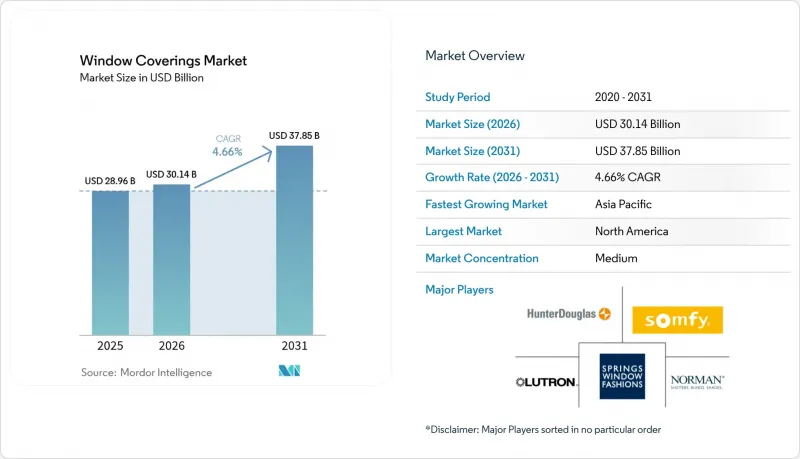
This report is Segmented by Product Type (Shades, Shutters, and More), Material (Fabric, Wood and Faux Wood, Metal, PVC/Vinyl, Composite, and More), Technology (Manual, Motorized, and Smart IoT-Enabled), End-User (Residential, Commercial, Hospitality, Healthcare and Institutional, and More), Distribution Channel (Offline, and Online), and Geography. The Market Forecasts are Provided in Terms of Value (USD).
Global Window Coverings Market Trends and Insights
Surging Residential Renovation Expenditure
Homeowner spending on envelope upgrades has created a predictable replacement cycle that lifts attachment rates for interior shades above new-construction baselines. In the United States, residential improvement outlays climbed from USD 472 billion in Q3 2024 to a projected USD 477 billion in Q3 2025, with windows and doors generating USD 22.1 billion in 2023. Contractors increasingly bundle glazing replacements with automated shade packages, allowing customers to consolidate permits and compress disruption. Low-emissivity glass amplifies solar-control needs, making motorized roller shades a logical upsell that safeguards thermal comfort without forfeiting views. Custom fabricators, which shipped 36%-49% of total units between 2015-2025, ride this trend by offering project-specific dimensions and premium fabrics that command higher margins. Renovation momentum therefore sustains a top-tier price band even as baseline housing starts flatten.
Rapid Adoption of Motorized, Smart Shades
Automation is transforming coverings from passive decor into active building-system elements. Custom-electronics integrators reported that projects using automated shades doubled within one year, with a median 10 units per residence and average spend of USD 25,000. Retrofit viability improved as the share of dealers skipping motorized shades in remodels fell from 15% to 2%. Matter 1.2 now certifies 20 window-covering devices, ensuring native compatibility across Apple, Google, and Amazon ecosystems. Designers are responding; 56% specify motorized solutions for luxury homes, up from negligible levels a decade ago. Battery-powered motors bypass the need for electrical rough-in, cutting installation labor and widening the addressable market among existing dwellings.
Volatility of Raw-Material Prices (PVC, Aluminum)
Prices for PVC resin and aluminum extrusions swung sharply through 2024-2025, complicating production planning. PVC in India fell to USD 600 per ton in December 2025, down from peaks above USD 1,200. U.S. aluminum spot rates hit USD 1.37 per pound after new import tariffs, lifting costs for headrails and bottom rails. Integrated players with hedged contracts protected margins, but smaller fabricators reliant on spot markets struggled to honor fixed bids. Composite blends that reduce virgin PVC offer partial insulation yet require capital outlays for new extrusion dies, delaying rapid migration. Currency swings additionally pressure multinational suppliers that source components in Asia and sell finished goods in Europe or North America.
Other drivers and restraints analyzed in the detailed report include:
- Energy-Efficiency Mandates and Green-Building Codes
- Commercial Daylight-Management for Employee Well-Being
- Environmental Pushback on Single-Use Plastics and Corded Blinds
For complete list of drivers and restraints, kindly check the Table Of Contents.
Segment Analysis
Shades represented a smaller share than blinds in 2025, yet the category is forecast to rise at a 5.12% CAGR, eclipsing the broader window coverings market trajectory. Architects favor roller systems that accept solar-reflective and blackout fabrics in one cassette, allowing integration with building-management systems. Lutron's USD 599 Triathlon Select lowered the entry barrier for automated roller shades, underscoring how pricing innovation can transfer volume from blinds to shades. Continuing launches of dual-fabric tubes and ultrawide rollers strengthen the proposition for commercial atriums and open-plan offices.
Blinds still own 38.68% of the market share in 2025 and will not vanish, but their growth lags because legacy corded designs face safety headwinds. Shutters, curtains, and niche systems such as panel tracks keep relevance in bespoke decor but contribute limited volume. For the forecast horizon, shades stand out as the prime beneficiary of interoperability protocols, positioning the window coverings market for a technology-driven mix shift.
Fabric kept a 39.77% of the market share in 2025, anchored by polyester and fiberglass weaves that deliver flame resistance and antimicrobial performance in one layer. Yet composite materials, blending recycled polymers with natural fibers, are set to log the quickest 5.68% CAGR, propelled by EU ecodesign rules requiring lifecycle disclosure. Architects in Germany and France already request digital passports at the bid stage, a hurdle that fabrics can clear faster than PVC slats.
Metal blinds remain cost-effective for entry multifamily projects but struggle to house wireless radios or sensors because headrail geometry limits PCB space. Wood and faux-wood solutions fill aesthetic niches but warp in humid climates, raising warranty accruals. PVC slats persist in price-sensitive geographies; however, phthalate bans are nudging suppliers toward bio-based plasticizers. Composites thus emerge as an elegant compromise between regulation and durability, keeping the window coverings market momentum intact without inflating embodied-carbon footprints.
Complete Report Scope:
- By Product Type
- Blinds
- Shades
- Shutters
- Curtains and Drapes
- Other Product Types
- By Material
- Fabric
- Wood and Faux Wood
- Metal
- PVC/ Vinyl
- Composite
- Other Materials
- By Technology
- Manual
- Motorized (Battery, Hard-Wired)
- Smart, IoT-Enabled
- By End-User
- Residential
- Commercial
- Hospitality
- Healthcare and Institutional
- Other End-Users
- By Distribution Channel
- Offline
- Online
- By Geography
- North America
- United States
- Canada
- Mexico
- South America
- Brazil
- Argentina
- Rest of South America
- Europe
- Germany
- United Kingdom
- France
- Italy
- Spain
- Rest of Europe
- Asia-Pacific
- China
- Japan
- India
- South Korea
- Australia and New Zealand
- Rest of Asia-Pacific
- Middle East and Africa
- Middle East
- United Arab Emirates
- Turkey
- Saudi Arabia
- Africa
- South Africa
- Nigeria
- Rest of Africa
- Middle East
- North America
Geography Analysis
North America held 40.34% share in 2025, anchored by U.S. renovation outlays and California's Title 24-2025 protocols that elevate automation complexity. Cordless mandates in Canada further skew volume toward tension-device or motorized designs. The window coverings market size for the region thus remains resilient even as single-family starts flatten because code triggers and insurance pilots sustain retrofit demand.
Europe benefits from the 2024 Energy Performance of Buildings Directive, which embeds solar-shading clauses into national regulations. Germany, France, and the United Kingdom lead uptake, bolstered by retrofit subsidies tied to 55% greenhouse-gas cuts by 2030. Southern European hospitality resorts also favor blackout tracks to mitigate summer cooling loads, widening demand diversity and cushioning office-construction cycles.
Asia-Pacific is projected for the fastest 6.19% CAGR to 2031, propelled by India's urban-household growth, Japan's aging demographics that value motorized lifts, and China's condominium pipeline. Tier-1 Chinese cities now require green-building features, nudging developers toward IoT-ready shades. Australia and New Zealand add upside via utility rebates that shorten payback on solar-control treatments. Elsewhere, South America and the Middle East and Africa remain smaller but show spot growth in hospitality and healthcare, segments that demand antimicrobial fabrics and ligature-safe hardware.
- Hunter Douglas N.V.
- Springs Window Fashions LLC
- Norman Window Fashions Ltd.
- Somfy S.A.
- Lutron Electronics Co., Inc.
- MechoShade Systems LLC
- Griesser AG
- Kvadrat Shade B.V.
- Decora Blind Systems Ltd.
- Insolroll Window Shading Systems
- Hillarys Blinds Ltd.
- Coulisse B.V.
- Roma KG
- 3 Day Blinds LLC
- Guangzhou JADY Window Coverings Technology Co., Ltd.
- Alta Window Fashions Inc.
- Legrand S.A. (BTicino and Netatmo Shades)
- Hunter Douglas India Pvt. Ltd.
- Rollease Acmeda
Additional Benefits:
- The market estimate (ME) sheet in Excel format
- 3 months of analyst support
TABLE OF CONTENTS
1 INTRODUCTION
- 1.1 Study Assumptions and Market Definition
- 1.2 Scope of the Study
2 RESEARCH METHODOLOGY
3 EXECUTIVE SUMMARY
4 MARKET LANDSCAPE
- 4.1 Market Overview
- 4.2 Market Drivers
- 4.2.1 Surging Residential Renovation Expenditure
- 4.2.2 Rapid Adoption of Motorized, Smart Shades
- 4.2.3 Energy-Efficiency Mandates and Green-Building Codes
- 4.2.4 Commercial Daylight-Management for Employee Well-Being
- 4.2.5 Insurance Rebates for Glare and Heat-Gain Control
- 4.2.6 Growth of Antimicrobial Fabrics in Healthcare Blinds
- 4.3 Market Restraints
- 4.3.1 Volatility of Raw-Material Prices (PVC, Aluminum)
- 4.3.2 Environmental Pushback on Single-Use Plastics and Corded Blinds
- 4.3.3 Rising Competition from Electro-Chromic Smart-Glass
- 4.3.4 IoT-Related Cybersecurity and Privacy Concerns
- 4.4 Industry Value Chain Analysis
- 4.5 Regulatory Landscape
- 4.6 Technological Outlook
- 4.7 Porter's Five Forces Analysis
- 4.7.1 Bargaining Power of Suppliers
- 4.7.2 Bargaining Power of Consumers
- 4.7.3 Threat of New Entrants
- 4.7.4 Threat of Substitutes
- 4.7.5 Intensity of Competitive Rivalry
- 4.8 Impact of Macroeconomic Factors on the Market
5 MARKET SIZE AND GROWTH FORECASTS (VALUE)
- 5.1 By Product Type
- 5.1.1 Blinds
- 5.1.2 Shades
- 5.1.3 Shutters
- 5.1.4 Curtains and Drapes
- 5.1.5 Other Product Types
- 5.2 By Material
- 5.2.1 Fabric
- 5.2.2 Wood and Faux Wood
- 5.2.3 Metal
- 5.2.4 PVC/ Vinyl
- 5.2.5 Composite
- 5.2.6 Other Materials
- 5.3 By Technology
- 5.3.1 Manual
- 5.3.2 Motorized (Battery, Hard-Wired)
- 5.3.3 Smart, IoT-Enabled
- 5.4 By End-User
- 5.4.1 Residential
- 5.4.2 Commercial
- 5.4.3 Hospitality
- 5.4.4 Healthcare and Institutional
- 5.4.5 Other End-Users
- 5.5 By Distribution Channel
- 5.5.1 Offline
- 5.5.2 Online
- 5.6 By Geography
- 5.6.1 North America
- 5.6.1.1 United States
- 5.6.1.2 Canada
- 5.6.1.3 Mexico
- 5.6.2 South America
- 5.6.2.1 Brazil
- 5.6.2.2 Argentina
- 5.6.2.3 Rest of South America
- 5.6.3 Europe
- 5.6.3.1 Germany
- 5.6.3.2 United Kingdom
- 5.6.3.3 France
- 5.6.3.4 Italy
- 5.6.3.5 Spain
- 5.6.3.6 Rest of Europe
- 5.6.4 Asia-Pacific
- 5.6.4.1 China
- 5.6.4.2 Japan
- 5.6.4.3 India
- 5.6.4.4 South Korea
- 5.6.4.5 Australia and New Zealand
- 5.6.4.6 Rest of Asia-Pacific
- 5.6.5 Middle East and Africa
- 5.6.5.1 Middle East
- 5.6.5.1.1 United Arab Emirates
- 5.6.5.1.2 Turkey
- 5.6.5.1.3 Saudi Arabia
- 5.6.5.2 Africa
- 5.6.5.2.1 South Africa
- 5.6.5.2.2 Nigeria
- 5.6.5.2.3 Rest of Africa
- 5.6.5.1 Middle East
- 5.6.1 North America
6 COMPETITIVE LANDSCAPE
- 6.1 Market Concentration
- 6.2 Strategic Moves
- 6.3 Market Share Analysis
- 6.4 Company Profiles (Includes Global Level Overview, Market Level Overview, Core Segments, Financials as Available, Strategic Information, Market Rank/Share, Products and Services, and Recent Developments)
- 6.4.1 Hunter Douglas N.V.
- 6.4.2 Springs Window Fashions LLC
- 6.4.3 Norman Window Fashions Ltd.
- 6.4.4 Somfy S.A.
- 6.4.5 Lutron Electronics Co., Inc.
- 6.4.6 MechoShade Systems LLC
- 6.4.7 Griesser AG
- 6.4.8 Kvadrat Shade B.V.
- 6.4.9 Decora Blind Systems Ltd.
- 6.4.10 Insolroll Window Shading Systems
- 6.4.11 Hillarys Blinds Ltd.
- 6.4.12 Coulisse B.V.
- 6.4.13 Roma KG
- 6.4.14 3 Day Blinds LLC
- 6.4.15 Guangzhou JADY Window Coverings Technology Co., Ltd.
- 6.4.16 Alta Window Fashions Inc.
- 6.4.17 Legrand S.A. (BTicino and Netatmo Shades)
- 6.4.18 Hunter Douglas India Pvt. Ltd.
- 6.4.19 Rollease Acmeda
7 MARKET OPPORTUNITIES AND FUTURE OUTLOOK
- 7.1 White-Space and Unmet-Need Assessment

