PUBLISHER: Mordor Intelligence | PRODUCT CODE: 2124564

PUBLISHER: Mordor Intelligence | PRODUCT CODE: 2124564
India Herbal Shampoo - Market Share Analysis, Industry Trends & Statistics, Growth Forecasts (2026 - 2031)
According to Mordor Intelligence, the India herbal shampoo market size was valued at USD 327.24 million in 2025 and estimated to grow from USD 360.07 million in 2026 to reach USD 580.69 million by 2031, at a CAGR of 10.03% during the forecast period (2026-2031).
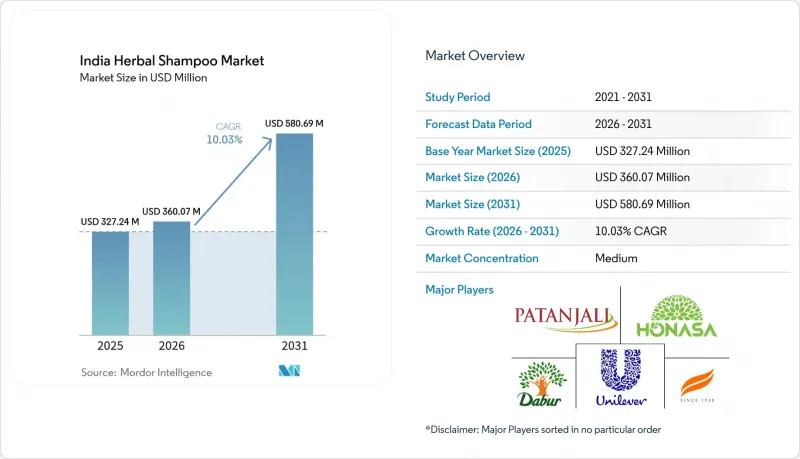
This report is Segmented by Category (Mass, Premium), End User (Adults, Children/Kids), Distribution Channel (Supermarkets/Hypermarkets, Pharmacy and Drug Store, Convenience/Traditional Stores, Online Retail Stores, Other Distribution Channels), and Geography (India). The Market Forecasts are Provided in Terms of Value (USD).
India Herbal Shampoo Market Trends and Insights
Demand for chemical-free and natural formulations
In 2024, industry surveys indicated that most beauty and personal care consumers in India now consciously prefer organic products. This shift extends beyond branding or promotional narratives; it's clearly reflected in actual buying patterns. For instance, brands offering herbal shampoos, especially those with traditional ingredients like onion peel oil and Japanese matcha, boast an impressive 80% user satisfaction rate after just 5-6 washes. Urban millennials and Gen-Z consumers, recognized for their careful examination of ingredient labels and strong preference for transparency, are at the forefront of this shift. In turn, companies are responding by reformulating existing products and launching new variants. These innovations avoid synthetic sulfates, parabens, and artificial fragrances, favoring instead clinically validated botanical ingredients.
Preference for anti-hair loss and scalp treatment solutions
Modern dermatological research is increasingly drawing from traditional Ayurvedic knowledge, leading to the emergence of a new category of therapeutic herbal shampoos. As highlighted by the Research Journal of Pharmacy and Technology, these formulations now feature scientifically validated ingredients such as ursolic acid and diosgenin. Furthermore, analytical methods are being crafted to guarantee consistent potency across batches. Brands are strategically repositioning hair-growth as a prestige offering, reformulating hair-loss treatments with botanically derived, clinically validated formulas, as noted by Cosmetics Business Hair Care Trends 2024. This clinical strategy directly tackles the rising concerns of hair fall among urban Indian consumers, especially in cities where pollution and stress are prevalent. By merging traditional ingredients like bhringaraj and nagarmotha with contemporary delivery systems, these products not only resonate with heritage but also promise tangible results.
Counterfeit herbal claims and weak standardization
Unverified herbal claims and insufficient ingredient validation are fueling consumer distrust and may be constraining market expansion. The FDA's warnings regarding heavy metal contamination in Indian herbal products highlight persistent quality control shortcomings, issues that also extend to cosmetic formulations. In the absence of clear, uniform standards defining what constitutes "herbal" or "natural" in products such as shampoos, inferior offerings can easily mislead buyers, ultimately undermining the credibility of reputable manufacturers. This lack of standardization is especially problematic in rural and semi-urban markets, where limited awareness of quality markers enables counterfeit products to gain traction through aggressive pricing strategies.
Other drivers and restraints analyzed in the detailed report include:
- Brand innovation, premiumization, and influencer-led marketing
- Government AYUSH promotion and tax incentives
- Supply volatility of certified organic botanicals
For complete list of drivers and restraints, kindly check the Table Of Contents.
Segment Analysis
In 2025, mass-market herbal shampoos dominate with an 85.64% market share, underscoring the price-sensitive tendencies of Indian consumers who seek value. Yet, the premium segment is on a robust growth trajectory, boasting a 10.58% CAGR through 2031. This surge is fueled by rising disposable incomes and a growing consumer inclination to invest in perceived quality and efficacy. Notably, haircare constituted about 10% of the luxury beauty market in 2023, highlighting the premiumization trend, as noted in the Luxasia-Kearney Luxury Beauty Report.
Established players like Patanjali and Dabur, with their vast distribution networks and aggressive pricing, dominate the mass segment, using economies of scale to keep prices in check. Meanwhile, premium brands are carving out distinct identities, emphasizing clinical formulations, eco-friendly packaging, and a nod to heritage. Companies like Forest Essentials and Kama Ayurveda are successfully navigating niche markets, steering clear of direct price competition. The rise of D2C brands in the premium arena is reshaping the competitive landscape. Notably, Mamaearth is adeptly straddling the line between mass and premium, leveraging digital-first tactics and a commitment to transparent ingredient communication.
Complete Report Scope:
- By Category
- Mass
- Premium
- By End User
- Adults
- Children/Kids
- By Distribution Channel
- Supermarkets/Hypermarkets
- Pharmacy and Drug Store
- Convenience/Traditional Stores
- Online Retail Stores
- Other Distribution Channels
List of Companies Covered in this Report:
- Dabur India Ltd.
- Patanjali Ayurved Ltd.
- Himalaya Global Holdings Ltd.
- Unilever PLC (Lever Ayush)
- Honasa Consumer Pvt. Ltd. (Mamaearth)
- Fit & Glow Healthcare Pvt. Ltd. (WOW Skin Science)
- CavinKare Pvt. Ltd.
- Emami Ltd.
- Lotus Herbals Pvt. Ltd.
- Bio Veda Action Research Co. (Biotique)
- Khadi Natural
- Patanjali Food & Herbal Limited (subsidiary but distinct branding)
- Marico Ltd. (Sesa, Herbal-based hair care)
- VLCC Personal Care Ltd.
- Joy Healthcare Pvt. Ltd.
- Kama Ayurveda Pvt. Ltd.
- Forest Essentials
- Shri Baidyanath Ayurved Bhawan Pvt. Ltd.
- The Aromatherapy Co.
- Brihans Natural Products Ltd.
Additional Benefits:
- The market estimate (ME) sheet in Excel format
- 3 months of analyst support
TABLE OF CONTENTS
1 INTRODUCTION
- 1.1 Study Assumptions and Market Definition
- 1.2 Scope of the Study
2 RESEARCH METHODOLOGY
3 EXECUTIVE SUMMARY
4 MARKET DYNAMICS
- 4.1 Market Overview
- 4.2 Market Drivers
- 4.2.1 Demand for a-chemical-free a-and natural formulations
- 4.2.2 Preference for anti-hair loss and scalp treatment solutions
- 4.2.3 Brand innovation, premiumization, and influencer-led marketing
- 4.2.4 Demand for products customized by hair type and concern
- 4.2.5 Government AYUSH promotion and tax incentives
- 4.2.6 Shift toward sulfate-free and paraben-free variants
- 4.3 Market Restraints
- 4.3.1 Counterfeit herbal claims and weak standardisation
- 4.3.2 Supply volatility of certified organic botanicals
- 4.3.3 High formulation cost versus synthetic shampoos
- 4.3.4 Lack of standardized quality certification
- 4.4 Consumer Behavior Analysis
- 4.5 Regulatory Landscape
- 4.6 Technological Outlook
- 4.7 Porters Five Forces
- 4.7.1 Threat of New Entrants
- 4.7.2 Bargaining Power of Buyers
- 4.7.3 Bargaining Power of Suppliers
- 4.7.4 Threat of Substitute Products
- 4.7.5 Intensity of Competitive Rivalry
5 MARKET SIZE AND GROWTH FORECASTS (VALUE)
- 5.1 By Category
- 5.1.1 Mass
- 5.1.2 Premium
- 5.2 By End User
- 5.2.1 Adults
- 5.2.2 Children/Kids
- 5.3 By Distribution Channel
- 5.3.1 Supermarkets/Hypermarkets
- 5.3.2 Pharmacy and Drug Store
- 5.3.3 Convenience/Traditional Stores
- 5.3.4 Online Retail Stores
- 5.3.5 Other Distribution Channels
6 COMPETITIVE LANDSCAPE
- 6.1 Market Concentration
- 6.2 Strategic Moves
- 6.3 Market Share Analysis
- 6.4 Company Profiles (includes Global level Overview, Market level overview, Core Segments, Financials, Strategic Information, Market Rank/Share, Products and Services, Recent Developments)
- 6.4.1 Dabur India Ltd.
- 6.4.2 Patanjali Ayurved Ltd.
- 6.4.3 Himalaya Global Holdings Ltd.
- 6.4.4 Unilever PLC (Lever Ayush)
- 6.4.5 Honasa Consumer Pvt. Ltd. (Mamaearth)
- 6.4.6 Fit & Glow Healthcare Pvt. Ltd. (WOW Skin Science)
- 6.4.7 CavinKare Pvt. Ltd.
- 6.4.8 Emami Ltd.
- 6.4.9 Lotus Herbals Pvt. Ltd.
- 6.4.10 Bio Veda Action Research Co. (Biotique)
- 6.4.11 Khadi Natural
- 6.4.12 Patanjali Food & Herbal Limited (subsidiary but distinct branding)
- 6.4.13 Marico Ltd. (Sesa, Herbal-based hair care)
- 6.4.14 VLCC Personal Care Ltd.
- 6.4.15 Joy Healthcare Pvt. Ltd.
- 6.4.16 Kama Ayurveda Pvt. Ltd.
- 6.4.17 Forest Essentials
- 6.4.18 Shri Baidyanath Ayurved Bhawan Pvt. Ltd.
- 6.4.19 The Aromatherapy Co.
- 6.4.20 Brihans Natural Products Ltd.
7 MARKET OPPORTUNITIES AND FUTURE TRENDS

