PUBLISHER: Mordor Intelligence | PRODUCT CODE: 2124575

PUBLISHER: Mordor Intelligence | PRODUCT CODE: 2124575
Advanced Distribution Management System - Market Share Analysis, Industry Trends & Statistics, Growth Forecasts (2026 - 2031)
According to Mordor Intelligence, the advanced distribution management system market size in 2026 is estimated at USD 4.31 billion, growing from 2025 value of USD 3.60 billion with 2031 projections showing USD 10.53 billion, growing at 19.60% CAGR over 2026-2031.
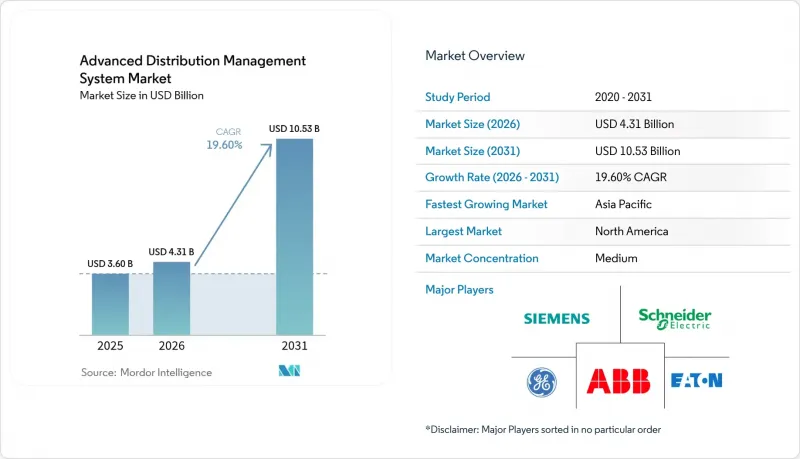
This report is Segmented by Offering (Software and Services), Deployment Mode (On-Premise, Cloud, and Hybrid), System Type (Distribution Management System (DMS), AMR / AMI, and More), End-User Vertical (Energy and Utilities, IT and Telecom, Manufacturing, and More), and Geography. The Market Forecasts are Provided in Terms of Value (USD).
Global Advanced Distribution Management System Market Trends and Insights
Rapid adoption of smart-grid digitalization
Utilities are fast-tracking digital control upgrades to replace legacy systems that lack real-time situational awareness. State Grid China earmarked USD 88.7 billion for 2025 distribution automation and advanced metering deployments, cementing the region's leadership in large-scale smart-grid roll-outs. European network operators must lift annual distribution spending to EUR 67 billion (USD 75.7 billion) to cope with electrification targets, a mandate that is forcing immediate ADMS procurement. Early adopters report a 21% fall in network outage minutes and a 17% cut in restoration time after fully integrated ADMS launches, yielding annual savings near USD 150 million.
Growing integration of distributed energy resources
Bidirectional power flows from rooftop solar, stationary batteries, and vehicle-to-grid assets overwhelm legacy distribution management workflows. India met a record 241 GW peak load in 2024 without deficit by leveraging advanced ADMS algorithms that co-optimize solar, hydro, and battery dispatch. In the United States, FERC Order 2222 forces market participation by aggregated distributed resources, compelling utilities to seek ADMS platforms that deliver synchronized DER visibility and dispatch.
High initial capex and integration complexity
Full-scale ADMS deployments can cost USD 5-50 million, excluding hardware. Long production lead times on transformers have stretched to 18-24 months, magnifying capital-allocation risk. Interfaces to legacy SCADA and billing platforms often double project timelines, challenging smaller utilities that look for Software-as-a-Service options.
Other drivers and restraints analyzed in the detailed report include:
- Rising energy demand and outage-reduction priorities
- EV-charging load balancing requirements
- Cyber-security and data-privacy concerns
For complete list of drivers and restraints, kindly check the Table Of Contents.
Segment Analysis
Software accounted for 80.30% of the Advanced Distribution Management System market in 2025, affirming utilities' preference for unified control suites. The services segment is tracking a 21.40% CAGR because long-tail integration, security hardening, and continuous optimization dictate specialist support. Schneider Electric booked EUR 38.2 billion (USD 43.2 billion) in 2024 revenue, with a sizable share tied to grid-software lifecycle services. Consulting engagements typically span 12-18 months and involve interoperability testing across metering, GIS, and outage systems. These immersive projects anchor recurring service contracts that smooth revenue cyclicality.
Rapid cloud adoption widens the addressable pool of mid-tier utilities that cannot fund large data-center refreshes. Managed service agreements now bundle hosting, patching, and real-time cyber monitoring, pushing the Advanced Distribution Management System market size for services toward USD 2.25 billion by 2031.
Distribution management systems held the top position, accounting for 35.20% of the Advanced Distribution Management System market share in 2025. Energy management systems exhibit a 21.05% CAGR because utilities view holistic optimization across transmission, distribution, and generation as a single economic equation. DER management modules naturally integrate with EMS frameworks, creating an integrated control plane. When utilities incorporate probabilistic renewables forecasting, they can reduce the frequency of ramping conventional generation units by 12%, resulting in lower fuel and operational costs. Front-office market bids also improve because the platform refines locational marginal price forecasts.
Meter data management and advanced metering infrastructure provide granular visibility into consumption, which feeds EMS algorithms. India's National Smart Grid Mission cleared 22 million additional smart meters in 2024, enlarging the data lake from which AI models learn. This linkage between meter data and EMS decision support underpins future energy-as-a-service propositions.
Complete Report Scope:
- By Offering
- Software
- Distribution Management System (core engine)
- DER Management Module
- Outage Management Module
- Services
- Consulting
- System Integration
- Support and Maintenance
- Software
- By Deployment Mode
- On-premise
- Cloud
- Hybrid
- By System Type
- Distribution Management System (DMS)
- AMR / AMI
- DER Management System (DERMS)
- Energy Management System (EMS)
- Customer Information System (CIS)
- Meter Data Management System (MDMS)
- By End-user Vertical
- Energy and Utilities
- IT and Telecom
- Manufacturing
- Defense and Government
- Infrastructure
- Transportation and Logistics
- By Geography
- North America
- United States
- Canada
- Mexico
- South America
- Brazil
- Argentina
- Rest of South America
- Europe
- Germany
- United Kingdom
- France
- Italy
- Spain
- Rest of Europe
- Asia Pacific
- China
- India
- Japan
- South Korea
- Rest of Asia Pacific
- Middle East and Africa
- Middle East
- Saudi Arabia
- United Arab Emirates
- Turkey
- Rest of Middle East
- Africa
- South Africa
- Nigeria
- Egypt
- Rest of Africa
- Middle East
- North America
Geography Analysis
Asia-Pacific is on track for a 21.70% CAGR through 2031, propelled by State Grid China's USD 88.7 billion 2025 allocation and strong Indian incentives for smart meters and feeder automation. Governments in the region prioritize distribution efficiency to integrate rooftop solar and a surging electric two-wheeler fleet. Europe faces mandatory annual distribution upgrades of USD 75.7 billion to honor fit-for-55 decarbonization rules. Advanced Distribution Management System market size in Europe will expand steadily as network operators front-load digital overlays before heavier conductor and transformer replacements.
North America, which controlled 39.30% of global revenue in 2025, continues to modernize under FERC Order 2222 and state resilience funding. Severe weather incidents justify real-time outage prediction analytics, and utilities are piloting AI-based network reconfiguration to trim public safety power shutoff events in wildfire-prone regions. Latin America is at an earlier stage, yet benefits from multilateral financing directed at loss reduction. African utilities focus first on revenue protection and feeder automation before rolling out full ADMS suites, but mobile-native cloud solutions could accelerate adoption.
Supply-chain friction is a universal constraint. Copperweld forecasts an 8 million-ton annual copper shortfall by 2034, which could inflate switchgear and conductor costs. Semiconductor shortages add delay to feeder automation hardware. Vendors now hedge by dual-sourcing custom ASICs and deploying flexible microcontroller designs that can accept alternative silicon.
- ABB Ltd.
- General Electric Co.
- Siemens AG
- Schneider Electric SE
- Eaton Corp.
- Open Systems International (Emerson)
- Survalent Technology
- ETAP / Operation Technology
- Oracle Utilities
- Capgemini
- Landis+Gyr
- ETAP/Operation Technology
- Itron
- Honeywell (Elster)
- Hexagon
- Hitachi Energy
- Survalent Technology
- SandC Electric
- Trimble
- Alstom SA
Additional Benefits:
- The market estimate (ME) sheet in Excel format
- 3 months of analyst support
TABLE OF CONTENTS
1 INTRODUCTION
- 1.1 Study Assumptions and Market Definition
- 1.2 Scope of the Study
2 RESEARCH METHODOLOGY
3 EXECUTIVE SUMMARY
4 MARKET LANDSCAPE
- 4.1 Market Overview
- 4.2 Market Drivers
- 4.2.1 Rapid adoption of smart-grid digitalisation
- 4.2.2 Growing integration of distributed energy resources (DER)
- 4.2.3 Rising energy demand and outage-reduction priorities
- 4.2.4 EV-charging load balancing requirements
- 4.2.5 Decarbonisation mandates (e.g., FERC 2222) accelerating ADMS roll-outs
- 4.2.6 Cloud-native ADMS lowering entry barriers for mid-size utilities
- 4.3 Market Restraints
- 4.3.1 High initial capex and integration complexity
- 4.3.2 Cyber-security and data-privacy concerns
- 4.3.3 Shortage of ADMS-skilled workforce
- 4.3.4 Proprietary protocols limiting interoperability
- 4.4 Industry Value Chain Analysis
- 4.5 Regulatory Landscape
- 4.6 Technological Outlook
- 4.7 Porter's Five Forces Analysis
- 4.7.1 Bargaining Power of Suppliers
- 4.7.2 Bargaining Power of Buyers
- 4.7.3 Threat of New Entrants
- 4.7.4 Threat of Substitutes
- 4.7.5 Competitive Rivalry
5 MARKET SIZE AND GROWTH FORECASTS (VALUE)
- 5.1 By Offering
- 5.1.1 Software
- 5.1.1.1 Distribution Management System (core engine)
- 5.1.1.2 DER Management Module
- 5.1.1.3 Outage Management Module
- 5.1.2 Services
- 5.1.2.1 Consulting
- 5.1.2.2 System Integration
- 5.1.2.3 Support and Maintenance
- 5.1.1 Software
- 5.2 By Deployment Mode
- 5.2.1 On-premise
- 5.2.2 Cloud
- 5.2.3 Hybrid
- 5.3 By System Type
- 5.3.1 Distribution Management System (DMS)
- 5.3.2 AMR / AMI
- 5.3.3 DER Management System (DERMS)
- 5.3.4 Energy Management System (EMS)
- 5.3.5 Customer Information System (CIS)
- 5.3.6 Meter Data Management System (MDMS)
- 5.4 By End-user Vertical
- 5.4.1 Energy and Utilities
- 5.4.2 IT and Telecom
- 5.4.3 Manufacturing
- 5.4.4 Defense and Government
- 5.4.5 Infrastructure
- 5.4.6 Transportation and Logistics
- 5.5 By Geography
- 5.5.1 North America
- 5.5.1.1 United States
- 5.5.1.2 Canada
- 5.5.1.3 Mexico
- 5.5.2 South America
- 5.5.2.1 Brazil
- 5.5.2.2 Argentina
- 5.5.2.3 Rest of South America
- 5.5.3 Europe
- 5.5.3.1 Germany
- 5.5.3.2 United Kingdom
- 5.5.3.3 France
- 5.5.3.4 Italy
- 5.5.3.5 Spain
- 5.5.3.6 Rest of Europe
- 5.5.4 Asia Pacific
- 5.5.4.1 China
- 5.5.4.2 India
- 5.5.4.3 Japan
- 5.5.4.4 South Korea
- 5.5.4.5 Rest of Asia Pacific
- 5.5.5 Middle East and Africa
- 5.5.5.1 Middle East
- 5.5.5.1.1 Saudi Arabia
- 5.5.5.1.2 United Arab Emirates
- 5.5.5.1.3 Turkey
- 5.5.5.1.4 Rest of Middle East
- 5.5.5.2 Africa
- 5.5.5.2.1 South Africa
- 5.5.5.2.2 Nigeria
- 5.5.5.2.3 Egypt
- 5.5.5.2.4 Rest of Africa
- 5.5.5.1 Middle East
- 5.5.1 North America
6 COMPETITIVE LANDSCAPE
- 6.1 Market Concentration
- 6.2 Strategic Moves
- 6.3 Market Share Analysis
- 6.4 Company Profiles {(includes Global level Overview, Market level overview, Core Segments, Financials as available, Strategic Information, Market Rank/Share for key companies, Products and Services, Recent Developments)}
- 6.4.1 ABB Ltd.
- 6.4.2 General Electric Co.
- 6.4.3 Siemens AG
- 6.4.4 Schneider Electric SE
- 6.4.5 Eaton Corp.
- 6.4.6 Open Systems International (Emerson)
- 6.4.7 Survalent Technology
- 6.4.8 ETAP / Operation Technology
- 6.4.9 Oracle Utilities
- 6.4.10 Capgemini
- 6.4.11 Landis+Gyr
- 6.4.12 ETAP/Operation Technology
- 6.4.13 Itron
- 6.4.14 Honeywell (Elster)
- 6.4.15 Hexagon
- 6.4.16 Hitachi Energy
- 6.4.17 Survalent Technology
- 6.4.18 SandC Electric
- 6.4.19 Trimble
- 6.4.20 Alstom SA
7 MARKET OPPORTUNITIES AND FUTURE OUTLOOK
- 7.1 White-space and Unmet-need Assessment

