PUBLISHER: Mordor Intelligence | PRODUCT CODE: 2124580

PUBLISHER: Mordor Intelligence | PRODUCT CODE: 2124580
Connected Drug Delivery Devices - Market Share Analysis, Industry Trends & Statistics, Growth Forecasts (2026 - 2031)
According to Mordor Intelligence, the connected drug delivery devices market size is projected to be USD 1.84 billion in 2025, USD 2.13 billion in 2026, and reach USD 4.37 billion by 2031, growing at a CAGR of 15.43% from 2026 to 2031.
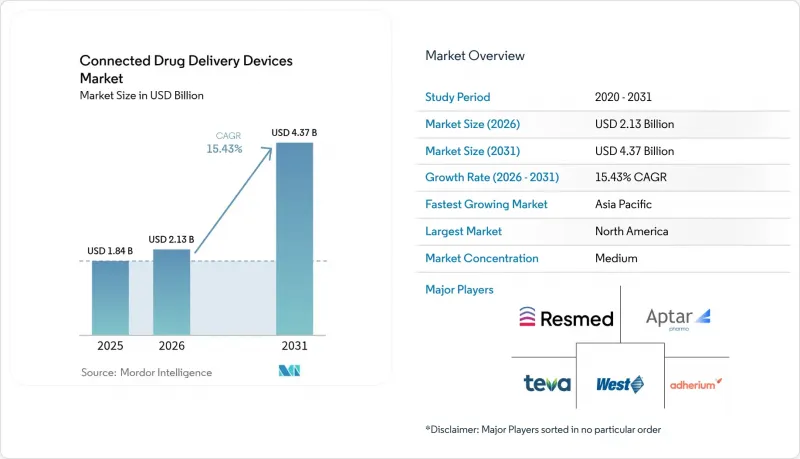
This report is Segmented by Product Type (Connected Sensors, and More), Device Type (Inhalers, and More), Technology (Bluetooth, NFC, and More), Route of Administration (Inhalational, Injectable), Therapeutic Application (Asthma & COPD, and More), End User (Home Care Settings, and More), and Geography (North America, Europe, and More). The Market Forecasts are Provided in Terms of Value (USD).
Global Connected Drug Delivery Devices Market Trends and Insights
Bluetooth Integration Cost Deflation
Bluetooth Low Energy chipsets fell to USD 0.42 per unit in 2025 after Taiwan Semiconductor Manufacturing Company shifted production to 5-nanometer nodes, doubling transistor density and reducing power draw. Hospitals in Germany and the United Kingdom subsequently listed connected injectors as first-line options because adherence data helps avoid bundled-payment penalties. Nordic Semiconductor shipped 180 million medical-grade SoCs in 2025, a 64% jump over 2024, giving smaller device makers turnkey modules that cut development cycles to nine months. The price collapse removes cost as a gating factor, allowing generic manufacturers to embed radios in pen injectors without exceeding a USD 2 bill-of-materials ceiling. As unit economics converge, procurement teams now treat connectivity as standard rather than a premium, broadening the addressable market for connected drug delivery devices.
Shift to Value-Based Care Reimbursement Models
The Centers for Medicare & Medicaid Services lifted its Chronic Care Management stipend to USD 63 per beneficiary per month in January 2025, explicitly rewarding remote adherence monitoring.UnitedHealthcare and Anthem insist on objective inhaler data before approving biologic step-ups for severe asthma, affecting 1.2 million members. England's National Health Service withholds 15% of diabetes-drug reimbursement if patients fail to upload pen-injector data at least 80% of prescribed doses. Japan followed with a COPD adherence tier in October 2025. These mandates flip incentives by penalizing non-adherence, accelerating adoption throughout the Connected drug delivery devices market.
Cyber-Security & Data-Privacy Compliance Burden
FDA's post-market guidance, effective October 2025, compels manufacturers to publish software bills of materials and close vulnerabilities within 30 days, adding an estimated USD 1.2 million in annual costs for mid-size firms. GDPR fines on device makers hit EUR 14 million in 2025, up 40% over 2024, mostly for unencrypted dose data. HIPAA classifies devices that locally store dosing logs as covered entities, bringing audits that once applied only to EHR systems. Compliance drained 18% of Insulet's 2025 R&D budget, diverting resources from new features. Rising obligations are putting pressure on consolidation in the Connected drug delivery devices market, as smaller players seek scale to amortize legal overheads.
Other drivers and restraints analyzed in the detailed report include:
- Post-COVID Telehealth Normalization
- Regulatory Fast-Track Pathways for SaMD-Drug Combination Products
- Single-Use Electronics-Waste Regulations Tightening
For complete list of drivers and restraints, kindly check the Table Of Contents.
Segment Analysis
Connected Sensors are climbing at a 17.96% CAGR, even though integrated connected devices retained 58.12% revenue in 2025. Retrofit clip-on designs let pharmaceutical partners upgrade legacy injectors within 12 months, whereas integrated platforms need 36 months for new tooling. Propeller Health's metered-dose inhaler sensor earned formulary status with 14 U.S. plans in 2025 because it avoided capital expense. Biocorp's Mallya achieved 92% accuracy in detecting missed doses, convincing Sanofi to bundle it with Lantus in France. Integrated units preserve a premium business model through recurring cartridges and software subscriptions. Tandem Diabetes's slim X2 pump integrated Dexcom CGM and secured 68% of U.S. automated insulin delivery users in 2025. The Connected drug delivery devices market, therefore, splits between high-value integrated ecosystems and cost-efficient sensor retrofits.
Wearable Injectors register an 18.48% CAGR, fastest across devices, as biologic volumes rise beyond syringe capacity. Enable Injections' enFuse gained six new FDA-approved indications in 2025, shifting oncology care from USD 3,000 infusion sessions to USD 400 at-home patches. Prefilled Syringes still dominate the connected drug delivery devices market, with a 38.05% share, because insulin and GLP-1 doses remain below 1 milliliter. Yet Amgen moved 40% of Repatha scripts to a 3.5 mL wearable in 2025. Becton, Dickinson and Company's reusable Libertas platform targets sustainability mandates and already shows 34% adoption among rheumatoid arthritis patients. Form-factor diversification widens choice and deepens market reach.
Complete Report Scope:
- By Product Type
- Connected Sensors
- Integrated Connected Devices
- By Device Type
- Inhalers
- Pen & Auto-Injectors
- Prefilled Syringes
- Wearable Injectors
- Others
- By Technology
- Bluetooth
- NFC
- Cellular / LPWAN
- Other
- By Route of Administration
- Inhalational
- Injectable
- By Therapeutic Application
- Asthma & COPD
- Diabetes
- Cardiovascular Disorders
- Autoimmune & Inflammatory Diseases
- Oncology
- Other
- By End User
- Home Care Settings
- Hospitals
- Clinics & Specialty Centers
- Other
- By Geography
- North America
- United States
- Canada
- Mexico
- Europe
- Germany
- United Kingdom
- France
- Italy
- Spain
- Rest of Europe
- Asia-Pacific
- China
- Japan
- India
- Australia
- South Korea
- Rest of Asia-Pacific
- Middle East & Africa
- GCC
- South Africa
- Rest of Middle East & Africa
- South America
- Brazil
- Argentina
- Rest of South America
- North America
Geography Analysis
North America controls 36.78% of 2025 revenue, buoyed by Medicare reimbursement, high device penetration, and FDA benchmark status. Growth moderates to 13.8% CAGR as saturation approaches, yet the region shapes global approval sequences under mutual recognition pacts. Asia-Pacific leads expansion at 21.41% CAGR as China reimburses inhaler data uploads for 180 million patients and India embeds insulin-pen logs in national health IDs. Japan's Sakigake scheme cleared nine connected pens in 2025, and Australia ties telehealth reimbursement to connected-device usage.
Diverse rules across 20 regimes raise compliance complexity, rewarding multinationals with local expertise. Overall, regional policy divergence shapes the strategic allocation of sales and regulatory resources in the connected drug delivery devices market.
- Adherium
- AptarGroup Inc.
- AstraZeneca
- Beckton Dickinson
- BEIGfoot Biomedical Inc.
- Biocorp
- Boehringer Ingelheim
- Eitan Medical
- Enable Injections Inc.
- GlaxoSmithKline
- Insulet
- Johnson & Johnson
- Medtronic
- Nemera
- Novartis
- Phillips-Medisize LLC
- Portal Instruments Inc.
- Propeller Health
- Sensirion
- Resmed
- Tandem Diabetes Care
- Teva Pharmaceutical Industries
- West Pharmaceutical Services
- Ypsomed
Additional Benefits:
- The market estimate (ME) sheet in Excel format
- 3 months of analyst support
TABLE OF CONTENTS
1 Introduction
- 1.1 Study Assumptions & Market Definition
- 1.2 Scope of the Study
2 Research Methodology
3 Executive Summary
4 Market Landscape
- 4.1 Market Overview
- 4.2 Market Drivers
- 4.2.1 Bluetooth Integration Cost Deflation
- 4.2.2 Shift To Value-Based Care Reimbursement Models
- 4.2.3 Post-COVID Telehealth Normalization
- 4.2.4 Regulatory Fast-Track Pathways for Samd-Drug Combination Products
- 4.2.5 Graphene-Based Sensor Miniaturization Breakthroughs
- 4.2.6 Battery-Free NFC Power-Scavenging Designs
- 4.3 Market Restraints
- 4.3.1 Cyber-Security & Data-Privacy Compliance Burden
- 4.3.2 Single-Use Electronics-Waste Regulations Tightening
- 4.3.3 Semiconductor-Grade MEMS Supply Shortages
- 4.3.4 Interoperability Hurdles with Fragmented EHR Standards
- 4.4 Regulatory Landscape
- 4.5 Technological Outlook
- 4.6 Porter's Five Forces Analysis
- 4.6.1 Threat of New Entrants
- 4.6.2 Bargaining Power of Buyers
- 4.6.3 Bargaining Power of Suppliers
- 4.6.4 Threat of Substitute Products
- 4.6.5 Intensity of Competitive Rivalry
5 Market Size & Growth Forecasts
- 5.1 By Product Type
- 5.1.1 Connected Sensors
- 5.1.2 Integrated Connected Devices
- 5.2 By Device Type
- 5.2.1 Inhalers
- 5.2.2 Pen & Auto-Injectors
- 5.2.3 Prefilled Syringes
- 5.2.4 Wearable Injectors
- 5.2.5 Others
- 5.3 By Technology
- 5.3.1 Bluetooth
- 5.3.2 NFC
- 5.3.3 Cellular / LPWAN
- 5.3.4 Other
- 5.4 By Route of Administration
- 5.4.1 Inhalational
- 5.4.2 Injectable
- 5.5 By Therapeutic Application
- 5.5.1 Asthma & COPD
- 5.5.2 Diabetes
- 5.5.3 Cardiovascular Disorders
- 5.5.4 Autoimmune & Inflammatory Diseases
- 5.5.5 Oncology
- 5.5.6 Other
- 5.6 By End User
- 5.6.1 Home Care Settings
- 5.6.2 Hospitals
- 5.6.3 Clinics & Specialty Centers
- 5.6.4 Other
- 5.7 By Geography
- 5.7.1 North America
- 5.7.1.1 United States
- 5.7.1.2 Canada
- 5.7.1.3 Mexico
- 5.7.2 Europe
- 5.7.2.1 Germany
- 5.7.2.2 United Kingdom
- 5.7.2.3 France
- 5.7.2.4 Italy
- 5.7.2.5 Spain
- 5.7.2.6 Rest of Europe
- 5.7.3 Asia-Pacific
- 5.7.3.1 China
- 5.7.3.2 Japan
- 5.7.3.3 India
- 5.7.3.4 Australia
- 5.7.3.5 South Korea
- 5.7.3.6 Rest of Asia-Pacific
- 5.7.4 Middle East & Africa
- 5.7.4.1 GCC
- 5.7.4.2 South Africa
- 5.7.4.3 Rest of Middle East & Africa
- 5.7.5 South America
- 5.7.5.1 Brazil
- 5.7.5.2 Argentina
- 5.7.5.3 Rest of South America
- 5.7.1 North America
6 Competitive Landscape
- 6.1 Market Concentration
- 6.2 Market Share Analysis
- 6.3 Company Profiles (includes Global Level Overview, Market Level Overview, Core Segments, Financials as Available, Strategic Information, Market Rank/Share for Key Companies, Products & Services, and Recent Developments)
- 6.3.1 Adherium Limited
- 6.3.2 AptarGroup Inc.
- 6.3.3 AstraZeneca plc
- 6.3.4 Becton, Dickinson and Company
- 6.3.5 BEIGfoot Biomedical Inc.
- 6.3.6 BIOCORP
- 6.3.7 Boehringer Ingelheim International GmbH
- 6.3.8 Eitan Medical Ltd.
- 6.3.9 Enable Injections Inc.
- 6.3.10 GlaxoSmithKline plc
- 6.3.11 Insulet Corporation
- 6.3.12 Johnson & Johnson Services Inc.
- 6.3.13 Medtronic plc
- 6.3.14 Nemera
- 6.3.15 Novartis AG
- 6.3.16 Phillips-Medisize LLC
- 6.3.17 Portal Instruments Inc.
- 6.3.18 Propeller Health (ResMed Inc.)
- 6.3.19 Sensirion AG
- 6.3.20 Resmed Inc
- 6.3.21 Tandem Diabetes Care Inc.
- 6.3.22 Teva Pharmaceutical Industries Ltd.
- 6.3.23 West Pharmaceutical Services Inc.
- 6.3.24 Ypsomed AG
7 Market Opportunities & Future Outlook
- 7.1 White-space & Unmet-Need Assessment

