PUBLISHER: Mordor Intelligence | PRODUCT CODE: 2124585

PUBLISHER: Mordor Intelligence | PRODUCT CODE: 2124585
Packaging Pumps and Dispensers - Market Share Analysis, Industry Trends & Statistics, Growth Forecasts (2026 - 2031)
According to Mordor Intelligence, the packaging pumps and dispensers market size was USD 10.03 billion in 2025 and is estimated to grow from USD 10.52 billion in 2026 to reach USD 13.43 billion by 2031, at a CAGR of 5.01% during the forecast period (2026-2031).
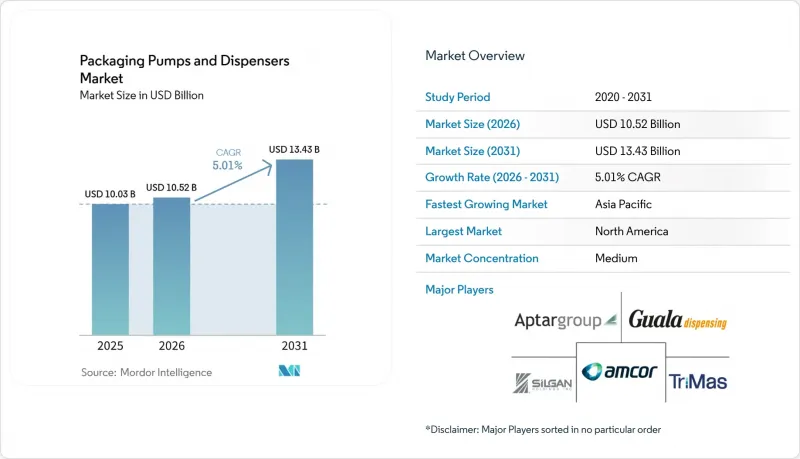
This report is Segmented by Product Type (Lotion and Cream Pumps, Spray and Trigger Pumps, Foam Pumps, Airless Pumps, and More), Material Type (Plastic, Metal, Glass, and More), Application (Beauty and Personal Care, Homecare, and More), Distribution Channel (Supermarkets and Hypermarkets, Specialty Stores, and More), and Geography. The Market Forecasts are Provided in Terms of Value (USD).
Global Packaging Pumps and Dispensers Market Trends and Insights
Rising Demand for Controlled-Dose and Convenient Packaging
Controlled-dose dispensing has become a core requirement in skincare, pharmaceutical, and household applications. It reduces product waste and can provide more consistent use. The need is especially visible in topical medicines and over-the-counter nasal products used outside clinical settings. Aptar reported USD 1.74 billion in 2025 pharma sales, up 6%, supported by emergency medicine, injectable systems, and consumer healthcare solutions. Its beauty segment also reported 13% core sales growth in personal care, including hair, body, and sun care products. These conditions favor suppliers that can combine consumer-friendly operation with pharmaceutical-grade dispensing experience.
Premiumization of Beauty and Personal Care Products
Premium beauty products require dispensers with a consistent feel, appearance, and performance. Airless pumps, custom fragrance actuators, and refillable systems carry higher value than conventional pumps. These designs also help brands protect sensitive ingredients and support a differentiated user experience. Silgan reported USD 2.7 billion in 2025 dispensing and specialty closures sales, a 17% increase, following the integration of Weener Packaging and growth in the fragrance and beauty segments. Aptar increased its ownership of BTY to 80% in 2025 and supplied INUNE prestige fragrance pumps for the launches of Christian Dior and Valentino. Smaller dermocosmetics brands are also seeking customized actuators, which increases the value of rapid tooling and decoration capabilities.
Volatile Resin, Metal, and Component Costs
Polypropylene and polyethylene represent much of the material content in standard pump assemblies. Their prices follow crude oil and naphtha movements, which can be difficult for smaller manufacturers to manage. Aptar's beauty segment adjusted EBITDA margin declined to 12.1% in 2025 from 13.0% in 2024, due to tariffs, supplier disruptions, manufacturing inefficiencies, and product mix. Silgan used its larger European manufacturing base after the Weener acquisition to support cost pass-through arrangements. Larger suppliers can spread sourcing risk through broader supply networks, while smaller producers may have less capital for redesign and compliance work. Steel spring costs also matter in fragrance and pharmaceutical products, where precision cannot be reduced.
Other drivers and restraints analyzed in the detailed report include:
- Adoption of Recyclable and Mono-Material Pump Systems
- E-Commerce Demand for Leak-Resistant and Lockable Dispensers
- Limited Recycling Infrastructure for Multi-Material Pump Assemblies
For complete list of drivers and restraints, kindly check the Table Of Contents.
Segment Analysis
Lotion and cream pumps held 28.43% of the packaging pumps and dispensers market share in 2025. They are widely used for shampoos, body lotions, conditioners, and mass skin care products. Their operating profile suits products that need high-volume dispensing with low actuation force. Private-label and value brands continue to use these pumps as a standard format. This installed base supports stable demand even as premium brands add specialized systems.
Airless pumps are projected to grow at a CAGR of 5.78% through 2031. They are used in preservative-free skin care, clinical dermocosmetics, and pharmaceutical topicals. Oxidation protection and dose accuracy support product stability claims in these applications. Magic One provides outputs from 0.3 ml to 1 ml through a single-engine concept and uses a PPWR-aligned polyolefin design. Spray and trigger pumps remain important in home care, while foam pumps are used in hand hygiene and gentle cleansing products. Specialty closures for industrial and food-service uses follow industrial output rather than consumer-product trends.
Plastic held 76.91% of the packaging pumps and dispensers market share by material type in 2025. Polypropylene and polyethylene are used across a range of applications because they offer chemical resistance, processability, and cost-effectiveness. Polypropylene remains common in standard lotion and trigger pumps. Polyethylene is gaining use in mono-material systems where brands seek recyclability certification. These materials can help a pump meet design-for-recycling requirements when the overall system is compatible.
Metal is projected to grow at a CAGR of 5.63% through 2031. Premium fragrances, pharmaceutical dispensing, and luxury skin care use metal components to ensure precision and enhance product presentation. Metal components are also used where a premium tactile effect and structural rigidity are important. Glass retains a small position in ultra-premium skin care and pharmaceutical packaging. PVC faces regulatory pressure under EU PPWR rules, while PET has modest use in food and beverage closures. The packaging pumps and dispensers industry is moving plastic designs toward mono-material polyethylene and polypropylene, while metalized and multi-layer formats face tighter requirements from 2030.
Complete Report Scope:
- By Product Type
- Lotion and Cream Pumps
- Spray and Trigger Pumps
- Foam Pumps
- Airless Pumps
- Other Product Types
- By Material Type
- Plastic
- Polypropylene (PP)
- Polyethylene (PE)
- Polyethylene Terephthalate (PET)
- Polyvinyl Chloride (PVC)
- Other Plastics
- Metal
- Glass
- Other Material Types
- Plastic
- By Application
- Beauty and Personal Care
- Homecare
- Pharmaceuticals and Healthcare
- Food and Beverages
- Industrial and Automotive
- Other Applications
- By Distribution Channel
- Supermarkets and Hypermarkets
- Specialty Stores
- Online Stores and Marketplaces
- By Geography
- North America
- United States
- Canada
- Mexico
- South America
- Brazil
- Argentina
- Colombia
- Rest of South America
- Europe
- Germany
- United Kingdom
- France
- Italy
- Spain
- Russia
- Rest of Europe
- Asia-Pacific
- China
- India
- Japan
- South Korea
- Australia
- Rest of Asia-Pacific
- Middle East
- Saudi Arabia
- United Arab Emirates
- Turkey
- Rest of Middle East
- Africa
- South Africa
- Egypt
- Nigeria
- Kenya
- Rest of Africa
- North America
Geography Analysis
North America held 29.56% of the packaging pumps and dispensers market share in 2025. Premium beauty adoption, established retail networks, and early uptake of recyclable pumps support demand across the packaging pumps and dispensers market in the region. The United States accounts for much of the regional base, while Canada and Mexico add demand through organized retail and pharmaceutical packaging. Silgan expects 2026 dispensing volumes and adjusted EBIT to exceed 2025 levels, with USD 310 million in capital expenditure directed toward dispensing and pet food growth. South America is centered on Brazil, where Aptar's acquisition of Sommaplast supports oral pharmaceutical dispensing capabilities.
Europe has a large base of premium beauty and pharmaceutical packaging in the packaging pumps and dispensers market. The PPWR applies from August 2026 and requires suppliers to demonstrate recyclability. Germany, France, the United Kingdom, Italy, and Spain are the primary demand markets for packaging pumps and dispensers. Amcor is commissioning a Magic One line in Lohne, Germany, with first deliveries expected in early 2027. Turkey, Saudi Arabia, and the UAE support demand in the Middle East for customized premium fragrance pumps.
Asia-Pacific is projected to grow at a CAGR of 6.09% through 2031, the fastest regional rate in the packaging pumps and dispensers market. China, India, South Korea, Japan, and Australia combine population scale with expanding beauty and personal care consumption. China's ingredient-focused beauty products support airless formats, while India's retail expansion supports first-time pump use in lower-tier cities. South Korean brands use dual-chamber and airless systems that can later appear in global product lines, while Africa has early-stage demand in South Africa, Egypt, Nigeria, and Kenya as consumers move from sachets toward pump-dispensed personal care products.
- AptarGroup, Inc.
- Silgan Holdings Inc.
- Amcor plc
- TriMas Corporation
- Coster Tecnologie Speciali S.p.A.
- Guala Dispensing S.p.A.
- Frapak Packaging B.V.
- Mitani Valve Co., Ltd.
- Quadpack Industries
- Taplast S.p.A.
- Raepak Ltd.
- Afa Dispensing Group B.V.
- Zhejiang Sun-Rain Industrial Co., Ltd.
- Gerresheimer AG
- Precision Valve Corporation
Additional Benefits:
- The market estimate (ME) sheet in Excel format
- 3 months of analyst support
TABLE OF CONTENTS
1 INTRODUCTION
- 1.1 Study Assumptions and Market Definition
- 1.2 Scope of the Study
2 RESEARCH METHODOLOGY
3 EXECUTIVE SUMMARY
4 MARKET LANDSCAPE
- 4.1 Market Overview
- 4.2 Market Drivers
- 4.2.1 Rising Demand for Controlled-Dose and Convenient Packaging
- 4.2.2 Premiumization of Beauty and Personal Care Products
- 4.2.3 Expansion of Liquid and Semi-Liquid Product Formats
- 4.2.4 Growth of Hygiene, Sanitizer, and Homecare Applications
- 4.2.5 Adoption of Recyclable and Mono-Material Pump Systems
- 4.2.6 E-Commerce Requirements for Leak-Resistant and Lockable Dispensers
- 4.3 Market Restraints
- 4.3.1 Volatile Resin, Metal, and Component Costs
- 4.3.2 High Tooling and Manufacturing Costs for Customized Pump Formats
- 4.3.3 Formulation Compatibility and Dose-Consistency Failures
- 4.3.4 Limited Recycling Infrastructure for Multi-Material Pump Assemblies
- 4.4 Impact of Macroeconomic Factors on the Market
- 4.5 Industry Value Chain Analysis
- 4.6 Regulatory Landscape
- 4.7 Technological Outlook
- 4.8 Porter's Five Forces Analysis
- 4.8.1 Threat of New Entrants
- 4.8.2 Bargaining Power of Suppliers
- 4.8.3 Bargaining Power of Buyers
- 4.8.4 Threat of Substitutes
- 4.8.5 Competitive Rivalry
5 MARKET SIZE AND GROWTH FORECASTS (VALUE)
- 5.1 By Product Type
- 5.1.1 Lotion and Cream Pumps
- 5.1.2 Spray and Trigger Pumps
- 5.1.3 Foam Pumps
- 5.1.4 Airless Pumps
- 5.1.5 Other Product Types
- 5.2 By Material Type
- 5.2.1 Plastic
- 5.2.1.1 Polypropylene (PP)
- 5.2.1.2 Polyethylene (PE)
- 5.2.1.3 Polyethylene Terephthalate (PET)
- 5.2.1.4 Polyvinyl Chloride (PVC)
- 5.2.1.5 Other Plastics
- 5.2.2 Metal
- 5.2.3 Glass
- 5.2.4 Other Material Types
- 5.2.1 Plastic
- 5.3 By Application
- 5.3.1 Beauty and Personal Care
- 5.3.2 Homecare
- 5.3.3 Pharmaceuticals and Healthcare
- 5.3.4 Food and Beverages
- 5.3.5 Industrial and Automotive
- 5.3.6 Other Applications
- 5.4 By Distribution Channel
- 5.4.1 Supermarkets and Hypermarkets
- 5.4.2 Specialty Stores
- 5.4.3 Online Stores and Marketplaces
- 5.5 By Geography
- 5.5.1 North America
- 5.5.1.1 United States
- 5.5.1.2 Canada
- 5.5.1.3 Mexico
- 5.5.2 South America
- 5.5.2.1 Brazil
- 5.5.2.2 Argentina
- 5.5.2.3 Colombia
- 5.5.2.4 Rest of South America
- 5.5.3 Europe
- 5.5.3.1 Germany
- 5.5.3.2 United Kingdom
- 5.5.3.3 France
- 5.5.3.4 Italy
- 5.5.3.5 Spain
- 5.5.3.6 Russia
- 5.5.3.7 Rest of Europe
- 5.5.4 Asia-Pacific
- 5.5.4.1 China
- 5.5.4.2 India
- 5.5.4.3 Japan
- 5.5.4.4 South Korea
- 5.5.4.5 Australia
- 5.5.4.6 Rest of Asia-Pacific
- 5.5.5 Middle East
- 5.5.5.1 Saudi Arabia
- 5.5.5.2 United Arab Emirates
- 5.5.5.3 Turkey
- 5.5.5.4 Rest of Middle East
- 5.5.6 Africa
- 5.5.6.1 South Africa
- 5.5.6.2 Egypt
- 5.5.6.3 Nigeria
- 5.5.6.4 Kenya
- 5.5.6.5 Rest of Africa
- 5.5.1 North America
6 COMPETITIVE LANDSCAPE
- 6.1 Market Concentration
- 6.2 Strategic Moves
- 6.3 Market Share Analysis
- 6.4 Company Profiles (includes Global Level Overview, Market Level Overview, Core Segments, Financials as available, Strategic Information, Market Rank/Share, Products and Services, Recent Developments)
- 6.4.1 AptarGroup, Inc.
- 6.4.2 Silgan Holdings Inc.
- 6.4.3 Amcor plc
- 6.4.4 TriMas Corporation
- 6.4.5 Coster Tecnologie Speciali S.p.A.
- 6.4.6 Guala Dispensing S.p.A.
- 6.4.7 Frapak Packaging B.V.
- 6.4.8 Mitani Valve Co., Ltd.
- 6.4.9 Quadpack Industries
- 6.4.10 Taplast S.p.A.
- 6.4.11 Raepak Ltd.
- 6.4.12 Afa Dispensing Group B.V.
- 6.4.13 Zhejiang Sun-Rain Industrial Co., Ltd.
- 6.4.14 Gerresheimer AG
- 6.4.15 Precision Valve Corporation
7 MARKET OPPORTUNITIES AND FUTURE OUTLOOK
- 7.1 White-Space and Unmet-Need Assessment

