PUBLISHER: Mordor Intelligence | PRODUCT CODE: 2124647

PUBLISHER: Mordor Intelligence | PRODUCT CODE: 2124647
Asia-Pacific Testing, Inspection And Certification (TIC) - Market Share Analysis, Industry Trends & Statistics, Growth Forecasts (2026 - 2031)
According to Mordor Intelligence, the Asia-Pacific TIC market size was valued at USD 124.85 billion in 2025 and estimated to grow from USD 131.13 billion in 2026 to reach USD 167.59 billion by 2031, at a CAGR of 5.03% during the forecast period (2026-2031).
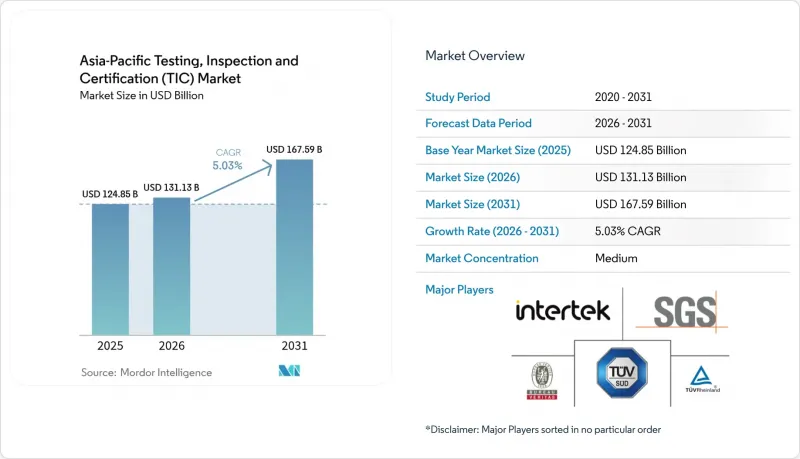
This report is Segmented by Service Type (Testing, Inspection, and Certification), Sourcing Type (In-House and Outsourced), Industry Vertical (Consumer Goods and Retail, ICT and Telecom, Automotive and Transportation, and More), Mode of Service Delivery (On-Site, Off-site/Laboratory, and Remote/Digital), and Country. The Market Forecasts are Provided in Terms of Value (USD).
Asia-Pacific Testing, Inspection And Certification (TIC) Market Trends and Insights
Trade-centric supply-chain complexity drives regional TIC demand
Asia sits at the heart of global manufacturing and now supports intricate, multi-jurisdictional supply chains that span hundreds of tier-1 and tier-2 suppliers. The ASEAN digital economy alone is targeting USD 1 trillion by 2030, a scale that intensifies conformity-assessment needs from chemicals to consumer electronics. TIC firms respond by expanding regional footprints. QIMA signed an MoU with Korea Testing and Research Institute to deepen cross-border quality control, while SGS launched its SMART cloud platform to provide real-time supply-chain oversight. The forthcoming ASEAN Digital Economy Framework Agreement is expected to harmonize cross-border data rules and further lift demand for unified testing and certification services across member states.
ESG and sustainability audits accelerate across regional markets
Ninety-eight of the region's 110 largest listed companies now publish sustainability disclosures, compared with fewer than half a decade earlier, reflecting tightened listing-rule requirements and rising investor scrutiny. Australia's AASB S2 climate rules mandate externally assured emissions statements from 2025, and Singapore will require limited assurance of Scope 1 and 2 data by fiscal year 2027. The global release of ISSA 5000 in late 2024 established a baseline for sustainability assurance, giving providers a consistent methodology to serve clients operating across multiple frameworks. Regional sustainable-bond issuance jumped 40% year-on-year in 2023, generating additional demand for pre- and post-issuance verifications and life-cycle carbon evaluations.
Advanced semiconductor testing capacity constraints limit growth
Asia hosts more than 80% of global assembly, test, and packaging capacity, yet shortages of skilled labor and EUV-ready test benches slow the expansion of next-generation fabrication lines. India alone needs an additional 250,000 engineers for its nascent foundry push, while Vietnam currently fulfils only one-fifth of the required semiconductor talent. Fan-out wafer-level packaging and 3D stack inspections demand expensive, high-precision gear that smaller labs struggle to finance, elongating certification lead times and raising costs for chipmakers.
Other drivers and restraints analyzed in the detailed report include:
- EV battery safety regulations drive harmonization and testing demand
- Digital-health compliance creates real-time testing opportunities
- Cyber-security vulnerabilities challenge digital inspection adoption
For complete list of drivers and restraints, kindly check the Table Of Contents.
Segment Analysis
Testing held 57.90% of the Asia-Pacific TIC market share in 2025, as product safety, quality control, and regulatory compliance underpin every manufacturing supply chain. Heavy semiconductor exposure amplifies volumes because over 80% of global assembly and test work is carried out within the region, requiring high-frequency yield monitoring and failure-analysis routines. Asia-Pacific TIC market size attributed to testing is projected to grow steadily as fabs migrate to sub-5 nm nodes that raise complexity and require new fault-isolation protocols.
Certification is the fastest-advancing slice at a 5.62% CAGR through 2031, propelled by mandatory ESG assurance, voluntary carbon-credit verification, and new hydrogen-fuel quality marks. Leon Inspection's overseas revenue climbed 21.3% in 2024 after it deployed AI-enabled spectral analysis and blockchain-backed data chains to speed CE-mark issuance for exporters. Providers investing in digital certificate vaults and auto-validation tools are positioned to capture share as governments pivot from self-declaration to third-party assurance.
Outsourced providers controlled 63.10% of the Asia-Pacific TIC market size in 2025 and are forecast to expand at a 5.32% CAGR. Moving compliance tasks to specialists allows OEMs to focus resources on design and distribution while accessing deep domain expertise, multi-country accreditation, and scalable lab networks. SGS's SMART platform integrates scheduling, document management, and analytics across thousands of factories, illustrating how outsourced partners enhance transparency to win new contracts.
In-house labs remain relevant in sectors where intellectual property is sensitive or continuous-process testing is embedded in the production line, such as pharmaceutical API analysis or petrochemical feedstock monitoring. Yet even these operators increasingly outsource niche tests such as recycled-content proof for EU battery exports when external labs can supply accredited results faster and at lower cost.
Complete Report Scope:
- By Service Type
- Testing
- Inspection
- Certification
- By Sourcing Type
- In-house
- Outsourced
- By Industry Vertical
- Consumer Goods and Retail
- ICT and Telecom
- Automotive and Transportation
- Aerospace and Defense
- Oil, Gas and Petrochemicals
- Energy and Utilities
- Industrial Manufacturing and Machinery
- Chemicals and Materials
- Construction and Infrastructure
- Life Sciences and Healthcare
- Food, Agriculture and Beverage
- Other Industry Verticals (Environment, Sustainability, etc.)
- By Mode of Service Delivery
- On-site
- Off-site / Laboratory
- Remote / Digital
- By Country
- China
- Japan
- India
- South Korea
- ASEAN
- Rest of Asia-Pacific
List of Companies Covered in this Report:
- SGS SA
- Bureau Veritas SA
- Intertek Group plc
- TUV SUD AG
- TUV Rheinland AG
- DEKRA SE
- UL Solutions Inc.
- TUV NORD Group
- DNV AS
- Eurofins Scientific SE
- Applus Services SA
- ALS Limited
- Lloyd's Register Group Ltd.
- BSI Group
- CSA Group
- Centre Testing International Group Co., Ltd. (CTI)
- China Certification and Inspection Group (CIC)
- Korea Testing and Research Institute (KTR)
- PT SUCOFINDO
- SIRIM QAS International Sdn Bhd
- Japan Quality Assurance Organization (JQA)
- QIMA Ltd.
- TUV Austria AG
- KIWA N.V.
- Petrochem Inspection and Testing Ltd.
Additional Benefits:
- The market estimate (ME) sheet in Excel format
- 3 months of analyst support
TABLE OF CONTENTS
1 INTRODUCTION
- 1.1 Study Assumptions and Market Definition
- 1.2 Scope of the Study
2 RESEARCH METHODOLOGY
3 EXECUTIVE SUMMARY
4 MARKET LANDSCAPE
- 4.1 Market Overview
- 4.2 Market Drivers
- 4.2.1 Trade-centric supply-chain complexity in Asia-Pacific
- 4.2.2 Ramp-up of sustainability and ESG-linked audits
- 4.2.3 Accelerated regulatory harmonisation for EV and battery safety
- 4.2.4 Rapid digital-health adoption demanding real-time compliance
- 4.2.5 Green hydrogen pilot projects scaling in Australia and Japan
- 4.2.6 AI-driven predictive maintenance enabling "test-less" inspection
- 4.3 Market Restraints
- 4.3.1 Shortage of accredited labs for advanced semiconductors
- 4.3.2 Fragmented national accreditation regimes
- 4.3.3 Low TIC spend-per-capita in emerging ASEAN
- 4.3.4 Cyber-security concerns on remote / digital inspections
- 4.4 Industry Value Chain Analysis
- 4.5 Impact of Macroeconomic Factors
- 4.6 Regulatory Landscape
- 4.7 Technological Outlook
- 4.8 Porter's Five Forces Analysis
- 4.8.1 Threat of New Entrants
- 4.8.2 Bargaining Power of Suppliers
- 4.8.3 Bargaining Power of Buyers
- 4.8.4 Threat of Substitutes
- 4.8.5 Competitive Rivalry
5 MARKET SIZE AND GROWTH FORECASTS (VALUES)
- 5.1 By Service Type
- 5.1.1 Testing
- 5.1.2 Inspection
- 5.1.3 Certification
- 5.2 By Sourcing Type
- 5.2.1 In-house
- 5.2.2 Outsourced
- 5.3 By Industry Vertical
- 5.3.1 Consumer Goods and Retail
- 5.3.2 ICT and Telecom
- 5.3.3 Automotive and Transportation
- 5.3.4 Aerospace and Defense
- 5.3.5 Oil, Gas and Petrochemicals
- 5.3.6 Energy and Utilities
- 5.3.7 Industrial Manufacturing and Machinery
- 5.3.8 Chemicals and Materials
- 5.3.9 Construction and Infrastructure
- 5.3.10 Life Sciences and Healthcare
- 5.3.11 Food, Agriculture and Beverage
- 5.3.12 Other Industry Verticals (Environment, Sustainability, etc.)
- 5.4 By Mode of Service Delivery
- 5.4.1 On-site
- 5.4.2 Off-site / Laboratory
- 5.4.3 Remote / Digital
- 5.5 By Country
- 5.5.1 China
- 5.5.2 Japan
- 5.5.3 India
- 5.5.4 South Korea
- 5.5.5 ASEAN
- 5.5.6 Rest of Asia-Pacific
6 COMPETITIVE LANDSCAPE
- 6.1 Market Concentration
- 6.2 Strategic Moves
- 6.3 Market Share Analysis
- 6.4 Company Profiles (includes Global level Overview, Market level overview, Core Segments, Financials as available, Strategic Information, Market Rank/Share for key companies, Products and Services, and Recent Developments)
- 6.4.1 SGS SA
- 6.4.2 Bureau Veritas SA
- 6.4.3 Intertek Group plc
- 6.4.4 TUV SUD AG
- 6.4.5 TUV Rheinland AG
- 6.4.6 DEKRA SE
- 6.4.7 UL Solutions Inc.
- 6.4.8 TUV NORD Group
- 6.4.9 DNV AS
- 6.4.10 Eurofins Scientific SE
- 6.4.11 Applus Services SA
- 6.4.12 ALS Limited
- 6.4.13 Lloyd's Register Group Ltd.
- 6.4.14 BSI Group
- 6.4.15 CSA Group
- 6.4.16 Centre Testing International Group Co., Ltd. (CTI)
- 6.4.17 China Certification and Inspection Group (CIC)
- 6.4.18 Korea Testing and Research Institute (KTR)
- 6.4.19 PT SUCOFINDO
- 6.4.20 SIRIM QAS International Sdn Bhd
- 6.4.21 Japan Quality Assurance Organization (JQA)
- 6.4.22 QIMA Ltd.
- 6.4.23 TUV Austria AG
- 6.4.24 KIWA N.V.
- 6.4.25 Petrochem Inspection and Testing Ltd.
7 MARKET OPPORTUNITIES AND FUTURE OUTLOOK
- 7.1 White-space and Unmet-Need Assessment

