PUBLISHER: Mordor Intelligence | PRODUCT CODE: 2116944

PUBLISHER: Mordor Intelligence | PRODUCT CODE: 2116944
Americas Testing, Inspection And Certification (TIC) - Market Share Analysis, Industry Trends & Statistics, Growth Forecasts (2026 - 2031)
According to Mordor Intelligence, the americas tIC market size is expected to grow from USD 57.61 billion in 2025 to USD 59.93 billion in 2026 and is forecast to reach USD 73.02 billion by 2031 at 4.03% CAGR over 2026-2031.
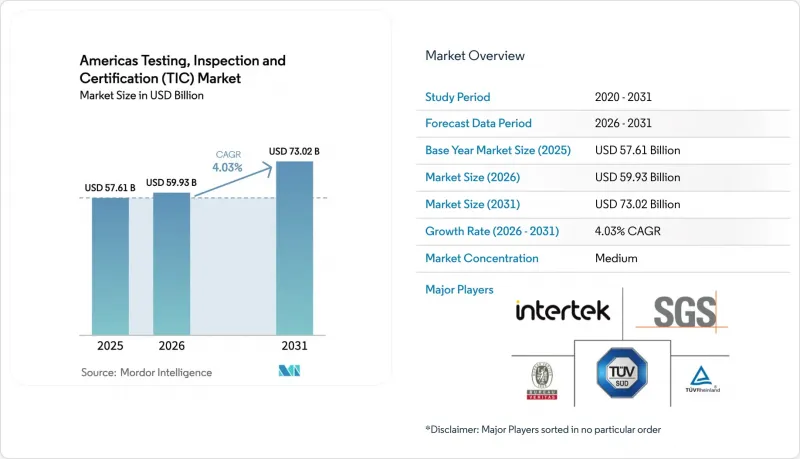
This report is Segmented by Service Type (Testing, Inspection, and Certification), Sourcing Type (In-House and Outsourced), Industry Vertical (Consumer Goods and Retail, ICT and Telecom, Automotive and Transportation, and More), Mode of Service Delivery (On-Site, Off-site/Laboratory, and Remote/Digital), and Region (North America and South America). The Market Forecasts are Provided in Terms of Value (USD).
Americas Testing, Inspection And Certification (TIC) Market Trends and Insights
Near-shoring compliance testing surge reshapes market dynamics
Local production shifts accelerated after pandemic-era supply chain disruptions, prompting new factories in Mexico's border states to commission extensive safety, environmental, and quality audits before products may enter the United States. Companies report that 70% of open technical roles remain unfilled, which obliges heavier reliance on outsourced providers to satisfy ISO 17025 and sector-specific standards. Spillover benefits reach logistics firms that require verification of warehouse automation systems, as well as financial service centers tasked with regional compliance oversight. The Americas TIC market enlarges as near-shoring also extends to consumer electronics, automotive drivetrains, and precision machinery that demand complex multi-discipline testing.
ESG auditing mandates create new revenue streams
The U.S. SEC rule, effective for 2025 large accelerated filers, obliges third-party assurance of Scope 1 and Scope 2 emissions, while the Canadian CSA implements parallel disclosure guidelines. The extraterritorial reach means subsidiaries across Latin America must submit verified carbon inventories, leading to cross-border engagements for established TIC firms. Insurers add weight by requesting ESG compliance certificates before underwriting property and casualty coverage. In response, providers launch carbon accounting, supply-chain transparency, and social-impact audit services, stimulating premium-rate contracts that lift overall Americas TIC market growth.
Technician shortage constrains market expansion
UNESCO warns that regional technical education shortfalls leave 70% of Mexican technology firms scrambling to source qualified workers. Specialized domains such as RF characterization, chemical analytics, and advanced materials see persistent vacancy rates, forcing providers to build intensive training pipelines that extend payback periods. Wage inflation for scarce skill sets compresses margins, especially for commoditized assays. Cross-border relocation of senior experts mitigates bottlenecks but adds visa and relocation costs.
Other drivers and restraints analyzed in the detailed report include:
- 5G / 6G equipment certification drives technical innovation
- Li-ion battery gigafactory expansion fuels specialized testing
- Regulatory fragmentation increases compliance costs
For complete list of drivers and restraints, kindly check the Table Of Contents.
Segment Analysis
Testing solutions delivered 60.02% of 2025 revenue, underlining their foundational role in product validation across every vertical. Certification, though smaller, is set to grow at a 4.74% CAGR because ESG audits, cybersecurity seals, and functional-safety endorsements carry increasing regulatory weight. Inspection services occupy the median niche, sustaining infrastructure integrity projects and preventive maintenance programs. Battery safety initiatives illustrate how demand migrates toward high-complexity assays where expert judgment and purpose-built chambers matter. The Americas TIC market size for certification services is projected to widen in tandem with mandates that require audited disclosures.
Competitive positioning shifts as labs pursue ISO 17025 baseline accreditation before layering sector-specific endorsements such as UL 2580 or IATF 16949. UL Solutions expanded its electric-vehicle battery test line to capture premium assignments, signaling a pivot toward high-value niches. Smaller firms without capital latitude gravitate to subcontract models under network partners, reinforcing the outsourced ecosystem. Automation and data analytics permeate routine tests, freeing skilled personnel to focus on interpretive tasks, yet staff shortages in advanced disciplines temper volume scalability.
Corporations continued to channel 68.72% of verification budgets to external partners in 2025, a pattern projected to hold with a 4.55% CAGR through 2031. Risk mitigation, regulator preference for independent sign-off, and ever-broadening standard catalogs underpin the outsourced share. The Americas TIC market share for outsourced activities benefits from cross-border manufacturing that complicates single-entity compliance.
Digital transformation amplifies this appeal. Providers embed real-time dashboards, seamless data feeds, and audit-ready report generators, reducing internal administrative loads. Mega-OEMs that have built captive labs still require impartial attestations before product launch. Consequently, the outsourced model remains integral, while hybrid arrangements surface in which corporate labs run pre-screens and external partners supply conformance certificates.
Complete Report Scope:
- By Service Type
- Testing
- Inspection
- Certification
- By Sourcing Type
- In-house
- Outsourced
- By Industry Vertical
- Consumer Goods and Retail
- ICT and Telecom
- Automotive and Transportation
- Aerospace and Defense
- Oil, Gas and Petrochemicals
- Energy and Utilities
- Industrial Manufacturing and Machinery
- Chemicals and Materials
- Construction and Infrastructure
- Life Sciences and Healthcare
- Food, Agriculture and Beverage
- Other Industry Verticals (Environment, Sustainability, etc.)
- By Mode of Service Delivery
- On-site
- Off-site / Laboratory
- Remote / Digital
- By Region
- North America
- United States
- Canada
- Mexico
- South America
- Brazil
- Argentina
- Chile
- Rest of South America
- North America
List of Companies Covered in this Report:
- Bureau Veritas SA
- SGS SA
- Intertek Group plc
- TUV SUD AG
- TUV Rheinland AG
- TUV NORD GROUP
- DEKRA SE
- Applus+ Services SA
- Eurofins Scientific SE
- DNV AS
- UL Solutions Inc.
- NSF International
- CSA Group Testing and Certification Inc.
- ALS Limited
- Kiwa NV
- Lloyd's Register Group Services Ltd.
- Element Materials Technology Group Ltd.
- MISTRAS Group, Inc.
- BSI Group (The British Standards Institution)
- American Bureau of Shipping
- Inmetro - Brazilian National Institute of Metrology, Quality and Technology
- Control Union Certifications
- LGC Limited
- Nemko Group AS
- Perry Johnson Laboratory Accreditation, Inc.
Additional Benefits:
- The market estimate (ME) sheet in Excel format
- 3 months of analyst support
TABLE OF CONTENTS
1 INTRODUCTION
- 1.1 Study Assumptions and Market Definition
- 1.2 Scope of the Study
2 RESEARCH METHODOLOGY
3 EXECUTIVE SUMMARY
4 MARKET LANDSCAPE
- 4.1 Market Overview
- 4.2 Market Drivers
- 4.2.1 Rising near-shoring drives demand for local compliance testing
- 4.2.2 Stricter ESG auditing mandates by U.S. SEC and Canadian CSA
- 4.2.3 Accelerated 5G/6G roll-outs require new radio-equipment certification
- 4.2.4 Surging Li-ion battery gigafactories in Mexico and Brazil
- 4.2.5 Digital traceability legislation in food supply chains
- 4.2.6 Insurance underwriters tightening loss-control inspection clauses
- 4.3 Market Restraints
- 4.3.1 Shortage of qualified lab technicians across LATAM
- 4.3.2 Fragmented regulatory regimes between Mercosur and USMCA
- 4.3.3 High capex for AI-driven remote inspection hardware
- 4.3.4 Rising in-house testing capabilities by mega OEMs
- 4.4 Industry Value Chain Analysis
- 4.5 Impact of Macroeconomic Factors
- 4.6 Regulatory Landscape
- 4.7 Technological Outlook
- 4.8 Porter's Five Forces Analysis
- 4.8.1 Threat of New Entrants
- 4.8.2 Bargaining Power of Buyers
- 4.8.3 Bargaining Power of Suppliers
- 4.8.4 Threat of Substitutes
- 4.8.5 Competitive Rivalry
5 MARKET SIZE AND GROWTH FORECASTS (VALUES)
- 5.1 By Service Type
- 5.1.1 Testing
- 5.1.2 Inspection
- 5.1.3 Certification
- 5.2 By Sourcing Type
- 5.2.1 In-house
- 5.2.2 Outsourced
- 5.3 By Industry Vertical
- 5.3.1 Consumer Goods and Retail
- 5.3.2 ICT and Telecom
- 5.3.3 Automotive and Transportation
- 5.3.4 Aerospace and Defense
- 5.3.5 Oil, Gas and Petrochemicals
- 5.3.6 Energy and Utilities
- 5.3.7 Industrial Manufacturing and Machinery
- 5.3.8 Chemicals and Materials
- 5.3.9 Construction and Infrastructure
- 5.3.10 Life Sciences and Healthcare
- 5.3.11 Food, Agriculture and Beverage
- 5.3.12 Other Industry Verticals (Environment, Sustainability, etc.)
- 5.4 By Mode of Service Delivery
- 5.4.1 On-site
- 5.4.2 Off-site / Laboratory
- 5.4.3 Remote / Digital
- 5.5 By Region
- 5.5.1 North America
- 5.5.1.1 United States
- 5.5.1.2 Canada
- 5.5.1.3 Mexico
- 5.5.2 South America
- 5.5.2.1 Brazil
- 5.5.2.2 Argentina
- 5.5.2.3 Chile
- 5.5.2.4 Rest of South America
- 5.5.1 North America
6 COMPETITIVE LANDSCAPE
- 6.1 Market Concentration
- 6.2 Strategic Moves
- 6.3 Market Share Analysis
- 6.4 Company Profiles (includes Global level Overview, Market level overview, Core Segments, Financials as available, Strategic Information, Market Rank/Share for key companies, Products and Services, and Recent Developments)
- 6.4.1 Bureau Veritas SA
- 6.4.2 SGS SA
- 6.4.3 Intertek Group plc
- 6.4.4 TUV SUD AG
- 6.4.5 TUV Rheinland AG
- 6.4.6 TUV NORD GROUP
- 6.4.7 DEKRA SE
- 6.4.8 Applus+ Services SA
- 6.4.9 Eurofins Scientific SE
- 6.4.10 DNV AS
- 6.4.11 UL Solutions Inc.
- 6.4.12 NSF International
- 6.4.13 CSA Group Testing and Certification Inc.
- 6.4.14 ALS Limited
- 6.4.15 Kiwa NV
- 6.4.16 Lloyd's Register Group Services Ltd.
- 6.4.17 Element Materials Technology Group Ltd.
- 6.4.18 MISTRAS Group, Inc.
- 6.4.19 BSI Group (The British Standards Institution)
- 6.4.20 American Bureau of Shipping
- 6.4.21 Inmetro - Brazilian National Institute of Metrology, Quality and Technology
- 6.4.22 Control Union Certifications
- 6.4.23 LGC Limited
- 6.4.24 Nemko Group AS
- 6.4.25 Perry Johnson Laboratory Accreditation, Inc.
7 MARKET OPPORTUNITIES AND FUTURE OUTLOOK
- 7.1 White-space and Unmet-need Assessment

