PUBLISHER: Mordor Intelligence | PRODUCT CODE: 2124661

PUBLISHER: Mordor Intelligence | PRODUCT CODE: 2124661
India Fleet Management Software - Market Share Analysis, Industry Trends & Statistics, Growth Forecasts (2026 - 2031)
According to Mordor Intelligence, the India fleet management software market size in 2026 is estimated at USD 1.91 billion, growing from 2025 value of USD 1.69 billion with 2031 projections showing USD 3.51 billion, growing at 12.96% CAGR over 2026-2031.
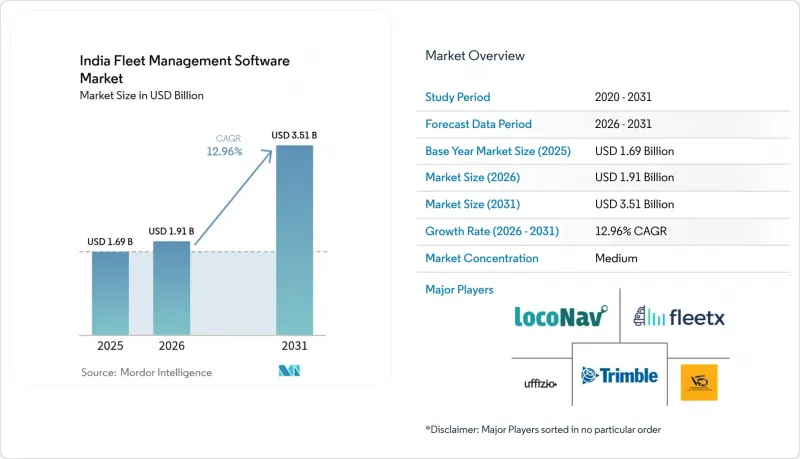
This report is Segmented by Deployment (On-Premise and Cloud/SaaS), Fleet Size (Small, Medium, and Large), Vehicle Type (Light Commercial Vehicles, Heavy Commercial Vehicles, Passenger Cars, and Two-Wheelers), End-User Industry (Logistics and Transportation, Manufacturing and Industrial, and More), Functionality/Module (Tracking and Telematics, Route Optimisation and Navigation, and More), and Region.
India Fleet Management Software Market Trends and Insights
AIS-140 and IS-16833 Compliance Mandates Drive Market Acceleration
Government directives compel every commercial vehicle to install GPS-enabled tracking devices that transmit real-time data to state transport servers. The mandates extend to panic buttons and driver-behavior monitoring, transforming fleet software from optional optimization to compulsory safety infrastructure. Small and medium operators that historically deferred tech spending now face time-bound compliance, triggering rapid adoption across the India fleet management software market. Vendors that embed over-the-air rule updates gain an edge because regulatory specifications evolve quickly. The compliance surge is also generating retrofit demand among used-truck dealers, broadening the addressable base beyond new-vehicle sales.
Volatile Fuel Prices Catalyze TCO-Focused Digitization
Fuel accounts for 40%-50% of trucking operating costs; recent price swings have eroded razor-thin margins and hastened technology uptake to rein in idling, speeding, and route detours. Fleet software now couples fuel sensors with predictive analytics that benchmark consumption across similar duty cycles, empowering operators to negotiate with drivers and shippers using objective data. Cloud dashboards that aggregate diesel invoices, driver scorecards, and route heatmaps deliver quick ROI, a persuasive narrative for cost-sensitive fleets evaluating subscription outlays.
Traditional Operator and Union Resistance Limits Early Uptake
Long-haul drivers often equate telematics with surveillance, and small-fleet owners view app-based freight platforms as threats to decades-old broker ties. The skepticism is amplified by an acute driver shortage that pushes employers to prioritize retention over strict monitoring. Successful vendors reframe software as a welfare enabler offering SOS alerts, salary advances, and in-cab infotainment to shift the narrative from control to empowerment. State-level awareness campaigns by transport departments are gradually softening resistance, but cultural change remains a multi-year journey.
Other drivers and restraints analyzed in the detailed report include:
- E-Commerce and On-Demand Logistics Boom Reshapes Fleet Requirements
- Declining IoT Hardware Costs Democratize Advanced Telematics
- High Capex for Multi-Sensor Telematics Constrains SMEs
For complete list of drivers and restraints, kindly check the Table Of Contents.
Segment Analysis
Cloud solutions claimed 69.10% of 2025 revenue, translating to the largest India fleet management software market share within the deployment spectrum. Cloud platforms minimize upfront investment, a decisive factor for India's 80% small-operator landscape. Pay-per-vehicle subscriptions, automatic over-the-air updates, and API-based integrations allow fleets to scale features without new servers. Over the next five years, this flexibility fuels a 13.55% CAGR, the fastest of any deployment mode.
On-premise installations remain relevant for large enterprises and public agencies requiring data residency or custom workflow logic. However, they lag in innovation velocity because each regulatory or feature update demands on-site patches. Amid the surge in electric vehicles and driver-scorecard analytics, cloud vendors push weekly releases, widening the functionality gap. Combined with India's improving 4G and 5G coverage, cloud subscription is expected to maintain its commanding India fleet management software market size leadership.
Medium fleets accounted for 51.10% of 2025 spending, reflecting the abundance of carriers that own 20-100 vehicles. Their operational complexity is high enough to warrant digitization but still agile enough to experiment with new vendors. These operators typically begin with tracking and upgrade to route optimization and maintenance modules within twelve months, driving sticky monthly recurring revenue.
Large fleets above 100 vehicles posted the highest 13.78% CAGR and are pivotal to forecasts of the India fleet management software market. Consolidation in e-commerce logistics and organized 3PLs produces mega-fleets that require real-time dashboards, driver engagement apps, and enterprise resource planning integration. Small fleets under twenty vehicles trail in adoption because owners tend to calculate payback in weeks, not months. Freemium mobile-first offerings remain the entry gateway for this cohort.
Complete Report Scope:
- By Deployment
- On-Premise
- Cloud/SaaS
- By Fleet Size
- Small (<20 vehicles)
- Medium (20-100)
- Large (>100)
- By Vehicle Type
- Light Commercial Vehicles (LCV)
- Heavy Commercial Vehicles (HCV)
- Passenger Cars
- Two-Wheelers
- By End-User Industry
- Logistics and Transportation
- Manufacturing and Industrial
- Passenger Transport (Bus, Taxi, School)
- Other End-User Industries (Corporate, Utilities, Waste Management)
- By Functionality / Module
- Tracking and Telematics
- Route Optimisation and Navigation
- Maintenance and Diagnostics
- Compliance and Safety
- Fuel and Energy Management
- Analytics and Reporting
- By Region
- North India
- West India
- South India
- East and North-East India
- Central India
List of Companies Covered in this Report:
- Trimble Mobility Solutions India Private Limited
- BT TechLabs Private Limited (LocoNav)
- fleetx Technologies Private Limited
- Uffizio India Software Consultants Private Limited
- Web World Digital Solutions Private Limited (TrackoBit)
- iTriangle Infotech Private Limited
- Azuga Telematics Private Limited
- Samsara Networks India Private Limited
- Geotab Inc. (India)
- Intellicar Telematics Private Limited
- Enmovil Solutions Private Limited
- Vamo Systems Private Limited (Vamosys)
- Binary Semantics Limited (FleetRobo)
- Taabi Mobility (Astra Mobility India Private Limited)
- Mind Your Fleet Tech Private Limited
- GeoSafe Technologies Private Limited
- Affable Web Solutions Private Limited (Fleetable)
- Llama Logisol Private Limited (FleetEnable)
- Pulse Energy India Private Limited
- NextBillion.ai India Private Limited
- Trackster Technologies Private Limited
- Cygnux Softtech Private Limited
Additional Benefits:
- The market estimate (ME) sheet in Excel format
- 3 months of analyst support
TABLE OF CONTENTS
1 INTRODUCTION
- 1.1 Market Definition and Scope of the Study
- 1.2 Study Assumptions
2 RESEARCH METHODOLOGY
3 EXECUTIVE SUMMARY
4 MARKET LANDSCAPE
- 4.1 India Fleet Management Software Market Overview
- 4.2 Stakeholder Analysis
- 4.3 Market Drivers
- 4.3.1 AIS-140 and IS-16833 compliance mandates
- 4.3.2 Volatile fuel prices driving Total-Cost-of-Ownership (TCO) reduction
- 4.3.3 E-commerce and on-demand logistics boom
- 4.3.4 Declining IoT hardware costs and GNSS accuracy gains
- 4.3.5 OEM data-monetization partnerships with FMS vendors
- 4.3.6 EV fleet electrification and energy-aware routing demand
- 4.4 Market Restraints
- 4.4.1 Traditional fleet-operator and driver-union technology resistance
- 4.4.2 High capex for multi-sensor telematics in SME fleets
- 4.4.3 Rural data-connectivity gaps hindering always-on tracking
- 4.4.4 2G/3G sunset forcing legacy-device retrofit costs
- 4.5 Industry Value Chain Analysis
- 4.6 Regulatory Landscape
- 4.7 Technological Outlook (IoT, AI-enabled Telematics)
- 4.8 Porter's Five Forces Analysis
- 4.8.1 Bargaining Power of Suppliers
- 4.8.2 Bargaining Power of Buyers
- 4.8.3 Threat of New Entrants
- 4.8.4 Threat of Substitutes
- 4.8.5 Intensity of Competitive Rivalry
- 4.9 Impact of Key Macroeconomic Trends on Market
5 MARKET SIZE AND GROWTH FORECASTS (VALUES)
- 5.1 By Deployment
- 5.1.1 On-Premise
- 5.1.2 Cloud/SaaS
- 5.2 By Fleet Size
- 5.2.1 Small (<20 vehicles)
- 5.2.2 Medium (20-100)
- 5.2.3 Large (>100)
- 5.3 By Vehicle Type
- 5.3.1 Light Commercial Vehicles (LCV)
- 5.3.2 Heavy Commercial Vehicles (HCV)
- 5.3.3 Passenger Cars
- 5.3.4 Two-Wheelers
- 5.4 By End-User Industry
- 5.4.1 Logistics and Transportation
- 5.4.2 Manufacturing and Industrial
- 5.4.3 Passenger Transport (Bus, Taxi, School)
- 5.4.4 Other End-User Industries (Corporate, Utilities, Waste Management)
- 5.5 By Functionality / Module
- 5.5.1 Tracking and Telematics
- 5.5.2 Route Optimisation and Navigation
- 5.5.3 Maintenance and Diagnostics
- 5.5.4 Compliance and Safety
- 5.5.5 Fuel and Energy Management
- 5.5.6 Analytics and Reporting
- 5.6 By Region
- 5.6.1 North India
- 5.6.2 West India
- 5.6.3 South India
- 5.6.4 East and North-East India
- 5.6.5 Central India
6 COMPETITIVE LANDSCAPE
- 6.1 Market Concentration
- 6.2 Strategic Moves
- 6.3 Market Share Analysis
- 6.4 Company Profiles (includes Global level Overview, Market level overview, Core Segments, Financials as available, Strategic Information, Market Rank/Share for key companies, Products and Services, and Recent Developments)
- 6.4.1 Trimble Mobility Solutions India Private Limited
- 6.4.2 BT TechLabs Private Limited (LocoNav)
- 6.4.3 fleetx Technologies Private Limited
- 6.4.4 Uffizio India Software Consultants Private Limited
- 6.4.5 Web World Digital Solutions Private Limited (TrackoBit)
- 6.4.6 iTriangle Infotech Private Limited
- 6.4.7 Azuga Telematics Private Limited
- 6.4.8 Samsara Networks India Private Limited
- 6.4.9 Geotab Inc. (India)
- 6.4.10 Intellicar Telematics Private Limited
- 6.4.11 Enmovil Solutions Private Limited
- 6.4.12 Vamo Systems Private Limited (Vamosys)
- 6.4.13 Binary Semantics Limited (FleetRobo)
- 6.4.14 Taabi Mobility (Astra Mobility India Private Limited)
- 6.4.15 Mind Your Fleet Tech Private Limited
- 6.4.16 GeoSafe Technologies Private Limited
- 6.4.17 Affable Web Solutions Private Limited (Fleetable)
- 6.4.18 Llama Logisol Private Limited (FleetEnable)
- 6.4.19 Pulse Energy India Private Limited
- 6.4.20 NextBillion.ai India Private Limited
- 6.4.21 Trackster Technologies Private Limited
- 6.4.22 Cygnux Softtech Private Limited
7 MARKET OPPORTUNITIES AND FUTURE OUTLOOK
- 7.1 White-Space and Unmet-Need Assessment

