PUBLISHER: Mordor Intelligence | PRODUCT CODE: 2124690

PUBLISHER: Mordor Intelligence | PRODUCT CODE: 2124690
United States Multi-Tenant (Colocation) Data Center - Market Share Analysis, Industry Trends & Statistics, Growth Forecasts (2026 - 2031)
According to Mordor Intelligence, the United States multi-tenant (colocation) data center market size is estimated at USD 13.85 billion in 2026, and is expected to reach USD 23.09 billion by 2031, at a CAGR of 10.76% during the forecast period 2026-2031.
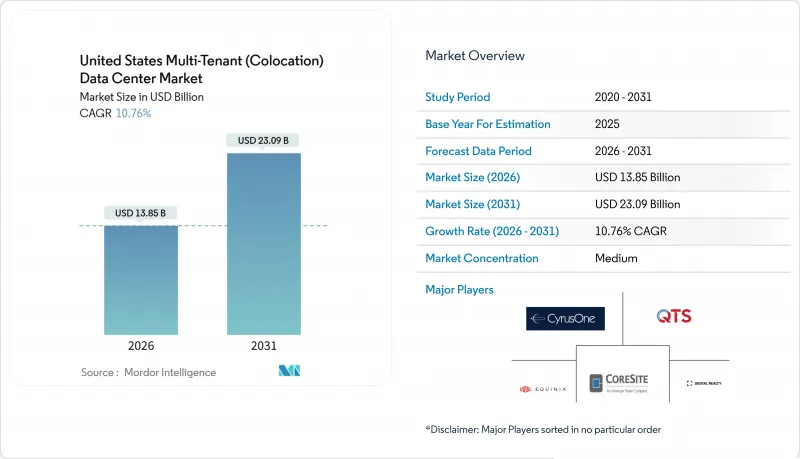
This report is Segmented by Solution Type (Wholesale Multi-Tenant and Retail Multi-Tenant), Tier Type (Tier 1 and 2, Tier 3, and Tier 4), and Data Center Size (Small Data Center, Medium Data Center, Large Data Center, and Hyperscale Data Center). The Market Forecasts are Provided in Terms of Value (USD).
United States Multi-Tenant (Colocation) Data Center Market Trends and Insights
Rapid Proliferation of AI and ML Workloads Requiring High-Density Colocation
Nvidia H100 clusters that underpin large-language-model training routinely exceed 100 kW per cabinet, a density that only 18% of US colocation halls could support in December 2025. Hyperscalers therefore reserve wholesale suites of 5-10 MW to secure liquid-cooling readiness before the next GPU allocation cycle. CyrusOne disclosed that AI customers represented 42% of all bookings during the first three quarters of 2025. Operators that invest in rear-door heat exchangers report 30-40% pricing premiums relative to legacy deployments, compressing payback periods to under four years. National Fire Protection Association is revising NFPA 75 to clarify lithium-ion battery suppression protocols for such high-density clusters.
Accelerating Adoption of Hybrid Cloud and Edge Computing Architectures
Flexential recorded a jump from 51% to 63% of enterprise customers running hybrid deployments between 2024 and 2025. Enterprises distribute workloads across on-premises racks, public-cloud regions, and colocation cages to satisfy latency and data-sovereignty mandates. EdgeConneX expanded to 42 edge locations by focusing on Omaha, Boise, and Raleigh, cities overlooked by national platforms. Analysts expect 800-1,000 MW of new edge colocation demand by 2028. Regulatory strictures such as HIPAA continue to favor hybrid cloud alliances with carrier-neutral operators.
Escalating Power Grid Constraints and Utility Lead Times
Pending interconnection requests in Northern Virginia exceed 4.2 GW, representing nearly three years of backlog. Dominion Energy froze new large-load hookups in portions of Loudoun County during 2025, compelling builders to self-fund substations or postpone energization. Arizona Public Service faces a similar strain in Phoenix, where data-center applications surpassed 1.8 GW in 2025. The Federal Energy Regulatory Commission may prioritize projects with firm site control and completed environmental reviews to clear queues faster. Operators have begun colocating adjacent to generation assets or installing on-site natural-gas peakers at an added USD 50-80 million per 50-MW hall.
Other drivers and restraints analyzed in the detailed report include:
- Hyperscaler Preference for Build-to-Suit Wholesale Colocation in Tier-2 US Metros
- Growing Availability of Renewable Energy Purchase Agreements in US Power Markets
- Rising Land Acquisition and Construction Costs in Core Hubs
For complete list of drivers and restraints, kindly check the Table Of Contents.
Segment Analysis
Retail colocation held 62.53% share of the United States multi-tenant (colocation) data center market in 2025, reflecting the appeal of turnkey rack-level leasing to small and midsized enterprises that avoid capital expenditure. Operators bundle power, cooling, and physical security so customers can scale workloads a single rack at a time. Wholesale leases of 5 MW or more are growing faster, at an 11.32% CAGR, as hyperscalers reserve contiguous capacity to bypass uncertainty in utility queues. The wholesale segment benefits from AI and hybrid-cloud workloads that demand bespoke electrical topologies, liquid-cooling loops, and dedicated meet-me rooms.
CyrusOne's Massively Modular builds allowed tenants to specify up to 30 kW per rack in 2025, capturing wholesale demand at premium rates. Digital Realty pre-leased 85% of its 240-MW 2025 pipeline before first power, signaling that supply still trails demand. Retail colocation will remain resilient because enterprises value geographic diversity and disaster-recovery options across multiple metros, yet wholesale's faster expansion ensures it will capture the majority of incremental megawatts commissioned during the forecast window. As a result, the United States multi-tenant (colocation) data center market will see a gradual rebalancing toward wholesale without eroding the entrenched retail installed base.
Complete Report Scope:
- By Solution Type
- Wholesale Multi-tenant
- Retail Multi-tenant
- By Tier Type
- Tier 1 and 2
- Tier 3
- Tier 4
- By Data Center Size
- Small Data Center
- Medium Data Center
- Large Data Center
- Hyperscale Data Center
List of Companies Covered in this Report:
- Equinix Inc.
- Digital Realty Trust Inc.
- CyrusOne LLC
- Quality Technology Services (QTS Realty Trust)
- CoreSite Realty Corporation (American Tower)
- Switch Inc.
- Iron Mountain Data Centers
- Aligned Data Centers
- Flexential Corp.
- Sabey Data Centers
- EdgeConneX Inc.
- STACK Infrastructure
- Compass Datacenters
- DataBank Ltd.
- NTT Communications Corporation
- KDDI Corporation (Telehouse America)
- DataGryd
- Rackspace Technology Inc.
- IBM Corporation
- Vantage Data Centers
Additional Benefits:
- The market estimate (ME) sheet in Excel format
- 3 months of analyst support
TABLE OF CONTENTS
1 INTRODUCTION
- 1.1 Study Assumptions
- 1.2 Market Definition and Scope of the Study
2 RESEARCH METHODOLOGY
3 EXECUTIVE SUMMARY
4 MARKET LANDSCAPE
- 4.1 Market Overview
- 4.2 Market Drivers
- 4.2.1 Accelerating Adoption of Hybrid Cloud and Edge Computing Architectures
- 4.2.2 Rapid Proliferation of AI/ML Workloads Requiring High-Density Colocation
- 4.2.3 Growing Availability of Renewable Energy Purchase Agreements in US Power Markets
- 4.2.4 Surging Demand for Interconnection Hubs from Content and OTT Providers
- 4.2.5 Hyperscaler Preference for Build-to-Suit Wholesale Colocation in Tier-2 US Metros
- 4.2.6 Federal and State Tax Incentives for Data Center Construction and Modernization
- 4.3 Market Restraints
- 4.3.1 Escalating Power Grid Constraints and Utility Lead Times in High-Demand Markets
- 4.3.2 Rising Land Acquisition and Construction Costs in Core US Data Center Hubs
- 4.3.3 Intensifying Sustainability Reporting Requirements Increasing Compliance Burden
- 4.3.4 Competition from Hyperscalers' Self-Built Facilities in Select Regions
- 4.4 Industry Supply-Chain Analysis
- 4.5 Impact of Macroeconomic Factors on the Market
- 4.6 Regulatory Landscape
- 4.7 Technological Outlook
- 4.8 Porter's Five Forces Analysis
- 4.8.1 Bargaining Power of Suppliers
- 4.8.2 Bargaining Power of Consumers
- 4.8.3 Threat of New Entrants
- 4.8.4 Threat of Substitutes
- 4.8.5 Intensity of Competitive Rivalry
5 MARKET SIZE AND GROWTH FORECASTS (VALUE)
- 5.1 By Solution Type
- 5.1.1 Wholesale Multi-tenant
- 5.1.2 Retail Multi-tenant
- 5.2 By Tier Type
- 5.2.1 Tier 1 and 2
- 5.2.2 Tier 3
- 5.2.3 Tier 4
- 5.3 By Data Center Size
- 5.3.1 Small Data Center
- 5.3.2 Medium Data Center
- 5.3.3 Large Data Center
- 5.3.4 Hyperscale Data Center
6 COMPETITIVE LANDSCAPE
- 6.1 Market Concentration
- 6.2 Strategic Moves
- 6.3 Market Share Analysis
- 6.4 Company Profiles (includes Global Level Overview, Market Level Overview, Core Segments, Financials as available, Strategic Information, Market Rank/Share, Products and Services, Recent Developments)
- 6.4.1 Equinix Inc.
- 6.4.2 Digital Realty Trust Inc.
- 6.4.3 CyrusOne LLC
- 6.4.4 Quality Technology Services (QTS Realty Trust)
- 6.4.5 CoreSite Realty Corporation (American Tower)
- 6.4.6 Switch Inc.
- 6.4.7 Iron Mountain Data Centers
- 6.4.8 Aligned Data Centers
- 6.4.9 Flexential Corp.
- 6.4.10 Sabey Data Centers
- 6.4.11 EdgeConneX Inc.
- 6.4.12 STACK Infrastructure
- 6.4.13 Compass Datacenters
- 6.4.14 DataBank Ltd.
- 6.4.15 NTT Communications Corporation
- 6.4.16 KDDI Corporation (Telehouse America)
- 6.4.17 DataGryd
- 6.4.18 Rackspace Technology Inc.
- 6.4.19 IBM Corporation
- 6.4.20 Vantage Data Centers
7 MARKET OPPORTUNITIES AND FUTURE OUTLOOK
- 7.1 White-Space and Unmet-Need Assessment

