PUBLISHER: Mordor Intelligence | PRODUCT CODE: 2124724

PUBLISHER: Mordor Intelligence | PRODUCT CODE: 2124724
Biometric Card - Market Share Analysis, Industry Trends & Statistics, Growth Forecasts (2026 - 2031)
According to Mordor Intelligence, the biometric card market size was valued at USD 1.01 billion in 2025 and estimated to grow from USD 1.62 billion in 2026 to reach USD 17.09 billion by 2031, at a CAGR of 60.2% during the forecast period (2026-2031).
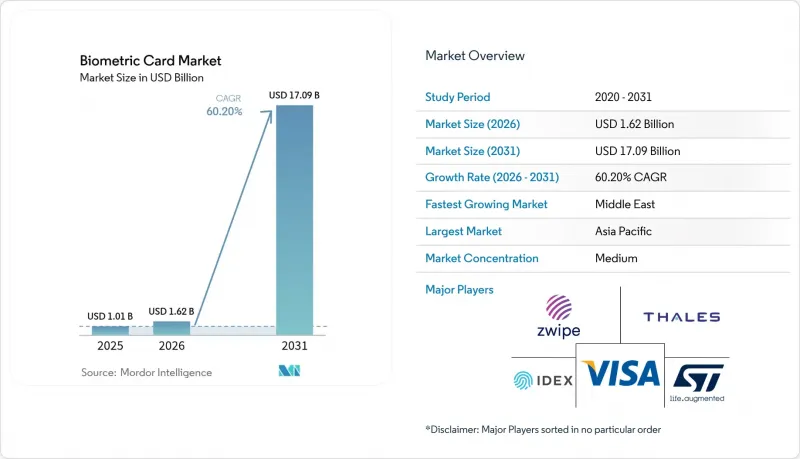
This report is Segmented by Card Type (Credit Card, Debit Card, and Hybrid/Dual-interface Card), Application (Payments, Access Control, Government ID and Financial Inclusion, and More), End-User Vertical (Banking Financial Services and Insurance, Retail, Government, Healthcare, and Commercial Entities), and Geography (North America, Europe, and More). The Market Forecasts are Provided in Terms of Value (USD).
Global Biometric Card Market Trends and Insights
Rising Adoption of Contactless Payments
Contactless usage shifted from convenience feature to preferred default during the pandemic and remains entrenched. Biometric cards remove the contactless value limit that otherwise triggers PIN entry, preserving tap-and-go speed while restoring lost fraud controls. Japan's Life Card program showed consumers quickly accept fingerprint verification for higher-ticket meals and transit fares. Payment networks now promote biometric authentication to keep the physical card relevant amid wallet-based ecosystems. Retailers benefit from shorter queues and lower chargeback risk, reinforcing merchant support for the biometric card market.
Declining Biometric Sensor and Secure-Element Costs
Volume production pushed fingerprint-sensor prices under USD 5, trimming bill-of-materials costs to the point where issuers can mass-issue biometric cards without annual fees. Infineon's Secora Pay Bio and Fingerprint Cards' single-chip architecture eliminated duplicate microcontrollers, shaving power budgets and simplifying lamination steps. Yield improvements in multi-layer construction reduced scrap rates that once exceeded 20%, unlocking new profit pools for contract manufacturers. As each capacity doubling historically cuts silicon cost 15-20%, the biometric card market now enjoys semiconductor-style cost curves formerly limited to mobile handsets.
High Production Cost and Low Manufacturing Yield
Complex card stacks pair fingerprint sensors, secure elements, antennas, and batteries into a 0.8 mm form factor. Misalignment or lamination voids render entire batches unusable, keeping yields below conventional contactless cards. Fingerprint Cards posted SEK 403.2 million (USD 38.5 million) revenue in 2024, down sharply as rising scrap curtailed volumes. Zwipe's March 2025 bankruptcy underscores the capital strain when production ramp-ups collide with persistent defects. Until automation and inline optical inspection mature, manufacturing economics will cap supply growth and temper the biometric card market.
Other drivers and restraints analyzed in the detailed report include:
- Regulatory Push for Strong Customer Authentication
- Banks Aiming to Reclaim Interchange Lost to OEM Wallets
- Competition from Smartphone Biometrics
For complete list of drivers and restraints, kindly check the Table Of Contents.
Segment Analysis
Debit cards generated 51.62% of revenue in 2025, reflecting everyday payment frequency and fraud-liability shifts toward issuers that favor biometric authentication. Users accept fingerprint verification because it removes PIN-entry friction while guarding checking-account balances. Credit cards trail but benefit from high-ticket international travel where offline biometric verification offers peace of mind. The hybrid dual-interface format now enjoys a 62.1% CAGR, outpacing the overall biometric card market size as issuers choose a single SKU that works in contact and contactless reader modes. Kona's PVC and metal approvals highlight extension into premium tiers carrying higher interchange.
Hybrid cards also streamline inventory and simplify consumer education because the fingerprint ritual stays identical at supermarket terminals, transit gates, or restaurant EMV readers. Metal substrates further appeal to affluent segments seeking tangible differentiation yet demand reliable sensor calibration to handle thicker housings. As volume scales, hybrid yields improve, reducing unit premiums and expanding availability beyond platinum-tier offerings. This feedback loop places hybrid formats at the competitive core of the biometric card market.
Complete Report Scope:
- By Card Type
- Credit Cards
- Debit Cards
- Hybrid / Dual-interface Cards
- By Application
- Payments
- Access Control
- Government ID and Financial Inclusion
- Other Applications
- By End-User Vertical
- Banking, Financial Services and Insurance
- Retail
- Government
- Healthcare
- Commercial Entities
- By Geography
- North America
- United States
- Canada
- Mexico
- South America
- Brazil
- Argentina
- Rest of South America
- Europe
- Germany
- United Kingdom
- France
- Italy
- Rest of Europe
- Asia Pacific
- China
- Japan
- India
- South Korea
- Australia and New Zealand
- Rest of Asia Pacific
- Middle East
- Saudi Arabia
- United Arab Emirates
- Turkey
- Rest of Middle East
- Africa
- South Africa
- Nigeria
- Kenya
- Rest of Africa
- North America
Geography Analysis
Asia Pacific accounted for 38.10% of 2025 global revenue as Japan's Life Card and China's digital-payments backbone set early adoption precedents. Local manufacturing kept costs low, and regulators framed biometrics as an inclusion tool for seniors or rural citizens less comfortable with smartphones. Rising domestic chip capabilities mean regional suppliers now compete head-to-head with European incumbents for international tenders.
North America follows, propelled by issuers facing interchange erosion and stray-chargeback exposure. Financial brands trial fingerprint cards with metal substrates to court affluent travelers, while regional banks view the technology as a retention perk amid fintech competition. Regulatory clarity around strong-customer authentication remains less prescriptive than Europe, but consumer expectation for seamless security provides market momentum.
The Middle East heads growth tables with a 66.4% CAGR as Saudi Vision 2030 and UAE smart-city blueprints funnel funds into digital-ID and cashless-society programs. Government procurement accelerates certification cycles, evidenced by IDEX Biometrics' 10,000-unit Visa order. Africa shows nascent traction through Pan-African financial-inclusion drives that blend payment capability with national-ID features, though unreliable power and POS coverage restrain near-term volume. Europe continues to benefit from PSD2 mandates, but market maturation tempers its relative pace compared with emerging regions, even as contactless ubiquity keeps baseline demand strong in the biometric card market.
- Thales SA
- IDEMIA Group SARL
- IDEX Biometrics ASA
- Zwipe AS
- Fingerprint Cards AB
- STMicroelectronics N.V.
- Infineon Technologies AG
- NXP Semiconductors N.V.
- Giesecke+Devrient GmbH
- Visa Inc.
- Mastercard Incorporated
- Samsung Electronics Co., Ltd. (System LSI Business)
- Goldpac FinTech Holding Limited
- Watchdata Technologies Pte Ltd
- CPI Card Group Inc.
- Seshaasai Business Forms (P) Ltd
- Smartmatic International Holding B.V.
- NEC Corporation
- HID Global Corporation
- Linxens Holding SAS
Additional Benefits:
- The market estimate (ME) sheet in Excel format
- 3 months of analyst support
TABLE OF CONTENTS
1 INTRODUCTION
- 1.1 Study Assumptions and Market Definition
- 1.2 Scope of the Study
2 RESEARCH METHODOLOGY
3 EXECUTIVE SUMMARY
4 MARKET LANDSCAPE
- 4.1 Market Overview
- 4.2 Market Drivers
- 4.2.1 Rising adoption of contactless payments
- 4.2.2 Declining biometric sensor and secure-element costs
- 4.2.3 Regulatory push for strong customer authentication
- 4.2.4 Financial-inclusion programmes in emerging economies
- 4.2.5 Banks aiming to reclaim interchange lost to OEM wallets
- 4.2.6 Demand for biometric cold-wallet crypto storage cards
- 4.3 Market Restraints
- 4.3.1 High production cost and low manufacturing yield
- 4.3.2 Competition from smartphone biometrics
- 4.3.3 Lack of standardised remote-enrolment processes
- 4.3.4 Sustainability concerns over multi-layer card materials
- 4.4 Industry Ecosystem Analysis
- 4.5 Regulatory Landscape
- 4.6 Technological Outlook
- 4.7 Impact of Macroeconomic Factors
- 4.8 Porter's Five Forces Analysis
- 4.8.1 Bargaining Power of Suppliers
- 4.8.2 Bargaining Power of Buyers
- 4.8.3 Threat of New Entrants
- 4.8.4 Threat of Substitutes
- 4.8.5 Intensity of Competitive Rivalry
- 4.9 Evolution of Biometric Cards
5 MARKET SIZE AND GROWTH FORECASTS (VALUE)
- 5.1 By Card Type
- 5.1.1 Credit Cards
- 5.1.2 Debit Cards
- 5.1.3 Hybrid / Dual-interface Cards
- 5.2 By Application
- 5.2.1 Payments
- 5.2.2 Access Control
- 5.2.3 Government ID and Financial Inclusion
- 5.2.4 Other Applications
- 5.3 By End-User Vertical
- 5.3.1 Banking, Financial Services and Insurance
- 5.3.2 Retail
- 5.3.3 Government
- 5.3.4 Healthcare
- 5.3.5 Commercial Entities
- 5.4 By Geography
- 5.4.1 North America
- 5.4.1.1 United States
- 5.4.1.2 Canada
- 5.4.1.3 Mexico
- 5.4.2 South America
- 5.4.2.1 Brazil
- 5.4.2.2 Argentina
- 5.4.2.3 Rest of South America
- 5.4.3 Europe
- 5.4.3.1 Germany
- 5.4.3.2 United Kingdom
- 5.4.3.3 France
- 5.4.3.4 Italy
- 5.4.3.5 Rest of Europe
- 5.4.4 Asia Pacific
- 5.4.4.1 China
- 5.4.4.2 Japan
- 5.4.4.3 India
- 5.4.4.4 South Korea
- 5.4.4.5 Australia and New Zealand
- 5.4.4.6 Rest of Asia Pacific
- 5.4.5 Middle East
- 5.4.5.1 Saudi Arabia
- 5.4.5.2 United Arab Emirates
- 5.4.5.3 Turkey
- 5.4.5.4 Rest of Middle East
- 5.4.6 Africa
- 5.4.6.1 South Africa
- 5.4.6.2 Nigeria
- 5.4.6.3 Kenya
- 5.4.6.4 Rest of Africa
- 5.4.1 North America
6 COMPETITIVE LANDSCAPE
- 6.1 Market Concentration
- 6.2 Strategic Moves
- 6.3 Market Share Analysis
- 6.4 Company Profiles (includes Global level overview, market level overview, core segments, financials as available, strategic information, market rank/share for key companies, products and services, and recent developments)
- 6.4.1 Thales SA
- 6.4.2 IDEMIA Group SARL
- 6.4.3 IDEX Biometrics ASA
- 6.4.4 Zwipe AS
- 6.4.5 Fingerprint Cards AB
- 6.4.6 STMicroelectronics N.V.
- 6.4.7 Infineon Technologies AG
- 6.4.8 NXP Semiconductors N.V.
- 6.4.9 Giesecke+Devrient GmbH
- 6.4.10 Visa Inc.
- 6.4.11 Mastercard Incorporated
- 6.4.12 Samsung Electronics Co., Ltd. (System LSI Business)
- 6.4.13 Goldpac FinTech Holding Limited
- 6.4.14 Watchdata Technologies Pte Ltd
- 6.4.15 CPI Card Group Inc.
- 6.4.16 Seshaasai Business Forms (P) Ltd
- 6.4.17 Smartmatic International Holding B.V.
- 6.4.18 NEC Corporation
- 6.4.19 HID Global Corporation
- 6.4.20 Linxens Holding SAS
7 MARKET OPPORTUNITIES AND FUTURE OUTLOOK
- 7.1 White-space and Unmet-need Assessment

