PUBLISHER: Mordor Intelligence | PRODUCT CODE: 2124780

PUBLISHER: Mordor Intelligence | PRODUCT CODE: 2124780
Drug Screening - Market Share Analysis, Industry Trends & Statistics, Growth Forecasts (2026 - 2031)
According to Mordor Intelligence, the drug screening market size was valued at USD 8.49 billion in 2025 and estimated to grow from USD 9.86 billion in 2026 to reach USD 20.86 billion by 2031, at a CAGR of 16.16% during the forecast period (2026-2031).
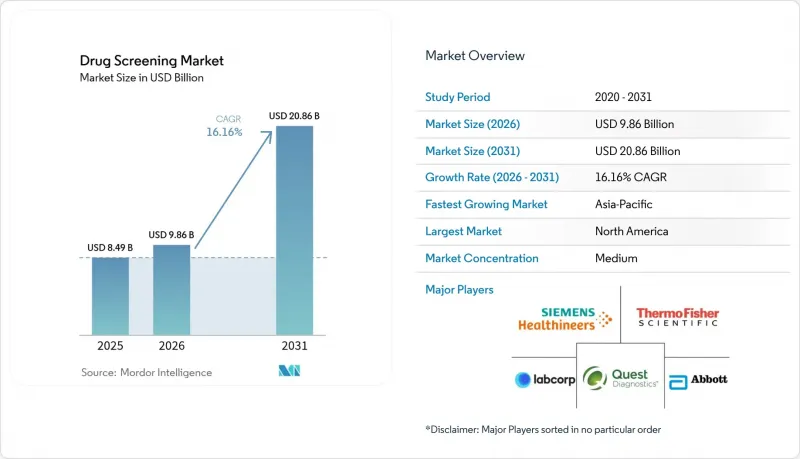
This report is Segmented by Product & Service (Consumables, Instruments, and More), Sample Type (Urine, Oral Fluid, and More), Technology (Immunoassay, Breath Analysers, and More), Testing Setting (Workplace, Criminal Justice, and More), End User (Drug Testing Laboratories, Hospitals, and More), and Geography (North America, Europe, and More). The Market Forecasts are Provided in Terms of Value (USD).
Global Drug Screening Market Trends and Insights
Escalating Workplace Compliance Requirements Across Safety-Sensitive Industries
Regulators have preserved a 50% random-testing rate for commercial motor-vehicle drivers and formally recognized oral-fluid specimens as an alternative to urine, energizing employer demand for diverse test panels. Legalization of recreational and medical cannabis in numerous states is prompting firms to recalibrate zero-tolerance policies while still safeguarding safety objectives. Positive marijuana findings are rising in routine workplace panels, challenging HR teams to differentiate recent impairment from residual metabolites. Federal statutes such as the Fair Credit Reporting Act and Title VII continue to shape pre-employment protocols, creating a patchwork of compliance obligations. Collectively, these dynamics intensify employer reliance on comprehensive screening platforms that integrate legal adjudication and digital result reporting.
Rising Global Prevalence of Substance Abuse and Overdose Mortality
The UN reported a 20% rise in drug use over the last decade, heavily burdening healthcare systems. Governments and payers are responding by mandating risk-stratified toxicology testing within addiction-treatment pathways. The surge in substance misuse also elevates employer healthcare costs and absenteeism, reinforcing corporate interest in routine testing. Consequently, demand for multi-panel kits capable of detecting emerging synthetics is swelling across clinical, workplace, and forensic settings.
Data-Privacy and Employee-Rights Regulations Limiting Random Testing
The proposal to reschedule marijuana from Schedule I to Schedule III signals softer federal posture, encouraging employees to challenge blanket testing policies. Overlapping statutes, such as the Americans with Disabilities Act and Fair Credit Reporting Act, require explicit consent and strict data handling, raising administrative burden. Companies increasingly shift to risk-based programs to avoid litigation, trimming test volumes and tempering near-term growth in the drug screening market.
Other drivers and restraints analyzed in the detailed report include:
- Expansion of Point-of-Care and Rapid Testing Technologies Enhancing Accessibility
- Integration in Opioid Stewardship and Pain-Management Protocols
- High Capital and Operational Costs of Confirmatory LC-MS/MS Platforms
For complete list of drivers and restraints, kindly check the Table Of Contents.
Segment Analysis
Consumables generated 33.72% of 2025 revenue, underlining their indispensable role in every assay and ensuring recurring income for suppliers. The segment is buoyed by steady replenishment cycles across hospital labs, workplace clinics, and forensic units. Heightened testing frequency within opioid-monitoring protocols guarantees stable demand for immunoassay reagents and calibrators. Rapid testing devices, though smaller today, are projected to record an 18.07% CAGR, reshaping the drug screening market with near-instant oral-fluid, saliva, and breath formats that circumvent laboratory delays. The drug screening market size for rapid devices could climb notably as DOT endorsements spur fleet operators to deploy field analyzers on a large scale. Instrument vendors concentrate on modular analyzers with AI-driven maintenance alerts, allowing mid-tier labs to scale capacity without adding skilled labor. Service bundles that merge kit supply, cloud result portals, and medical review are also emerging, deepening client stickiness.
The strategic pivot to hybrid product-service ecosystems is sharpening competitive differentiation. Labcorp's Global Trial Connect enhancement digitizes requisitions and automates chain-of-custody, reducing paper by 70% and speeding resolution of lab queries. Such integrated offerings elevate customer experience and reinforce supplier lock-in. Start-ups specializing in designer-drug panels are grabbing share in sub-segments like harm-reduction clinics, indicating that product breadth paired with digital convenience will dictate future gains in the drug screening market.
Chromatography coupled with high-resolution mass spectrometry captured 44.77% of 2025 revenues, maintaining its status for definitive confirmation. The capability to quantify trace levels of nitazenes and xylazine safeguards clinical decisions and forensic conclusions, anchoring its leadership in the drug screening market. SCIEX QTOF instruments deliver high-throughput acquisition without sacrificing mass accuracy, enabling labs to confirm positives from large screening programs. However, immunoassay platforms now grow at 19.27% CAGR, leveraging improved antibodies and microfluidics to deliver lab-quality performance at the point of care. bioMerieux's acquisition of SpinChip for EUR 111 million (USD 126.9 million) adds an ultra-rapid cartridge format to its portfolio, delivering 10-minute results vital for emergency departments.
Breath analyzers are gaining acceptance in roadside enforcement due to non-invasive sampling and real-time detection within impairment windows, and graphene-based biosensors promise to enhance anabolic-steroid screening sensitivity. The drug screening market share of mass spectrometry may gradually taper as decentralized settings opt for faster immunoassays; nonetheless, confirmatory demand ensures enduring relevance for high-complexity labs. The interplay between accuracy requirements and operational constraints will keep both modalities financially attractive.
Complete Report Scope:
- By Product & Service
- Consumables
- Instruments
- Rapid Testing Devices
- Services
- By Technology
- Immunoassay
- Chromatography & Mass-Spectrometry
- Breath Analysers
- Others
- By Sample Type
- Urine
- Oral Fluid
- Hair
- Other Samples
- By Testing Setting
- Workplace
- Criminal Justice & Law Enforcement
- Pain Management & Opioid Monitoring
- Drug Treatment & Rehabilitation
- By End User
- Drug Testing Laboratories
- Hospitals & Clinics
- Home & OTC
- Others
- Geography
- North America
- United States
- Canada
- Mexico
- Europe
- Germany
- United Kingdom
- France
- Italy
- Spain
- Rest of Europe
- Asia-Pacific
- China
- Japan
- India
- South Korea
- Australia
- Rest of Asia-Pacific
- Middle East and Africa
- GCC
- South Africa
- Rest of Middle East and Africa
- South America
- Brazil
- Argentina
- Rest of South America
- North America
Geography Analysis
North America dominated with 40.88% revenue in 2025, reflecting stringent federal mandates, extensive insurance reimbursement, and high employer adoption. Fentanyl and norfentanyl joined federal panels in July 2025, compelling public employers to upgrade assays and sustain growth in the drug screening market. Leading laboratories deploy robotics and AI-enabled informatics, reinforcing regional cost and quality leadership.
Asia-Pacific represents the fastest expansion, forecast at a 19.61% CAGR for 2026-2031. China's 2025-2027 regulatory roadmap simplifies registration procedures, accelerating new test launches and attracting investment. Nations such as South Korea and Singapore nurture biotech clusters, while Indonesia and Vietnam scale domestic manufacturing, each scenario widening access to point-of-care kits and lab services. Growing road-safety campaigns and employer policies converge to enlarge specimen volumes. As a result, Asia-Pacific's contribution to the drug screening market size will likely surpass Europe during the forecast window. Europe maintains significant share through rigorously enforced worker-safety directives and roadside impairment programs. Intelligent Bio Solutions' alliance with IVY Diagnostics targets the region's USD 3.6 billion opportunity with oral-fluid solutions that align with roadside initiatives. Middle East and Africa markets show emerging potential amid hospital-build programs and multinational workforce regulation in GCC economies. South America, led by Brazil, benefits from expanding public-health funding and corporate awareness campaigns, yet infrastructure gaps temper near-term growth. Geographic heterogeneity obliges suppliers to tune pricing, specimen preferences, and regulatory dossiers for each jurisdiction, but it also insulates the global drug screening market against localized downturns.
- LabCorp
- Quest Diagnostics
- Abbott Laboratories
- Thermo Fisher Scientific
- Roche
- Siemens Healthineers
- Orasure Technologies
- Dragerwerk
- Shimadzu
- Alfa Scientific Designs
- LifeLoc Technologies
- Premier Biotech Inc.
- Beckman Coulter Diagnostics
- Psychemedics
- Omega Laboratories
- Intoximeters
- Cordant Health Solutions
- Bio-Rad Laboratories
- Danaher
- Agilent Technologies
Additional Benefits:
- The market estimate (ME) sheet in Excel format
- 3 months of analyst support
TABLE OF CONTENTS
1 Introduction
- 1.1 Study Assumptions & Market Definition
- 1.2 Scope of the Study
2 Research Methodology
3 Executive Summary
4 Market Landscape
- 4.1 Market Overview
- 4.2 Market Drivers
- 4.2.1 Escalating Workplace Compliance Requirements Across Safety-Sensitive Industries
- 4.2.2 Rising Global Prevalence of Substance Abuse and Overdose Mortality
- 4.2.3 Integration of Drug Screening in Opioid Stewardship and Pain-Management Protocols
- 4.2.4 Advancements in Laboratory Automation Reducing Turnaround Times & Costs
- 4.2.5 Strengthening Road-Traffic Safety and Law-Enforcement Programs Worldwide
- 4.2.6 Expansion of Point-of-Care & Rapid Testing Technologies Enhancing Accessibility
- 4.3 Market Restraints
- 4.3.1 Data-Privacy and Employee-Rights Regulations Limiting Random Testing
- 4.3.2 Reliability Concerns Due to Potential False Positives/Negatives
- 4.3.3 Limited Toxicology Infrastructure in Low-Resource Regions
- 4.3.4 High Capital and Operational Costs of Confirmatory LC-MS/MS Platforms
- 4.4 Porter's Five Forces
- 4.4.1 Threat of New Entrants
- 4.4.2 Bargaining Power of Buyers
- 4.4.3 Bargaining Power of Suppliers
- 4.4.4 Threat of Substitutes
- 4.4.5 Intensity of Competitive Rivalry
5 Market Size & Growth Forecasts (Value, USD)
- 5.1 By Product & Service
- 5.1.1 Consumables
- 5.1.2 Instruments
- 5.1.3 Rapid Testing Devices
- 5.1.4 Services
- 5.2 By Technology
- 5.2.1 Immunoassay
- 5.2.2 Chromatography & Mass-Spectrometry
- 5.2.3 Breath Analysers
- 5.2.4 Others
- 5.3 By Sample Type
- 5.3.1 Urine
- 5.3.2 Oral Fluid
- 5.3.3 Hair
- 5.3.4 Other Samples
- 5.4 By Testing Setting
- 5.4.1 Workplace
- 5.4.2 Criminal Justice & Law Enforcement
- 5.4.3 Pain Management & Opioid Monitoring
- 5.4.4 Drug Treatment & Rehabilitation
- 5.5 By End User
- 5.5.1 Drug Testing Laboratories
- 5.5.2 Hospitals & Clinics
- 5.5.3 Home & OTC
- 5.5.4 Others
- 5.6 Geography
- 5.6.1 North America
- 5.6.1.1 United States
- 5.6.1.2 Canada
- 5.6.1.3 Mexico
- 5.6.2 Europe
- 5.6.2.1 Germany
- 5.6.2.2 United Kingdom
- 5.6.2.3 France
- 5.6.2.4 Italy
- 5.6.2.5 Spain
- 5.6.2.6 Rest of Europe
- 5.6.3 Asia-Pacific
- 5.6.3.1 China
- 5.6.3.2 Japan
- 5.6.3.3 India
- 5.6.3.4 South Korea
- 5.6.3.5 Australia
- 5.6.3.6 Rest of Asia-Pacific
- 5.6.4 Middle East and Africa
- 5.6.4.1 GCC
- 5.6.4.2 South Africa
- 5.6.4.3 Rest of Middle East and Africa
- 5.6.5 South America
- 5.6.5.1 Brazil
- 5.6.5.2 Argentina
- 5.6.5.3 Rest of South America
- 5.6.1 North America
6 Competitive Landscape
- 6.1 Market Concentration
- 6.2 Market Share Analysis
- 6.3 Company Profiles (includes Global level Overview, Market level overview, Core Business Segments, Financials, Headcount, Key Information, Market Rank, Market Share, Products and Services, and analysis of Recent Developments)
- 6.3.1 LabCorp (Laboratory Corporation of America Holdings)
- 6.3.2 Quest Diagnostics
- 6.3.3 Abbott Laboratories
- 6.3.4 Thermo Fisher Scientific Inc.
- 6.3.5 F. Hoffmann-La Roche Ltd
- 6.3.6 Siemens Healthineers
- 6.3.7 OraSure Technologies Inc.
- 6.3.8 Dragerwerk AG & Co. KGaA
- 6.3.9 Shimadzu Corporation
- 6.3.10 Alfa Scientific Designs Inc.
- 6.3.11 LifeLoc Technologies
- 6.3.12 Premier Biotech Inc.
- 6.3.13 Beckman Coulter Diagnostics
- 6.3.14 Psychemedics Corporation
- 6.3.15 Omega Laboratories Inc.
- 6.3.16 Intoximeters Inc.
- 6.3.17 Cordant Health Solutions
- 6.3.18 Bio-Rad Laboratories
- 6.3.19 Danaher Corporation
- 6.3.20 Agilent Technologies
7 Market Opportunities & Future Outlook
- 7.1 White-Space & Unmet-Need Assessment

