PUBLISHER: Mordor Intelligence | PRODUCT CODE: 2124850

PUBLISHER: Mordor Intelligence | PRODUCT CODE: 2124850
Pharmaceutical Spray Drying - Market Share Analysis, Industry Trends & Statistics, Growth Forecasts (2026 - 2031)
According to Mordor Intelligence, the pharmaceutical spray drying market size was valued at USD 2.29 billion in 2025 and is estimated to grow from USD 2.46 billion in 2026 to reach USD 3.5 billion by 2031, at a CAGR of 7.32% during the forecast period (2026-2031).
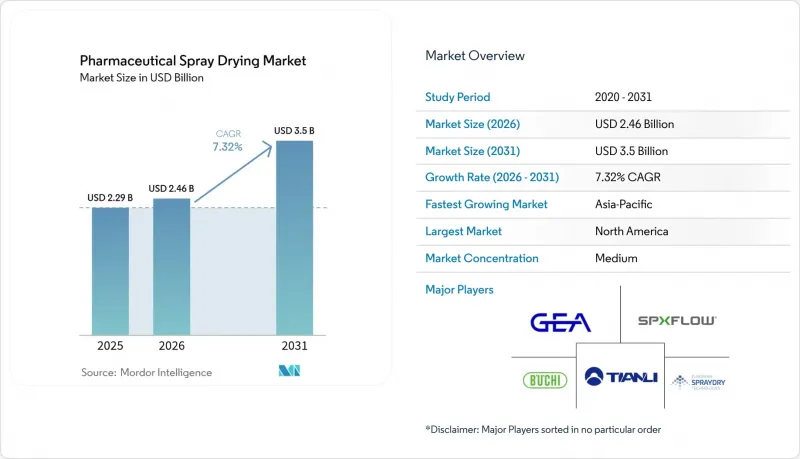
This report is Segmented by Application (Excipient Production, and More), Formulation Type (Small-Molecule APIs, and More), Spray Dryer Type (Rotary Atomizer, and More), Scale (Laboratory/Pilot and Commercial-Scale), Service Type (In-House Manufacturing and Contract (CDMO/CMO) Services), and Geography (North America, Europe, and More). The Market Forecasts are Provided in Terms of Value (USD).
Global Pharmaceutical Spray Drying Market Trends and Insights
Growing Demand for Enhanced Drug Solubility
Roughly 70% of new chemical entities in late-stage development display poor aqueous solubility, driving formulation scientists to adopt spray drying to create amorphous solid dispersions that dissolve two- to ten-times faster than crystalline forms. FDA approvals of spray-dried drugs such as telaprevir and vemurafenib validate the platform's ability to meet regulatory expectations on stability and performance. Targeted oncology assets with hydrophobic backbones increasingly rely on hydroxypropyl methylcellulose acetate succinate or Soluplus carriers to remain in solution after oral dosing. The trend lifts the pharmaceutical spray drying market as sponsors funnel pipeline drugs into specialized CDMOs that maintain large compatibility libraries. Broader acceptance of amorphous science by clinicians also improves market prospects because therapeutic exposure can be achieved with lower drug loads.
Rising Outsourcing to CDMOs for Spray-Dried Dispersions
Supply disruptions exposed the vulnerability of single-site manufacturing, prompting companies to pivot toward asset-light operating models. Hovione's USD 100 million capacity expansion in Ireland and the United States highlights confidence in sustained demand for contracted services. CDMOs compress development timelines by leveraging validated GMP suites, digital data sets, and regulatory expertise that small biotechnology clients cannot replicate internally. The outsourcing wave adds volume to the pharmaceutical spray drying market and promotes standardization of polymer libraries, atomization protocols, and real-time release testing.
High Capital & Operating Costs for GMP Units
Building a single GMP spray drying suite costs USD 10 million-USD 15 million once cleanroom, solvent recovery, and process analytical technology are included. Operating expenses can reach USD 1 million per year for a 500 kg-per-day plant that consumes nitrogen, electricity, and validation labor. Smaller firms in emerging markets struggle to justify the expense because financing is scarce and payback horizons exceed seven years. Although CDMO fees lower the upfront burden, prices of USD 5,000-USD 15,000 per kilogram erode margins on high-volume generics, which tempers growth in parts of the pharmaceutical spray drying market.
Other drivers and restraints analyzed in the detailed report include:
- Expansion of Inhalable & Oral Thin-Film Therapies
- Continuous Closed-Loop Manufacturing Adoption
- Stringent Validation & Solvent-Emission Rules
For complete list of drivers and restraints, kindly check the Table Of Contents.
Segment Analysis
Excipient production held 42.55% of the pharmaceutical spray drying market share in 2025, anchored by large-volume outputs of lactose, microcrystalline cellulose, and hydroxypropyl methylcellulose powders. Manufacturers favor rotary atomizers because they handle viscous feeds and deliver the flow characteristics that tablet presses require. Yet bioavailability enhancement is expanding at a 9.85% CAGR through 2031 as drug pipelines contain more BCS Class II and IV molecules that need amorphous solid dispersions to reach target exposures.
The pharmaceutical spray drying market is therefore tilting toward value-added dispersion services that rescue otherwise unviable candidates. Encapsulation, which embeds active ingredients in enteric or taste-masking polymers, is also rising in pediatric and geriatric niches. Niche uses such as probiotic and enzyme stabilization add incremental demand, but the growth inflection is clearly linked to solubility challenges that mainstream chemistries cannot solve.
Small-molecule APIs accounted for 46.53% of pharmaceutical spray drying market revenue in 2025 as formulators continued to convert crystalline actives into fast-dissolving dispersions. Rotary and nozzle systems manage the thermal profile well enough to protect synthetic compounds, securing the installed base. Vaccines, however, are projected to grow at a 9.75% CAGR between 2026 and 2031, supported by global investment in thermostable pulmonary and oral platforms that reduce cold-chain reliance.
Thermal stress remains a hurdle for mRNA and lipid nanoparticle constructs, yet cryoprotectants such as trehalose preserve bioactivity below 50 °C outlet temperatures. Biologics and peptides, once viewed as unsuitable for spray drying, now benefit from low-shear nozzle designs and closed-loop nitrogen setups that keep oxygen levels below flammability limits. Collectively, these innovations raise the long-term addressable share of the pharmaceutical spray drying market size.
Complete Report Scope:
- By Application
- Excipient Production
- Encapsulation
- Enhancing Bioavailability
- Other Applications
- By Formulation Type
- Small-Molecule APIs
- Biologics & Peptides
- Vaccines (Incl. mRNA/LNP)
- Inhalable Formulations
- Others
- By Spray Dryer Type
- Rotary Atomizer
- Nozzle Atomizer
- Fluidized / Closed-Loop
- Others
- By Scale
- Laboratory / Pilot
- Commercial-Scale
- By Service Type
- In-house Manufacturing
- Contract (CDMO/CMO) Services
- Geography
- North America
- United States
- Canada
- Mexico
- Europe
- Germany
- United Kingdom
- France
- Italy
- Spain
- Rest of Europe
- Asia-Pacific
- China
- India
- Japan
- Australia
- South Korea
- Rest of Asia-Pacific
- Middle East and Africa
- GCC
- South Africa
- Rest of Middle East and Africa
- South America
- Brazil
- Argentina
- Rest of South America
- North America
Geography Analysis
North America contributed 39.52% of the pharmaceutical spray drying market share in 2025. FDA programs that fast-track continuous manufacturing, combined with a deep bench of CDMOs, make the United States the largest single market. Capacity expansions in New Jersey and California focus on high-potency APIs and inhalation powders. Canada and Mexico are fast followers as both nations attract near-shoring contracts from U.S. sponsors that want supply resilience.
Asia-Pacific is forecast to post the highest CAGR at 8.32% through 2031. China, with clusters in Shanghai and Suzhou, offers GMP spray drying at 30%-50% lower cost than Western peers, luring early-phase projects. India's Production-Linked Incentive scheme offsets capital outlays by up to 20%, boosting installations in Hyderabad and Ahmedabad. Japan and South Korea focus on high-value biologic dispersions, while Australia supplies clinical trial material for oncology and rare disease studies.
Europe ranks as the second-largest regional segment. Strict solvent-emission rules favor closed-loop installations, and equipment makers like GEA and Syntegon reinforce the leadership position. Ireland, Germany, and Switzerland cluster CDMO capacity that serves both regional and transatlantic clients. Meanwhile, South America and the Middle East remain nascent pockets, installing pilot units to localize excipient production and reduce import dependence, yet their combined contribution to the pharmaceutical spray drying market size stays modest.
- Advanced Drying Systems
- BUCHI Labortechnik AG
- Carrier Vibrating Equipment
- Catalent Pharma Solutions
- Cyclops Spray Drying
- Dedert Corporation
- European SprayDry Technologies
- Fluid Air
- Fuji Chemical Industry Co.
- GEA Group
- Hovione Farmaciencia SA
- Lemar Drying Engineering
- Lonza Ltd.
- New AVM Systech
- ProCepT NV
- Seqens CDMO
- Shandong Tianli Drying Tech
- Spray-Tek Inc.
- SPX FLOW Inc.
- Syntegon Technology
Additional Benefits:
- The market estimate (ME) sheet in Excel format
- 3 months of analyst support
TABLE OF CONTENTS
1 Introduction
- 1.1 Study Assumptions & Market Definition
- 1.2 Scope of the Study
2 Research Methodology
3 Executive Summary
4 Market Landscape
- 4.1 Market Overview
- 4.2 Market Drivers
- 4.2.1 Growing demand for enhanced drug solubility
- 4.2.2 Rising outsourcing to CDMOs for spray-dried dispersions
- 4.2.3 Expansion of inhalable & oral thin-film therapies
- 4.2.4 Continuous closed-loop manufacturing adoption
- 4.2.5 AI-driven digital-twin process optimisation
- 4.2.6 Temperature-shift high-solids feeds reducing solvent load
- 4.3 Market Restraints
- 4.3.1 High capital & operating costs for GMP units
- 4.3.2 Stringent validation & solvent-emission rules
- 4.3.3 Limited global supply of spray-drying-grade excipients
- 4.3.4 Energy intensity & sustainability concerns
- 4.4 Regulatory Landscape
- 4.5 Technological Outlook
- 4.6 Porter's Five Forces
- 4.6.1 Threat of New Entrants
- 4.6.2 Bargaining Power of Buyers
- 4.6.3 Bargaining Power of Suppliers
- 4.6.4 Threat of Substitutes
- 4.6.5 Competitive Rivalry
5 Market Size & Growth Forecasts (Value, USD)
- 5.1 By Application
- 5.1.1 Excipient Production
- 5.1.2 Encapsulation
- 5.1.3 Enhancing Bioavailability
- 5.1.4 Other Applications
- 5.2 By Formulation Type
- 5.2.1 Small-Molecule APIs
- 5.2.2 Biologics & Peptides
- 5.2.3 Vaccines (Incl. mRNA/LNP)
- 5.2.4 Inhalable Formulations
- 5.2.5 Others
- 5.3 By Spray Dryer Type
- 5.3.1 Rotary Atomizer
- 5.3.2 Nozzle Atomizer
- 5.3.3 Fluidized / Closed-Loop
- 5.3.4 Others
- 5.4 By Scale
- 5.4.1 Laboratory / Pilot
- 5.4.2 Commercial-Scale
- 5.5 By Service Type
- 5.5.1 In-house Manufacturing
- 5.5.2 Contract (CDMO/CMO) Services
- 5.6 Geography
- 5.6.1 North America
- 5.6.1.1 United States
- 5.6.1.2 Canada
- 5.6.1.3 Mexico
- 5.6.2 Europe
- 5.6.2.1 Germany
- 5.6.2.2 United Kingdom
- 5.6.2.3 France
- 5.6.2.4 Italy
- 5.6.2.5 Spain
- 5.6.2.6 Rest of Europe
- 5.6.3 Asia-Pacific
- 5.6.3.1 China
- 5.6.3.2 India
- 5.6.3.3 Japan
- 5.6.3.4 Australia
- 5.6.3.5 South Korea
- 5.6.3.6 Rest of Asia-Pacific
- 5.6.4 Middle East and Africa
- 5.6.4.1 GCC
- 5.6.4.2 South Africa
- 5.6.4.3 Rest of Middle East and Africa
- 5.6.5 South America
- 5.6.5.1 Brazil
- 5.6.5.2 Argentina
- 5.6.5.3 Rest of South America
- 5.6.1 North America
6 Competitive Landscape
- 6.1 Market Concentration
- 6.2 Market Share Analysis
- 6.3 Company Profiles (includes Global level Overview, Market level overview, Core Segments, Financials, Strategic Information, Market Rank/Share, Products & Services, Recent Developments)
- 6.3.1 Advanced Drying Systems
- 6.3.2 BUCHI Labortechnik AG
- 6.3.3 Carrier Vibrating Equipment
- 6.3.4 Catalent Pharma Solutions
- 6.3.5 Cyclops Spray Drying
- 6.3.6 Dedert Corporation
- 6.3.7 European SprayDry Technologies
- 6.3.8 Fluid Air
- 6.3.9 Fuji Chemical Industry Co.
- 6.3.10 GEA Group AG
- 6.3.11 Hovione Farmaciencia SA
- 6.3.12 Lemar Drying Engineering
- 6.3.13 Lonza Ltd.
- 6.3.14 New AVM Systech
- 6.3.15 ProCepT NV
- 6.3.16 Seqens CDMO
- 6.3.17 Shandong Tianli Drying Tech
- 6.3.18 Spray-Tek Inc.
- 6.3.19 SPX FLOW Inc.
- 6.3.20 Syntegon Technology
7 Market Opportunities & Future Outlook
- 7.1 White-Space & Unmet-Need Assessment

