PUBLISHER: Mordor Intelligence | PRODUCT CODE: 2124872

PUBLISHER: Mordor Intelligence | PRODUCT CODE: 2124872
Home Audio - Market Share Analysis, Industry Trends & Statistics, Growth Forecasts (2026 - 2031)
According to Mordor Intelligence, the home audio market size is expected to grow from USD 39.04 billion in 2025 to USD 43.2 billion in 2026 and is forecast to reach USD 71.69 billion by 2031 at 10.7% CAGR over 2026-2031.
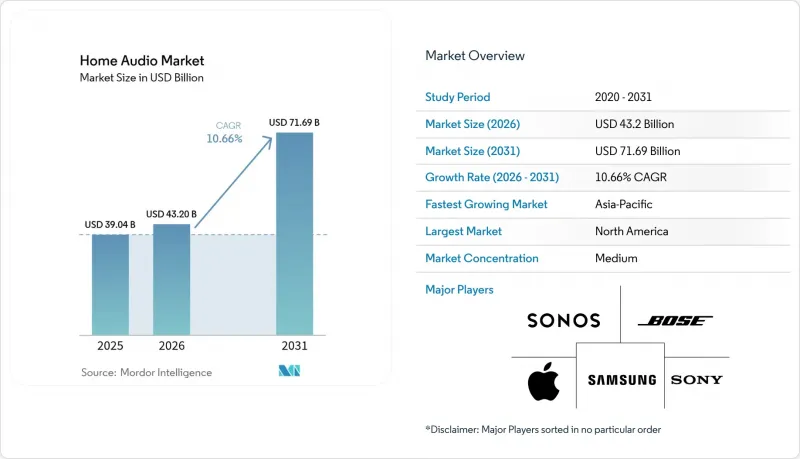
This report is Segmented by Product Type (A/V Receivers, Hi-Fi Systems and Shelf-Systems, Sound Bars, and More), Technology (Wired, Wireless), Distribution Channel (Online E-Commerce, and More), Price Range (Entry-Level, Mid-Range, Premium), End User (Residential, Commercial), and Geography (North America, South America, Europe, Asia-Pacific, and More). The Market Forecasts are Provided in Terms of Value (USD).
Global Home Audio Market Trends and Insights
Proliferation of AI-Enabled Smart Speakers
Generative AI shifts voice control from scripted commands to contextual conversation, raising replacement demand in the home audio market as users seek devices that understand intent and nuance. Amazon's Alexa Plus showcases this transition yet still reveals accuracy gaps that limit full trust. Google's migration from Assistant to Gemini underscores a broader recognition that legacy stacks lack the processing muscle for multimodal AI. Device makers now integrate more powerful edge-AI chips, which increase bill-of-materials cost but unlock premium pricing and recurring revenues from AI feature subscriptions. Competitive intensity accelerates as ecosystem giants leverage vast data assets to personalize audio experiences. Consumers respond favorably, evidenced by a steady rise in smart-speaker replacement cycles across North America and East Asia.
Integration of Immersive Spatial-Audio Formats
Dolby Atmos and DTS:X are no longer confined to high-end home theaters; their support now appears in mid-priced TVs, sound bars, and even true wireless earbuds, broadening mass-market exposure. Eight of every ten domestic box-office releases in 2024 shipped with Dolby mixing, setting new consumer expectations for cinematic sound quality at home. Dolby's FlexConnect, debuting in TCL's 2024 televisions, auto-calibrates wireless speakers to eliminate historical setup pain points.[2] Yet manufacturers face difficult codec-licensing decisions, highlighted by LG's move to drop DTS support to trim royalties. Automotive deployments, such as Cadillac's 2026 electric lineup, further normalize spatial audio, indirectly boosting residential demand as consumers grow accustomed to 3D sound on daily commutes.
Global Semiconductor Supply-Chain Volatility
Extended lead times for critical chips force design revisions that delay product launches in the home audio market, especially for smaller firms that lack purchasing clout. Component cycles stretched beyond six months during 2024, and single-source raw materials such as high-purity quartz remain vulnerable to climate events. China's rare-earth export limits put magnet supplies at risk, threatening over 21,000 jobs in India's audio sector and sparking interest in lower-performance ferrite substitutes. Companies hedge by multi-sourcing silicon and stockpiling, but the result is higher working-capital needs that compress margins.
Other drivers and restraints analyzed in the detailed report include:
- Rapid Decline in Component Pricing for MEMS Microphones
- Bundled Music-Streaming and Hardware Subscription Models
- Consumer Privacy Concerns Around Always-On Microphones
For complete list of drivers and restraints, kindly check the Table Of Contents.
Segment Analysis
A/V receivers accounted for 38.75% of the home audio market size in 2025, making them the single largest category. Enthusiasts value their calibration features, multiple HDMI inputs, and high-current amplification that anchors dedicated surround systems. Growth trends, however, favor wireless speakers that post an 11.1% CAGR through 2031 as households opt for compact, cable-free setups. Voice-assistant integration, automatic room tuning, and easier multi-room pairing help wireless units reach casual buyers who previously avoided complex installations.
The coexistence of both segments signals bifurcation in the home audio market. Audiophile consumers still embrace receivers for flexibility, while mainstream users gravitate toward sound bars and smart speakers. Newer sound bars incorporate upward-firing drivers for Dolby Atmos, blurring lines with entry-level surround systems. Shelf systems and docks now serve niche listeners, yet their inclusion of lossless streaming, phono inputs, and high-quality DACs keeps them relevant. Accessory DACs and headphone amplifiers in the "Others" sub-segment cater to hobbyist tinkerers seeking audible gains from existing gear.
Wireless solutions represented 65.85% of the home audio market share in 2025 and will grow at a 11.85% CAGR. Bluetooth LE Audio cuts latency and enables synchronized playback on multiple speakers, meeting the demands of gamers and party hosts alike. Wi-Fi 6E delivers higher bandwidth and less congestion, important for lossless and spatial streams. Brands also explore Ultra-Wideband for precise speaker positioning that enhances auto-calibration routines.
Wired systems retain loyalists among studio engineers and purist listeners who prioritize low jitter and zero compression. These users often pair balanced connections with external DACs to drive reference headphones or passive speakers. Even so, hybrid platforms now let wired speakers receive wireless signals via hub adapters, bridging convenience and fidelity. Multi-protocol chips reduce bill-of-materials and simplify firmware updates, facilitating future-proof designs across the home audio market.
Complete Report Scope:
- By Product Type
- A/V Receivers
- Hi-Fi Systems and Shelf-Systems
- Sound Bars
- Wireless Speakers
- Bluetooth / Wi-Fi Speakers
- Smart Speakers (with VA)
- Dedicated Docks and Audio Stations
- Others (DACs, Amplifiers)
- By Technology
- Wired
- Wireless (Wi-Fi, Bluetooth, Zigbee, UWB)
- By Distribution Channel
- Online E-commerce
- Organized Retail Chains
- Specialty Audio Stores
- Direct-to-Consumer (D2C)
- By Price Range
- Entry-Level (< USD 150)
- Mid-Range (USD 150 - 500)
- Premium (> USD 500)
- By End User
- Residential
- Commercial (Hospitality, Offices, Studios)
- By Geography
- North America
- United States
- Canada
- Mexico
- South America
- Brazil
- Argentina
- Rest of South America
- Europe
- Germany
- United Kingdom
- France
- Italy
- Rest of Europe
- Asia-Pacific
- China
- Japan
- South Korea
- India
- Rest of Asia-Pacific
- Middle East
- Saudi Arabia
- United Arab Emirates
- Rest of Middle East
- Africa
- South Africa
- Rest of Africa
- North America
Geography Analysis
Asia-Pacific shows the fastest 11.35% CAGR thanks to rising disposable income, smart-home enthusiasm, and a burgeoning middle class. China posted 28.4% music-market expansion in 2024, underpinned by paid streaming growth, while India targets USD 300 billion in consumer-electronics output by 2026. Local manufacturing of TWS earbuds reached a 16% unit share in Q2 2024, shortening supply chains and lowering entry-level prices. Japan contributes innovation leadership through Sony, which maintained a 27% recorded-music share and industry-leading 19.7% margins in 2024.
North America led with 31.35% market share in 2025, supported by high average selling prices and an entrenched home-theater culture. E-commerce maturity encourages brand experimentation with D2C portals posting 11.55% CAGR across the forecast. Gaming continues to propel premium headset and sound-bar sales, while California privacy rules shape microphone design choices nationwide. Consumers display replacement cycles of three to four years, shortened by AI-enabled features that make earlier models feel dated.
Europe balances heritage audio craftsmanship with strict environmental policy. The EU's updated Battery Regulation and broader e-waste directives push OEMs to adopt modular, repairable architectures. Circular-economy principles, already two decades in the making, gain urgency as global e-waste could hit 82 million tons by 2030. European buyers value authenticity and provenance, keeping artisanal brands like Sonus Faber relevant. These dynamics preserve premium price elasticity, supporting steady growth even as overall volumes plateau in mature Western markets.
- Amazon.com Inc.
- Google LLC
- Apple Inc.
- Samsung Electronics Co., Ltd.
- Sony Group Corporation
- Sonos Inc.
- Bose Corporation
- Yamaha Corporation
- LG Electronics Inc.
- Harman International Industries (JBL)
- Bowers & Wilkins (Sound United)
- Denon Holdings Corp.
- Klipsch Audio Technologies
- Vizio Inc.
- Bang & Olufsen A/S
- Onkyo Corporation
- Dynaudio A/S
- Polk Audio LLC
- Pioneer Corporation
- Boston Acoustics Inc.
Additional Benefits:
- The market estimate (ME) sheet in Excel format
- 3 months of analyst support
TABLE OF CONTENTS
1 Introduction
- 1.1 Study Assumptions and Market Definition
- 1.2 Scope of the Study
2 Research Methodology
3 Executive Summary
4 Market Landscape
- 4.1 Market Overview
- 4.2 Market Drivers
- 4.2.1 Proliferation of AI-enabled smart speakers
- 4.2.2 Integration of immersive spatial-audio formats (Dolby Atmos, DTS:X)
- 4.2.3 Rapid decline in component pricing for MEMS microphones
- 4.2.4 Bundled music-streaming and hardware subscription models
- 4.2.5 Smart-home interoperability mandates (Matter, Thread)
- 4.2.6 Growth of at-home gaming and e-sports driving premium audio demand
- 4.3 Market Restraints
- 4.3.1 Global semiconductor supply-chain volatility
- 4.3.2 Fragmented licensing costs for next-gen codecs
- 4.3.3 Consumer privacy concerns around always-on microphones
- 4.3.4 Rising e-waste regulation compliance costs
- 4.4 Industry Value Chain Analysis
- 4.5 Regulatory Landscape
- 4.6 Technological Outlook
- 4.7 Porter's Five Forces Analysis
- 4.7.1 Bargaining Power of Suppliers
- 4.7.2 Bargaining Power of Buyers
- 4.7.3 Threat of New Entrants
- 4.7.4 Threat of Substitutes
- 4.7.5 Intensity of Competitive Rivalry
5 Market Size and Growth Forecasts (Value)
- 5.1 By Product Type
- 5.1.1 A/V Receivers
- 5.1.2 Hi-Fi Systems and Shelf-Systems
- 5.1.3 Sound Bars
- 5.1.4 Wireless Speakers
- 5.1.4.1 Bluetooth / Wi-Fi Speakers
- 5.1.4.2 Smart Speakers (with VA)
- 5.1.5 Dedicated Docks and Audio Stations
- 5.1.6 Others (DACs, Amplifiers)
- 5.2 By Technology
- 5.2.1 Wired
- 5.2.2 Wireless (Wi-Fi, Bluetooth, Zigbee, UWB)
- 5.3 By Distribution Channel
- 5.3.1 Online E-commerce
- 5.3.2 Organized Retail Chains
- 5.3.3 Specialty Audio Stores
- 5.3.4 Direct-to-Consumer (D2C)
- 5.4 By Price Range
- 5.4.1 Entry-Level (< USD 150)
- 5.4.2 Mid-Range (USD 150 - 500)
- 5.4.3 Premium (> USD 500)
- 5.5 By End User
- 5.5.1 Residential
- 5.5.2 Commercial (Hospitality, Offices, Studios)
- 5.6 By Geography
- 5.6.1 North America
- 5.6.1.1 United States
- 5.6.1.2 Canada
- 5.6.1.3 Mexico
- 5.6.2 South America
- 5.6.2.1 Brazil
- 5.6.2.2 Argentina
- 5.6.2.3 Rest of South America
- 5.6.3 Europe
- 5.6.3.1 Germany
- 5.6.3.2 United Kingdom
- 5.6.3.3 France
- 5.6.3.4 Italy
- 5.6.3.5 Rest of Europe
- 5.6.4 Asia-Pacific
- 5.6.4.1 China
- 5.6.4.2 Japan
- 5.6.4.3 South Korea
- 5.6.4.4 India
- 5.6.4.5 Rest of Asia-Pacific
- 5.6.5 Middle East
- 5.6.5.1 Saudi Arabia
- 5.6.5.2 United Arab Emirates
- 5.6.5.3 Rest of Middle East
- 5.6.6 Africa
- 5.6.6.1 South Africa
- 5.6.6.2 Rest of Africa
- 5.6.1 North America
6 Competitive Landscape
- 6.1 Market Concentration
- 6.2 Strategic Moves
- 6.3 Market Share Analysis
- 6.4 Company Profiles (includes Global level Overview, Market level overview, Core Segments, Financials as available, Strategic Information, Market Rank/Share for key companies, Products and Services, and Recent Developments)
- 6.4.1 Amazon.com Inc.
- 6.4.2 Google LLC
- 6.4.3 Apple Inc.
- 6.4.4 Samsung Electronics Co., Ltd.
- 6.4.5 Sony Group Corporation
- 6.4.6 Sonos Inc.
- 6.4.7 Bose Corporation
- 6.4.8 Yamaha Corporation
- 6.4.9 LG Electronics Inc.
- 6.4.10 Harman International Industries (JBL)
- 6.4.11 Bowers & Wilkins (Sound United)
- 6.4.12 Denon Holdings Corp.
- 6.4.13 Klipsch Audio Technologies
- 6.4.14 Vizio Inc.
- 6.4.15 Bang & Olufsen A/S
- 6.4.16 Onkyo Corporation
- 6.4.17 Dynaudio A/S
- 6.4.18 Polk Audio LLC
- 6.4.19 Pioneer Corporation
- 6.4.20 Boston Acoustics Inc.
7 Market Opportunities and Future Outlook
- 7.1 White-Space and Unmet-Need Assessment

