PUBLISHER: Mordor Intelligence | PRODUCT CODE: 2124879

PUBLISHER: Mordor Intelligence | PRODUCT CODE: 2124879
Confocal Microscope - Market Share Analysis, Industry Trends & Statistics, Growth Forecasts (2026 - 2031)
According to Mordor Intelligence, the confocal microscope market size is projected to expand from USD 1.15 billion in 2025 and USD 1.19 billion in 2026 to USD 1.40 billion by 2031, registering a CAGR of 3.20% between 2026 to 2031.
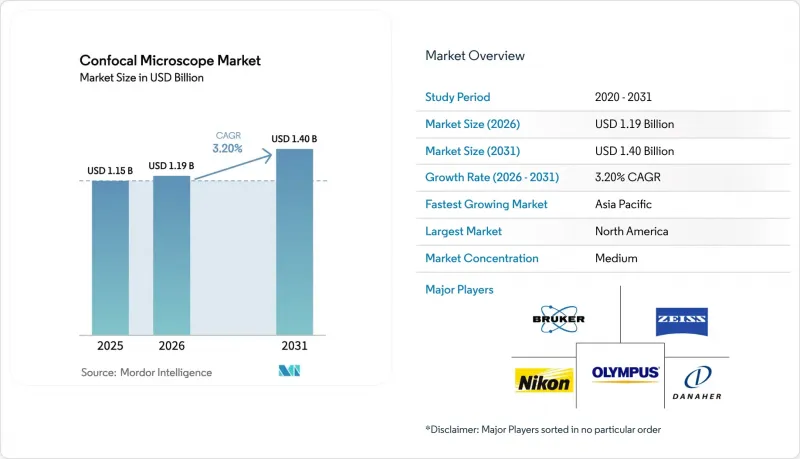
This report is Segmented by Microscope Type (Laser Scanning Microscopes, Spinning Disk Confocal Microscopes and More), Light Source (Diode Lasers, OPSL & Fiber Lasers, and More) End User (Hospitals & Clinics, Diagnostic Laboratories and More), and Geography (North America, Europe, Asia-Pacific, Middle East and Africa and South America). The Market Forecasts are Provided in Terms of Value (USD).
Global Confocal Microscope Market Trends and Insights
Rising Demand for Ophthalmic-Care Confocal Imaging
In-vivo corneal confocal microscopy is moving from research use toward standard-of-care diagnostics, especially for early detection of diabetic peripheral neuropathy and infectious keratitis. The American Academy of Ophthalmology updated its 2025 guidelines to recommend corneal-nerve fiber density quantification for patients with type 2 diabetes showing subclinical neuropathy, prompting hospitals to purchase Heidelberg Retina Tomograph and Nidek Confoscan modules. Medicare assigned CPT 92499 to corneal confocal microscopy in January 2025, reimbursing USD 285 per bilateral exam and removing a financial barrier for U.S. practices. Contact-lens-related microbial keratitis cases surged 18% year-over-year in 2025, and real-time imaging shortens diagnosis from 48 hours to under 20 minutes. India's blindness-control program earmarked INR 120 crore (USD 14.4 million) in fiscal 2025-26 to equip tier-2 city eye-care centers with confocal systems. These policy shifts bolster the confocal microscopy market across multiple geographies.
Expansion of Life-Science & Neurophysiology R&D Budgets
The U.S. National Institutes of Health budget rose to USD 51.3 billion in 2025, with a focus on neuroscience, cancer biology, and infectious disease, where confocal microscopy is foundational. China's National Natural Science Foundation dedicated CNY 3.5 billion (USD 490 million) to neuroscience imaging, mandating the installation of multiphoton confocal microscopes at leading universities. Horizon Europe earmarked EUR 2.1 billion (USD 2.3 billion) for 2025-2027 life-science infrastructure, explicitly calling for advanced imaging cores. Japan's Brain/MINDS project allocated JPY 8.2 billion (USD 55 million) to marmoset connectome mapping using two-photon confocal systems. Sustained funding de-risks vendor R&D, encouraging innovation in adaptive optics and AI autofocus that expands the confocal microscopy market.
High Capital and Maintenance Cost & Long ROI Cycles
Confocal microscopes range from USD 50,000 for entry-level spinning-disk units to USD 600,000 for multiphoton platforms with environmental chambers, exceeding budgets of community colleges and regional hospitals. Annual service contracts consume 10%-12% of the purchase price, and laser modules require replacement every 8,000-12,000 hours at up to USD 80,000. Import duties add 20% in India and up to 18% in Brazil, inflating landed costs by 30%-40% versus U.S. pricing. Leasing models are emerging, yet adoption remains below 5% of total placements. High entry barriers temper near-term growth in the confocal microscopy market.
Other drivers and restraints analyzed in the detailed report include:
- Growing Incidence of Microbial Keratitis & Corneal Disorders
- AI-Enabled Automated Image-Analysis Workflows
- Shortage of Advanced Microscopy Specialists
For complete list of drivers and restraints, kindly check the Table Of Contents.
Segment Analysis
Laser scanning systems captured 59.65% of the confocal microscopy market share in 2025, sustained by flexibility in fluorophore selection and compatibility with three decades of published protocols. Zeiss LSM 980 and Leica STELLARIS 8 platforms offer spectral detection from 400 nm to 800 nm and record 420 frames per second, making them indispensable for calcium imaging in neurons. Spinning-disk microscopes such as Yokogawa CSU-W1 achieve 200-500 fps with reduced photobleaching, serving live-cell embryology studies. Two-photon systems like Bruker Ultima Investigator penetrate 2 mm of scattering tissue, fulfilling brain-mapping requirements.
Programmable array microscopes are forecast to expand at a 4.32% CAGR through 2031, outpacing the overall confocal microscopy market. Oxford Instruments' Andor Dragonfly combines spinning-disk speed with computational super-resolution that approaches 100 nm lateral resolution without the phototoxicity of STED. Swept-field and line-scanning modes occupy niche positions in high-throughput screening; Nikon AX R line scanning reduces 96-well plate acquisition time by 40%. Vendors holding ISO 13485 certification are winning diagnostic tenders, reinforcing first-mover advantages.
Complete Report Scope:
- By Microscope Type
- Laser Scanning Confocal Microscopes
- Spinning-Disk Confocal Microscopes
- Programmable Array Microscopes (PAM)
- Two-Photon / Multiphoton Confocal Microscopes
- Swept-Field & Line-Scanning Confocal Microscopes
- By Light Source
- Diode Lasers
- OPSL & Fiber Lasers
- LED Illumination
- Others
- By End User
- Hospitals & Clinics
- Diagnostic Laboratories
- Academic & Research Institutes
- Pharmaceutical & Biotechnology Companies
- Other End Users
- By Geography
- North America
- United States
- Canada
- Mexico
- Europe
- Germany
- United Kingdom
- France
- Italy
- Spain
- Rest of Europe
- Asia-Pacific
- China
- Japan
- India
- South Korea
- Australia
- Rest of Asia-Pacific
- Middle East & Africa
- GCC
- South Africa
- Rest of Middle East & Africa
- South America
- Brazil
- Argentina
- Rest of South America
- North America
Geography Analysis
North America captured 36.71% of 2025 revenue, underpinned by NIH funding exceeding USD 51 billion and Medicare reimbursement that positions confocal imaging as a billable clinical service. The U.S. BRAIN Initiative allocated USD 140 million to imaging infrastructure, mandating multiphoton confocal systems at 22 institutions. Canada's NSERC directed CAD 450 million (USD 330 million) to imaging cores, while Mexico launched a USD 25 million modernization program, albeit hampered by 15% import tariffs.
Asia-Pacific is projected to grow at a 4.17% CAGR through 2031, the fastest among major regions. China installed 320 confocal units in 2025, 60% with multiphoton capability, fueled by CNY 3.5 billion neuroscience grants. Japan's Brain/MINDS project invested JPY 8.2 billion (USD 55 million) in 2025, installing adaptive-optics-enabled systems for deep-brain imaging. India earmarked INR 180 crore (USD 21.6 million) for advanced microscopy, yet 20% duties and limited operator pools restrict utilization to 60%. South Korea's Institute for Basic Science standardized on Zeiss and Leica to streamline data sharing across 18 imaging centers.
Germany's DFG funded 45 confocal acquisitions, prioritizing STED-capable platforms. The U.K. BBSRC invested GBP 28 million (USD 35 million) in imaging infrastructure, concentrating assets at the Francis Crick Institute and leading universities. France's CNRS standardized on Leica STELLARIS across 32 platforms to ease cross-site training. Saudi Arabia's KAUST installed six Zeiss LSM 980 units, while South Africa's NRF funded upgrades at two universities, indicating emerging regional adoption. Currency volatility and customs delays continue to hinder South American growth, with Brazil's ICMS taxes adding up to 18% to instrument prices.
- Agilent Technologies
- Bruker
- Caliber Imaging & Diagnostics
- Confocal.nl
- CrestOptics S.p.A
- Hitachi High-Tech Corp.
- HORIBA
- ISS
- JEOL Ltd.
- Keyence Corporation
- Danaher
- Molecular Devices
- Nikon
- Olympus Corporation (Evident)
- Oxford Instruments (Andor)
- PerkinElmer (Revvity)
- PicoQuant GmbH
- Thermo Fisher Scientific
- Thorlabs
- Yokogawa Electric
- Carl Zeiss
Additional Benefits:
- The market estimate (ME) sheet in Excel format
- 3 months of analyst support
TABLE OF CONTENTS
1 Introduction
- 1.1 Study Assumptions & Market Definition
- 1.2 Scope of the Study
2 Research Methodology
3 Executive Summary
4 Market Landscape
- 4.1 Market Overview
- 4.2 Market Drivers
- 4.2.1 Rising Demand for Ophthalmic-Care Confocal Imaging
- 4.2.2 Expansion Of Life-Science & Neurophysiology R&D Budgets
- 4.2.3 Growing Incidence of Microbial Keratitis & Corneal Disorders
- 4.2.4 AI-Enabled Automated Image-Analysis Workflows
- 4.2.5 Adoption Of Super-Resolution Modules for Live-Cell Studies
- 4.2.6 Government-Funded Brain-Connectome Mega-Projects
- 4.3 Market Restraints
- 4.3.1 High Capital/Maintenance Cost & Long ROI Cycles
- 4.3.2 Shortage Of Advanced Microscopy Specialists
- 4.3.3 Shift Of Organoid Research Toward Light-Sheet Microscopy
- 4.3.4 Cybersecurity Compliance Burden For Networked Instruments
- 4.4 Supply-Chain Analysis
- 4.5 Regulatory Landscape
- 4.6 Technological Outlook
- 4.7 Porter's Five Forces
- 4.7.1 Threat of New Entrants
- 4.7.2 Bargaining Power of Buyers
- 4.7.3 Bargaining Power of Suppliers
- 4.7.4 Threat of Substitutes
- 4.7.5 Intensity of Competitive Rivalry
5 Market Size & Growth Forecasts (Value, USD)
- 5.1 By Microscope Type
- 5.1.1 Laser Scanning Confocal Microscopes
- 5.1.2 Spinning-Disk Confocal Microscopes
- 5.1.3 Programmable Array Microscopes (PAM)
- 5.1.4 Two-Photon / Multiphoton Confocal Microscopes
- 5.1.5 Swept-Field & Line-Scanning Confocal Microscopes
- 5.2 By Light Source
- 5.2.1 Diode Lasers
- 5.2.2 OPSL & Fiber Lasers
- 5.2.3 LED Illumination
- 5.2.4 Others
- 5.3 By End User
- 5.3.1 Hospitals & Clinics
- 5.3.2 Diagnostic Laboratories
- 5.3.3 Academic & Research Institutes
- 5.3.4 Pharmaceutical & Biotechnology Companies
- 5.3.5 Other End Users
- 5.4 By Geography
- 5.4.1 North America
- 5.4.1.1 United States
- 5.4.1.2 Canada
- 5.4.1.3 Mexico
- 5.4.2 Europe
- 5.4.2.1 Germany
- 5.4.2.2 United Kingdom
- 5.4.2.3 France
- 5.4.2.4 Italy
- 5.4.2.5 Spain
- 5.4.2.6 Rest of Europe
- 5.4.3 Asia-Pacific
- 5.4.3.1 China
- 5.4.3.2 Japan
- 5.4.3.3 India
- 5.4.3.4 South Korea
- 5.4.3.5 Australia
- 5.4.3.6 Rest of Asia-Pacific
- 5.4.4 Middle East & Africa
- 5.4.4.1 GCC
- 5.4.4.2 South Africa
- 5.4.4.3 Rest of Middle East & Africa
- 5.4.5 South America
- 5.4.5.1 Brazil
- 5.4.5.2 Argentina
- 5.4.5.3 Rest of South America
- 5.4.1 North America
6 Competitive Landscape
- 6.1 Market Concentration Analysis
- 6.2 Market Share Analysis
- 6.3 Company Profiles (includes Global level Overview, Market level overview, Core Segments, Financials as available, Strategic Information, Market Rank/Share for key companies, Products & Services, and Recent Developments)
- 6.3.1 Agilent Technologies
- 6.3.2 Bruker Corporation
- 6.3.3 Caliber Imaging & Diagnostics
- 6.3.4 Confocal.nl
- 6.3.5 CrestOptics S.p.A
- 6.3.6 Hitachi High-Tech Corp.
- 6.3.7 Horiba Ltd.
- 6.3.8 ISS Inc.
- 6.3.9 JEOL Ltd.
- 6.3.10 Keyence Corporation
- 6.3.11 Leica Microsystems (Danaher)
- 6.3.12 Molecular Devices
- 6.3.13 Nikon Corporation
- 6.3.14 Olympus Corporation (Evident)
- 6.3.15 Oxford Instruments (Andor)
- 6.3.16 PerkinElmer (Revvity)
- 6.3.17 PicoQuant GmbH
- 6.3.18 Thermo Fisher Scientific
- 6.3.19 Thorlabs Inc.
- 6.3.20 Yokogawa Electric Corporation
- 6.3.21 ZEISS Group
7 Market Opportunities & Future Outlook
- 7.1 White-space & Unmet-need Assessment

