PUBLISHER: Mordor Intelligence | PRODUCT CODE: 2124900

PUBLISHER: Mordor Intelligence | PRODUCT CODE: 2124900
India Access Control Hardware - Market Share Analysis, Industry Trends & Statistics, Growth Forecasts (2026 - 2031)
According to Mordor Intelligence, India access control hardware market size in 2026 is estimated at USD 682.83 million, growing from 2025 value of USD 610 million with 2031 projections showing USD 1.2 billion, growing at 11.94% CAGR over 2026-2031.
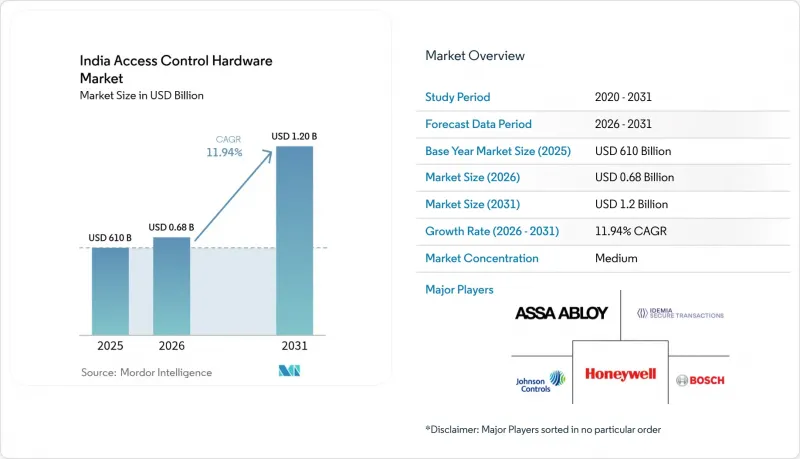
This report is Segmented by Industry Vertical (IT and Telecom, Banking Financial Services and Insurance, Government and Public Sector, Manufacturing, Healthcare, and More), Product Type (Card Readers and Access Devices, Biometric Readers, Electronic Locks, and More), and Component (Hardware, Software, and Services). The Market Forecasts are Provided in Terms of Value (USD).
India Access Control Hardware Market Trends and Insights
Surge in Government Smart-City Public-Safety Spending
The Smart Cities Mission extension allocated INR 48,000 crore (USD 5.76 billion) through March 2025 and installed more than 83,000 CCTV cameras plus integrated command-and-control centers across 100 cities. Municipalities have progressed from passive cameras to active identity verification, procuring card readers, biometric gates, and electronic locks for civic buildings and transport hubs. Tamil Nadu's Safe City Project awarded contracts in late 2024 to deploy facial-recognition turnstiles at 42 district headquarters, while Uttar Pradesh is fitting biometric panels at 75 police stations. The Government e-Marketplace portal accelerated hardware uptake by publishing unified specifications, letting smaller towns buy proven devices with 90-day procurement cycles. Collectively, these deployments amplify baseline demand in the India access control hardware market as states replicate flagship models in second-tier cities.
Rapid Growth of Contactless Biometrics in Post-Pandemic Workplaces
Touchless modalities, including facial recognition, iris scanning, and palm-vein analysis, became mainstream in 2024 when enterprises replaced fingerprint scanners to curb infection risks. Digi Yatra's facial-recognition boarding processed 15 million passengers across 24 airports by mid-2024, validating sub-two-second authentication at scale. Corporate campuses in Bengaluru and Hyderabad subsequently shifted to kiosk-based face readers linked to cloud dashboards that log entries in real time. AIIMS New Delhi reduced outpatient wait times by 40% after implementing similar technology in early 2024. Falling sensor costs and Aadhaar interoperability reduce integration expenses, allowing domestic suppliers such as Mantra Softech to win state tenders with contactless kits priced 18% below those of their multinational equivalents. As deployment experience compounds, the India access control hardware market gains a virtuous cycle of cost decline and feature enrichment.
Fragmented State-Level Procurement Standards Delaying Roll-outs
Maharashtra mandates iris scanners for police armories, Karnataka prefers palm-vein readers for citizen centers, and Rajasthan still specifies fingerprint modules. Such divergence forces vendors to maintain multiple SKUs and certifications, eroding scale economies. Although GeM published unified specs in 2024, only 18 states adopted them by November, leaving integrators to juggle legacy clauses. Documentation rework and variant testing add 8-10 weeks to project timelines and increase integration costs by up to 12%, dampening the near-term uptake of the India access control hardware market.
Other drivers and restraints analyzed in the detailed report include:
- Expansion of Data-Center Infrastructure Demanding High-Security Hardware
- Rising Adoption of Mobile-Credential and Cloud-Based Access Management
- High Initial CAPEX for Multi-Modal Systems Deterring SME Adoption
For complete list of drivers and restraints, kindly check the Table Of Contents.
Segment Analysis
Government and Public Sector deployments accounted for 35.90% of the Indian access control hardware market share in 2025, with widespread installations at smart city command centers, police stations, and bus depots. The vertical keeps steady procurement funnels via GeM, though price sensitivity invites competition from domestic integrators. Healthcare is forecast to compound at 14.72% through 2031, the fastest among verticals, driven by Ayushman Bharat Health Account requirements that mandate biometric verification at registration desks in more than 150,000 health and wellness centers.
Other verticals reinforce volume. BFSI entities retrofit biometric panels into branch server rooms to comply with the RBI directive, while manufacturing sites implement zone-based controls that feed attendance data into HR systems. Transport hubs are testing facial-recognition gates, with the Delhi Metro reporting a 30% faster throughput on its pilot line. IT and telecom campuses advance mobile credentials, while defense facilities maintain a niche demand for multi-factor authentication. Altogether, diverse end-user mandates sustain the India access control hardware market.
Complete Report Scope:
- By Industry Vertical
- IT and Telecom
- Banking, Financial Services and Insurance
- Government and Public Sector
- Manufacturing
- Healthcare
- Transportation and Logistics
- Defense and Aerospace
- Other Industry Verticals
- By Product Type
- Card Readers and Access Devices
- Biometric Readers
- Electronic Locks
- Controllers and Panels
- Other Types
- By Component
- Hardware
- Software
- Services
List of Companies Covered in this Report:
- Honeywell International Inc.
- Johnson Controls International plc
- Robert Bosch GmbH
- ASSA ABLOY AB
- IDEMIA Identity and Security India Private Limited
- HID Global Corporation
- Dahua Technology Co. Ltd.
- Hangzhou Hikvision Digital Technology Co. Ltd.
- Gallagher Group Limited
- Paxton Access Limited
- Mantra Softech India Private Limited
- eSSL Security
- Realtime Biometrics India Limited
- IDCUBE Identification Systems Private Limited
- Godrej and Boyce Manufacturing Company Limited
- Suprema Inc.
- Matrix Comsec Private Limited
- ZKTeco Biometrics India Private Limited
- Tyco Security Products India Private Limited
- NEC Corporation India Private Limited
Additional Benefits:
- The market estimate (ME) sheet in Excel format
- 3 months of analyst support
TABLE OF CONTENTS
1 INTRODUCTION
- 1.1 Study Assumptions and Market Definition
- 1.2 Scope of the Study
2 RESEARCH METHODOLOGY
3 EXECUTIVE SUMMARY
4 MARKET LANDSCAPE
- 4.1 Market Overview
- 4.2 Market Drivers
- 4.2.1 Surge in Government - Smart-City Public-Safety Spending
- 4.2.2 Rising Adoption of Mobile-Credential and Cloud-Based Access Management
- 4.2.3 Rapid Growth of Contactless Biometrics in Post-Pandemic Workplaces
- 4.2.4 Expansion of Data-Center Infrastructure Demanding High-Security Hardware
- 4.2.5 Falling ASPs of IoT-Enabled Smart Locks Boosting Residential Uptake
- 4.2.6 Make-in-India Incentives Catalyzing Local Hardware Manufacturing
- 4.3 Market Restraints
- 4.3.1 Fragmented State-Level Procurement Standards Delaying Roll-outs
- 4.3.2 High Initial CAPEX for Multi-Modal Systems Deterring SME Adoption
- 4.3.3 Supply-Chain Volatility for Semiconductor Components
- 4.3.4 Increasing Cyber-Physical Convergence Raising Data-Privacy Risks
- 4.4 Industry Value Chain Analysis
- 4.5 Regulatory Landscape
- 4.6 Technological Outlook
- 4.7 Impact of Macroeconomic Factors
- 4.8 Porter's Five Forces Analysis
- 4.8.1 Bargaining Power of Suppliers
- 4.8.2 Bargaining Power of Buyers
- 4.8.3 Threat of New Entrants
- 4.8.4 Intensity of Competitive Rivalry
- 4.8.5 Threat of Substitutes
5 MARKET SIZE AND GROWTH FORECASTS (VALUE)
- 5.1 By Industry Vertical
- 5.1.1 IT and Telecom
- 5.1.2 Banking, Financial Services and Insurance
- 5.1.3 Government and Public Sector
- 5.1.4 Manufacturing
- 5.1.5 Healthcare
- 5.1.6 Transportation and Logistics
- 5.1.7 Defense and Aerospace
- 5.1.8 Other Industry Verticals
- 5.2 By Product Type
- 5.2.1 Card Readers and Access Devices
- 5.2.2 Biometric Readers
- 5.2.3 Electronic Locks
- 5.2.4 Controllers and Panels
- 5.2.5 Other Types
- 5.3 By Component
- 5.3.1 Hardware
- 5.3.2 Software
- 5.3.3 Services
6 COMPETITIVE LANDSCAPE
- 6.1 Market Concentration
- 6.2 Strategic Moves
- 6.3 Market Share Analysis
- 6.4 Company Profiles (includes Global level Overview, Market level overview, Core Segments, Financials as available, Strategic Information, Market Rank/Share for key companies, Products and Services, and Recent Developments)
- 6.4.1 Honeywell International Inc.
- 6.4.2 Johnson Controls International plc
- 6.4.3 Robert Bosch GmbH
- 6.4.4 ASSA ABLOY AB
- 6.4.5 IDEMIA Identity and Security India Private Limited
- 6.4.6 HID Global Corporation
- 6.4.7 Dahua Technology Co. Ltd.
- 6.4.8 Hangzhou Hikvision Digital Technology Co. Ltd.
- 6.4.9 Gallagher Group Limited
- 6.4.10 Paxton Access Limited
- 6.4.11 Mantra Softech India Private Limited
- 6.4.12 eSSL Security
- 6.4.13 Realtime Biometrics India Limited
- 6.4.14 IDCUBE Identification Systems Private Limited
- 6.4.15 Godrej and Boyce Manufacturing Company Limited
- 6.4.16 Suprema Inc.
- 6.4.17 Matrix Comsec Private Limited
- 6.4.18 ZKTeco Biometrics India Private Limited
- 6.4.19 Tyco Security Products India Private Limited
- 6.4.20 NEC Corporation India Private Limited
7 MARKET OPPORTUNITIES AND FUTURE OUTLOOK
- 7.1 White-Space and Unmet-Need Assessment

